Cristobal Ordoñez

6.3K posts

Cristobal Ordoñez banner
Cristobal Ordoñez

Cristobal Ordoñez

@CristobalOrd

Politiquiando ando

Katılım Nisan 2011
125 Takip Edilen87 Takipçiler
Cristobal Ordoñez retweetledi

Richie
Richie@MelisMatik·
"Se condena el diálogo y se le reclaman resultados inmediatos, pero rara vez se exige lo mismo, con el mismo tono y la misma severidad, sobre las políticas de seguridad ¿Por qué las políticas de seguridad no son sometidas al mismo escrutinio de resultados, costos e impactos que se les exige a los esfuerzos de paz?"
El Espectador@elespectador

Las salidas dialogadas, con todos sus retos y riesgos, siempre serán menos costosas que la guerra eterna. 🔗👇 trib.al/yQbuXnB

Español
0
9
20
762
Sofía 💙
Sofía 💙@Soofisaurio·
Prefiero que sean ateos y vean semana santa como vacaciones a que sean muy “creyentes” y al mismo tiempo sean racistas y clasistas. La fe se encuentra más fácil que la decencia, gas.
Sofía 💙 tweet media
Español
44
1.2K
11.9K
159.3K
Cristobal Ordoñez
Cristobal Ordoñez@CristobalOrd·
@SoftLofi_ @EnzoSuperGabri1 Imaginate construir un edificio, e ir en contra de poner bases de cierto tamaño ya que " Solo lo dijeron profesionales" y es una "Falacia de autoridad" La ciencia funciona cuestionando, si, pero el siguiente paso es proponer un contrargumento con pruebas que sean más fuertes.
Español
0
0
16
101
Soft Lofi
Soft Lofi@SoftLofi_·
@EnzoSuperGabri1 tú solo estás diciendo "son expertos, por tanto, tienen razón", no estás usando ningún tipo de análisis, así que, ciertamente es una falacia, ahora bien cada quien es libre de creer lo que quiera y en quienes quiera, pero eso en un debate o discusión no tiene ningún valor
Español
4
0
2
809
Enzo Memebriel🇪🇸
Enzo Memebriel🇪🇸@EnzoSuperGabri1·
Imagina ir al medico a que te diagnostique lo que tienes y decirle tu: "FALACIA DE AUTORIDAD" Pues así suenas.
luis espadas@LuisespadasLuis

@EnzoSuperGabri1 @ludas__ Falacia de autoridad. Da un argumento válido o seguirás sin haber desmentido nada. Y encima falacia de una autoridad que ha demostrado mentir. Lamentable el nivel de los zurdos sectarios inhumanos.

Español
7
39
484
10.3K
Cristobal Ordoñez
Cristobal Ordoñez@CristobalOrd·
@LuisespadasLuis @Rafagas2498 @EnzoSuperGabri1 @ludas__ Imaginate construir un edificio, e ir en contra de poner bases de cierto tamaño ya que " Solo lo dijeron profesionales" y es una "Falacia de autoridad" La ciencia funciona cuestionando, si, pero el siguiente paso es proponer un contrargumento con pruebas que sean más fuertes.
Español
1
0
5
84
luis espadas
luis espadas@LuisespadasLuis·
@Rafagas2498 @EnzoSuperGabri1 @ludas__ Yo ya he dado argumentos de sobra incluyendo contradicciones y falsedades por parte de la defensa. Es a ellos a los que les toca argumentar y en vez de eso repiten como loros "lo dijeron profesionales!" 😂 Los zurdos como siempre con la mentira y la falacia como única herramienta
Español
1
0
0
376
Enzo Memebriel🇪🇸
Enzo Memebriel🇪🇸@EnzoSuperGabri1·
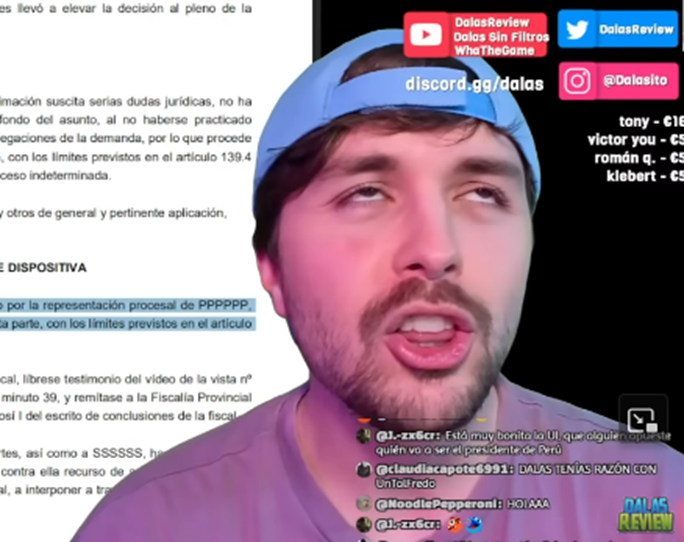
Dalas Review ha vuelto a hacer un directo de 2h comentando algunas cosas de la sentencia de Noelia Castillo. Os hago un resumen + algunos comentarios.
Enzo Memebriel🇪🇸 tweet media
Español
27
45
743
60.4K
Cristobal Ordoñez retweetledi
Inge Juan Osma
Inge Juan Osma@IngJuanOsma·
El conductor no tenia licencia y las modificaciones de pintura no estaban registradas en la tarjeta de propiedad. “Persecución política” “obstrucción” algo parecido salio a decir cuando ud @soyjaimeandres hizo trampa en elecciones! La típica politiquera!
Jaime Andrés Beltrán@soyjaimeandres

El Tigretón fue inmovilizado sin razón en La Estrella, Antioquia, evidenciando una clara obstrucción a la campaña de @ABDELAESPRIELLA. Como Gerente de Regiones rechazo que algunos mandatarios utilicen sus corrientes políticas para atacar campañas contrarias. Los municipios deben garantizar neutralidad en el proceso electoral.

Español
6
23
191
5.9K
Cristobal Ordoñez retweetledi
Aakash Gupta
Aakash Gupta@aakashgupta·
The comparison sounds clever on an Accenture slide. It falls apart the second you check the history. Edison spent years studying gas lamps, arc lamps, and every existing illumination technology before building the lightbulb. His key breakthrough, a carbonized bamboo filament that lasted 1,200 hours, came from testing 3,000 materials across 14 months of continuous iteration. He didn't skip the candle. He studied every candle ever made and then built something better. The iPhone was a continuous improvement of the Palm Pilot, which was a continuous improvement of the Newton, which was a continuous improvement of the Psion Organizer. Google was a continuous improvement of AltaVista. Tesla was a continuous improvement of the GM EV1. The consulting version of innovation sounds like "think different and skip the boring work." The actual version is "study every existing solution until you understand the constraints so deeply that the next step becomes obvious." Accenture charges $500/hour to show this slide to Fortune 500 executives. The companies that actually build the next electric light are in the lab running experiment 2,999.
Mustafa@oprydai

i often think about this..

English
33
292
1.9K
167.8K
Cristobal Ordoñez retweetledi
Anish Moonka
Anish Moonka@anishmoonka·
Those wheels you’re looking at are 0.75 millimeters thick. That’s half the thickness of a US dime. Each one was carved from a single block of aluminum, and NASA sent six of them to Mars knowing they’d eventually shred. Curiosity was built for a 2-year mission. It landed in August 2012, and by December that year NASA had already extended the mission indefinitely. Thirteen years and 35.5 kilometers later, the rover is still going, but the wheels started cracking just 14 months in. The damage came faster than anyone at JPL predicted. Sharp embedded rocks were punching straight through the skin between the treads. So NASA assembled a Wheel Wear Tiger Team (a crisis problem-solving tradition that goes back to Apollo 13) and got to work. In 2017, they uploaded a traction control algorithm from Earth that adjusts each wheel’s speed in real time based on the terrain, reducing force on the front wheels by 20%. They rerouted the rover to softer ground and started driving backward when possible, because pulling wheels over rocks produces less force than pushing them into rocks. The wildest part: if enough treads snap off, Curiosity is designed to find a sharp rock on Mars and use it to deliberately rip out the damaged inner section of its own wheel. JPL tested this on a replica rover and found Curiosity can keep driving on just the outer third. They predict this won’t be needed until around 2034. Every 1,000 meters, the rover pulls over and uses the camera on its robotic arm to photograph its own wheels so engineers on Earth can count every crack. Each wheel also has tiny holes that spell “JPL” in Morse code, which Curiosity uses to measure distance by photographing its own tracks in the dirt. These photos directly changed the next rover. When NASA built Perseverance, engineers 3D-printed about 70 different tread designs before landing on 48 curved treads instead of Curiosity’s 24, with thicker skin. They tested the new wheels over 60 kilometers and got zero damage by Curiosity’s original failure definition. “A boring graph with no data on it,” as one JPL engineer put it. A $2.5 billion machine doing self-surgery with rocks on another planet because the mission outlasted its design by 6x.
Curiosity@CuriosityonX

【Breaking 🚨】 Curiosity wheels taken yesterday, showing the damages caused during the 13 years it has been on the Red Planet

English
174
2.7K
36.2K
4.4M
Ricardo Beltran
Ricardo Beltran@RicardoB334455·
@oOoConservas @elbosstroll16 Cómo si ser nazi fuera insulto Lo más vergonzoso sería ser un liberal, gay. Feminista, depravado, corrupto, que abogue por el libertinaje etc etc Los nacional socialistas son personas cultas, educadas, leídas, conscientes, con valores tradicionales, etc etc
Español
259
7
73
298.3K
yet i
yet i@yeti_0x·
@anishmoonka Did they test ereaders or the book app on phones that go page by page instead of a single scrolling page? Seems like a mechanism thing no?
English
6
2
81
9.2K
Anish Moonka
Anish Moonka@anishmoonka·
Went down the rabbit hole on this. Your brain treats a physical book like a landscape. It builds a spatial map of the text, the same way it maps trails, rooms, and city blocks. When you scroll on a phone, that map breaks apart. Seven large-scale research reviews and direct brain scans confirm what you already feel. A 2023 study in PLOS ONE attached brain-activity sensors to children’s heads while they read the same text on paper and on screen. Paper reading produced fast brain waves, the pattern linked to focused attention. Screen reading shifted the brain into slow waves, the pattern linked to mind wandering and daydreaming. Same kids. Same words. Measurably different brain states. A separate 2022 study from Showa University in Japan scanned the front of the brain, the area that manages focus and comprehension, during phone versus paper reading. Smartphones sent that region into overdrive, meaning the brain was straining just to keep up with basic processing. Paper reading produced a moderate load that triggered natural deep breathing, which helped regulate brain function and sustain focus. The phone suppressed that breathing pattern entirely. Since 2017, researchers have published seven major reviews combining hundreds of individual studies. Six of seven reached the same conclusion: people understand less on screens. A 2018 review of 54 studies and 170,000+ participants, literally titled “Don’t throw away your printed books,” found paper outperformed screens across the board for non-fiction. A 2024 follow-up with 49 more studies confirmed it. The gap has grown steadily every year since 2001. Being a “digital native” doesn’t help. The best explanation is how your brain tracks where you are. Your short-term memory can only juggle about 7 things at once. A physical book gives you constant location cues: the weight shifting from right hand to left, where a paragraph sits on the page, how thick the remaining pages feel. Your brain hands off the “where am I in this text?” job to those physical signals, leaving more room for actually understanding what you’re reading. On a phone, every screen looks identical. Your brain has to track position and process meaning at the same time, and something gives. A Norwegian eye-tracking study analyzing 25,000+ individual eye movements found screen readers processed text more shallowly. The students had no idea they were reading differently. In 2019, nearly 200 reading scientists from 30+ countries signed an open letter warning that screen reading was degrading deep comprehension. Since then, Scandinavian countries, among the most digitized school systems on Earth, have started putting physical books back in classrooms.
shree🪄@Goldensky0

reading books on a phone and reading paperback books are two different things

English
144
2.1K
9.5K
1.5M
Cristobal Ordoñez
Cristobal Ordoñez@CristobalOrd·
@juanitoMetaway @AleHiSoto No se necesita ser hippie para saber que ser crítico también es parte de la educacion para el mercado laboral. Lo que quieren algunos son borregos que digan si a todo acepten cualquier trabajo por explotador que sea
Español
0
0
0
9
Metaway
Metaway@juanitoMetaway·
@AleHiSoto Veo muchos hippies y filosofos renegando de lo que dice Oviedo, pero es que es cierto, por lo menos desde el punto de vista de la reducción de informalidad. Hay gente que estudia por amor al arte, y todos tenemos hobbies, pero la eduación formal es entrar al mercado laboral.
Español
2
3
16
637
Alejandro Higuera Sotomayor
Alejandro Higuera Sotomayor@AleHiSoto·
Hay mucha gente diciendo que la educación es para formar personas críticas y miles de cosas tiernas e ingenuas. Por favor aterricen en este país, necesitamos educación que se vuelva fuerza productiva. No puede ser que haya miles de profesionales cuyo perfil no hace match con nuestras empresas ni tienen ellos mismos la capacidad de crearla.
Juan Daniel Oviedo@JDOviedoAr

La educación tiene que servir para una cosa clara: dar trabajo. Punto. Si logramos eso, formalizamos la economía como el país se merece. Esto no va de dividir, va de sumar: distritos, sector público y privado. Ahí está la clave de lo que haremos con @PalomaValenciaL ⚡️

Español
30
40
248
16.6K
SEUÑ
SEUÑ@YKoluwaseun9·
Being an atheist is another sign of łow intelligence
English
557
335
2.5K
425.6K
Cristobal Ordoñez retweetledi
Gonzalo Guillén
Gonzalo Guillén@HELIODOPTERO·
URGENTE: MERECIDA CONDENA A CONGRESISTA VIOLADOR: La Corte Suprema de Justicia de Colombia condenó al representante a la Cámara Modesto Enrique Aguilera Vides a ocho años y seis meses de prisión tras hallarlo responsable del delito de acto sexual violento. La decisión fue adoptada por la Sala Especial de Primera Instancia mediante sentencia del 10 de marzo de 2026, con ponencia de la magistrada Blanca Nélida Barreto Ardila. El fallo establece además la inhabilitación para ejercer derechos y funciones públicas por el mismo tiempo de la condena. La Corte también negó al congresista cualquier beneficio judicial, incluida la suspensión condicional de la pena y la prisión domiciliaria, por lo que, una vez la sentencia quede en firme, se emitirá la orden de captura para que cumpla la pena en un establecimiento carcelario. En la misma decisión, la Corte ordenó que Aguilera Vides indemnice a la víctima, Guisella del Carmen Mejía Viana, con el equivalente a 100 salarios mínimos legales mensuales vigentes por concepto de perjuicios morales, monto que deberá actualizarse al momento de su liquidación. La Corte también dispuso el pago de agencias en derecho equivalentes al 5 % del valor de esa condena. La víctima fue representada por el penalista Frederickt Barros Mendoza.
Gonzalo Guillén tweet media
Español
138
2.2K
3.9K
88.9K
Cristobal Ordoñez retweetledi
Anish Moonka
Anish Moonka@anishmoonka·
The actual research is wild. Every time you push down a feeling, your brain has to choose between suppressing that emotion and recording what’s happening around you. It picks the suppression. The memory doesn’t get saved. A 2000 Stanford study confirmed this: people told to hide their emotions while watching a film remembered far fewer details than people who just reacted naturally. Suppressing emotions uses up mental energy, and that leaves less brain power for saving new memories. Brain scans show why. A 2012 study found that suppression quiets the hippocampus (your brain’s memory-recording center) right when it should be saving information. The two brain regions that normally team up to lock in memories stop talking to each other. Over time it gets worse. Suppression keeps cortisol (the stress hormone) elevated, and cortisol shrinks the hippocampus. Chronically stressed people can lose 10 to 15% of its volume. Just three weeks of high cortisol can shrink the tiny connection points between brain cells by about 20%. The good news: studies show this shrinkage can partially reverse once stress levels drop. Not necessarily permanent. A Finnish study of 1,137 older adults tracked over roughly a decade found that habitual emotion suppressors had nearly 5x the risk of developing dementia, even after controlling for genetics, smoking, obesity, and education. There’s a better way to handle emotions that doesn’t cost you your memory. It’s called cognitive reappraisal: instead of bottling the feeling, you reframe what’s causing it. (“This meeting isn’t a threat, it’s practice.”) A 2003 Stanford/UC Berkeley study found reappraisers had more positive emotion, better relationships, and higher wellbeing. Suppressors got the opposite on every measure. And reappraisal carries zero memory cost. The difference comes down to timing. Suppression kicks in after the emotion has already fired, so your brain is fighting its own response while simultaneously trying to record the moment. Reappraisal changes how you interpret the situation before the emotion fully activates. Same event, same person, but your hippocampus stays free to do its actual job: recording your life.
syl ♡ 𐔌՞. .՞𐦯@sylviapuffs

SUPRESSING YOUR EMOTIONS CAUSES MEMORY LOSS WTF???

English
363
17K
97.7K
3.9M
Cristobal Ordoñez retweetledi
Anish Moonka
Anish Moonka@anishmoonka·
Went down the rabbit hole on this. One equation from 1926 explains why your lungs and that tree look identical. A physiologist figured out that any system pushing fluid through branching tubes will naturally evolve toward the same shape. His rule is simple: when a tube splits into two smaller tubes, their sizes follow a precise ratio that wastes the least energy. Blood vessels follow it. Lung airways follow it. The water pipes inside trees follow it too. Your lungs branch 23 times between your windpipe and the tiny air sacs where oxygen enters your blood. Each split shrinks the tubes by the same ratio. After 23 rounds, a single 2cm-wide tube becomes 480 million air sacs with a combined surface area bigger than a studio apartment, all packed inside your chest. Trees do the same thing in reverse, branching outward to catch as much sunlight and CO2 as possible. Leonardo da Vinci noticed this 500 years before Murray. He wrote that all the branches of a tree at any height, when combined, are equal in thickness to the trunk below them. He used it to draw realistic trees. It took five more centuries for biologists to realize the same geometry applies inside your body. But the tweet oversimplifies the gas exchange part. Trees are not our primary oxygen source. NOAA estimates tiny ocean organisms called phytoplankton produce roughly half of Earth’s oxygen. One single species, Prochlorococcus (so small that 20,000 fit in a drop of seawater), produces about 20% of all the oxygen in our atmosphere. That’s more than every tropical rainforest combined. The Amazon’s net oxygen output is actually close to zero because the animals and microbes in the rainforest consume almost as much as the trees make. The real story behind that image: physics solved the same engineering problem billions of years apart, in completely unrelated organisms, and landed on the exact same answer.
Science girl@sciencegirl

We breathe what trees release and they breathe what we exhale.

English
90
2.3K
23.4K
1.1M
Cristobal Ordoñez retweetledi
goma
goma@soigomaa·
In the 1800s,women who showed emotion in public were diagnosed with "hysteria" The treatment?Institutionalisation.isolation.silence But one woman didn’t accept this she faked being mentally ill,got herself committed and spent 10 days inside and notorious Asylum. Then she wrote everything down Her report, shocked the world and completely reformed The mental health system That womanman was Neillie Bly. sometimes the most radical thing a woman can do is refuse to be silenced.
English
23
866
5K
86.3K
Cristobal Ordoñez retweetledi
Stealthy Jess 🇨🇦 💜
Stealthy Jess 🇨🇦 💜@AdvancedTweaker·
"The researchers describe a realistic scenario that should make you pause: You ask an AI chatbot for heart-healthy dinner recipes. The model infers you may have a cardiovascular condition. That classification flows through the company's broader ecosystem. You start seeing ads for medications. The information reaches insurance databases. The effects compound over time."
Guri Singh@heygurisingh

🚨 Stanford just analyzed the privacy policies of the six biggest AI companies in America. Amazon. Anthropic. Google. Meta. Microsoft. OpenAI. All six use your conversations to train their models. By default. Without meaningfully asking. Here's what the paper actually found. The researchers at Stanford HAI examined 28 privacy documents across these six companies not just the main privacy policy, but every linked subpolicy, FAQ, and guidance page accessible from the chat interfaces. They evaluated all of them against the California Consumer Privacy Act, the most comprehensive privacy law in the United States. The results are worse than you think. Every single company collects your chat data and feeds it back into model training by default. Some retain your conversations indefinitely. There is no expiration. No auto-delete. Your data just sits there, forever, feeding future versions of the model. Some of these companies let human employees read your chat transcripts as part of the training process. Not anonymized summaries. Your actual conversations. But here's where it gets genuinely dangerous. For companies like Google, Meta, Microsoft, and Amazon companies that also run search engines, social media platforms, e-commerce sites, and cloud services your AI conversations don't stay inside the chatbot. They get merged with everything else those companies already know about you. Your search history. Your purchase data. Your social media activity. Your uploaded files. The researchers describe a realistic scenario that should make you pause: You ask an AI chatbot for heart-healthy dinner recipes. The model infers you may have a cardiovascular condition. That classification flows through the company's broader ecosystem. You start seeing ads for medications. The information reaches insurance databases. The effects compound over time. You shared a dinner question. The system built a health profile. It gets worse when you look at children's data. Four of the six companies appear to include children's chat data in their model training. Google announced it would train on teenager data with opt-in consent. Anthropic says it doesn't collect children's data but doesn't verify ages. Microsoft says it collects data from users under 18 but claims not to use it for training. Children cannot legally consent to this. Most parents don't know it's happening. The opt-out mechanisms are a maze. Some companies offer opt-outs. Some don't. The ones that do bury the option deep inside settings pages that most users will never find. The privacy policies themselves are written in dense legal language that researchers people whose job is reading these documents found difficult to interpret. And here's the structural problem nobody is addressing. There is no comprehensive federal privacy law in the United States governing how AI companies handle chat data. The patchwork of state laws leaves massive gaps. The researchers specifically call for three things: mandatory federal regulation, affirmative opt-in (not opt-out) for model training, and automatic filtering of personal information from chat inputs before they ever reach a training pipeline. None of those exist today. The uncomfortable truth is this: every time you type something into ChatGPT, Gemini, Claude, Meta AI, Copilot, or Alexa, you are contributing to a training dataset. Your medical questions. Your relationship problems. Your financial details. Your uploaded documents. You are not the customer. You are the curriculum. And the companies doing this have made it as hard as possible for you to stop.

English
13
871
4.8K
279.5K
Cristobal Ordoñez
Cristobal Ordoñez@CristobalOrd·
@simonmaechling "It has been studied for 50 years. Hundreds of regulatory reviews." Tens of millions of dollars in settlements from cancer-patients against Monsanto. You should also disclose that you benefit from it being used, as you work in Bayern
English
0
0
0
14
Simon Maechling
Simon Maechling@simonmaechling·
Now that everyone here thinks they are an expert on glyphosate, I want to add some context to the noise. Glyphosate is a molecule. It has been studied for 50 years. Hundreds of regulatory reviews. Tens of thousands of pages of data. Toxicology, residue studies, epidemiology, environmental fate. You don’t have to “trust Monsanto.” You can read assessments from: 🇺🇸 EPA 🇪🇺 EFSA 🇯🇵 PMDA 🇨🇦 Health Canada Here’s what gets lost in the shouting: Hazard ≠ Risk. Risk = Hazard × Exposure. Real-world dietary exposure? Measured in micrograms. Hundreds of times below conservative safety limits. That’s risk assessment. And no - IARC saying “probably carcinogenic” does not mean “causes cancer at real-world exposure.” It means “can under some conditions.” Same category as: • Red meat. • Night shift work. • Very hot beverages. Context matters. If you think farmers spray poison because they enjoy it, you’ve never met a farmer. They use tools. Tools are evaluated. If they don’t work, they’re dropped. If they aren’t safe under regulation, they’re not approved. The claim that we are all being secretly poisoned? That collapses under dose-response curves and biomonitoring data. Emotion spreads faster than toxicology. But toxicology still wins. If you care about food, health, and the environment, learn the difference between hazard and risk. It will change how you see almost every chemical debate online.
Cary Kelly@CaryKelly11

Environmentalist claims you can drink a whole quart of glyphosate and “it won’t hurt you.” The interviewer calls his bluff and offers him a glass of glyphosate. The interview ends 22 seconds later.

English
78
119
423
46.3K
Cristobal Ordoñez
Cristobal Ordoñez@CristobalOrd·
@cesarastudillo En Colombia depende del padre, puede ser bien negra y marcada en forma de cruz, hasta suave y casi que un punto apenas. Dura todo el día
Español
0
0
1
109