




Crotts

1.6K posts

Crotts banner
Crotts

Crotts

@Crotts__

marketing with intention @morpho

Katılım Ağustos 2021
498 Takip Edilen1.5K Takipçiler
Crotts
Crotts@Crotts__·
@0xstrobe @Morpho There is no general blocking of VPN. Cloudfront does block IPs with bad reputation and some geo-blcking. It could impact some VPN IP range. We'd be happy to help via the support page.
English
1
0
0
177
strobie reeeee 🍓 莓莓 ストロベリ
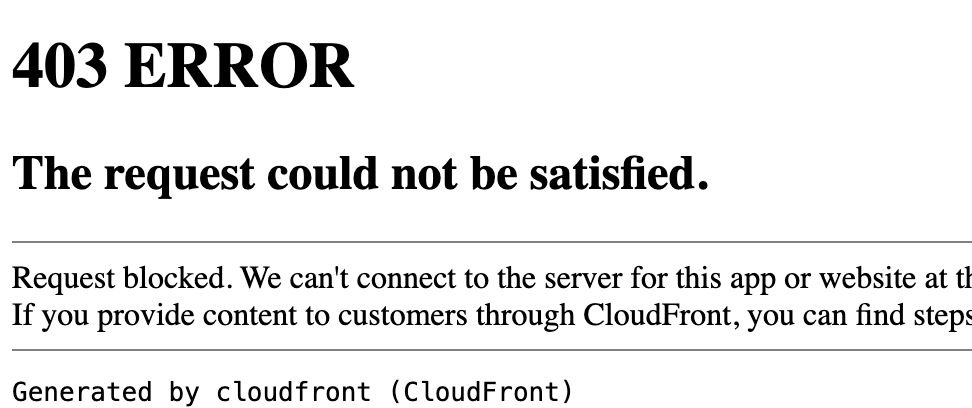
hey @Morpho why did u block all VPN IPs from literally visiting ur app? i can even understand if you put a banner or block the deposit option, but don't block readonly or withdrawal bruh imagine i was at airport, saw the USR hack, went to panic check my pos, then kept getting hit with this, no use rotating thru 20 VPN IPs
strobie reeeee 🍓 莓莓 ストロベリ tweet media
English
19
5
127
20.8K
Crotts retweetledi
Paul Frambot 🦋
Paul Frambot 🦋@PaulFrambot·
As we approach the official release of Morpho’s fixed rate markets protocol it’s becoming clear that it should not be seen as an iteration of the existing Morpho variable rate markets (today known as Markets V1). It is a completely new paradigm that’s unlike anything DeFi has seen before. Fixed rate markets are an extension of Morpho's offering, not a replacement. Variable rate markets remain a foundational part of DeFi for the few years to come. The two will complement one another. For that reason, we’re drop the versioning naming we've been using up until now, and the protocols will no longer be named Markets V1 and Markets V2. We’re changing: Markets V1 → Morpho “Blue” (as it was originally) Markets V2 → Morpho “[TBA]” Blue introduced permissionless open-term variable rate markets, with externalized risk management. [TBA] will introduce fixed term, fixed rate, intent lending, with externalized risk and rate management. A completely different structure for pricing and matching that will take Morpho from $10B to $100B+. As a side note: Morpho Vaults retain versioning because Vaults V2 is a direct improvement designed to supersede Vaults V1, exactly what versioning is meant to signal. It has been an incredibly hard 2 years of building [TBA], but we are very excited to share more information about Morpho fixed-rate markets soon.
English
45
25
399
58.1K
Crotts retweetledi
Morpho 🦋
Morpho 🦋@Morpho·
Introducing the new Morpho Dashboard Track network growth, chain-specific metrics, liquidations, and vault curation — all in one place. Data source: @Dune
Morpho 🦋 tweet media
English
15
14
178
19.7K
Crotts retweetledi
Morpho 🦋
Morpho 🦋@Morpho·
Onchain lending via Taurus-PROTECT, powered by Morpho @taurus_hq banking clients can allocate capital to Morpho Vaults through the custodial interface of Taurus-PROTECT, compliant with existing governance frameworks, approval flows, and operational controls.
Morpho 🦋 tweet media
English
5
23
62
15.9K
Crotts retweetledi
Fabzar
Fabzar@fabzar111·
Paul Framboise is a real beast
Fabzar tweet media
Paul Frambot 🦋@PaulFrambot

People finally realize that @Morpho is an infrastructure play. We don't aspire to become a fintech, a crypto bank, or an asset manager. We want to be the internet protocol for financing that empowers every fintech, every bank, and every asset manager, connecting them all in a single network.


English
1
1
11
1K
Judoka
Judoka@abderraJudoka·
@Morpho @Anchorage Hello @Morpho I love your platform but it keeps crashing out multiple times for me. Any meaningful solutions please to remedy that? It’s ruining my user experience and blocks me from my funds at times due to that lag.
English
1
0
1
43
Crotts retweetledi
Morpho 🦋
Morpho 🦋@Morpho·
Access Morpho via @Anchorage Institutions can now allocate capital to Morpho Vaults via Anchorage Digital, enabling access to noncustodial strategies from a federally regulated custodian.
Morpho 🦋 tweet media
English
17
53
141
66.5K
Crotts retweetledi
Anton Cheng
Anton Cheng@antonttc·
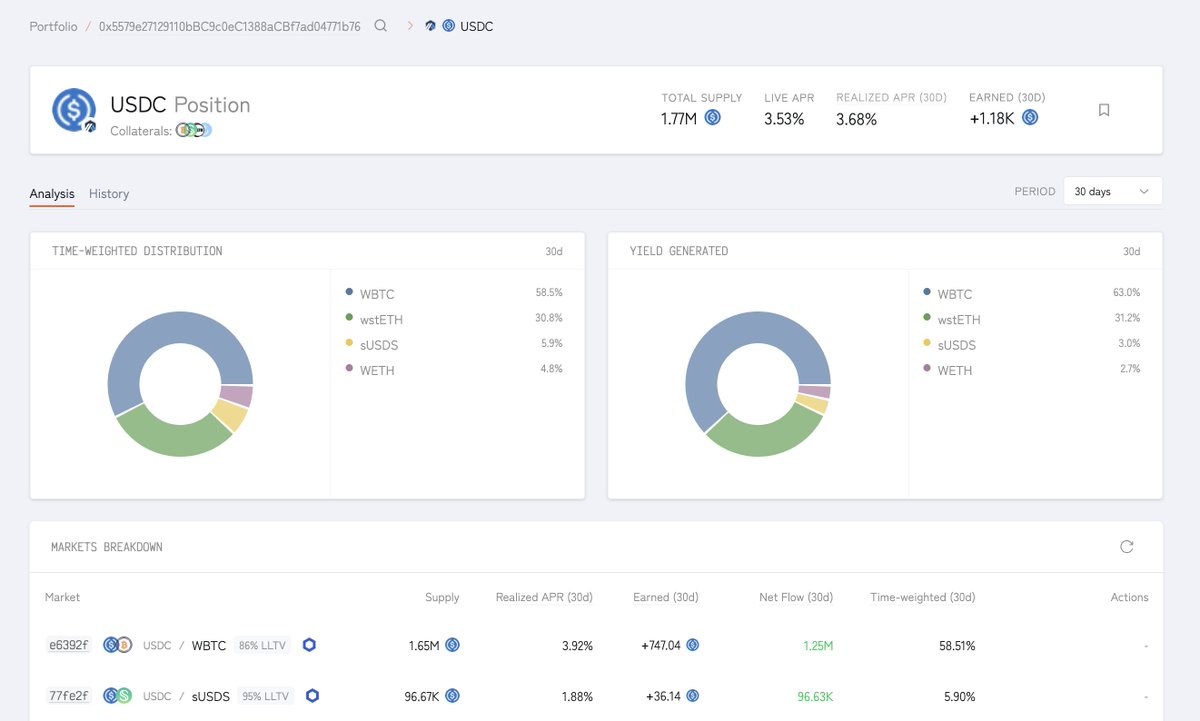
Monarch just shipped something big. The new position detail page gives you full visibility into your positions — yield sources, allocation changes, complete history. No more guessing where "yield" comes from.
Anton Cheng tweet media
English
7
4
20
739
Crotts retweetledi
pashov
pashov@pashov·
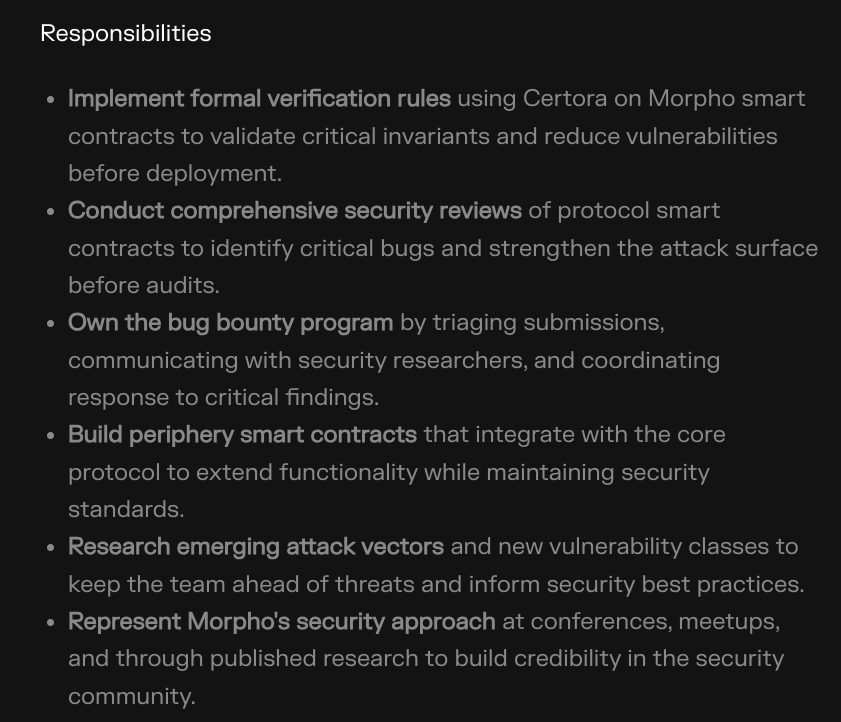
In-house roles for security researchers in web3 projects are getting more attention lately. Here is Morpho's job ad for "Protocol Security Engineer" - formal verification, audits, owning bug bounty program etc. Good opportunity for people looking for full-time roles.
pashov tweet media
English
6
6
96
15.2K
Crotts retweetledi
Omar
Omar@TheOneandOmsy·
Coinbase x Morpho is the posterchild for crypto mullet: > CeFi frontend + defi rails under the hood > Users borrow cash while Coinbase dogfoods its full stack (cbBTC, Base chain, Exchange, USDC, Wallet) > Bitcoin loans o/s are now up to $1b (+5x in 7 months) > 22k active loans, ~50k avg loan size, 0.57 avg LTV > Pretty easy to imagine how the mullet will be grown out for non-crypto native assets (i.e. CB stock)
Omar tweet media
Omar@TheOneandOmsy

Coinbase + Morpho - Defi Mullet 2.0 now up to $197m in BTC collateralized loans o/s A few interesting stats: 5,945 active loans, $33k avg. loan size, and 0.45 avg LTV Imagine we start seeing caps lifted (currently $1m) and new assets (starting w/ ETH)

English
19
13
159
37.6K
Crotts retweetledi
Morpho 🦋
Morpho 🦋@Morpho·
.@bitwise, a global crypto asset manager with $15B+ in client assets, is joining the Morpho network as a curator. A key theme in Bitwise’s 2026 predictions: onchain vaults would see assets under curation double this year. Now, they're backing that thesis on Morpho.
Morpho 🦋 tweet media
English
28
46
283
92.3K
Crotts retweetledi
Anton Cheng
Anton Cheng@antonttc·
Vaults have potential, but we're currently leaning too much into convenience instead of customization and risk-adjusted yields. With Morpho Vaults V2, there are tons of opportunities waiting to explode -- Morpho alone will provide both fixed rate and variable rate yield sources on any collateral. When set up right, vaults can become your personal bank, integrating monitoring and de-risking services. Get ready for the "self-curated" vault meta to take off.
English
6
3
42
3.6K
Crotts
Crotts@Crotts__·
This is a long way to write: Morpho is the way.
vitalik.eth@VitalikButerin

An important, and perenially underrated, aspect of "trustlessness", "passing the walkaway test" and "self-sovereignty" is protocol simplicity. Even if a protocol is super decentralized with hundreds of thousands of nodes, and it has 49% byzantine fault tolerance, and nodes fully verify everything with quantum-safe peerdas and starks, if the protocol is an unwieldy mess of hundreds of thousands of lines of code and five forms of PhD-level cryptography, ultimately that protocol fails all three tests: * It's not trustless because you have to trust a small class of high priests who tell you what properties the protocol has * It doesn't pass the walkaway test because if existing client teams go away, it's extremely hard for new teams to get up to the same level of quality * It's not self-sovereign because if even the most technical people can't inspect and understand the thing, it's not fully yours It's also less secure, because each part of the protocol, especially if it can interact with other parts in complicated ways, carries a risk of the protocol breaking. One of my fears with Ethereum protocol development is that we can be too eager to add new features to meet highly specific needs, even if those features bloat the protocol or add entire new types of interacting components or complicated cryptography as critical dependencies. This can be nice for short-term functionality gains, but it is highly destructive to preserving long-term self-sovereignty, and creating a hundred-year decentralized hyperstructure that transcends the rise and fall of empires and ideologies. The core problem is that if protocol changes are judged from the perspective of "how big are they as changes to the existing protocol", then the desire to preserve backwards compatibility means that additions happen much more often than subtractions, and the protocol inevitably bloats over time. To counteract this, the Ethereum development process needs an explicit "simplification" / "garbage collection" function. "Simplification" has three metrics: * Minimizing total lines of code in the protocol. An ideal protocol fits onto a single page - or at least a few pages * Avoiding unnecessary dependencies on fundamentally complex technical components. For example, a protocol whose security solely depends on hashes (even better: on exactly one hash function) is better than one that depends on hashes and lattices. Throwing in isogenies is worst of all, because (sorry to the truly brilliant hardworking nerds who figured that stuff out) nobody understands isogenies. * Adding more _invariants_: core properties that the protocol can rely on, for example EIP-6780 (selfdestruct removal) added the property that at most N storage slots can be changedakem per slot, significantly simplifying client development, and EIP-7825 (per-tx gas cap) added a maximum on the cost of processing one transaction, which greatly helps ZK-EVMs and parallel execution. Garbage collection can be piecemeal, or it can be large-scale. The piecemeal approach tries to take existing features, and streamline them so that they are simpler and make more sense. One example is the gas cost reforms in Glamsterdam, which make many gas costs that were previously arbitrary, instead depend on a small number of parameters that are clearly tied to resource consumption. One large-scale garbage collection was replacing PoW with PoS. Another is likely to happen as part of Lean consensus, opening the room to fix a large number of mistakes at the same time ( youtube.com/watch?v=10Ym34… ). Another approach is "Rosetta-style backwards compatibility", where features that are complex but little-used remain usable but are "demoted" from being part of the mandatory protocol and instead become smart contract code, so new client developers do not need to bother with them. Examples: * After we upgrade to full native account abstraction, all old tx types can be retired, and EOAs can be converted into smart contract wallets whose code can process all of those transaction types * We can replace existing precompiles (except those that are _really_ needed) with EVM or later RISC-V code * We can eventually change the VM from EVM to RISC-V (or other simpler VM); EVM could be turned into a smart contract in the new VM. Finally, we want to move away from client developers feeling the need to handle all older versions of the Ethereum protocol. That can be left to older client versions running in docker containers. In the long term, I hope that the rate of change to Ethereum can be slower. I think for various reasons that ultimately that _must_ happen. These first fifteen years should in part be viewed as an adolescence stage where we explored a lot of ideas and saw what works and what is useful and what is not. We should strive to avoid the parts that are not useful being a permanent drag on the Ethereum protocol. Basically, we want to improve Ethereum in a way that looks like this:

English
0
0
2
137
Crotts retweetledi
Dennis Bree
Dennis Bree@dennisbree·
After 4 incredible years building the GTM team at @Figment_io, I’m excited to share I’ve joined @Morpho to lead Institutional Growth. We built Figment into the largest independent staking provider globally with a world-class team. I’m deeply proud of what we achieved—and the team keeps raising the bar under @lorientree. Huge thanks to the Figment team and partners 🤟 The next chapter: building infrastructure that lets capital flow where it’s needed most—giving anyone, anywhere access to the best possible terms. Excited to help build the most powerful DeFi infrastructure for lending and capital markets at @Morpho with @PaulFrambot @MerlinEgalite & team🦋
English
8
4
73
22K