The Navy rejected her for being too old and too thin—so she invented the code that still runs your bank account, and became an Admiral.
In 1943, Grace Hopper was 37 years old with a PhD in mathematics from Yale when she tried to enlist in the U.S. Navy during World War II. They turned her down. She exceeded the age limit by two years. She was 15 pounds underweight. And she was a woman trying to work with military technology—something the Navy didn't believe women could handle.
Grace found another way in through the WAVES program and received a waiver. They gave her a uniform and assigned her to an impossible challenge: the Harvard Mark I computer.
It was 1944. The Mark I filled an entire room, weighed 5 tons, contained 750,000 mechanical parts, and made strange clanking sounds as it calculated artillery trajectories. Few people understood how it worked. Even fewer believed a woman could master it.
Grace Hopper didn't just master it—she taught it to speak English.
THE REVOLUTIONARY IDEA
In the 1940s and 1950s, programming meant writing in machine code—endless strings of ones and zeros that only computers understood. It was tedious, error-prone, and required programmers to think like machines.
Grace thought that was backward.
"Why should humans have to speak the computer's language?" she asked. "Why can't we teach computers to understand ours?"
The computing establishment told her it was impossible. Computers could only process numbers. They could never understand words or human language. You were wasting your time even trying.
In 1952, Grace proved them spectacularly wrong.
She invented the first compiler—a program that could translate human-readable instructions into machine code. She called it the A-0 System, and it was revolutionary.
"Nobody believed it," she recalled years later. "I had a running compiler and nobody would touch it. They told me computers could only do arithmetic."
But Grace kept pushing. Her compiler evolved into something even more transformative.
THE LANGUAGE THAT RUNS THE WORLD
By the late 1950s, Grace was leading the team developing COBOL—Common Business-Oriented Language. COBOL was designed to be readable by non-programmers. Instead of cryptic symbols, it used actual English words: READ, WRITE, COMPUTE, ADD.
For the first time, business people could understand what a program did just by reading it.
The programming elite dismissed it. It was too simple. Too English. Real programmers didn't need "readable" code.
COBOL became the most widely used business programming language in history.
Today—right now, as you're reading this—COBOL still processes:
95% of ATM transactions
80% of in-person credit and debit purchases
Most airline reservations
Major credit card systems
Social Security payments
Trillions of dollars in daily financial transactions
The code Grace championed in the 1950s is still running the world's financial infrastructure seventy years later.
THE MOTH
In 1947, Grace was debugging the Mark II computer when it malfunctioned. Her team opened it up and found a moth trapped in Relay #70.
Grace carefully taped the moth into the logbook with the notation: "First actual case of bug being found."
That moth is still preserved at the Smithsonian. Grace didn't invent the term "bug"—engineers had used it for decades. But she loved the story because it perfectly captured her philosophy: Find the problem. Fix it. Document it. Move forward.
THE NANOSECOND
Grace remained in the Navy for decades, becoming one of its most respected officers. She became famous for a teaching technique that made the abstract concrete.
She carried pieces of wire exactly 11.8 inches long—the distance light travels in one nanosecond, one-billionth of a second. She'd hand them to generals and admirals and say:
"This is how far your signal travels in one nanosecond. Now you understand why satellite communications have delays."
Then she'd show them a coil of wire nearly 1,000 feet long—one microsecond.
"This is why you can't waste time," she'd say.
It was brilliant. She made the invisible visible. She made the incomprehensible concrete. She turned abstract computer science into something you could hold in your hand.
THE ADMIRAL
Grace was recalled from retirement multiple times because the Navy desperately needed her expertise. Each time, she said yes.
She finally retired in 1986 at age 79—the oldest active-duty commissioned officer in the United States Navy. By then, she was Rear Admiral Grace Hopper. She'd received the Defense Distinguished Service Medal and over 40 honorary degrees. She'd been inducted into the National Women's Hall of Fame.
In her final interviews, she wore her uniform with sharp precision and still handed out those nanosecond wires.
"You have no excuse to be slow," she'd say with a smile.
THE LEGACY
Grace Hopper died on New Year's Day 1992 at age 85.
The Navy named a destroyer after her: USS Hopper (DDG-70). Yale named a supercomputer in her honor. Google named a building after her. Microsoft created the Grace Hopper Celebration—the world's largest gathering of women in technology.
But her real legacy is something you experience every single day.
Every time you use a computer and it understands what you want, you're using Grace Hopper's vision. Every time you read code that makes sense, you're reading in the language she championed. Every time you debug a program, you're using the process she helped define.
She was told computers were too complicated for women.
She was told humans couldn't make computers understand English.
She was told she was too old to serve her country.
She proved them all catastrophically wrong.
Grace Hopper didn't just program computers. She programmed the future. She proved that technology should serve humans, not the other way around. She showed that the best code is code people can understand. She demonstrated that age means nothing when you have vision and determination.
They called her "Amazing Grace."
She preferred Admiral.
Every time you withdraw cash from an ATM, swipe a credit card, book a flight, or use a computer that speaks your language instead of binary code—you're standing on her foundation.
Rear Admiral Grace Hopper (1906-1992): The woman who taught computers to speak English and changed the world forever.
"The most dangerous phrase in the language is, 'We've always done it this way.'" — Grace Hopper
She never did things the old way. And we're all better for it.
The Arsham Voyager Access Pass mint window has been extended indefinitely for pass holders.
We've coerced Customer Service into releasing 20 Access Passes for public which will be claimable in Otherside at an undisclosed location on May 8th around 12 PM ET.
Sōkan (宗監) traces back to ancient structures of discipline & order. A fusion of “Sō” (宗), meaning origin, doctrine, or sacred lineage, and “Kan” (監), meaning one who oversees, watches, & governs.
Always proud of this title & honored to represent what @Dojo_Kidz is building!
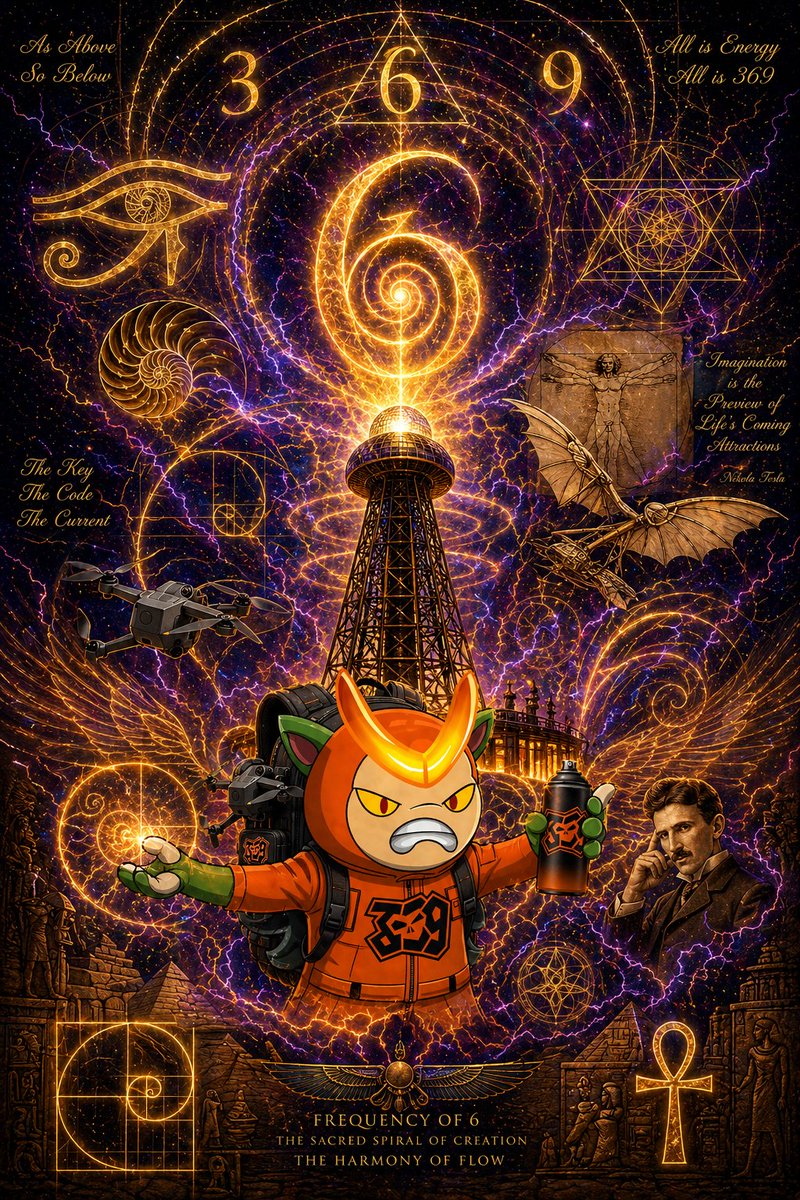
@CryptoFuzzy@abpmoon That imagery of revealing the pure Light is spot on. You’ve truly embodied the frequency of the 9 for the movement
Well executed Fuzzy!
Isao Tomita, 1980. The Moog III wasn't an instrument he bought. It was one he assembled, module by module, sound by sound. The Japanese composer who proved the synthesizer could hold the weight of a full orchestra.
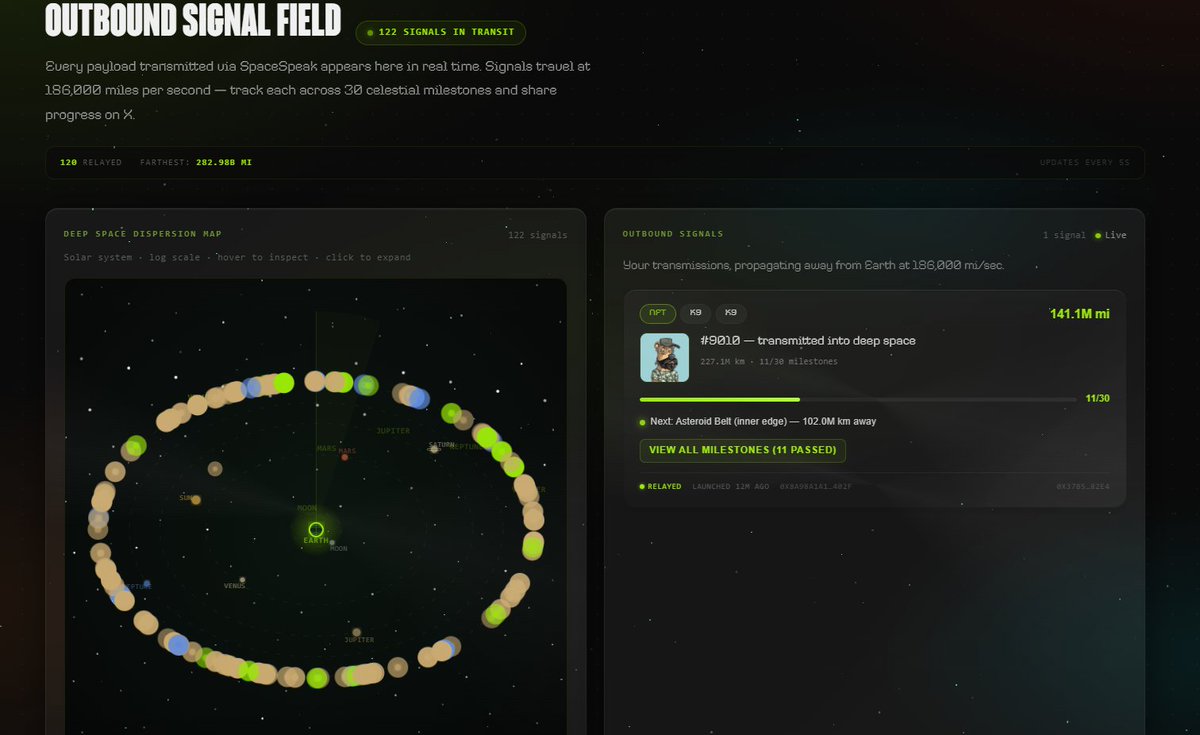
Rambo Bear #9010 was immortalized in deep space via @clutchmarkets First Contact Project. Already 1.1M mi from Earth at the speed of light. Message is awaiting launch @abpmoon
Send your NFTs to deep space before it's too late 🛸
contact.clutch.market