I did EVERYTHING grinded, stayed active,, supported early have and still got hit with: 🔹OG and SOG 🔹scouter 🔹21k points 🔹premium badge You’re not eligible 0 rewards 0 explanation Thanks @billions_ntwk for the memories Thanks @provenauthority
Sara 🦋
7.4K posts

@Crypto_Sara99
Crypto addict | Community helper | Billions SOG | ✨️


I did EVERYTHING grinded, stayed active,, supported early have and still got hit with: 🔹OG and SOG 🔹scouter 🔹21k points 🔹premium badge You’re not eligible 0 rewards 0 explanation Thanks @billions_ntwk for the memories Thanks @provenauthority


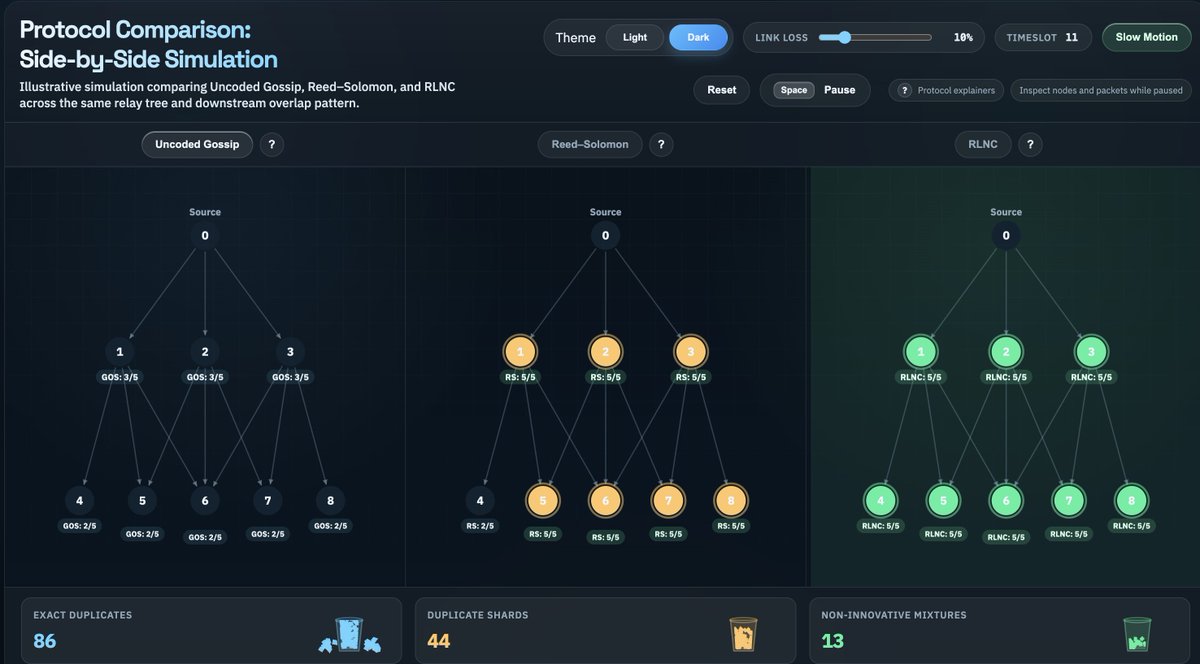
Why RLNC Outperforms Traditional Erasure Codes Not all coding systems are equal. Many networks already use erasure coding methods like Reed–Solomon. But RLNC introduces something more powerful: recoding. A node can generate entirely new coded shards from the shards it already has without waiting for full reconstruction. This enables continuous propagation. And continuous propagation reduces latency dramatically. @get_optimum argues that RLNC outperforms traditional approaches in large distributed systems because it combines: • flexibility • resilience • propagation efficiency This is why RLNC is at the center of Optimum’s architecture. Not as a marketing term. But as the actual mechanism driving performance gains. Cc: @blockchainjeff @tgogayi


I did EVERYTHING grinded, stayed active,, supported early have and still got hit with: 🔹OG and SOG 🔹scouter 🔹21k points 🔹premium badge You’re not eligible 0 rewards 0 explanation Thanks @billions_ntwk for the memories Thanks @provenauthority


Performance Under Pressure Most systems perform well under normal conditions. The real test is under load. When network activity increases: • latency rises • packets drop • performance degrades @get_optimum is designed to handle this. By improving data efficiency, it reduces the load on the network. This allows it to maintain: • low latency • stable propagation • consistent performance Even under pressure. This is what defines real infrastructure. Not peak performance but reliable performance at scale. CC: @blockchainjeff @cryptooflashh


May the force 🅱️ with you and May the 4th 🅱️ with you 💙🅱️


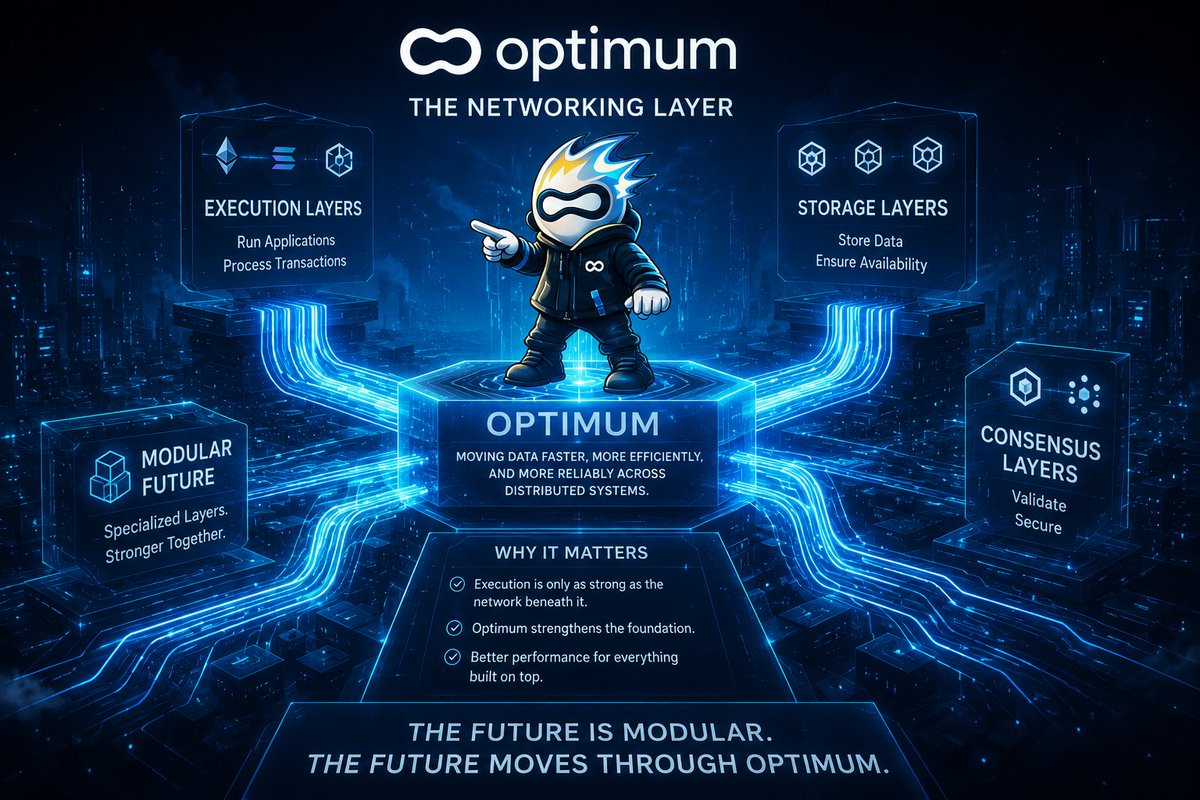
Infrastructure is where real value lives in Web3. Apps get the attention but performance is defined underneath in how data moves. Most issues like slow transactions and lag aren’t from the app… they’re from the network layer. This is where Optimum comes in. Not a chain. Not an app. A performance layer. By improving data propagation (mump2p + RLNC), it reduces latency, speeds up delivery, and makes everything on top run better. Better infra → better DeFi, games, and UX. Fix the foundation, and everything built on it improves. CC: @blockchainjeff @tgogayi @cryptooflashh


The Real Meaning of Speed And Where Optimum Wins Speed in blockchain is often misunderstood. Most people think it’s about how fast a transaction is processed. But real speed is something deeper. It’s about how fast information spreads across the network. A block is only useful when the entire network knows about it. If half the network is ahead and the other half is behind, you don’t have speed. You have inconsistency. This is why propagation speed matters. It determines synchronization. And synchronization determines stability. This is exactly where most networks struggle. Traditional propagation methods introduce delays. Blocks can take around ~1 second to fully propagate. At scale, that delay creates: • misalignment between validators • higher fork probability • slower and less reliable confirmations This is where @get_optimum changes the equation. With its networking layer mump2p, propagation time can drop to around ~150ms. That’s not a small improvement. That’s a 6x increase in propagation speed. But the real advantage isn’t just speed. Optimum improves how data moves, not just how fast. Using RLNC, data is transmitted more efficiently: • fewer retransmissions • less redundancy • more information per packet This leads to: • faster synchronization across validators • reduced latency at the network level • more consistent global state The result? A network that doesn’t just process faster but stays aligned in real time. This is real performance. Not measured in TPS alone, but in how efficiently the entire system operates. Optimum doesn’t redefine speed. It redefines what speed actually means in blockchain. CC: @blockchainjeff @tgogayi @cryptooflashh


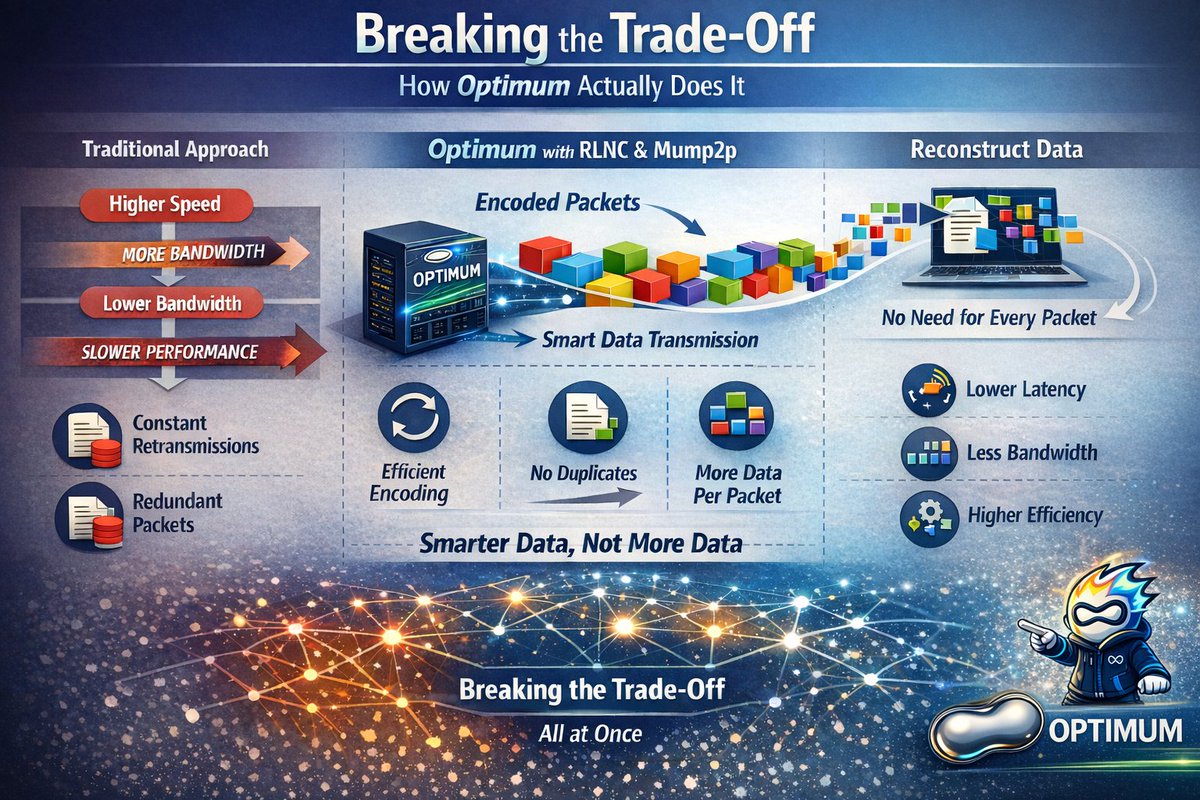
Breaking the Trade-Off a How Optimum Actually Does It In most systems, improving one thing means sacrificing another. More speed → more bandwidth usage. Less bandwidth → slower performance. This trade-off is almost universal. But this is exactly the limitation @get_optimum is designed to break. Through its networking layer mump2p, powered by RLNC, Optimum fundamentally changes how data is transmitted. Instead of sending the same data repeatedly, it sends encoded packets, where each packet carries information from multiple original packets. This means: • no need for constant retransmissions • no need for redundant packet copies • more information delivered per transmission And here’s the key advantage: Data can be reconstructed without receiving every packet. This eliminates the traditional dependency on full delivery. The result is something unusual: • lower latency • lower bandwidth consumption • higher efficiency All at the same time. This isn’t a minor optimization. It’s a shift in how network communication works. Instead of sending more data to achieve speed, Optimum sends smarter data. And that’s how it breaks the trade-off. CC: @blockchainjeff @tgogayi @cryptooflashh