@neutanent So many cool names mentioned in the TG group I liked:
Arisa
Aria
Sofia
Emby
English
Cryptonic_Bull
9.3K posts

@Cryptonic_Bull
Crypto Investor since 2017 | You Become What You Believe

"Everyone is racing to build AI games - almost no one is building good ones" our take on why prompt-to-game tools are shipping hype, not games, and why we built @SPARQWORLDS differently read the full piece 👇


Our 2nd opinion piece on building in AI & Gaming is out. I think the subtitle summarizes our stance quite nicely; "Prompt-to-game tools make great demos but bad games. The missing piece is an engine built for AI from the ground up" Read more here: khaleejtimes.com/business/innov…

We just invented a new Global Illumination method. IRIS: Indirect Radiance in Sparse Tiles for Low-Cost Diffuse Global Illumination IRIS was invented by the $NEURAL team, and is - in scientific terms - essentially a real-time diffuse global illumination method built on a sparse, hashed world-space irradiance cache. It trades unbiased accuracy for low, predictable cost and temporal stability, approximating multi-bounce light transport through stabilized previous-frame feedback rather than per-pixel path tracing. In other words; A low-cost method for realistic bounced lighting in real-time graphics, built on a reusable lighting cache rather than per-pixel calculation. But why does it matter? In one sentence: IRIS brings nice, natural-looking lighting to games and apps on hardware this was previously impossible, without the slowdowns or glitches that usually come with doing it cheaply. The 3 key improvements are; It makes good lighting cheap. Realistic bounced light - the way a red wall casts a soft red glow on a white floor - is normally very expensive to compute. IRIS gets a convincing version of it for a fraction of the cost, so it can run on phones, laptops, web games, and other modest hardware that usually can't afford it. It's steady and predictable. It doesn't hiccup or cause sudden frame-rate drops. The cost stays roughly the same from frame to frame, which makes it easy to rely on. And it doesn't flicker or leak light through walls - common problems with cheap lighting tricks. It saves the work instead of redoing it. Rather than recalculating the lighting for every pixel every frame, it stores it and reuses it. That's the main reason it's so much faster. Below you can see we got a test scene going to find and resolve any remaining issues with IRIS. But it's looking very nice already.
I feel like we are truly unique. In my eyes it's an experiment crypto rarely gets to see through. I really don't mean that in an arrogant way. Let's recap: $NEURAL started as a fair-launch at 50k mcap. The core thesis behind it was always to improve game creation (with AI). Our first goal was to create a 3D AI gen web app. Which we did. Shortly after that we delivered staking, a bittensor subnet and so on. Most people still thought we are larping/scammers. And I can understand that - the fair-launch token landscape is wild. To us, over time, it became clear that 3D gen AI was still quite a bit away from AAA quality, and there was a lot surrounding it that just wasn't there yet either to create proper games. And then came our biggest and most profound pivot: Out of the idea "Make apps that improve game dev with AI" became: "What would it take to ACTUALLY let anyone create games?" On top of our team's already extensive experience in the gaming industry, we spent 2+ months purely researching how we could solve for this question. And I can assure you, this is not an easy question to answer. If your immediate answer is "oh just build an AI game engine", you must be insane. We actively tried to find ways around it. We aren't chasing X hype and views, so we didn't care if that route would have been the most popular or not. We just tried to answer that question as efficiently and risk-averse as possible. Sadly, after months of research, we came to the conclusion that the only way to actually create a groundbreaking product in this space, was to actually build a full cross-platform game engine, from the ground, reimagined for AI-native workflows and with a renderer capable of competing with high-end graphics. We didn't want to compromise. Some examples: 1. We wanted to allow creators to build games at high fidelity - if they wanted to. 2. We wanted to integrate AI models not just on a surface-level - like an AI agent plugin - but from the ground up. Our code-base is structured and built to be optimized for AI usage. We built our own machine-learning model that trains and predicts ray-tracing results in real-time. Interestingly enough, we also ended up inventing our own ray-tracing algorithm and called it IRIS. 3. We wanted to create an engine and user experience that gives full flexibility to the creator. SPARQ has 5 levels of depth and complexity built-in. The creator can choose which level he wants to work on; be it natural language, talking to our AI Agent (level 1) or all the way down to level 5 - engine-level functions. 4. We wanted to build an ecosystem - not just an engine - that allows creators to really focus on the 1 thing that actually matters in game creation; A GOOD GAME. The only way to do that was to remove ANY distractions. That starts with our node-based asset pipeline, our proprietary asset version control system (think dropbox for game creators), matchmaking, networking, 1-click game publishing, and so much more. I skipped some parts here to not go overboard, but as you can see, this is an insanely complex and hard task. But, there is no way around it. You take a shortcut in 1 place, and it all starts falling apart. The experience degrades. Game creation is the most challenging medium out there. Building a new ecosystem that can truly be called "the next generation of game creation" is probably among the top 10 most ambitious goals in software development. But nonetheless, we chose this path. We are uniquely positioned to actually pull it off. And now 1 1/2 years into it and with initial user feedback, we know for certain it's doable. It's a journey we knew wouldn't be easy. We didn't know if our community would understand, would want to be a part of it or support us. But we saw this unique window of opportunity, and we simply couldn't let it slip without trying our best to achieve it. So here we are now, with the answer to our question: Create a novel, AI-native game creation engine and ecosystem which makes building games FUN, more PERSONAL, and much FASTER. I believe going from a "shitcoin" launch to building the next generation of game creation is an opportunity crypto rarely sees through. And I want to thank everyone who is still with us now, and who supported us all the way. We are working hard to exceed expectations. More to come soon 🫡
The past 1 1/2 years have been an insane journey for the $NEURAL team. We bet everything on a completely new way of developing a complex product such as SPARQ. We have ten people building a game engine that's closing in on Unity, and in some areas even Unreal. The edge we have isn't just "using AI" - it's that we restructured the entire team around the fact that AI writes a different kind of code, and the old ways of developing software can't handle it. Here's what we actually built 👇



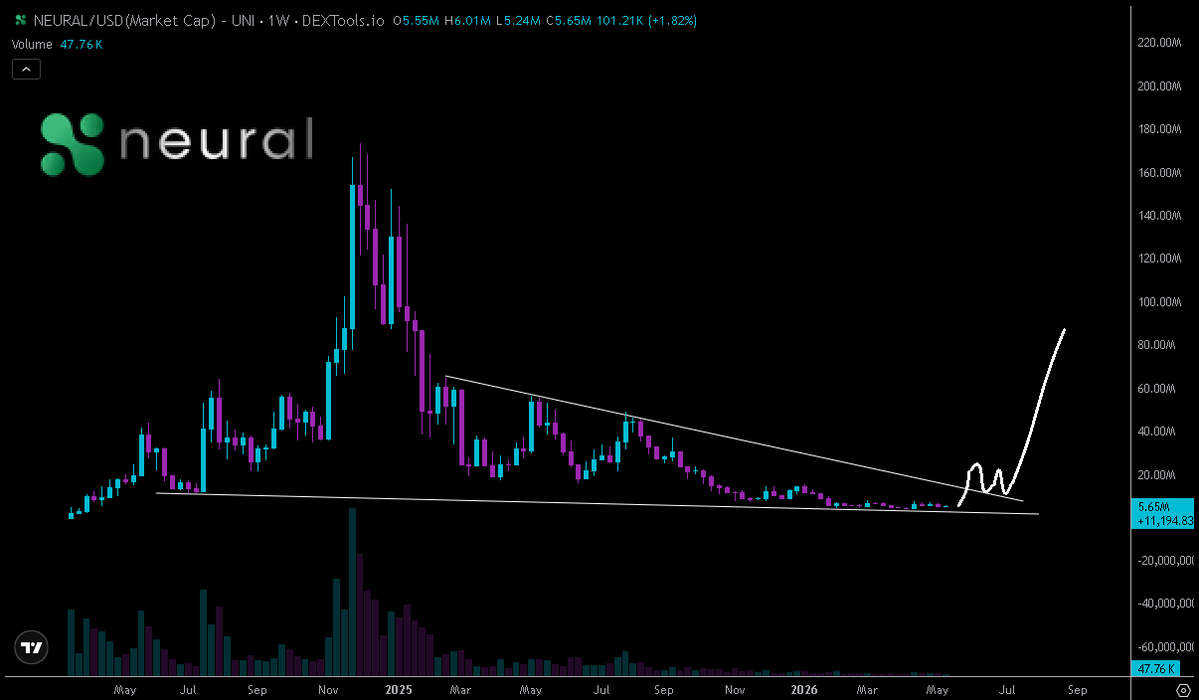


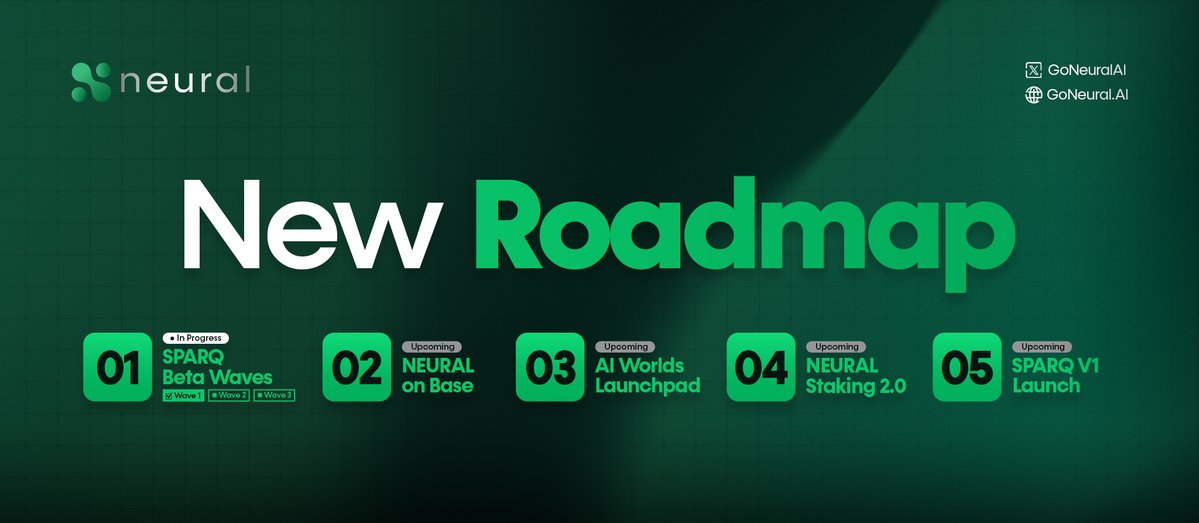
new roadmap just dropped you've been asking what's next, here it is, what we're shipping and in what order