Sabitlenmiş Tweet
We're going hybrid! Current Biology now offers a gold #openaccess option to all authors. #openaccess" target="_blank" rel="nofollow noopener">cell.com/current-biolog… (image: Nipam Patel)
English
Current Biology
5.1K posts
@CurrentBiology
Scientific journal publishing original research, overview and commentary across all of biology. All of it! @CellPressNews https://t.co/pfSLHA1KDS

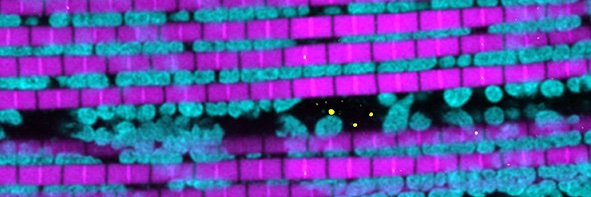
We often assume that an organism carries the same genome within all of its cells. But in many cases — from nematodes to hagfish, lampreys to songbirds — the truth is far messier. At least 100 species are known to do something called “programmed DNA elimination,” in which large swaths of the genome is removed from somatic cells during development. Marie Delattre, a cell biologist at the École Normale Supérieure, studies this phenomenon in a worm called M. belari, which belongs to the same family as C. elegans. Her research group “compared the genomes of M. belari’s germline cells — the specialized reproductive cells like sperm and eggs — with the genomes of the worm’s somatic (nonreproductive) cells,” according to reporting in Quanta Magazine. “The somatic genomes were missing long strings of sequences present in germline genomes. Sometime between the embryo’s growth from seven cells to 32, huge chunks of DNA had vanished.” “The scientists then watched nematode embryos develop under a microscope. As the cells grew and replicated their genomes, they broke 20 chromosomes down into fragments and then reassembled them into 40 miniature chromosomes. Most of the fragments rejoined in this new, smaller genome — but a substantial fraction were left out.” Specifically, the worm eliminated about one-third of its own genome from somatic cells. This DNA removal process begins during early embryogenesis, typically during the first few rounds of cell division. Germline cells (those destined to become gametes; eggs or sperm) retain the entire intact genome. The exact amount of eliminated DNA varies widely between species; a parasitic nematode found in cow stomachs, called Parascaris univalens, eliminates 90% of its genome!! The question, of course, is why organisms bother to do this at all. It seems that the eliminated genes are useful in the germline but unnecessary, or even harmful, in somatic cells. The eliminated sequences include transposons, which are "self-replicating DNA sequences that steal the cell’s machinery to copy themselves by the thousands or millions," according to the Quanta article. "This amounts to molecular grand larceny, as well as a waste of the time and energy that the cell must spend to suppress these sequences. Cells routinely curb transposons with epigenetic marks that silence them, or by intercepting and destroying their RNA. But some species, such as M. belari, may remove them entirely through [programmed DNA elimination]." This process, then, is basically a way to partition the genome, keeping the full sequence safely in the germline while paring down somatic DNA for energetic efficiency or stability. If somatic cells contain a bunch of excess genes that are no longer needed, and it takes lots of energy to continuously 'silence' those genes, then it's just more efficient to cut them out entirely. The excision is not random, either. In the best-studied nematode that does this, called Ascaris, the same exact genes and DNA segments are eliminated in every embryo, every time. Eliminated DNA sequences tend to be AT-rich and repetitive. They are usually tagged with methyl groups, which alerts the cell that this DNA should be tightly packed and kept ‘silenced’. Programmed DNA elimination sounds esoteric, but any strange phenomenon is usually a rich source of material for biotechnology discovery. Clearly these organisms have evolved an effective means to silence genes, streamline genomes, and keep transposons from causing trouble. Instead of relying on reversible switches, though, they just cut out the unneeded pieces. If we understood and harnessed this, perhaps we could build smaller synthetic genomes or reprogram chromosomes in useful ways. Thanks for reading.