
Dollie 🇮🇳 retweetledi
Dollie 🇮🇳
13.4K posts


Dollie 🇮🇳
@DBombayBrunette
Proud Indian, wife, mother, content creator, fragrance lover, travel addict…that's the multi faceted me ;) Also Head of Marketing at @dragonhilllife
🇮🇳 Katılım Ocak 2013
747 Takip Edilen2.7K Takipçiler

Dollie 🇮🇳 retweetledi
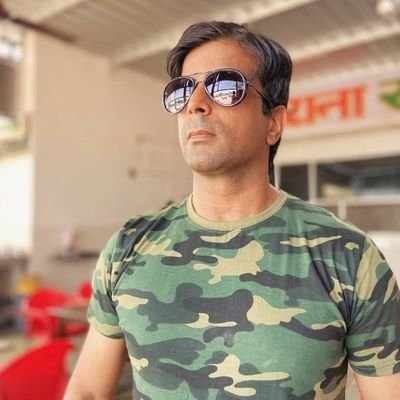
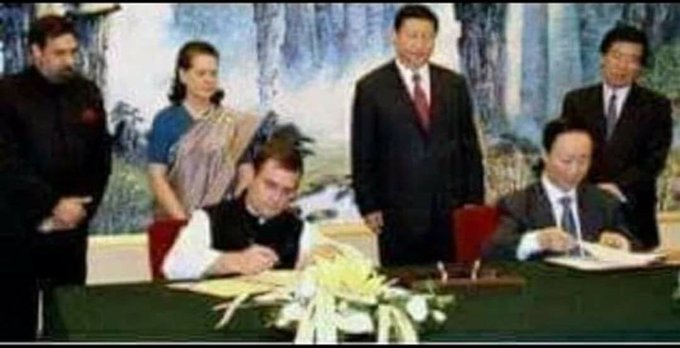
Chinese Dhurandhar (Thread)
7th August 2008, Beijing (China)
Congress Party of India signed a secret MoU with Chinese Communist party
From Congress side, Rahul Gandhi and from CCP side Xi Jinping signed this document
What was in that document
No body knows till now
1-17
English
Hey @AskPayPal , got this WhatsApp msg that’s apparently from your business account. Is this genuine or just another scam?

English
@AdityaRajKaul @VarunKrRana The Dhurandhar addiction is something else! My husband and I start watching something else on OTT and within 20 mins, go back to Dhurandhar. Lost count of how many times we’ve seen it. Watched D2 in theatre 3 times already!
English

Dhurandhar 1 and Dhurandhar 2 together have crossed 3000 crores globally. Aditya Dhar scripts history with Dhurandhar in Indian cinema. 🇮🇳
English
@priyasamagod @mountain_rats Agree. Plain white has always been for mourning in India .
English

@DBombayBrunette @mountain_rats Plain white or plain extremely pale colours are not part of any Indian traditions. Wherever white or cream is worn, it is in combination with Gold or Red or some other bright colour.
English

Bollywood has a history of distorting Indian culture rituals or portray it in trivial manner or depicting them as backwards .
Aping the Western culture and promoting them seems to have turned into a cult .
Latest trend is use of White dresses for bride in marriage rituals/ functions / ceremonies against traditional red / green etc .
In Sanatan White symbolises sanyas / peace / death rituals .
Promoting such trends are akin to Maculay' s strike on the then existing Indian education system .
English
Dollie 🇮🇳 retweetledi

🚨Last night, India switched on a reactor.
Here are 9 numbers nobody is talking about:
→ 72 years: Time since Homi Bhabha conceived this plan
→ 22 years: Time to actually build it
→ ₹7,700 crore: Final cost (started at ₹3,492 crore)
→ 500 MW: Power it will generate
→ 2nd: India's global rank only Russia had this before
→ 25%: India's share of world's thorium reserves
→ 400 years: How long those reserves can power India
→ 200+: Indian companies that built it. Zero foreign designs.
→ 3: Countries that tried and quit - USA, Germany, UK
🧵 A thread that will blow your mind:
English
@AdityaDharFilms @shashwatology @B62Studios @jiostudios The music is addictive! Dhurandhar songs are the only ones I’ve been listening to since December! ❤️🔥
English
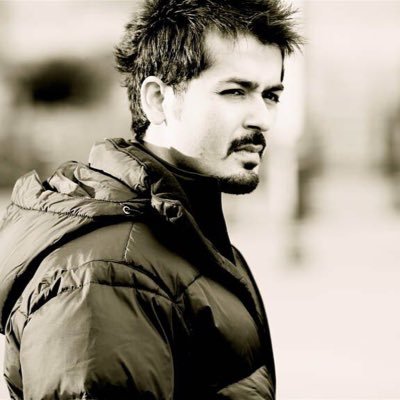
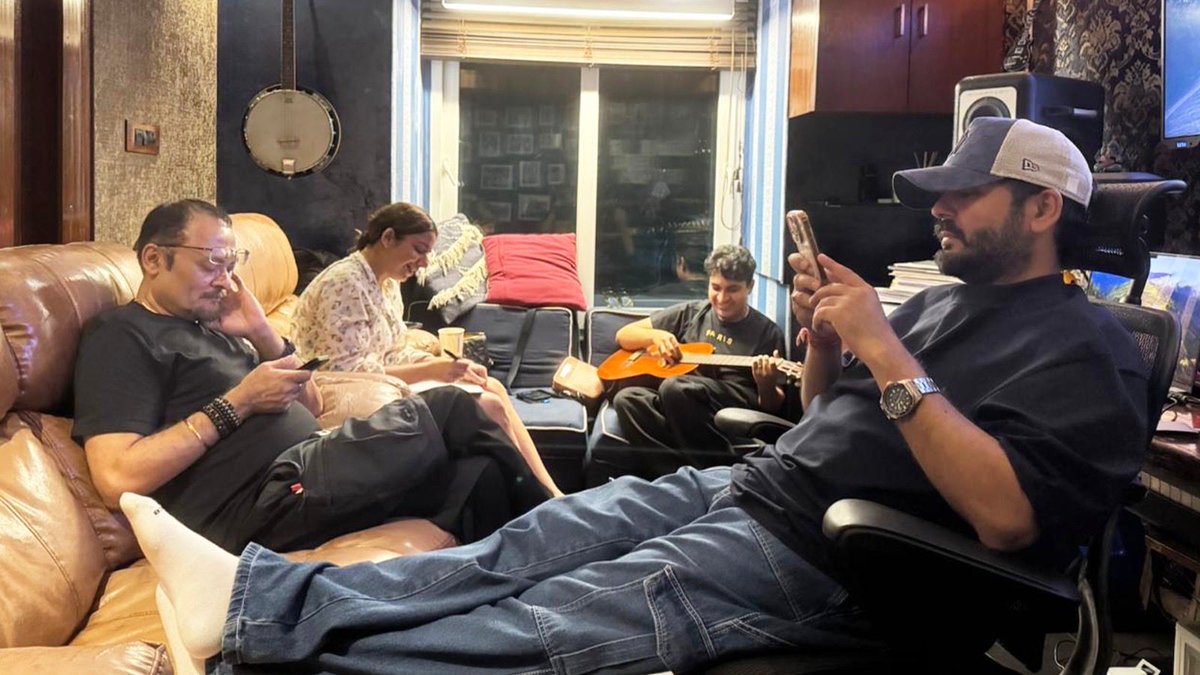
Here’s to Shashwat Sachdev.
Some collaborations go beyond work, they become deeply personal.
Sha has been that for me.
Not just the music composer of Dhurandhar but someone I see as a younger brother, someone I’ve shared chaos, silence, ideas and some of the most intense creative days with.
What he’s done on this film still doesn’t feel real when I say it out loud.
9 songs in 9 days for Dhurandhar Part 1, with the entire BGM done in 6 days.
And then Dhurandhar Part 2, 14 songs in 11 days, BGM in 3.
At that speed, at that scale, with that kind of emotional depth and that kind of extraordinary quality, it’s beyond crazy.
And what makes it even more unreal is how both the albums, released within a span of 3 months, reached top global charts, with almost every song being loved and celebrated, something that’s an absolute rarity for any film in the world.
For almost 15 days, my house stopped being a house. It became a living, breathing studio. Every room had something going on, music in the living room, recordings in the bedrooms, writing in the balconies. Singers and musicians walking in and out endlessly. Days and nights just blending into each other. 21–22 hour stretches, no real sense of time, just a shared madness to get it right.
And right at the center of all of it was Sha.
Holding everything together. Creating, composing, guiding, reacting, evolving, all at once. There were days he was unwell, running on barely any sleep, dealing with health scares but he still showed up fully, without compromise, without slowing down.
That kind of resilience is rare.
Having the legendary Irshad Kamil Sir alongside, and a team that gave everything they had, pushed this into something even more special.
Everyone went into absolute God mode. And through all that chaos, Magic (Sha’s better half) was the anchor, keeping things steady, holding the energy together when everything could have easily fallen apart.
What makes Sha truly special is not just his talent. It’s his hunger. His refusal to settle. His instinct to keep digging until something feels honest. He doesn’t chase easy, he chases truth in every note.
That kind of commitment doesn’t come from skill alone.
It comes from love.
Love to achieve God through music.
And you can feel that love in every second of Dhurandhar.
Always grateful.
Always rooting for you. ❤️

English
@3k6Varun35889 @Starboy2079 Yes, I had replied with this casting to someone’s tweet when the first look of Ranvir and Sai Pallavi had got leaked. Ram Charan in RRR actually looked like Bhagwan Ram. And see Yami Gautam’s wedding pics…she’d be the perfect Mata Sita.
English

Maybe it is just me but in my opinion even #RamCharan could have played it very well as he looks naturally so divine
He has a very natural intensity and a great physique that makes him look so right for this character
Everyone has done their best but his aura is just something else
English
Dollie 🇮🇳 retweetledi
1️⃣
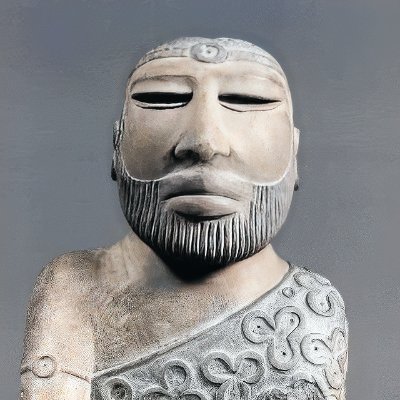
Patriarchy is not timeless.
It is not universal.
It behaves like a wave 🌊
Formed under specific material pressures, it moved west → east, absorbing, reshaping, overwriting older social systems.
India did not generate this wave.
India encountered it — late.

English
@AstroCounselKK Something similar has been mentioned in @mainakdhar in his book 03:02.
English

💣 By the way, this bomb is something else; it doesn't kill people.
The moment it explodes, it destroys everything electronic & electrical.
It ruins all electronic devices, & within minutes, you are sent back to the Stone Age.
In an instant, all aircraft carriers, submarines, & the like will turn into drifting pieces of iron on the water's surface without any guidance, & planes will fall from the sky.
This is the
Electro Magnetic Pulse (EMP) Bomb, and those who openly possess it are: North Korea, China, Russia, & USA.
As for who possesses it in secret, only God knows ..
And No "guessing games" are allowed here!

English
Dollie 🇮🇳 retweetledi

If you think Ram Rajya had no problems.
You have never understood Ram.
Ram Rajya was never perfection.
It was correction under pressure.
Now look at Bharat.
GDP
2000: ~460 billion dollars.
2025: ~4.5 trillion dollars.
Per Capita Income
2000: ~$450
2025: ~$2,700
Life Expectancy
2000: ~62 years
2025: ~70+ years
Poverty
2000: ~45%+
2025: ~12%
Agriculture
2000: Food security stabilizing
2025: Largest rice exporter
Middle Class
2000: ~50 million
2025: ~300 million
Hospitals
2000: ~18,000
2025: ~70,000+
Literacy
2000: ~62%
2025: ~77%
Airports
2000: ~50
2025: ~150
Highways
2000: ~50,000 km
2025: ~145,000 km
Digital
2000: Negligible
2025: ~170 billion transactions
₹2,200+ trillion value
Universities
2000: ~250
2025: ~1330
IITs
2000: 7
2025: 23
Medical Colleges
2000: ~150
2025: ~800
Defence Exports
2000: Zero
2025: ~₹20,000 crore
Companies > ₹10,000 Cr
2000: Few dozen
2025: 300+
MSMEs
2000: ~1–2 crore
2025: ~6+ crore
Exports
2000: ~60 billion
2025: ~750 billion
This is not just exponential growth.
This is remembrance.
But numbers are not the full story.
Rajpath becomes Kartavya Path.
Central Vista replaces imperial corridors.
Old Parliament gives way to new.
Sengol replaces sceptre.
Canopy gets Netaji.
Amar Jawan gets its place.
Ram Mandir returns.
Kashi reconnects.
Mahakal expands.
Allahabad becomes Prayagraj.
Faizabad becomes Ayodhya.
Gurgaon becomes Gurugram.
Macaulay cracks.
Bharatiya Nyaya emerges.
Languages return.
This is not symbolism.
This is decolonisation.
For 200 years.
We were told who we are.
Now we decide.
And still.
Some people complain daily.
Because they hate who sits in power.
More than they love the nation.
That is not dissent.
That is insecurity.
Look outside.
America is cracking.
Europe is fragmenting.
Old dominance is fading.
But here.
The system holds.
Not perfect.
But stable.
That is Ram Rajya.
Not absence of evil.
Clarity in response.
Not weak.
Not reckless.
Directed power.
Ram Rajya is not built by leaders.
It is sustained by citizens.
You want corruption gone.
But adjust small lies.
You want fairness.
But chase shortcuts.
You want merit.
But play identity.
This is the real problem.
So stop asking.
When will Ram Rajya come?
Look again.
We are already inside it.
Look deeper.
Ram is within you.
You have the power to decide.
Are you aligned with him?
Or resisting him within?
Question the government.
Corner them when needed.
That is your right.
But never stand against Bharat.
Never support those who divide it.
Know the difference.
Because you are Bharat.

English
Dollie 🇮🇳 retweetledi
They say:
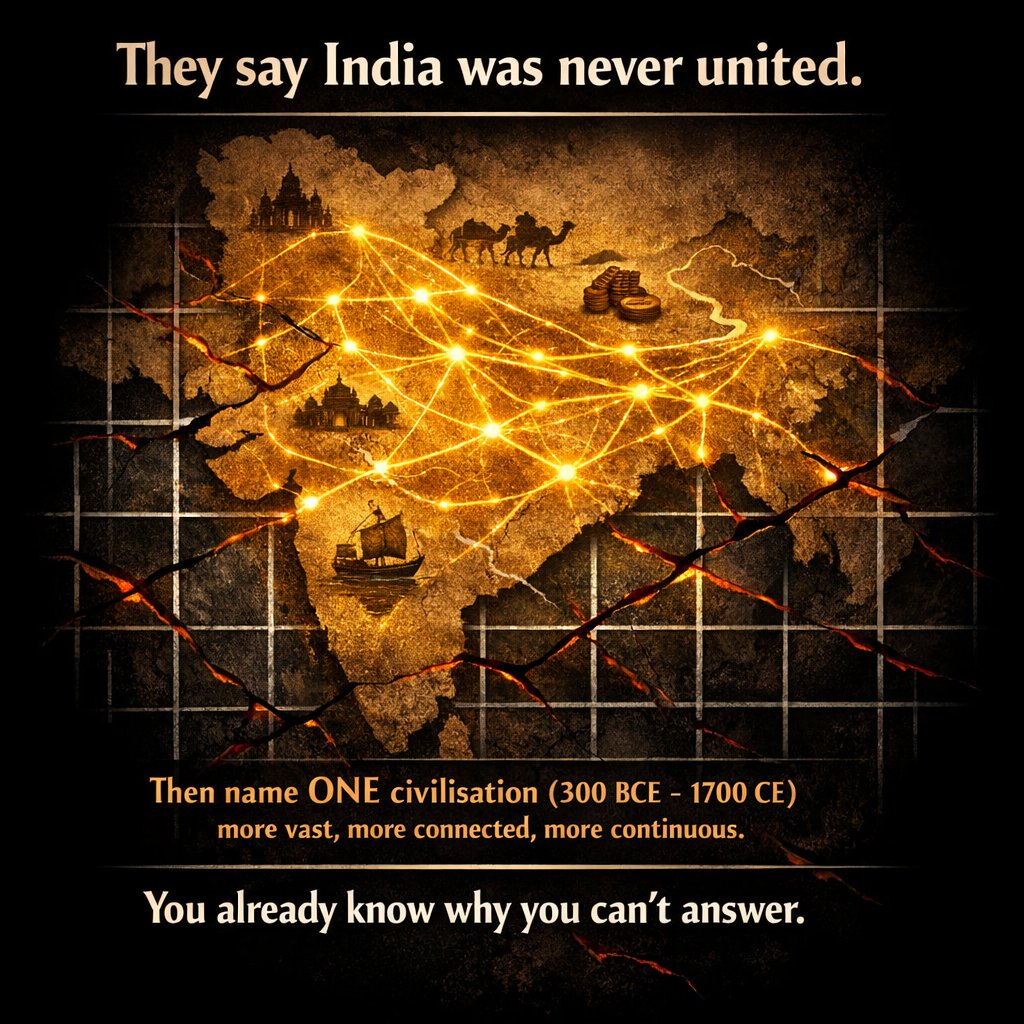
“India wasn’t a country. It was fragmented. The British united it.”
Pause.
Breathe.
Now ask the only question that matters.
Name one civilisation between 300 BCE and 1700 CE that was more geographically vast, economically integrated, and culturally continuous than India — without using 19th-century nation-state standards.
Silence usually follows.
Because here’s the inconvenient truth.
Pre-modern India wasn’t a modern nation-state.
Neither was France.
Neither was Germany.
Neither was Italy.
Neither was China for most of its history.
Fragmentation was the global norm.
Civilisational continuity was the exception.
India had shared sacred geographies.
Pilgrimage routes crossing kingdoms.
Epics known from Kabul to Kanchipuram.
Trade networks spanning oceans.
Legal, monetary, linguistic, and cosmological continuities that survived dynastic rise and collapse.
That’s not chaos.
That’s civilisation.
What the British did was not “unite” India.
They conquered existing polities.
Flattened organic networks into extractive grids.
Called administrative centralisation “unity.”
And sold plunder as a civilising act.
The myth persists because it performs a function.
If India was always broken, colonial rule becomes a rescue.
If India was always divided, looting becomes management.
History doesn’t support that claim.
Comparative history destroys it.
Next time someone thanks the British for “uniting” India, don’t argue.
Just ask the question.
They already lost when they can’t answer. 🧠🔥
#UncropTheTruth #Decolonisation
English
Dollie 🇮🇳 retweetledi


My daily routine for the past week has been on repeat:Open social media
Immediately dive into Dhurandhar appreciation posts and god-tier edits
Put the Dhurandhar OST on loop
Repeat
It’s not just a habit anymore… it’s a full-blown lifestyle
English
Dollie 🇮🇳 retweetledi


Dollie 🇮🇳 retweetledi
₹40,000 crore.
That is roughly the size of the global probiotic market today.
Pause for a moment.
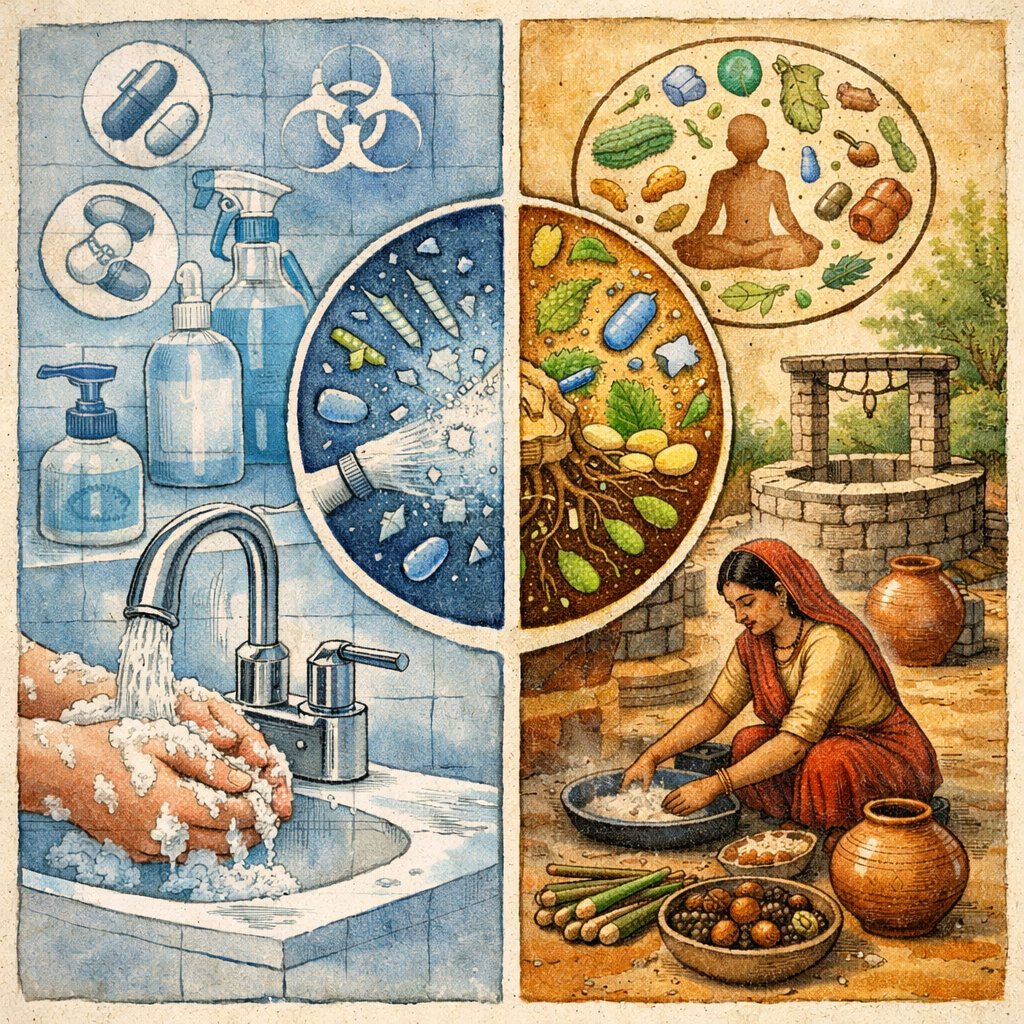
Modern hygiene first wipes out microbes with antibiotics, antiseptics, antibacterial soaps, sterilized surfaces, RO filtration. Then science discovers that humans cannot live without microbes. Suddenly the market is full of probiotic capsules to restore “good bacteria”.
Kill them.
Then sell them back.
But traditional Indian life followed a very different logic. Not sterility. Balance.
Consider the village house.
Floors were often plastered with a thin layer of cow dung mixed with clay. To a modern eye this looks primitive. Yet dried dung contains soil bacteria such as Bacillus species that suppress harmful pathogens. The plaster also controls humidity and dust.
Instead of chemical sterilization, the floor hosted a stable microbial layer.
Clean. But alive.
Now look at washing practices.
Before commercial soaps, many households used ash to clean utensils or hands. Wood ash contains alkaline salts like potassium carbonate. When mixed with water it behaves like a mild soap, breaking down grease.
It cleans.
But it does not flood the surface with synthetic antimicrobial chemicals that wipe out everything.
Hair care followed the same ecological logic.
Reetha and shikakai were common cleansers. These plants contain natural saponins that produce foam and remove dirt, yet they are far gentler than modern sulfate shampoos. The scalp oils remain. The skin barrier survives. The microbial ecosystem stays intact.
Oral hygiene was also interesting.
People commonly brushed with datun sticks made from neem or babool. When chewed, the fibers fray into a natural brush. Neem carries antibacterial phytochemicals that suppress cavity-causing bacteria.
But the mouth is not sterilized.
The oral microbiome remains balanced.
Water tells another part of the story.
Drinking water came from wells, stepwells, ponds, and tanks. Groundwater naturally carries minerals like calcium and magnesium. These minerals influence gut chemistry and microbial growth.
Modern RO filtration often strips them away.
Water becomes chemically pure, but biologically poorer.
Add one more layer.
Traditional life meant constant contact with soil. Courtyards, fields, earthen floors, bare feet, clay vessels. Soil microbes interacted daily with human skin and immune systems.
Today immunologists call this the “hygiene hypothesis”.
When microbial exposure disappears, immune systems become confused. Allergies and autoimmune diseases rise.
The pattern becomes hard to ignore.
Traditional Indian hygiene did not aim for sterility.
It aimed for equilibrium.
Clean surfaces.
Living ecosystems.
Modern science is slowly rediscovering the same idea through microbiome research, fermented foods, and probiotic therapy.
Which leaves an uncomfortable question.
If the future of medicine is restoring microbial balance, were many traditional Indian practices quietly doing exactly that all along? 🧬
English

Is there anyone who has been using the same SIM number for 10 years?
Mine - 8 Year
English