

WitnezMe
272 posts


@sailaunderscore I’m noticing some similarities between all the accounts I’ve seen complain about Renaissance and impressionist art today
English

This is basically the same argument people use against neo-classical buildings. Yes, it is possible to do 'old-money' or 'classical' aesthetics in a gauche and tasteless, way.
But even this tasteless version is clearly better that corporate genderless blobicans.


English

part of the anthroposophical model of early childhood (what waldorf is based on), is that the child begins life in a kind of magic bubble, and that the time spent in this state is essential for their long term spiritual development.
you can accidentally rush them out of this stage.
the child goes through a process of recapitulating the stages of civilization itself: they eventually go through an egyptian stage, and become fascinated with writing, symbols, and what we think of as the hallmarks of that civilization. later, they go through an antiquity / roman stage, and become fascinated by building, laws (rules), and the things we think of humanity as generally acquiring during that time. later, the medieval, and so on.
but at the start, the child is in magic world. this is occasionally referred to as “the garden”, as in the garden of eden, but i just think of it as fairy world, where the boundary between myth, story, imagination, and reality is completely fluid.
taking this view puts you at odds with modern parenting in ways that you would not expect. a lot of parenting discussion online is about nutrition, discipline in general, appropriate punishments, homeschooling, giving them tablets - there’s a clear set of basic controversial topics.
taking a concern about rushing the child out of this initial state and into the next one too quickly puts you at odds with other less obvious aspects of parenting style. the one i find most interesting is the conception of early childhood and learning itself that i see as flowing downstream from the modern scientific worldview.
recently, i was at an aquarium. they have this large cylinder tank that you can walk around and look into. the walls are glass. in the center, there’s a (real) fish that’s huge - easily the biggest fish i’ve ever seen.
a girl runs up and says, “wow, that’s a huge fish”. the mom says: “yes, it is a large fish, but just keep in mind that the glass is convex. when glass is bent this way, it makes things inside look bigger. but it is a big fish”.
now, the kid asks, “so, it’s not a big fish?”, and the mom says, “well, yes, it is a big fish, but…” and reiterates the explanation about what convex glass is and what it does to your perception.
in the modern scientific worldview, part of “becoming wise” is accumulating facts and that are not intuitive, and that undercut empirical perception. becoming educated means knowing these facts and having them at hand to make sure you’re perceiving things accurately - unlike someone uneducated, who wouldn’t know about glass distorting perception, and the finer mechanics of how and why that happens.
this means that “passing on wisdom” and being “the wise elder” often amounts to passing on and dispensing these facts. here, the kid is looking at something - but has to be told: “don’t get the wrong idea. i, the wise elder, know something you don’t, and i’ll let you in on the secret.”
there’s nothing wrong with this in and of itself, but it’s completely at odds with the world the child is presently inhabiting (in my opinion). the child is just in awe of a large fish. this is a total, magical, all encompassing spiritual experience - but the adult has to step in and take them out of it, to ensure that they’re giving primacy to a scientific perception.
the adult, due to their model of what knowledge is, is constantly stepping in to jet pack the child out of their direct perception, into abstractions that have nothing to do with their inner world.
once you notice this, you really see it all the time. i’m at the park, and a kid is hitting a log with a stick. it’s making a cool sound. he says, “dad, look at this”, and the dad starts explaining that sound is really vibrations, what vibrations are - bam: smash the eject button. the kid can’t just hear the sound: an adult has to step in and make sure that the experience of hearing the sound is being filtered through this paradigm’s conception of what knowledge, and life, “really” is.
English
@aakashgupta Only true if you one shot it or delegate the final produce. It’s possible to think in conversation with the model.
English

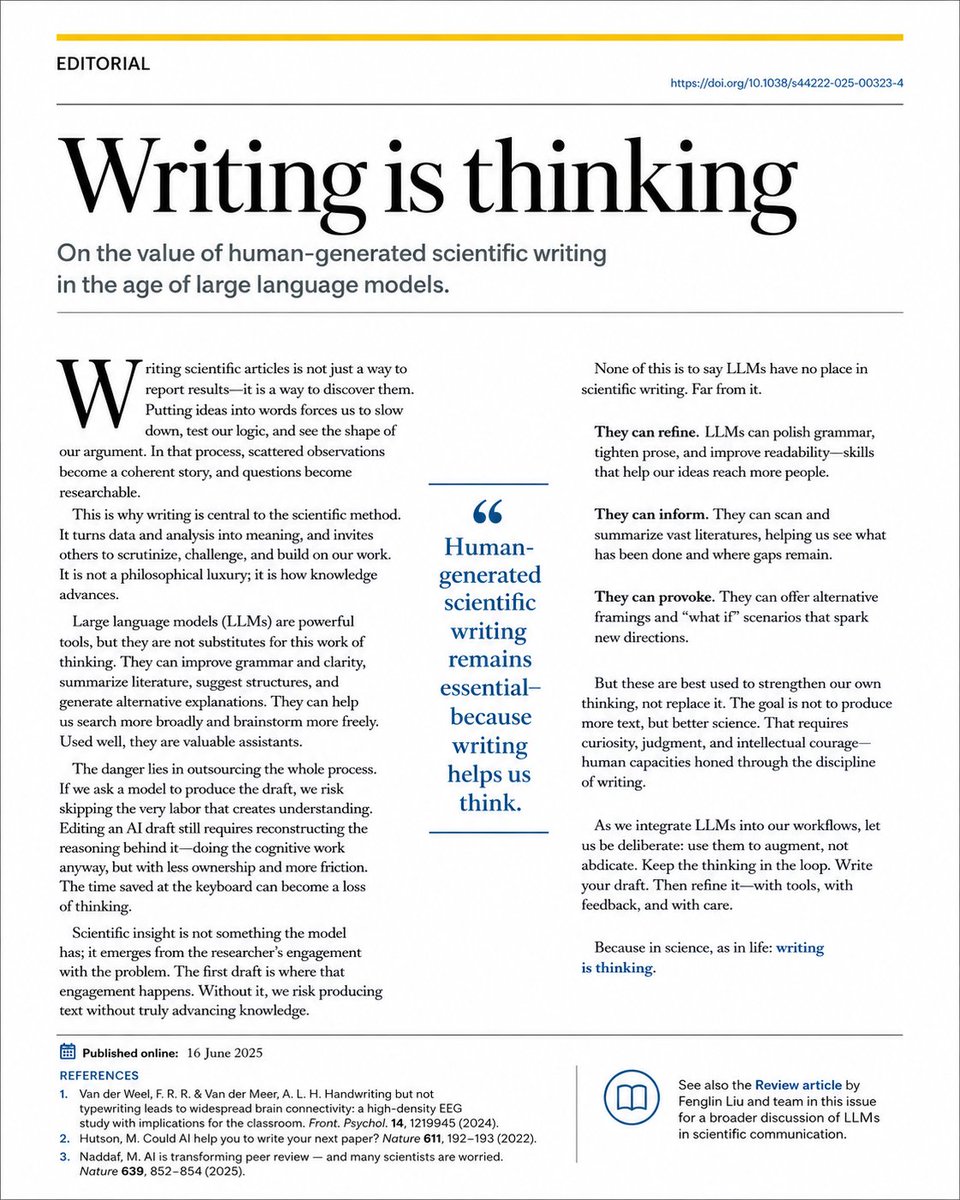
Your brain doesn't form the thought until you write it down.
Nature Reviews Bioengineering published the case for that claim last summer in an editorial titled "Writing is thinking." The cited evidence is a 2024 EEG study at the Norwegian University of Science and Technology. 36 students alternated between handwriting and typing the same words. 256-channel sensor array. Cursive on a touchscreen versus keys on a keyboard. Same words both ways.
Handwriting produced widespread connectivity across parietal and central brain regions. Typing didn't. The theta and alpha frequency bands the literature ties to memory formation and encoding lit up almost exclusively when the hand was forming the letters.
The motor act was producing the cognition.
What the editorial extends from that finding is the more uncomfortable claim. Writing a scientific article is the mechanism by which a researcher discovers what their main message actually is. The act of constructing sentences forces the chaotic, non-linear way the mind wanders into a structured, intentional narrative. You sort years of research into a story, and in the sorting, you find out what you believe.
Then the line:
If writing is thinking, are we not then reading the thoughts of the LLM rather than those of the researchers behind the paper?
Nature endorses LLMs for grammar, search, brainstorming, breaking through writer's block. Where the line gets drawn is outsourcing the whole writing process. Because the writing process is the thinking process.
Even editing the LLM's draft is harder than writing one from scratch. To restructure someone else's reasoning you have to reconstruct it first, which means doing the cognitive work anyway, with worse leverage and more friction.
The time savings on the keyboard turn out to be cognitive savings on the part of the brain you wanted to use.
Your first draft was the thinking.
English

i built a small cli ambient assistant for myself that pulls me back to my desk when i drift away. the algo is built to keep you in the feed, my beast laptop is now built to pull me out of it and back to the work. counter trap for the trap.
we forget after a bathroom break or a stretch that work was waiting. now my room reminds me out loud, in the same room where the work happens.
traps are everywhere anon. build your own tools to grow. once you get familiar with what these models actually do, the gap between idea and shipping collapses. you can build anything you like, anything people like.
stop waiting for someone to ship the tool you need. ship it yourself. the age of acceleration is here. if you can think it you can build it.
English
@rolibosch @enjojoyy Hermes works with OpenAi and Chinese subscriptions
English

@enjojoyy Claude Code subscription or Codex subscription. They subsidize them heavily. They’re agents anyways, and it’s a subscription instead of price per token:
English


renaissance branding in 2026 is the new corporate memphis
Andrew Neel@andrewneel
This might be the best footer I've ever seen. Well done @contralabs_ai
English


behold the most cursed aesthetic of 2026:
"Taste" set in Instrument serif over a midjourney generated impressionist painting
not corporate memphis. more like noguchi table from temu vibes

mehedi@mehedih_
renaissance branding in 2026 is the new corporate memphis
English

Hermes Agent now has multi-agent via the Kanban, new in v0.12.0.
Agents claim tasks from a board, work in parallel, and hand off when blocked. You watch progress and unblock from one easy view instead of juggling terminals.
We asked it to plan and make this video about itself:
English
@leftcurvedev_ Literally me, and after watching iron man last night
English


@yacineMTB Opus 4.7 and 5.5 xhigh spent 14 hours reverse engineering a kernel to find out why there was TPS decay.
4.6 came along: “oh, did you check if your laptop is thermal throttling”
It was indeed thermal throttling…
English


New update for HermesWorkspace 💡
Just shipped:
>Live tool cards mid-run expandable, with args + output
>Chat sends recover across navigation
>No stale tool cards across turns
>Cleaner terminal & session lifecycle
+bug fixes!
Tell your agent to clone👉🏻 Hermes-Workspace.com
English
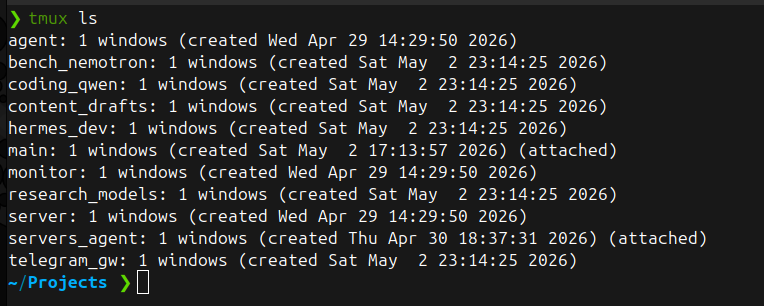
i get this question a lot so here is the answer everyone running hermes agent or any local agent should hear: tmux is the separation layer. cheapest, simplest, most reliable way to keep agent contexts from bleeding into each other.
i run a lot of hermes sessions in parallel. one per project, one per active model, sometimes both. each session has its own working directory, its own memory context, its own conversation thread. the work session, the personal session, and the client session never see each other.
a typical day on my main box has 6 to 10 hermes sessions running at any given time. coding project here, research session there, content drafting in another, telegram gateway routing requests in a fourth, model benchmarks in a fifth. zero overhead to switch, zero risk of context bleed.
you do not need docker, a second machine, or elaborate workflow tooling for this. tmux plus a clear naming convention plus one hermes per session is the whole setup. the tools have been there the whole time, most people just have not connected them.
Nemanja@Nemanjadotcom
@sudoingX How do you organize projects and separation? Like would you use the same instance for managing work and personal things?
English
@alejandroreyes @Shpigford Kinda doing the same thing. Strategy chat in Claude with output docs —> New Hermes instance using gpt subscription
English

@Shpigford hermes + gpt 5.5 right now.
speaking from someone who's not technical at all.
built my plan in claude code based on the bottlenecks in my business (surprise... it's ME) and deployed it in hermes and has been working great so far.
English

what's the "personal AI" that doesn't require a blood sacrifice or a PhD in quantum physics to use? who's built the "Apple" of personal AI where it Just Works™?
English
WitnezMe retweetledi

“Nature loves courage.
You make the commitment and nature will respond to that commitment by removing impossible obstacles.
Dream the impossible dream and the world will not grind you under, it will lift you up. This is the trick.
This is what all these teachers and philosophers who really counted, who really touched the alchemical gold, this is what they understood.
This is the shamanic dance in the waterfall.
This is how magic is done.
By hurling yourself into the abyss and discovering it's a feather bed.”
― Terence McKenna
Xiaoyin Qu@quxiaoyin
Being a failed founder is now better than being a successful employee. I'm seeing this everywhere. Decagon created a special "founder office." Lovable brags about how many Y Combinator founders joined their team. It's obvious what's happening: companies don't care which big tech company you worked at anymore. They want to know if you've ever started something. Sure, most of these founders failed - successful ones wouldn't be job hunting. But in America, startup failure isn't really risky anymore. In the AI era, the scarce skill isn't technical knowledge. It's owning problems end-to-end. Having initiative. Working like a founder. So if you're still a cog in some big company machine, getting yelled at by your boss, worried about promotions - maybe it's time to start something. Here's the beautiful part: if you fail, you can join Anthropic's founder program. If you succeed, you become the next Anthropic. Either way, you win. This makes sense. Society needs people who can handle entire business functions, not just specialized tasks. That's what founders do. As AI gets better, founders get more powerful. They handle diverse work, they're accountable for results, and AI amplifies all of that. A founder might go from 10x to 100x to 1000x productivity. But specific roles? AI might replace those entirely. The better AI gets, the more obsolete narrow jobs become. Founder might be the best job of the future. Best case: you become the next Sam Altman. Worst case: you join Dario's company and make bank. Pretty good risk profile. #Entrepreneurship #Startups #Founder #AI #TechCareers #Anthropic #YCombinator #FutureOfWork #Innovation
English

it is mentally exhausting to have your army of agents asking you questions, but also they trend toward slop if you don't keep an eye on them.
this is why you must teach your agents to manage up.
here is the prompt I give mine. it also works well for new human employees too!
Any time we’re working on something new, follow these steps:
1. Repeat back to me what you think I’m asking you to do, and what you think success looks like, so I can confirm we’re on the same page.
2. Once I confirm, tell me what steps you’ll take to accomplish the goal and what inputs you’ll use.
3. Break the work down into way, way smaller steps than you otherwise would. Like, 10x smaller.
4. Before each step, tell me your recommended next action, your two best alternatives, and why you’re recommending the one you are. Frame any tradeoffs in terms of what you understand I care about, and abstract out details that are unlikely to matter to me. Phrase it so I can just reply “yes” and you have what you need to move forward.
5. As we work, in a separate doc, keep track of where I accept your recommendations and where I push back, and what that tells you about me.
6. Over time, draw on those observations so you can check in with me less often.
English


renaissance visuals on tech landing pages are so overplayed😭
Andrew Neel@andrewneel
This might be the best footer I've ever seen. Well done @contralabs_ai
English