Carter Duncan retweetledi
Carter Duncan
404 posts

Carter Duncan
@DCarterDuncan
NC → ATX → NC. faith | software | music | history
USA Katılım Mart 2009
290 Takip Edilen89 Takipçiler

@jonathanrstern @nireyal Indistractable*
I'll blame autocorrect for the "u," but I take full responsibility for the "i." :)
English

@jonathanrstern This is why becoming Industractible only gets more important, c.f. @nireyal.
I'd just add that I suspect who one is around will continue to matter, thank goodness. College in a closet (fueled by self discipline) doesn't sound like a fun replacement.
English

In previous ages, becoming educated required either growing up in an elite family or gaining admission to elite schools.
In the age of AI, the cost to become educated will drop to $0. Elite institutions will not be necessary.
Despite this, time and effort *will be*.
Self-motivation will be the great differentiator.
Suhail@Suhail
I cannot seem to let go how much AI seems to help me learn. Education is going to be completely overhauled with an infinitely patient teacher. Perhaps what will matter more are whether teachers can inspire you to self-motivate than teach you.
English
Carter Duncan retweetledi

E138 - besties in conversation w/ presidential candidate @VivekGRamaswamy
- why he's running
- energy
- immigration
- russia/china
- media + campaign strategy
- relationship w/ trump
- establishment appeal
- abolishing the DOE + social issues
++ more
🔊: bit.ly/alline138
📺: bit.ly/alline138yt
English
Carter Duncan retweetledi

@jonathanrstern @tylercowen I like to think I've answered most of your emails too! Not bad company 😂
English

Both Noam Chomsky and @tylercowen have answered every email I’ve ever sent them. Can’t wait to hear about why!
conversationswithtyler.com/episodes/noam-…
English
Carter Duncan retweetledi

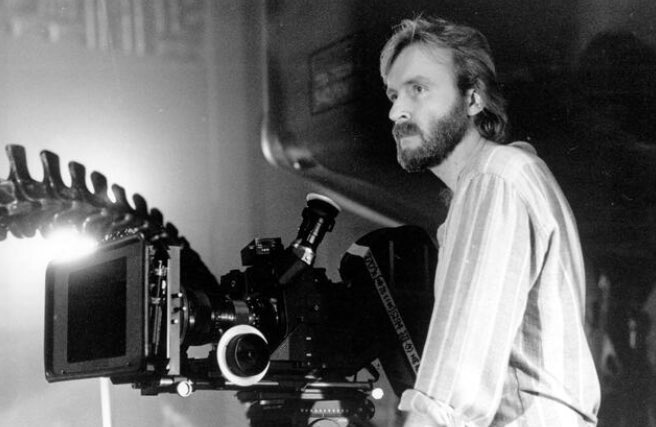
James Cameron has written & directed 3 of the top 4 highest-grossing movies of all time (Avatar, Avatar: The Way of Water, and Titanic).
Before he made movies, Cameron was a truck driver.
He didn't go to film school.
Instead, on the weekends, he would go to the library and..
"I'd pull any thesis that [University of Southern California] graduate students had written [on] anything that related to film technology," Cameron explained.
"And for the cost of xeroxing (photocopying), I [got] all these doctoral dissertations [and] build up these big binders on how everything was done."
"So I literally gave myself a full graduate course on film technology for about $120.
I didn’t have to enroll in school because it was all there in the library. I’d set it up to go in like I was on a tactical mission, find out what I needed to know, and take it all home."
Takeaway 1:
When asked what motivated him to read those big binders full of information on filmmaking, Cameron said he was just following what excited him.
"People seek out the information and knowledge they need," he said. "It's like a divining rod."
The mythologist Joseph Campbell similarly talked about how reading is like "a divining rod," a way to find what you are uniquely attracted to and meant to do.
"You’ve got to read," Campbell said. "Find [what] excites you. And if it doesn’t excite you…It’s not yours.”
Takeaway 2:
Of course, at some point, Cameron had to put the binders down and pick up a camera.
When he eventually attempted to make his first movie, Cameron said, “It was a bit like a doctor doing his first appendectomy after having only read about it."
The bestselling author and learning expert, Scott Young, has a great article with a great title, "Do The Real Thing."
"When you examine case studies of people who have had major accomplishments," Scott writes, "you expect there to be some trick or shortcut...More often, however, the strategy used is dead simple: doing the real thing."
Takeaway 3:
Leonardo da Vinci used to sign off his letters, “Leonardo da Vinci, disscepolo della sperientia” ("disciple of experience").
He used to believe that one learns best by solely "doing the real thing."
Over time, however, he evolved out of this belief and, biographer Walter Isaacson writes, "became a disciple of both experience and received wisdom."
When you examine case studies of people who have mastered their craft, you usually find they are "disciples of both experience and received wisdom."
Like Cameron, they read the library and they do the real thing.
- - -
“Those who are in love with practice without theoretical knowledge are like the sailor who goes onto a ship without rudder or compass and who never can be certain whither he is going.” — Leonardo da Vinci
Follow @bpoppenheimer for more content like this!

English

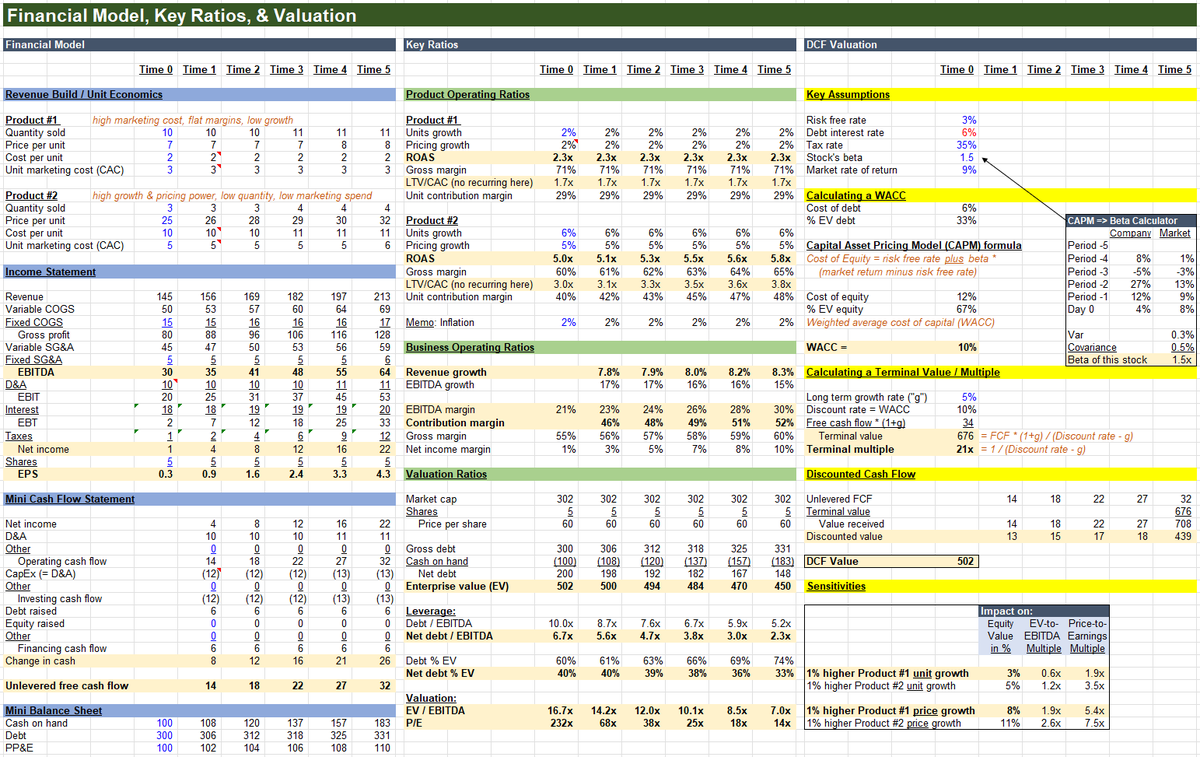
An entire MBA fits on one page.
But you better know the math cold.
Like & comment if you want the excel.
6 topics:
*1) Unit economics*
This builds from product-level unit economics to company financials.
Quantity per unit, growth in units.
Price per unit, growth in pricing.
Cost per unit, marketing spend per unit.
Get you return on ad spend (ROAS), customer acquisition cost (CAC), LTV/CAC, gross margins, unit contribution margins, and more.
This model sets up two diverging products:
A higher gross margin (GM), higher marking cost, low pricing power, low growth product.
Against a lower GM, better pricing power, better growing, lower unit market cost product.
To show how the dynamics of the two play out over time.
*2) Accounting*
Unit drivers flow into revenue, variable COGS, and variable SG&A.
Then to EBITDA, EBIT, EBT, Net income & EPS.
Simple cash flow statements & balance sheets reconcile D&A to inflation-adjusted replacement CapEx, debt levels, & GAAP PP&E.
You have to be fluent in accounting to look at public companies.
Not because accounting itself matters.
But because accounting can obscure what matters.
And your task it to translate GAAP into meaningful business logic.
*3) Operating ratios*
Unit drivers output financials, financials output overall business ratios.
Revenue growth, EBITDA growth, EBITDA margins.
Contribution margins (= change in profit over change in revenue).
Net debt-to-EBITDA, net debt % of EV.
*4) Valuation*
You can drive valuation on multiples or a DCF.
Which are equivalent:
The discount rate minus the growth rate determines the 'terminal multiple.'
Using a P/E instead of a DCF simply uses next year as the terminal value.
This model drives value from the DCF, and maps that to the multiples to show how they connect.
*5) Corporate finance & DCFs*
DCF math attached using the CAPM.
The summary is a beta from historical returns, add the cost of debt.
To get the WACC - the theoretically correct discount rate.
DCFs are extremely assumption laden - you can get out almost whatever you want.
But realistically.
Your banker (or analyst) will make the math work out to a 7-13% discount rate.
Depending on the risks, industry, markets - and what they want to achieve.
*6) Sensitivities & the hard part*
The last section sensitizes the equity value and multiples to unit and price growth.
Bringing unit drivers full circle to valuation outcomes.
Ultimately, the hard part isn't the math.
You have to be fluent in the math, its nuances and its limitations.
If not, you will lose out to those who are.
But once you are, you also have to shift focus.
To the hard part.
Which is always in filling in the numbers.
If you're investing, that means thoughtful views on unit drivers; on how, when, and why they shift.
And if you're building, it means making the numbers on the page happen.
That's all for now.
Like & comment if you want the excel.

English

@premiumbusiness @TwitterSupport It took 38 days but the blue check has arrived! 🥳
English

@elonmusk Approaching 10 days since I signed up for Blue. Still haven’t heard back.
English

@KXAN_News Oh wow, so sorry to hear this. Wasn't the building or location formerly A Stevie Ray Vaughan era music venue?
English

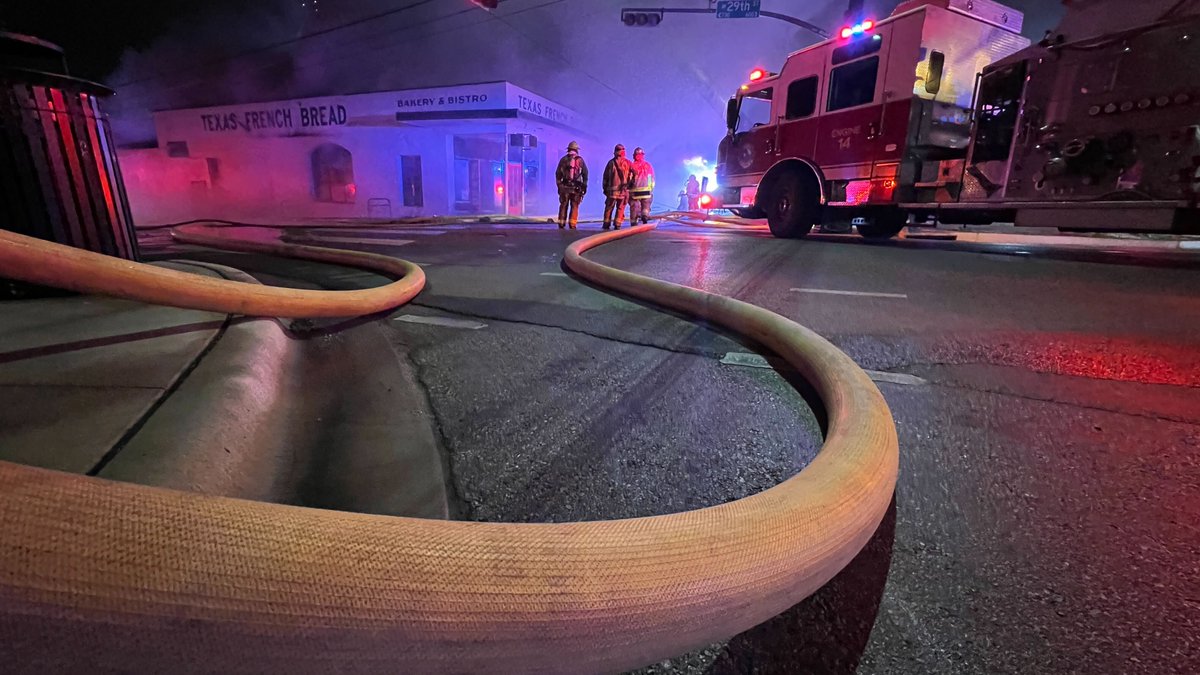
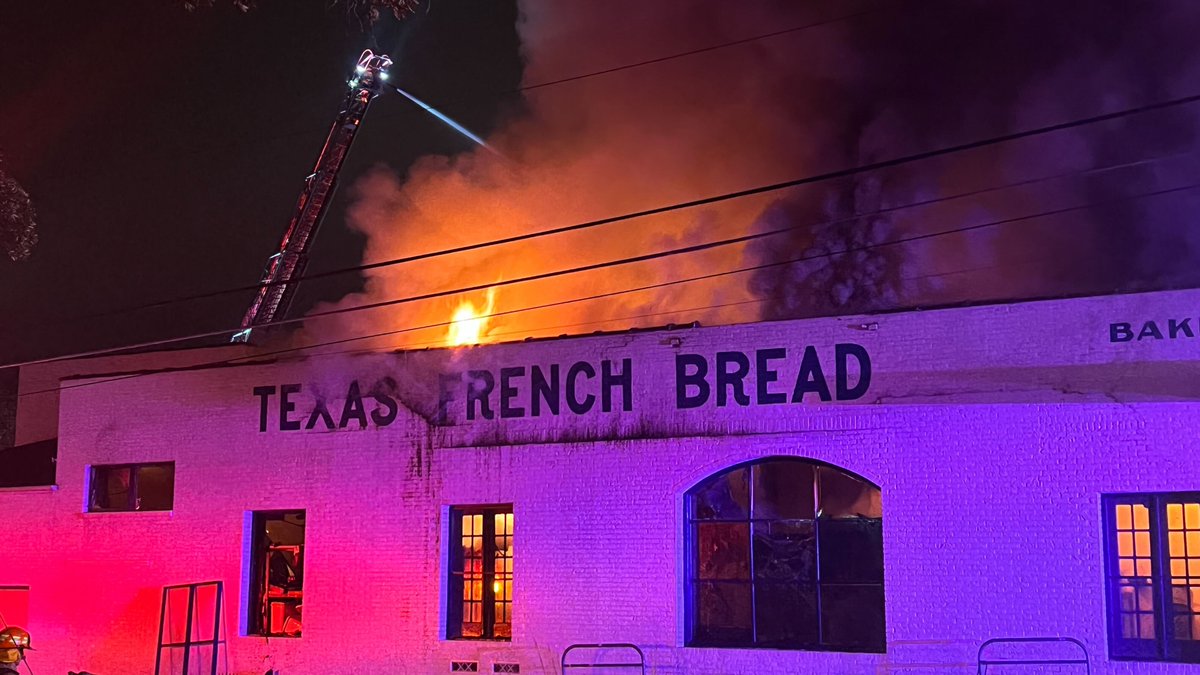
The Texas French Bread Bakery caught fire overnight and AFD said all the workers who were inside were able to get out unharmed. trib.al/PNXnbb1


English
Carter Duncan retweetledi

Look out Windy City. The UA Marching Band is headed your way.
Chicago Thanksgiving Parade@ChiParade
The Marching Cardinals of Union Academy are joining us for the 2019 Chicago Thanksgiving Day Parade all the way from Monroe, North Carolina! #ChiParade
English

@mateodelnorte I'm tempted to agree. However, I encountered a point against the supposed intuitiveness of "short-termism" (goo.gl/WYLLgK) in today's episode of Econtalk. See the paragraph of the transcription beginning "That's okay."
English

"Being public also subjects us to the quarterly earnings cycle that puts enormous pressure on Tesla to make decisions that may be right for a given quarter, but not necessarily right for the long-term."
Now apply that to every publicly traded co in the US
tesla.com/blog/taking-te…
English
Carter Duncan retweetledi