Donald E Davis

2K posts

Donald E Davis

Donald E Davis

@DDAVISSPACEART

I am a space artist, portraying the wonders out there being revealed by space exploration. I now create fulldome animations for Planetariums.

Katılım Mart 2018
212 Takip Edilen4.5K Takipçiler
Donald E Davis
Donald E Davis@DDAVISSPACEART·
@space_stations @peterrhague There have been designs for rovers for Venus, starting with a sail powered wheeled platform to big mobile machines either refrigerated inside or made to function in that temperature etc. I get that it's hard, but that kind of envelope pushing seems like an engineering challenge.
English
0
0
0
36
Artificial Gravity Space Stations
Artificial Gravity Space Stations@space_stations·
@DDAVISSPACEART @peterrhague Venus will be tough without a massive terraforming effort as it's lie throwing a robot into a 800 degree vat of acid. I'm all for dropping balloons into the astmosphere than can strip carbon from oxygen and drop cubes of graphite to the surface as it goes.
English
1
0
0
20
Peter Hague
Peter Hague@peterrhague·
This is from a book published in 1971, it’s sort of an annual summary of world news. Already we have the myth forming that robotic missions are better for science is forming, likely as a result of the author taking Soviet statements at face value. He would have no way of knowing that the USSR was at that time trying and failing to get a human lunar program to work, and touting the supremacy of robots was mere propaganda. Let’s evaluate this in retrospect - who seriously thinks the Soviet Luna program returned more science than Apollo, even per $? The only time humans and robots went head to head in planetary exploration - humans clearly won. At the end of the article we see the environmental argument against space already forming; that going out there only reminds us of our duties here. It’s interesting to see that the arguments have essentially been frozen in time, and were rooted in the activism of the 60s.
Peter Hague tweet mediaPeter Hague tweet media
English
8
7
54
2.6K
Donald E Davis
Donald E Davis@DDAVISSPACEART·
@peterrhague Some places, like Venus and Titan, are probably always the realm of robotic exploration. Advanced VR interface rovers are the way to go for these places, as well as for wider exploration of various worlds with panoramic and stereo cameras. Save the people for the priority sites.
English
2
0
1
124
Donald E Davis
Donald E Davis@DDAVISSPACEART·
@peterrhague For getting a first look at some distant place, albeit with narrow pre defined 'windows', probes extend our awareness and reveal places that were just dots. If one is willing to spend a lot more, people return far greater volume and variety of info in places they can visit.
English
1
0
1
171
Donald E Davis
Donald E Davis@DDAVISSPACEART·
@BrunetPau The portrayal of the impact was awful. They should have consulted the appropriate experts in the field and listened to them.
English
0
0
1
446
Pau Brunet
Pau Brunet@BrunetPau·
Cumple 28 años la película de desastres más deprimente de la historia: “Deep Impact”, de Mimi Leder.
Español
43
42
557
57.6K
Donald E Davis
Donald E Davis@DDAVISSPACEART·
@space_stations @peterrhague I would rather build advanced rovers that could be controlled in real time from orbit. They could have stereo cameras, tools etc to examine suitable places, if any. Getting a sample back from down there is highly problematical, but we could learn much from labs landed there.
English
0
0
0
69
Donald E Davis
Donald E Davis@DDAVISSPACEART·
@peterrhague If Venus had a past era with oceans, contemplating the possibility of past life there is tempting.
English
1
0
1
99
Peter Hague
Peter Hague@peterrhague·
@DDAVISSPACEART I’m still learning about the planet; as I understand it the surface has been so thoroughly rearranged by volcanos as to make it unlikely to have left fossils. But we still know so little about the surface. Need to send more robots!
English
1
0
4
354
Peter Hague
Peter Hague@peterrhague·
Venus is kind of like an alternate history version of Earth where the Permian-Triassic event was even worse. The fact that this happened on literally the next planet over makes me think it’s a decent candidate for the great filter (a subset of the Rare Earth hypothesis)
English
22
16
273
12.8K
Donald E Davis
Donald E Davis@DDAVISSPACEART·
@peterrhague It would be intriguing to look for very old fossils in suitable locations with advanced rovers. Higher quality radar maps of Venus will be forthcoming which will help unravel its geologic past.
English
1
0
5
556
Donald E Davis
Donald E Davis@DDAVISSPACEART·
@markgadala Interpolating frames can be a help. Adding color is a problem, it removes the footage from being a historical record and turns it into something diverging from the real information, unless there is detailed reference for what color things like clothes, advertising signs etc were.
English
0
0
2
318
Mark Gadala-Maria
Mark Gadala-Maria@markgadala·
This is incredible. People are using AI to restore old World War 2 footage. This is people fleeing Berlin in 1945. Credit: World War Footage on YT
English
72
345
3.9K
554.9K
Donald E Davis
Donald E Davis@DDAVISSPACEART·
@skdh @DrBeaVillarroel @Rizstanford The questions that some to mind include are the spots on the original negatives. Do they appear in all the sets of copies. How long were the original exposures, as the longer they were with none of them being streaks the more likely I think it is they are photographic artifacts.
English
0
0
1
78
Sabine Hossenfelder
Sabine Hossenfelder@skdh·
Astrophysicists have found evidence of UAPs in old photographic plates. Something seems to have been orbiting around our planet before we had satellites! This finding has been independently confirmed. Still, scientists are afraid to speak out. @DrBeaVillarroel @Rizstanford
English
332
919
6K
469.8K
Donald E Davis
Donald E Davis@DDAVISSPACEART·
@tony873004 Is this an accurate display of the Lunar libration? It looks like the bright crater Giordano Bruno is just visible. I have wondered if it's bright rim could be a limb feature at the best possible libration/lighting from part of Earth showing a bit more of the Lunar Eastern limb.
English
1
0
1
136
Tony Dunn
Tony Dunn@tony873004·
The Moon. Simulation.
English
2
12
50
2.3K
Donald E Davis
Donald E Davis@DDAVISSPACEART·
@zihanshen115982 Ideally any specular reflection from the artwork surface will dissappear when the art is photographed with Polaroid filters over the lights and over the lens. If you paint black it will photograph nice and black.
English
1
0
4
252
Baols
Baols@zihanshen115982·
Watercolor portrait: Muttaburrasaurus The reflection of pigments is difficult to solve through photography
Baols tweet media
English
5
106
713
8.2K
Donald E Davis
Donald E Davis@DDAVISSPACEART·
@deltaIV9250 It was too late by then. If the Soviets had done it around Apollo 11, that may well gave stimulated other space related budget choices, especially if they went ahead and built up a Moon base. By 1972 the Apollo hardware assembly lines were still going but the end was in sight.
English
0
1
3
560
Delta9250
Delta9250@deltaIV9250·
Legit curious what would’ve happened if the Soviets landed men in the moon by like 1972 or so
English
61
5
1.3K
39.8K
Donald E Davis
Donald E Davis@DDAVISSPACEART·
@erikkuna @SuperclusterHQ @KelbyOne @NASAArtemis @bhphoto I agree, once you have a top tier camera their performance will be comparable. The low light capability, capable lenses and high resolution sensors give an able photographer the tools needed to convey what they are seeing. The Astronauts did a fantastic job in their photography.
English
0
1
1
441
Erik Kuna 🚀
Erik Kuna 🚀@erikkuna·
These photos are a good reminder that Photographers argue about gear way more than history does. Some people will cheer because they were shot on Nikon. Some will say they would’ve looked better on Sony. Some will say the astronauts should’ve taken a Hasselblad and it would have been perfect. But that misses the point completely. These images, Earth, the Moon, Earth setting behind the lunar horizon, a close-up of a crater, were made on a journey around the Moon with 10-year-old Nikon DSLRs. And they’re stunning. And would have been stunning with a Lecia too, or a Canon, with similar focal lengths and sensor. Because great photographs are rarely about having the newest camera. They’re about having the right tool, knowing how to use it, and being ready when the moment happens. The brand didn’t make these images. The age of the camera didn’t make these images. The astronauts did. Their eye, their preparation, their connection to what they were seeing, and their ability to use the gear they had in one of the most extraordinary places humans have ever gone. Shoot, just hearing that they had proper shrouds over the windows and dimmed the lighting in the cabin to cut reflections, my photographer soul rejoiced! They thought through how to best capture the moments! Yes, being in the right place at the right time matters. In a moment like this, it may matter more than anything. But when that moment comes, what matters next is knowing your gear well enough to make the picture and being setup with the right gear to make it happen. Not chasing the newest model. Not arguing over logos. Not pretending the camera is the artist. Vision matters. Passion matters. Timing matters. But when that moment comes, what matters next is knowing your gear well enough to make the picture and being set up with the right gear to make it happen. moment happens. (now let the silly camera model debates start...) Photo Credit: NASA
Erik Kuna 🚀 tweet mediaErik Kuna 🚀 tweet mediaErik Kuna 🚀 tweet mediaErik Kuna 🚀 tweet media
English
60
468
4.9K
212.2K
Donald E Davis
Donald E Davis@DDAVISSPACEART·
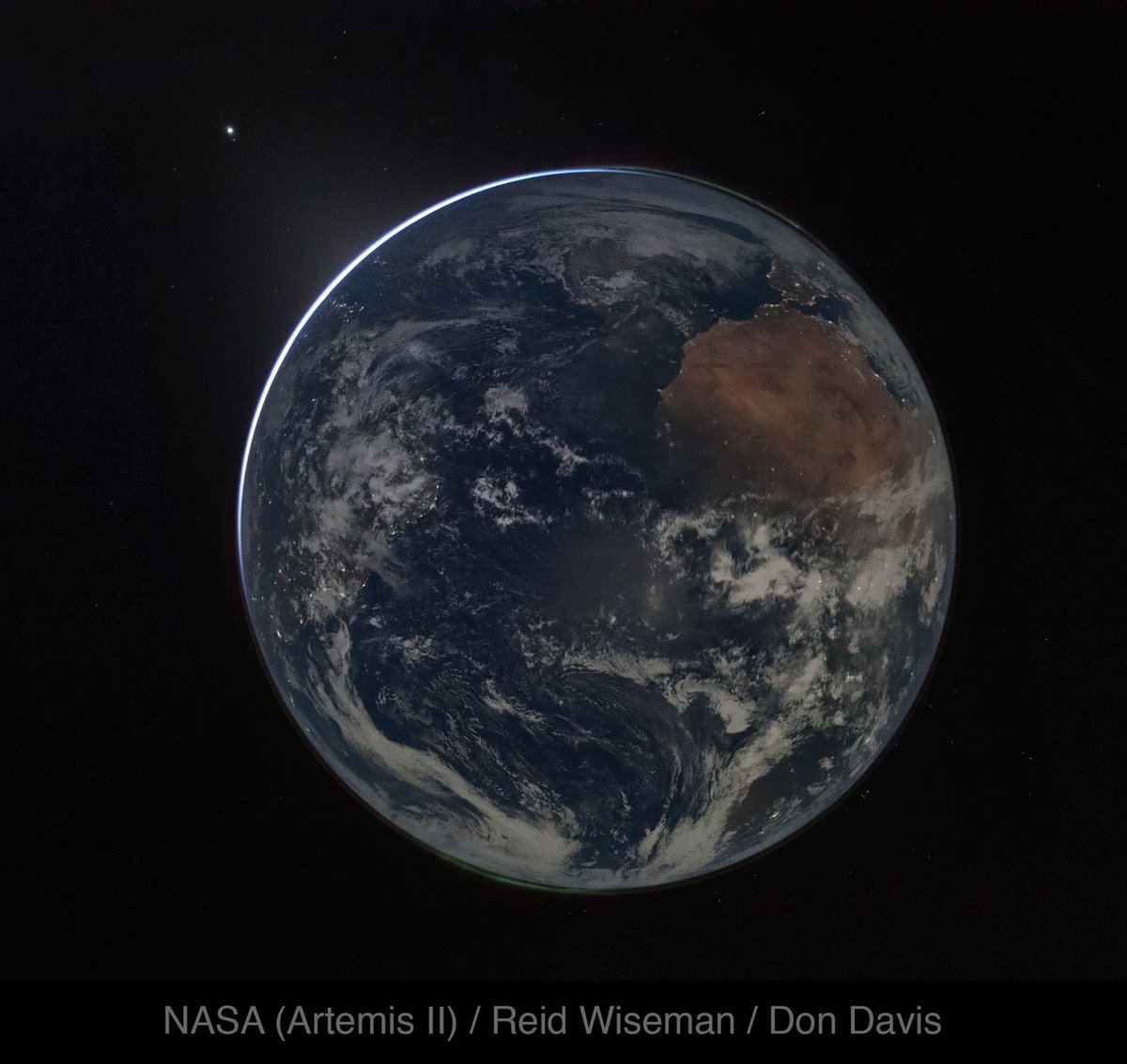
The recent photo of the Moonlit whole Earth is among the greatest photos from space ever obtained. Here two exposures, one darker and one showing dim light details, were composited with interior reflections removed. This attempts to reconstruct a dark adapted visual impression.
Donald E Davis tweet media
English
4
49
402
14.4K
Everyday Astronaut
Everyday Astronaut@Erdayastronaut·
This photo of Earth is EXTRA spectacular for a good reason... let me explain. Most images you see of Earth from space are the daylight side of the Earth, and it's obviously very bright (see my last image), this means stars are too dim to be seen with that bright exposure setting (low ISO, high shutter and / or stopped down aperture). BUT this image taken by the Orion crew looks so incredible because you can see the sun is BEHIND the earth, meaning it's night time on the side of the earth facing the crew in this image. So how do you expose a night time earth from space? Same way you do on Earth! A mixture of opening up the aperture (F4 in this case), cranking the ISO (51,200 here), and using a relatively long exposure (1/4 of a second). We can see the settings used by looking at the exif data from the camera. What this means is our camera is also sensitive enough to see stars in the background of Earth, leading to an extraordinary image!!! GREAT WORK!!! These are the kind of images I've been so excited to see!
Everyday Astronaut tweet mediaEveryday Astronaut tweet mediaEveryday Astronaut tweet media
NASA@NASA

We see our home planet as a whole, lit up in spectacular blues and browns. A green aurora even lights up the atmosphere. That's us, together, watching as our astronauts make their journey to the Moon.

English
214
2K
14.6K
1.1M
Donald E Davis
Donald E Davis@DDAVISSPACEART·
@GaryNicholls52 @Erdayastronaut There were numerous photos made during the Apollo missions showing stars, albeit as streaks, and the dark Lunar horizon. They were made in Lunar orbit to capture the zodiacal light emerging from behind the Moon.
English
0
0
1
28
Cosmology Fact Check
Cosmology Fact Check@GaryNicholls52·
@Erdayastronaut Will the camera be able to detect stars from cislunar space I wonder? None of the films that were available during the Apollo missions could with even 5 minutes of exposure. Without Earths atmosphere we would not even see the stars by eye from the surface.
English
1
0
1
577
Donald E Davis
Donald E Davis@DDAVISSPACEART·
@JPMajor I saw essentially that view through binoculars, from a cruise ship.
English
0
0
0
140
Jason Major
Jason Major@JPMajor·
The last time humans launched to the Moon looked like this. It was on December 7, 1972 when the Apollo 17 Saturn V lifted off from LC 39A at Kennedy Space Center at 12:33 a.m. More than 53 years later and we're finally going back again.
English
6
136
833
37.6K
Donald E Davis
Donald E Davis@DDAVISSPACEART·
@tony873004 Great preview. I hope they photograph the sunrise on the way out.
English
0
0
3
337
Tony Dunn
Tony Dunn@tony873004·
A view of Earth from Artemis II. If you can see your region, then you might be able to spot Artemis II with a telescope or binoculars.
English
18
88
810
63.1K