⛩️ DailyJapaneseChallenge

3.7K posts

⛩️ DailyJapaneseChallenge banner
⛩️ DailyJapaneseChallenge

⛩️ DailyJapaneseChallenge

@DJC_Japanese

👉 FOLLOW 🔴 for a daily sentence 💪 join the challenge to fluency! 🇯🇵 ⛩️ main channel is on insta (+downloads) 👇

Katılım Kasım 2022
65 Takip Edilen196 Takipçiler
Sabitlenmiş Tweet
⛩️ DailyJapaneseChallenge
⛩️ DailyJapaneseChallenge@DJC_Japanese·
#DailyJapaneseChallenge 🔴 これから日本語でどんどん上手になるはずだぞ! 👆 にほんご・じょうず You are sure to steadily become more skilled in Japanese from now on! [988] This is the new format on Instagram. I hope I'm gonna be able to continue it. #langtwt
⛩️ DailyJapaneseChallenge tweet media⛩️ DailyJapaneseChallenge tweet media⛩️ DailyJapaneseChallenge tweet media
日本語
0
0
0
219
⛩️ DailyJapaneseChallenge
⛩️ DailyJapaneseChallenge@DJC_Japanese·
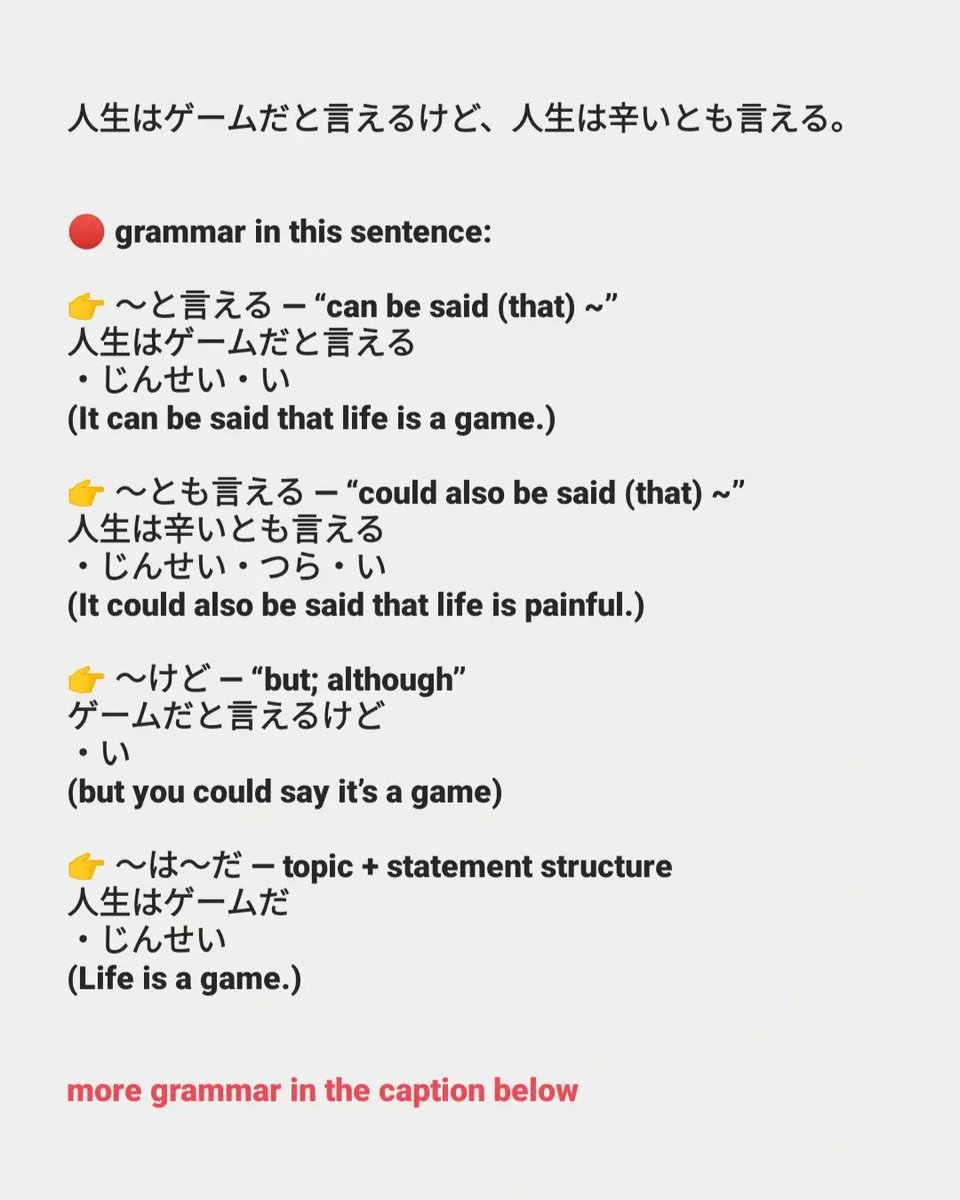
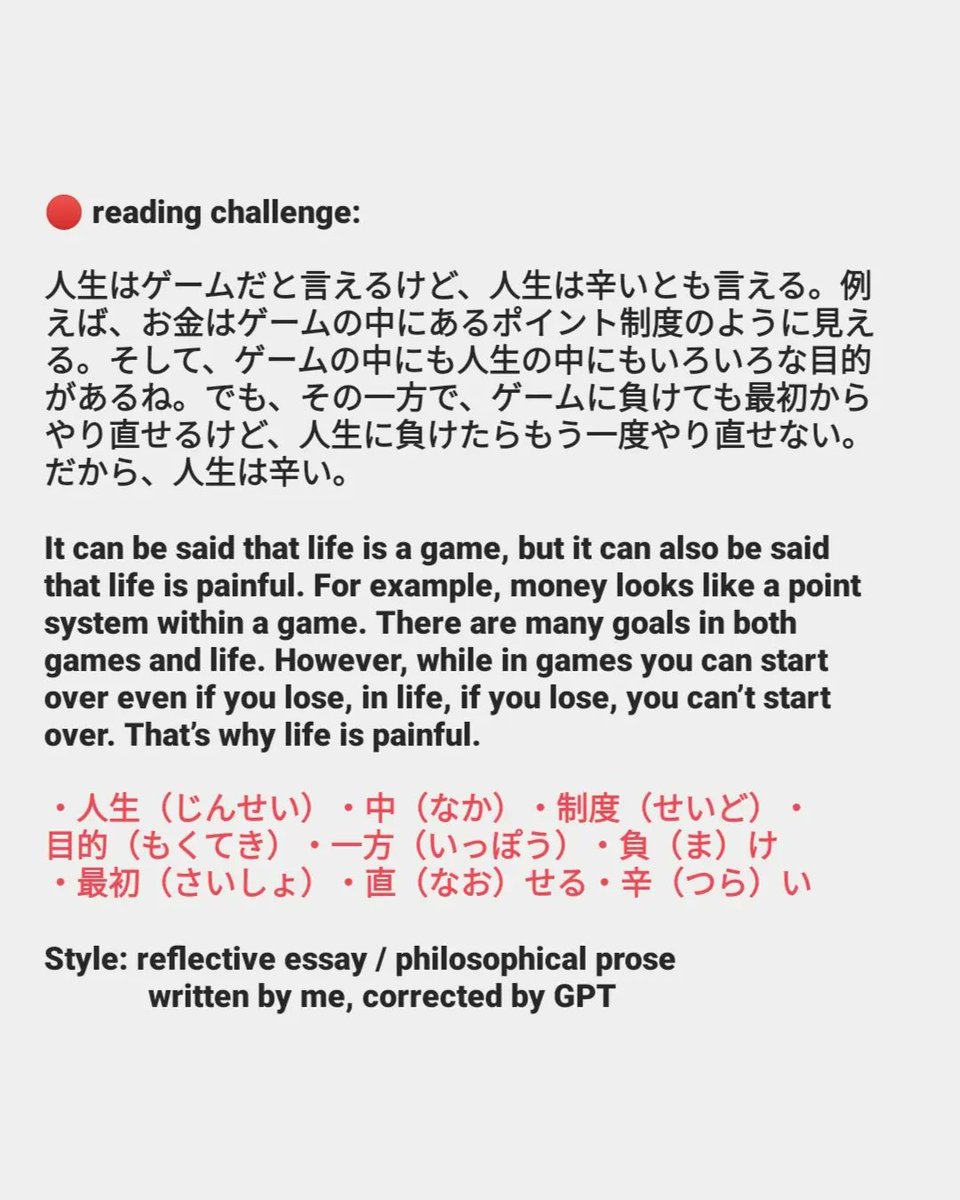
#DailyJapaneseChallenge 🔴 人生はゲームだと言えるけど、人生は辛いとも言える。 👆 じんせい・い・つら You could say that life is a game, but you could also say that life is painful. [1026-1030] (I have to catch up to 1299, so I started writing the reading challenge.) #langtwt
⛩️ DailyJapaneseChallenge tweet media⛩️ DailyJapaneseChallenge tweet media⛩️ DailyJapaneseChallenge tweet media
日本語
0
0
1
77
⛩️ DailyJapaneseChallenge
⛩️ DailyJapaneseChallenge@DJC_Japanese·
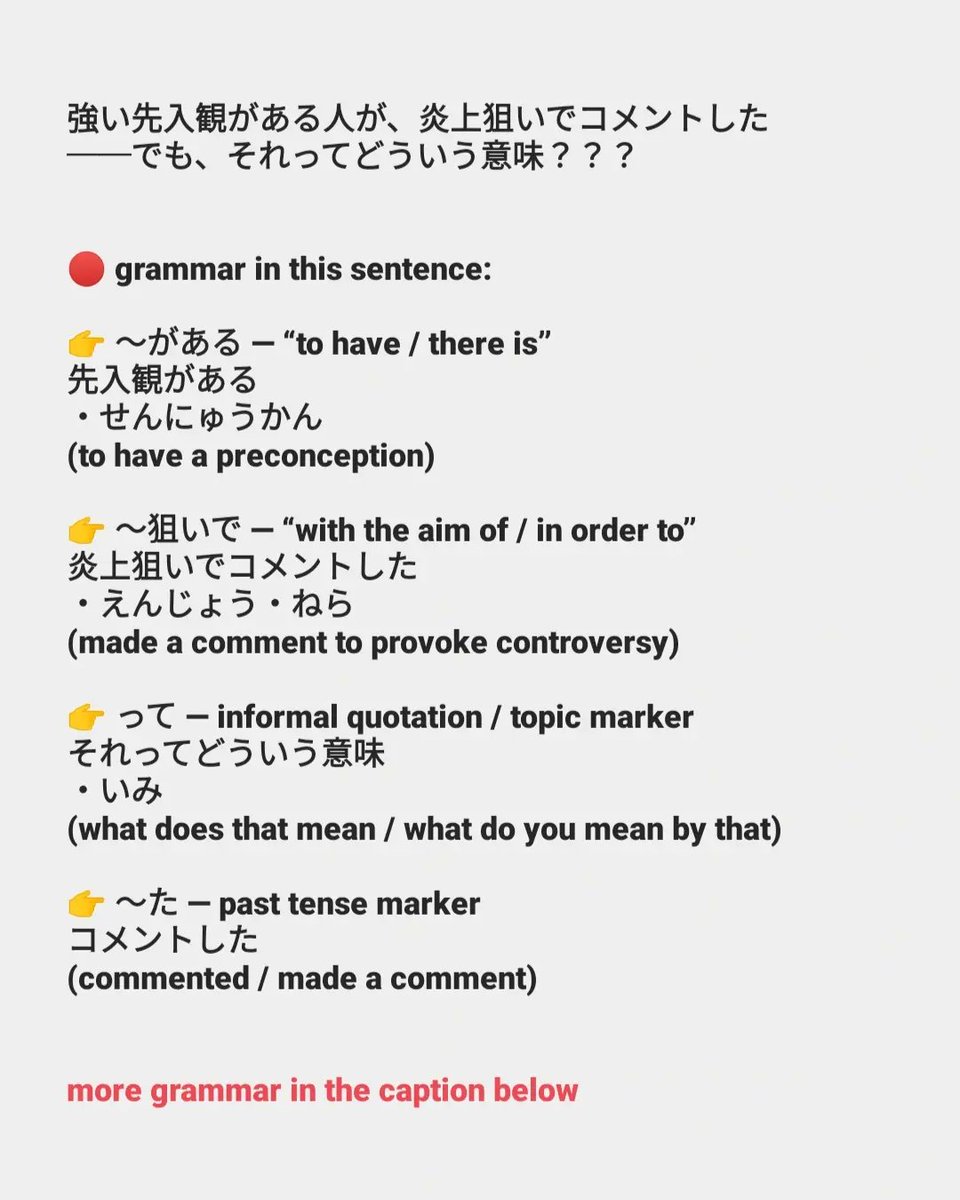
#DailyJapaneseChallenge 🔴 強い先入観がある人が、炎上狙いでコメントした──でも、それってどういう意味??? 👆 つよい・せんにゅうかん・ひと・えんじょう・ねら・いみ A person with strong preconceptions made a comment just to cause an uproar—but what does that even mean??? [1016]
⛩️ DailyJapaneseChallenge tweet media⛩️ DailyJapaneseChallenge tweet media⛩️ DailyJapaneseChallenge tweet media
日本語
0
0
0
82
⛩️ DailyJapaneseChallenge
⛩️ DailyJapaneseChallenge@DJC_Japanese·
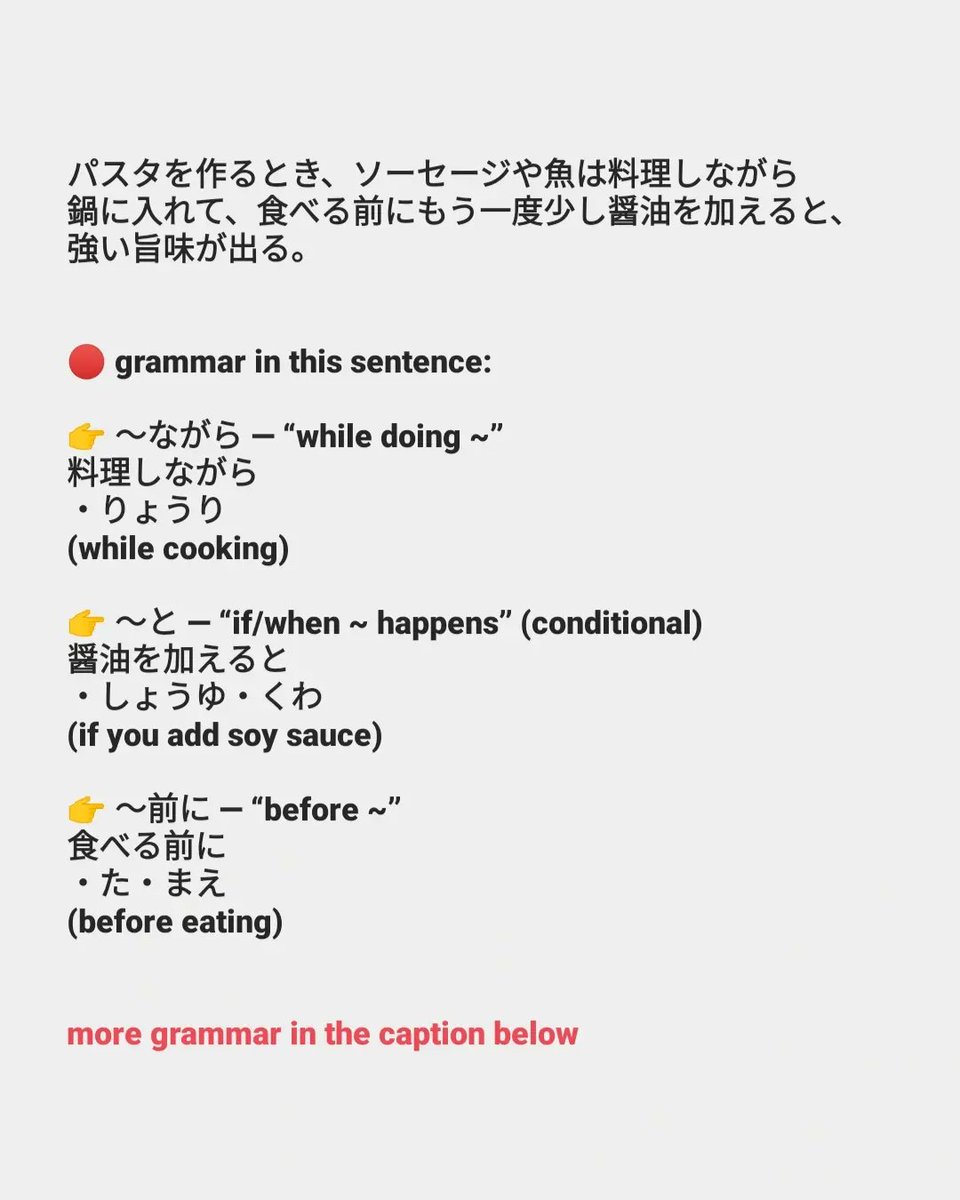
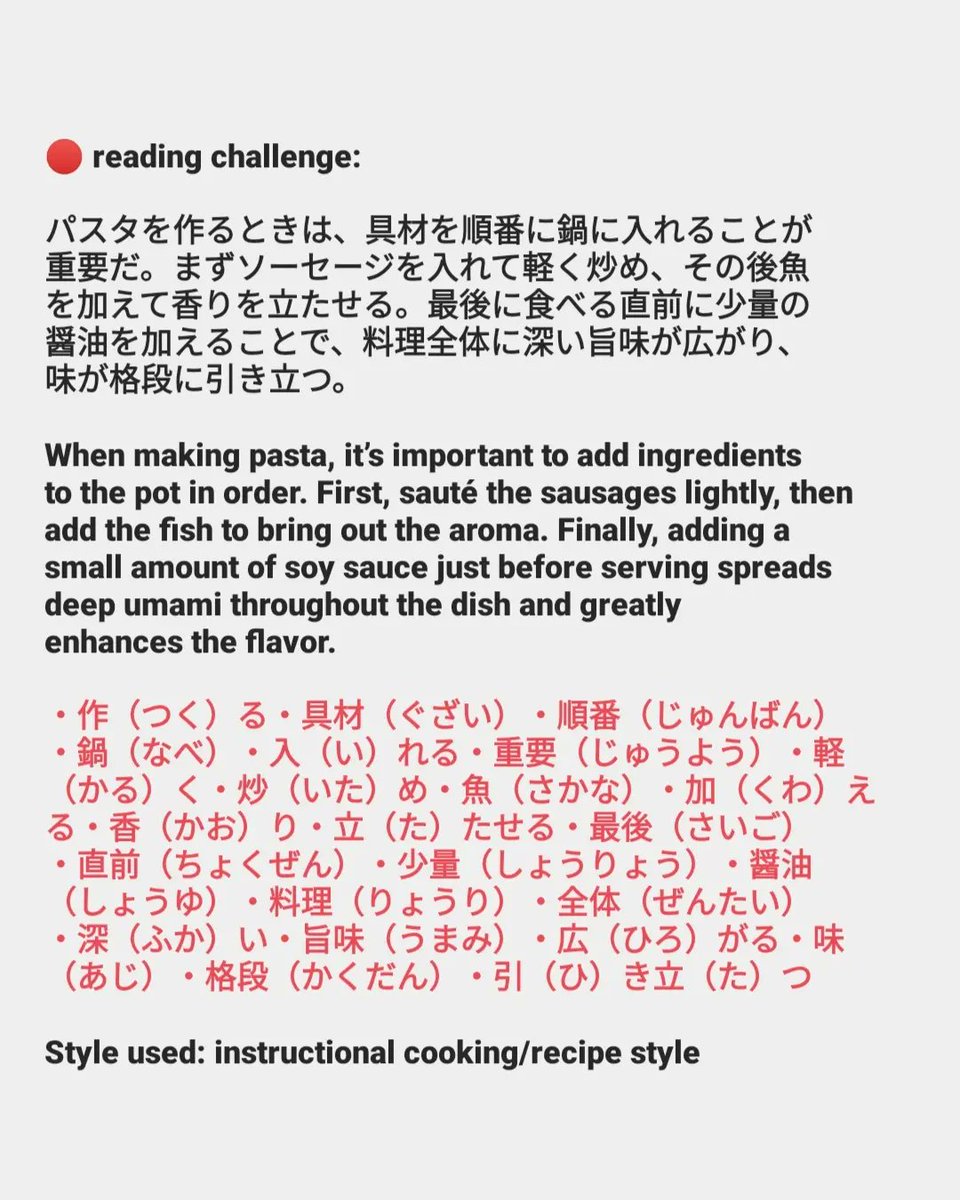
translation: 👇 When making pasta, add sausages and fish to the pot while cooking, and if you add a little more soy sauce just before eating, it brings out a strong umami flavor.
English
0
0
0
26
⛩️ DailyJapaneseChallenge
⛩️ DailyJapaneseChallenge@DJC_Japanese·
correct readings: 👇 パスタ(ぱすた)を作(つく)るとき、ソーセージや魚(さかな)は料理(りょうり)しながら鍋(なべ)に入(い)れて、食(た)べる前(まえ)にもう一度(いちど)少(すこ)し醤油(しょうゆ)を加(くわ)えると、強(つよ)い旨味(うまみ)が出(で)る。
日本語
1
0
0
116
⛩️ DailyJapaneseChallenge
⛩️ DailyJapaneseChallenge@DJC_Japanese·
#DailyJapaneseChallenge 🔴 パスタを作るとき、ソーセージや魚は料理しながら鍋に入れて、食べる前にもう一度少し醤油を加えると、強い旨味が出る。 👆 べんきょう・ひと・あくま・まほう・かいぶつ・しゅんかん・たす・さけ [1018] #langtwt
⛩️ DailyJapaneseChallenge tweet media⛩️ DailyJapaneseChallenge tweet media⛩️ DailyJapaneseChallenge tweet media
日本語
1
0
0
111
⛩️ DailyJapaneseChallenge
⛩️ DailyJapaneseChallenge@DJC_Japanese·
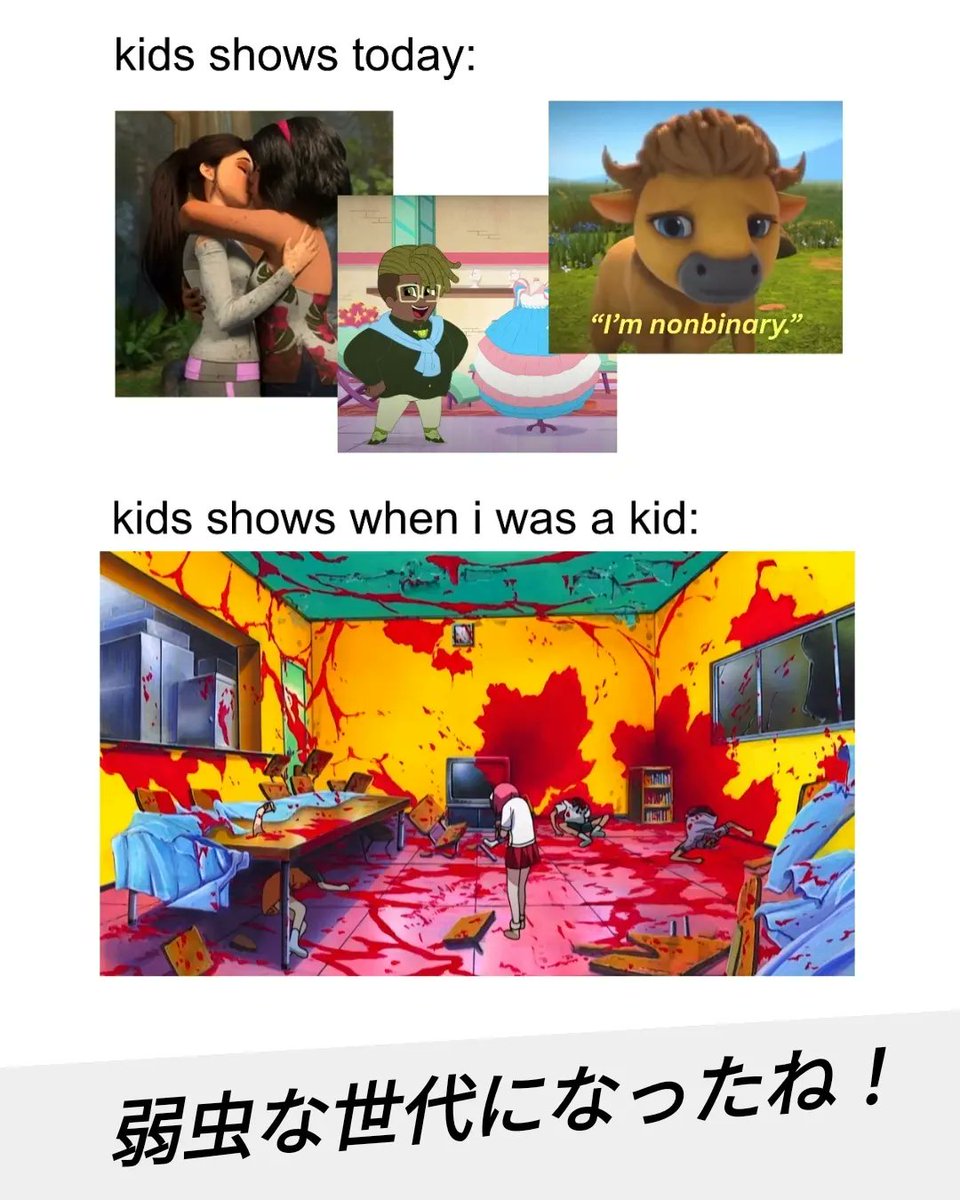
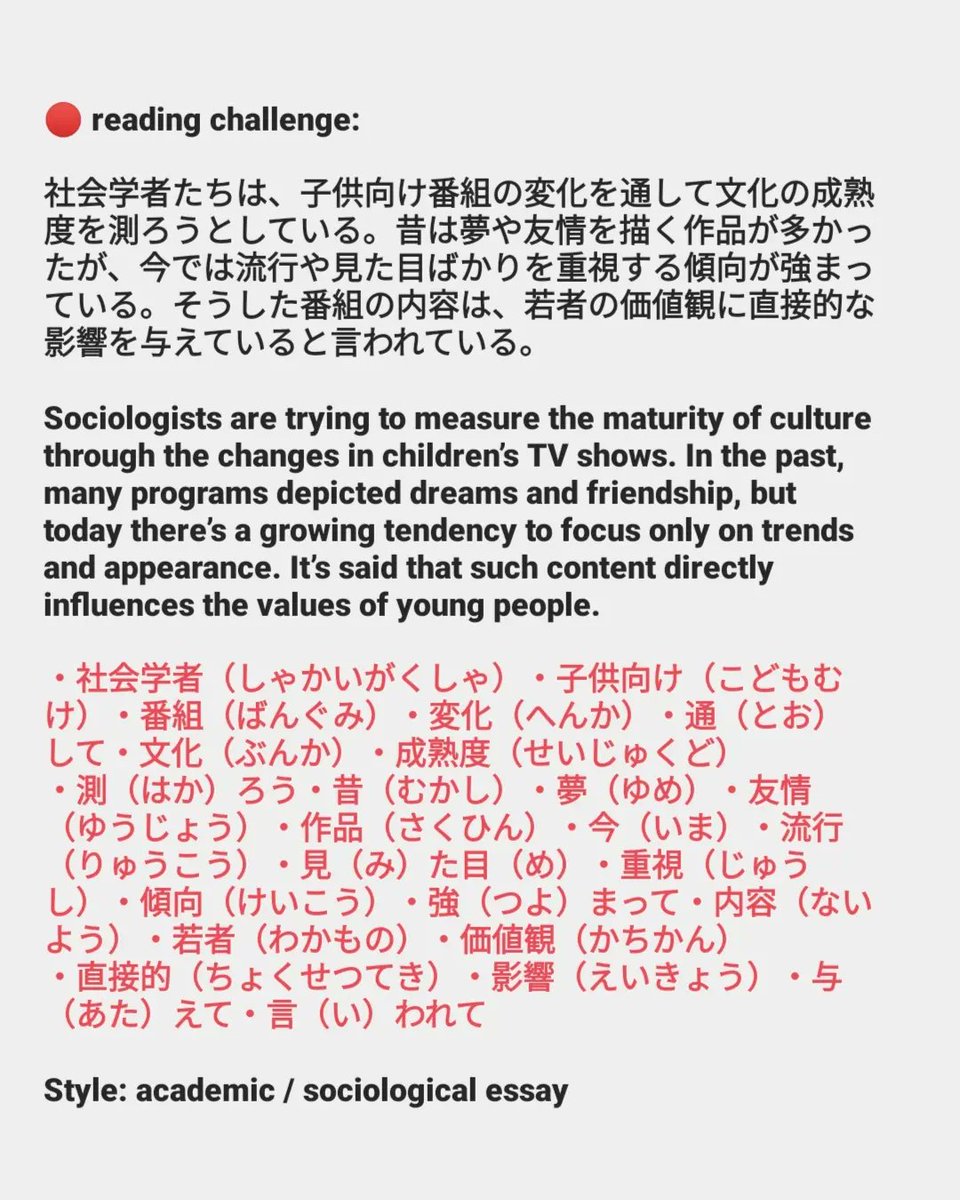
🔴 最近の子供番組はあまり大人っぽくも哲学的でもないから、Z世代は頭が浅くて弱虫な世代になったのかもしれない。 👆 さいきん・こども・ばんぐみ・おとな・てつがくてき・せだい・あたま・あさ・よわむし・せだい ... Gen Z might have become a shallow and weak generation.
⛩️ DailyJapaneseChallenge tweet media⛩️ DailyJapaneseChallenge tweet media⛩️ DailyJapaneseChallenge tweet media
日本語
0
0
3
196
⛩️ DailyJapaneseChallenge
⛩️ DailyJapaneseChallenge@DJC_Japanese·
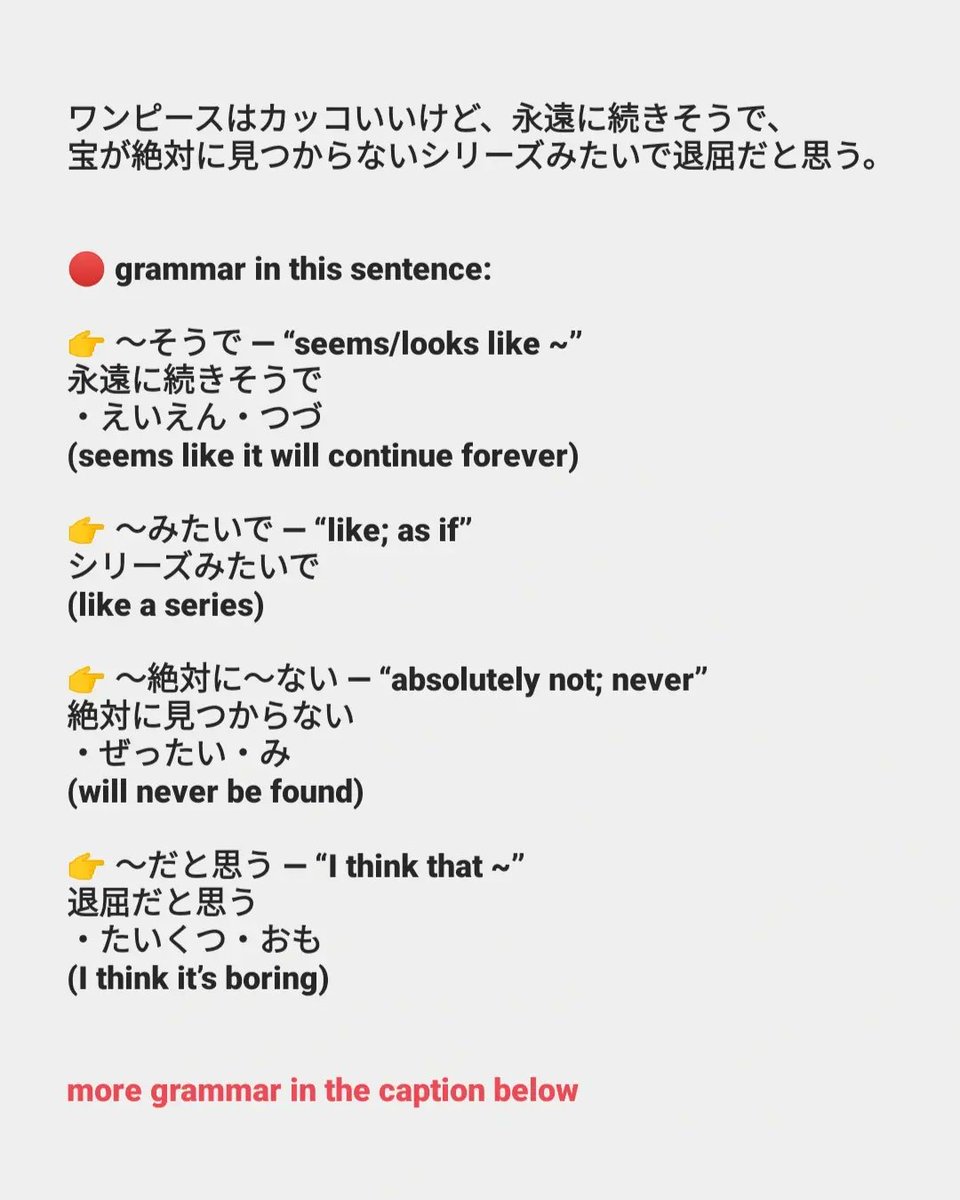
#DailyJapaneseChallenge 🔴 ワンピースはカッコいいけど、永遠に続きそうで、宝が絶対に見つからないシリーズみたいで退屈だと思う。 👆 えいえん・つづ・たから・ぜったい・み・たいくつ・おも (translation on the image) [1012] #langtwt
⛩️ DailyJapaneseChallenge tweet media⛩️ DailyJapaneseChallenge tweet media⛩️ DailyJapaneseChallenge tweet media
日本語
0
0
0
55
⛩️ DailyJapaneseChallenge
⛩️ DailyJapaneseChallenge@DJC_Japanese·
@ThatYuta I don't understand why testing it would be difficult though. Just have different classes that only use this or that method and at the end of the year give them the same test. For example teaching grammar only by theoretical explanations VS teaching it via input, but same grammar
English
0
0
0
8
⛩️ DailyJapaneseChallenge
⛩️ DailyJapaneseChallenge@DJC_Japanese·
@ThatYuta Alright. So it's not about unconscious learning, like in the style of subliminal messages, but it actually is based on some effort that you consciously have to choose to do. It's just fuzzy, because it's based more on experience than memorizing something.
English
1
0
0
11
Yuta Aoki
Yuta Aoki@ThatYuta·
People who discuss Stephen Krashen's Comprehensible Input often demonstrate flimsy logic and questionable interpretations of studies. I believe this applies to both camps. One case that stands out is the famous French-Canadian immersion program study. Some people cite it as evidence against Comprehensible Input, but that doesn’t make much sense. The study, conducted in Ottawa public schools in 1973–74 by Barik & Swain (1974), examined the effect of the French immersion program in Canada. It compared two groups of native English-speaking kids: Group 1: kids who had approximately one hour a day of French class Group 2: immersion kids who received all of their classes in French (except for English classes). (The study actually involved multiple cohorts and schools, but let’s simplify the results.) The kids took several kinds of French and English tests. On the French comprehension test, immersion kids did significantly better than non-immersion kids (which was expected because they had much more input). On the French achievement test (Test de Rendement en Français), the researchers compared immersion kids to native French-speaking Canadian kids. Grade 3 immersion pupils scored lower than native-French speaking kids, which is about the 23rd to 39th percentile range compared to native speakers. That’s below natives, but still fairly impressive considering the immersion kids were not native speakers and had only been exposed to French in school for a few years. The question is: does this count as compelling counter-evidence against Krashen’s Input Hypothesis (Krashen, 1982), which argues that we acquire language by getting Comprehensible Input? Not really. If anything, it shows the power of CI: despite receiving far less input than native French speakers (who started getting input since birth inside and outside school), immersion kids performed reasonably well. So people who bring this up as evidence against the Input Hypothesis seem to be arguing against an imaginary position—that L2 learners should be able to achieve native-like proficiency with significantly less input than natives. But I don’t know anybody who actually holds that position. Some also use this study to argue that Comprehensible Input is not enough for developing production skills, since Merrill Swain later developed her Output Hypothesis (Swain, 1985). But this specific study cannot be used to support that claim. T The output ability tested was very limited—mainly a few written responses. Again, people using this argument are effectively arguing against another imaginary position: that L2 speakers need significantly less input to develop native-like fluency. This doesn’t mean the construct of Comprehensible Input or Krashen’s hypotheses are without problems. They’ve been criticised for being hard to operationalise for rigorous experiments and for being difficult to falsify. Personally, I don’t usually use “Comprehensible Input” unless I’m specifically discussing Krashen. I prefer using better-defined and less emotionally charged terms. So here, I’m not making a case for or against some people's Krashen-inspired approaches. My point is that many people discussing it seem to rely on weak logic and severe misinterpretations of studies. A better question to ask, in my opinion, is: Does output practice have benefits? And if so, what kind of benefits? For this, Swain herself conducted many experiments that directly address these questions. So if you are interested in the role of output in language acquisition, there are better studies to read because they actually investigate those points directly. --- Barik, H. C., & Swain, M. (1974). Bilingual Education Project: Evaluation of the 1973–74 French Immersion Program in Grades 1–3 in the Federal Capital’s Public Schools. Toronto: Ontario Institute for Studies in Education.
English
5
0
11
1.2K
Yohei from Japan🇯🇵
Yohei from Japan🇯🇵@learning_yohei·
We don’t have this kind of phrase in Japanese, so I don’t know how to respond🥹
Yohei from Japan🇯🇵 tweet media
English
241
24
539
21.3K
⛩️ DailyJapaneseChallenge
⛩️ DailyJapaneseChallenge@DJC_Japanese·
@ThatYuta Maybe you first need to give examples what unconscious learning is even supposed to look like and why it's considered "unconscious". And yes, I will always question such definitions by linguists, because linguists are weird. (Some other scientists as well.)
English
1
0
0
50
Yuta Aoki
Yuta Aoki@ThatYuta·
1. > I'm not sure about 1. If you didn't learn vocabulary, you couldn't get grammatical input, because you can't even understand it. So without conscious learning there is no unconscious learning. You made an assumption that you can only learn grammar consciously. Do you think that’s the case? 2. > Even with grammar I would think so. Here, you seem to think that consciously learning grammar is “necessary”. How did you reach that conclusion? Earlier, I mentioned that there is more than half a century of research on this and the research shows there is no strong interface between conscious learning and unconscious learning. Do you think your conclusion here should supersede decades of research findings? 3. > Even children seem to consciously try to learn new words and get corrected grammatically by parents, even if it's not an explicit academic grammar lesson it's still conscious correction. Do you think when kids get corrected several times by parents, they end up producing the correct form? Do you think kids who didn't get corrected wouldn't acquire the correct form? 4. > Maybe those studies done so far are lacking, because they don't even define conscious grammar learning in a useful way. Do you think researchers who study second language acquisition all day, every day don’t define “conscious grammar learning in a useful way”? How did you reach that conclusion? 5. > if unconscious learning would work by itself, you would have to be able to learn a language without receiving any explanation whatsoever. that's impossible, so conscious learning (in any way) is number one You seem to have a pretty black and white perspective on this. You seem to think that if unconscious learning works, it should work on every aspect of a language and completely obviate any explanations. If unconscious learning doesn’t completely remove explanation, no conscious learning should work. Do you see this as all or nothing matter? That if you can't learn everything without any explanations, unconsciously, you can't learn anything unconsciously whatsoever. Is that your position?
English
2
0
0
44
⛩️ DailyJapaneseChallenge
⛩️ DailyJapaneseChallenge@DJC_Japanese·
@ThatYuta ...the vocab was already in my head and listening to videos is arguably listening-practice. I never learned grammar by academic rules, but by practice and exposure — both didn't happen by accident. Even though a lot of exposure might have been "unintended" in a way.
English
0
0
0
12
⛩️ DailyJapaneseChallenge
⛩️ DailyJapaneseChallenge@DJC_Japanese·
@ThatYuta That's impossible, since I wouldn't remember unconscious learning since it isn't conscious, right? 😅 After having studied English at school and looked up a lot of vocab on YuGiOh! cards and from English books, I consumed a lot of YT videos and understood more and more...however
English
1
0
0
18