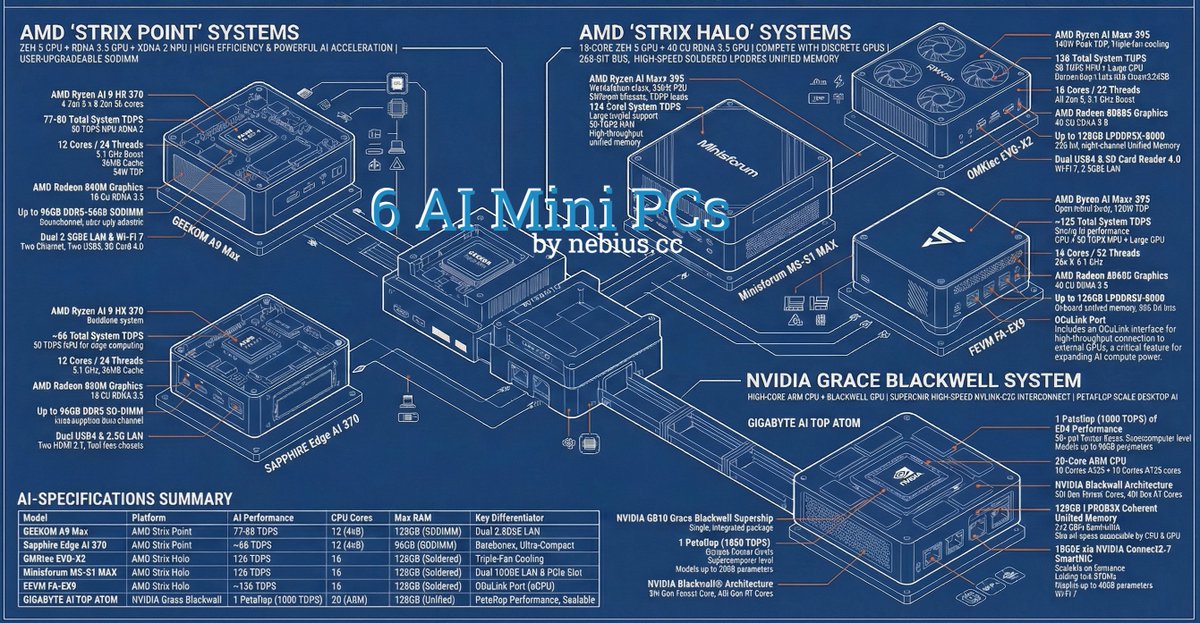
Silicon Sovereignty Wars – The AI Mini Station Apocalypse is Here (And It's Adorably Tiny) figshare.com/articles/prepr… (DOI 10.6084/m9.figshare.30631142) github.com/slavasolodkiy/…
🚨 Imagine a world where your fridge doesn't just chill your beer – it hallucinates recipes in real-time, powered by a shoebox-sized AI beast humming under your counter. No cloud overlords spying on your midnight snack sins. This is the "AI Mini Station" revolution: local AI hardware clawing back sovereignty from Big Tech's data vampires. But it's a geopolitical bloodbath. Buckle up, future-dwellers. #AIHardwareRevolt
First, the macro carnage: Global AI Workstation market? Bloated to $5-6B in '25, metastasizing at 10-19% CAGR to $12-260B by 2032. Why? GenAI demand shock – your Copilot fantasies need raw, on-prem muscle. No more begging @AWScloud or @Azure for scraps. Enter the "missing middle": towers between datacenter dinosaurs and wimpy AI PCs. Privacy? Check. Latency? Vaporized. IP theft? Locked in your vault. @nvidia's GPUs are the throbbing heart, but tariffs loom like storm clouds. Geopolitics, baby.
Tier 1 titans rule the roost: @Dell 's Precision slabs peddle enterprise dreams to data drudges. @HP 's Z-Series? Power-sucking fortresses for the paranoid C-suite. @Lenovo 's ThinkStation? Portable-ish hybrids mocking desk slavery. They own 70%+ share in this oligopoly orgy. But here's the table truth: AMD Threadripper Pro vs @intel Xeon CPU cage match? VRAM is the new MHz – 128GB+ for local LLMs, or GTFO. @AMD edges with efficiency; @intel clings to legacy thrones.
Boutique berserkers crash the party: @lambdalabs stacks custom GPU Jenga for indie alchemists. @PugetSystems tailors rigs like bespoke suits for ML madmen. @exxactcorp whispers "we build what you dream" in the shadows. High-density horde? @Supermicro & @bizoncompute forge server-adjacent monsters that laugh at PCIe limits. These underdogs? Scraping crumbs while giants feast – but watch 'em swarm.
@nvidia : Arms dealer supreme. DGX Station (A100/H100) is yesterday's king; enter DGX Spark (GB10) – a "new category" mini-titan with 1TB storage tease. Flaw? Bottleneck city on I/O. CUDA moat vs @AMD ROCm? NVIDIA wins the software siege... for now. Liquid cooling? Not luxury, necessity – your rig's a vampire guzzler. Unified memory post-PCIe? The future's glue, dissolving bottlenecks into ether.
Asia's shadow war: US sanctions? China's "self-sufficiency sprint" births @Huawei 's Ascend ecosystem – chip-to-supercluster defiance. @AlibabaGroup 's T-Head? Cloud-native inference overlord, devouring latency. @Samsung 's Mach-1? Korea's ambitious middle finger to the West. APAC gobbles 42% market ($20B+), fueled by factories & fiat. Tariffs? Spice up the chaos. Europe? GDPR ghosts haunt the halls.
Now, the tiny tyrants: Edge AI epoch. "AI Mini Stations": Decentralized rebels for privacy paranoids. Drivers? Data hoarding (GDPR/HIPAA whip), low-latency lust, TCO sanity, offline autonomy. Challenges? Fragmented UX, arch anarchy (x86/ARM/RISC-V cage fight). Market? $X Bn '25, exploding to Y by '34. Swarms over boxes; home micro-datacenters; AI routers invading your NAS.
Segment slaughter: Personal AI Servers (Prosumer/SME) – @Olares_OS 's One: Sovereign cloud-in-a-box. Von Neumann's "JOHNAIC"? Brainiac for bedroom boffins (hunt @VonNeumannAI if it tweets). Compact Pros: @MaxsunOfficial 's MoDT Mini – stealth workstation ninja. Table: Olares edges on portability; JOHNAIC crushes compute density.
Consumer conquest: Smart Home Hubs. @SwitchBot 's AI Hub: Your butler-bot overlord. Incumbents @LGUS & @Apple ? LG's webOS whispers; Apple's Neural Engine lurks in iPads. But local VLM (vision-language models) as '26 killer app? Your walls will judge your vibes. Industrial edge: @Advantech_IIoT boxes for factory phantoms.
Enablers: NPU/GPU arms race (@nvidia vs all). Model distillation shrinks LLMs to fit these Lilliputians. Software? Emerging "OS" for local AI – open-source moats vs enterprise chains. Trends: Portable personal servers by '27; '26 smart home battle royale; swarms, not silos. Societal gut-punch: AI in every crevice, from robo-nannies to climate oracles.
Provocative punch: Cloud hangover? Bill shock therapy. Privacy paranoia? Data hoarding chic. TOPS Olympics? Theater for toddlers. Fragmented stacks? Janky UX hell. Arch chaos? RISC-V wildcards incoming. Sarcasm lens: This "shoebox economy" is bloated speculation stuffed in a corpse. But oh, the gold.
Futuristic fever dream: By 2030, your AI Mini Station evolves – grotesque hybrids of tablet & supercomp (@ASUS ROG Flow Z13 leads the nomadic charge). @GIGABYTEUSA & @Fujitsu_Global nibble industrial edges. Home micro-dats hum symphonies; AI NAS silent-invade; regulation forges edge fortresses. RISC-V rebels topple x86 empires. Humans? Obsolete sidekicks in the silicon saga.
Strategic shade: Hardware hawkers (@Dell@HP@Lenovo@Supermicro), invest in modular madness. Soft devs? Build the "OS" moat. Cloud dinosaurs (@Amazon@Google@Microsoft)? Pivot or perish – edge eats your lunch. Opportunities: VC floods startups; mergers mash monsters; LatAm democratizes (sarcasm: for those with tickets).
The punchline: Little boxes, big ego trip. Tiny tyrants herald tech apocalypse – bloated markets pulsing with putrescence, carnal chip chieftains (@nvidia@AMD@intel@Samsung@Huawei) in a carnival of carnage. 2026-30 novelties? Nightmarish: Swarm intelligence, grotesque predictions of AI routers ruling routers.
Evidence leans toward absurdity: Edge AI green GPUs pretending eco-heroics while vamping volts. Hybrid horrors blending cloud chimeras. Portable powerhouses mocking immobility. Reddit/X buzz? Local rigs for robo-rebels; high-RAM beasts for everyman enthusiasts. Asia reshapes; tariffs twist.
This ain't hype – it's heresy against cloud cults. What's your bet: Mini stations save us, or swarm us into oblivion? Reply with your dystopia. #LocalAI#EdgeComputing#AIFuture
Your move, chip lords. Who's building the swarm? 👀🔥
👾 Tiny Titans 🤖 nextdoor.love A curated collection of AI mini stations, gaming rigs, and edge computing devices. From compact powerhouses to full-tower beasts. Everything you need to build your local AI infrastructure. Compact powerhouses designed for local AI inference, edge computing, and efficient workloads. Perfect for developers, researchers, academia and AI enthusiasts - by @SlavaSolodkiy
The Atom's Fizzle: How We Learned to Stop Worrying and Love… Solar Panels? @slavasolodkiy_67243/atomic-dreams-and-human-realities-2566ef0f9c66" target="_blank" rel="nofollow noopener">medium.com/@slavasolodkiy… Ah, the Atomic Age! That glorious epoch that never quite was. Picture it: a utopia powered by miniature suns, cars zipping around on vitamin-sized pellets of pure energy, and maybe, just maybe, a three-eyed fish or two as a fun little bonus. It was the future we were promised, a future so bright, we'd all need to wear those snazzy atomic-themed sunglasses (even indoors). Instead, we got... well, reality. A reality where the only thing glowing brighter than a reactor core is the smug smile of a solar panel salesman.
So, what's the moral of this atomic-sized cautionary tale? Perhaps it's that sometimes, the shiny, futuristic dream isn't all it's cracked up to be. Sometimes, the simpler, less explosive solution is the better one. Or maybe it's just that we should all invest in solar panels and start practicing our smug smiles. After all, in the energy game, as in life, it's always nice to be on the winning side, especially when the losing side has a tendency to go boom. And by the way, don't forget to install an underground bunker in your backyard just in case. You know... for old times' sake. #NuclearEnergy
A Secretive $11 Billion+ @DRAMgold Market Exists — And You're Not Invited: DRAM.gold <- The Biggest Opportunity Isn't in Hardware, But in Software That Makes It More Efficient
Beneath the consumer market, a massive and sophisticated capital market for compute is now firmly established. This isn't an isolated trend; major deals confirm that billions in financing are being collateralized by GPUs. CoreWeave has secured $7.5 billion in debt financing, Lambda Labs has obtained $500 million, and UK-based Fluidstack has arranged a massive $10 billion GPU-backed facility.
However, the secret to this market is counter-intuitive: lenders aren't primarily betting on the hardware's resale value. Instead, they are securing loans against the predictable cash flows generated by that hardware. CoreWeave’s GPU fleet, for example, generates an estimated $1.9 billion in annual revenue from cloud rental contracts with clients like Microsoft and OpenAI. The hardware depreciates, but the service contracts provide a steady, bankable revenue stream. This is precisely why consumer-grade hardware is excluded. Your gaming PC or stockpiled memory sticks don't generate cash flow, can't be easily tracked at scale, and lack a standardized liquidation channel, making them unattractive as collateral.
While headlines focus on the eye-watering cost of hardware, the largest and most defensible market opportunity lies in software that optimizes its use. The AI inference market alone is projected to reach $106 billion in 2025, and a huge portion of that value will go to companies that help hardware run more efficiently. The high valuations and acquisitions in this space—from Multiverse Computing's $215M raise to NVIDIA's strategic purchase of OctoAI—signal where the "smart money" is flowing: not into the hardware itself, but into the intelligence that multiplies its efficiency.
The impact of optimization software is staggering. For example:
• Open-source frameworks like vLLM and DeepSpeed-FastGen have delivered up to 2.7x improvements in processing throughput by optimizing memory management.
• Multiverse Computing, which raised $215 million, developed "CompactifAI," a technology that can reduce the size of Large Language Models (LLMs) by up to 95% with minimal precision loss.
• The M&A landscape is heating up, with Red Hat acquiring Neural Magic and NVIDIA acquiring OctoAI, confirming the immense strategic value of optimization technology.
This is a critical insight. Rather than speculating on the fluctuating price of a depreciating asset, optimization software directly attacks the problem of hardware scarcity by making existing resources more powerful. It's a scalable and defensible business model that creates lasting value across the entire ecosystem.
You Can Turn Your Gaming PC into a Cash-Flowing Asset!
While individuals can't access the enterprise lending market, a new opportunity has emerged for turning consumer hardware into a revenue-generating asset: decentralized GPU-as-a-Service (GPUaaS) networks. These peer-to-peer marketplaces allow anyone to earn money by renting out their idle compute power.
Platforms like Cocoon, and Gonka AI connect hardware owners with users who need processing power for AI tasks. The business model is simple: you connect your GPU to the network, and the platform handles the marketplace, billing, and job distribution, paying you for the time your hardware is used. The economics can be compelling, particularly for inference workloads which run profitably on consumer GPUs. To illustrate the potential, a margin analysis from Lambda Labs shows that an enterprise-grade A10 GPU, costing around $3,500, can generate over $5,201 in annual revenue, achieving a payback in under eight months. While the revenue potential for consumer cards will differ, this model provides a direct path for individuals with high-end gaming PCs to monetize an existing asset that would otherwise sit idle.
Yesterday's Tech is Literally a Gold Mine
The rapid pace of AI development is creating a mountain of electronic waste—and a massive entrepreneurial opportunity in the circular economy. With fewer than one in five discarded GPUs being properly recycled, a fortune in valuable materials is waiting to be recovered.
Consider these powerful statistics:
• E-waste contains 40 to 800 times more gold per ton than ore extracted from traditional mines.
• The global value of recoverable raw materials from e-waste is estimated at $57 billion.
This has opened several entry points for new businesses with varying capital requirements. Key strategies include GPU/Memory Component Brokerage, Data Center Decommissioning, establishing a Regional Collection and Sorting Hub, and creating a Memory Testing and Certification Service. For vertically integrated processing operations that can handle precious metal extraction, margins can reach over 40%. In the rush to acquire the newest hardware, the value locked in yesterday's technology is one of the most overlooked opportunities.
The AI infrastructure crisis is real, but treating hardware like a speculative commodity is a losing strategy. The rapid pace of technological obsolescence guarantees that today's prized chip is tomorrow's e-waste. Chasing short-term price spikes is a high-risk gamble.
The real, sustainable opportunities lie elsewhere. They are found in providing services that make hardware useful (like GPUaaS), in developing software that makes it more efficient, and in building the circular systems that recover its value at the end of its life. These are the "shovels" of the great AI build-out. As this technological revolution continues, who will truly get rich: those speculating on the price of silicon, or those building the services and software that make it useful? @dram_gold