Денис Варванец

463 posts

Денис Варванец

Денис Варванец

@DVarvanec17259

Katılım Haziran 2023
6 Takip Edilen23 Takipçiler
Peter Wildeford🇺🇸🚀
Peter Wildeford🇺🇸🚀@peterwildeford·
AI capabilities are doubling fast, but so is Congressional awareness of AI superintelligence and the risks. You can make a "METR graph" for AI policy and it shows an explosion... and it's bipartisan ->
Peter Wildeford🇺🇸🚀 tweet media
English
20
41
400
47.1K
Jesse Michels
Jesse Michels@AlchemyAmerican·
🚨BREAKING: NASA's Lead Electrostatics Scientist claims he’s discovered a “new force” that counteracts gravity with no fuel necessary. Dr. Charles Buhler has run 2,000 vacuum chamber experiments showing a propellantless thrust force that persists after the power is switched off, and cannot be explained by ion wind, magnetic effects, or classical energy conservation. The input is pure electricity and the output is millinewtons of thrust counteracting gravity. He believes his work vindicates the legacy of midcentury antigravity pioneer Thomas Townsend Brown and will lead to a new paradigm of propellantless deep space travel that transcends chemical combustion rockets🚨 Charles Buhler has a PhD in condensed matter physics from Florida State University, spent over two decades at NASA's Electrostatics and Surface Physics Laboratory at Kennedy Space Center (which he now leads), and is the incoming president of the Electrostatic Society of America. He is NASA’s authority on electrostatics. His colleague Andrew Aurigema, a 35-year veteran engineer working from the Townsend Brown electrogravitics lineage, developed a parallel version of the same experiment independently, and the two discovered each other through a mutual colleague who had been watching both of them work in silence for years. Together, under their company Exodus Propulsion Technologies, they have tested nearly 2,000 variations of what they believe is a previously undocumented force. He’s also developed a quantum electrodynamics based theory to explain his results. Buhler’s patent is now under formal examination by the U.S. Patent Office with affidavit-signing witnesses being contacted independently. This is the future of space travel, beyond chemical combustion. With Rocketry, we can only get to Proxima Centauri B in 80,000 years. And you’d burn through the fuel well before that. It’s completely untenable for interstellar travel. 1. Buhler’s Skeptic Mentor Stopped Cold in 2010 The first demonstration happened in a non-vacuum lab using a laser aimed at a wall to detect small displacements. Buhler had his future brother-in-law run the test. His mentor, Dr. Sid Clements, an electrostatics expert who had dismissed the work entirely, watched the laser move and immediately abandoned what he was doing. He walked over, ran through a series of verification steps on the spot, and never questioned the reality of the effect again. That was 2010. It took two more years working with Drew before Buhler realized the force appeared even without any B field or current present. He wasn't in the field momentum regime at all. He was in pure electrostatics. 2. The Force is Not Explainable by Newton’s Laws or Ion Wind Ion wind produces thrust in the same direction the ionized air is traveling. The “Exodus force” (Buhler’s name for his new force) produces thrust perpendicular to the expected ion wind direction, reverses cleanly when the device is flipped, and remains present inside a sealed enclosure where no ionized air can escape. Buhler documented this publicly with video: a balsa lifter placed inside a sealed plastic box on a scale, powered up, lifts internally while the scale reads flat. That is conservation of momentum. That is what ion wind looks like. The Exodus force is something different, and Buhler, as the person who leads NASA's only electrostatics lab, is in an unambiguous position to make that distinction. 3. 2,000 Variations, All Producing the Same Result Since beginning collaboration with Drew, Buhler has tracked nearly 2,000 distinct test articles, each tested multiple times. Pendulums. Spinners. Rotators. Force plates. Scales. Pendulum deflections inside Faraday cages. Reversed polarity tests. Vacuum chamber runs at multiple pressure levels. DC-only configurations that eliminate magnetic field artifacts entirely. Every geometry, every material, every packaging approach. The force appears consistently. When a confounding variable is proposed, they address it, run the modified test, and the force is still there. Buhler says if an exotic explanation remains, it is not one he or any colleague has been able to name. 4. The Device Generates Thrust With the Power Off This is the finding that breaks the classical framework entirely. After charging the device and disconnecting it from the power supply, the thrust continues. The capacitor does not drain in the way a simple energy storage calculation would predict. Put on a scale, the weight reduction persists. Buhler's description: if placed in space with the power off, the device would accelerate. He cannot explain that to the scientific community and says so directly. David Chester, who has independently interacted with Drew through APEC sessions and private communications, said he cannot think of a prosaic explanation for this. The phenomenon has been reproduced enough times across enough configurations that calling it experimental error is no longer a defensible position. 5. The Implications of This for Past Antigravity Work Buhler believes his work is derivative of and related to Townsend Brown’s midcentury asymmetric capacitor experiments also showing thrust with pure electricity as the input. Chemical combustion is limited - plain and simple - we can’t get to the nearest habitable planet (Proxima Centauri B) in close the amount of time we’d need; it would take us 80,000 years and we’d burn through the fuel before we got there. It’s a checkmate in one argument against anyone claiming rockets are the frontier of efficiency. This was the dream of Thomas Townsend Brown – one that got stifled and suppressed behind the veil of secrecy and subcompartments. The common trope from experiments around the world are high electric field differentials seem to result in thrust. Buhler’s experiment exists in this lineage. 6. The Patent Office is Running the Peer Review Buhler made a deliberate choice not to pursue academic peer review as a primary path. His second patent is currently under examination, and the examiner's office has been reaching out to independent witnesses who have signed affidavits confirming they have seen and reproduced the effect. Buhler describes this as equivalent to scientific peer review, run by people with no financial interest in the outcome. His first patent may have been held under a national security review process before release. He does not confirm this, but he was aware it was a risk when he filed. 7. A QED Theorist Could Poke Holes in the Theory, But Not the Experiment We brought in UCLA PhD David Chester to evaluate Buhler’s ideas on quantum electrodynamics (which might account for the thrust being seen). David Chester's contribution was not to validate the theory Buhler proposed. He found some issues with the specific scalar virtual photon framing Buhler had developed. What Chester could not do was provide a prosaic explanation for the experimental results themselves. He said directly that, of all the anomalous phenomena he has surveyed, Buhler and Drew's work ranks in the top ten for experimental persuasiveness, specifically because of the iteration rate and the self-consistency across configurations. He noted that Drew's innovation rate alone, constantly testing new geometries and material stacks, is unlike anything he has seen from other groups making similar claims. Buhler pointed out that his theories were based on time-independent perturbation theory which Chester admits requires further examination from him. 8. NASA's UAP Investigation Had No Physicists Buhler and his wife, an engineer in NASA's Launch Services Program, were approached to assist with NASA's second UAP follow-on investigation. When Buhler asked to be placed with the physicists on the project, he was told there were none. The group was instrumentation-focused. Buhler says he was genuinely shocked. His reaction, expressed directly: if you are facing objects that defy the laws of physics, why is there not a single physicist in the room. He described the same reaction Eric Davis has expressed publicly. This is either institutional brain death or something else is happening somewhere else. 9. Six Lights Emerged from the Ocean Near Patrick Air Force Base Around 2013, Buhler and his wife were alone on the beach near Cocoa Beach, Florida, three miles south of Patrick Air Force Base. A red light appeared roughly three miles offshore, grew extremely bright, then appeared to explode, lighting the full length of beach. A helicopter launched from Patrick Air Force Base, flew to the location, hovered briefly, and returned to base without intervening. The light did not stop. It began moving toward them. At some point it split from one light into six rotating orange-pink lights that went under the water and re-emerged in a repeating cycle. The lights tracked their movement along the beach for forty minutes, closing to within roughly fifty yards before disappearing. Buhler says similar lights have been reported by others in the same area, and Stephen Greer runs group observation sessions approximately forty minutes south of the same beach. 10. The Force Crosses the Unity Threshold for Space Already The current demonstrated force is in the five to ten millinewton range. For Earth launch, that is not yet sufficient, and Buhler does not claim otherwise. For orbital station-keeping, for preventing satellite orbital decay, for repositioning between orbits in microgravity, the force exceeds what is needed. Buhler calls this hitting unity for space, moon, and Mars applications without any major development beyond what has already been demonstrated. The self-launcher, a device capable of lifting itself from Earth's surface, is the declared goal. No blueprints exist yet for the energy requirements. But the force is real, it is directional, it reverses on command, and it does not require continuous power to sustain. Why This Matters NASA's lead electrostatics scientist ran nearly 2,000 controlled experiments, eliminated every prosaic explanation the field has available, documented a thrust that persists after the power is cut, watched the fine structure constant emerge from the data repeatedly, and submitted a second patent currently under formal examination. A QED theorist with no commercial stake in the outcome reviewed the experimental claims and could not find a conventional explanation. The standard debunking line for this entire lineage of experiments has always been ion wind. That argument has been answered, documented, and filmed. What remains is a force that requires either new physics or an error that two decades of systematic testing has not been able to locate. The patent process will resolve part of this. The vacuum chamber footage will resolve more of it. Full conversation is live now. The next stage in human space travel is here.
English
408
1.1K
5.5K
708.9K
Ethan Mollick
Ethan Mollick@emollick·
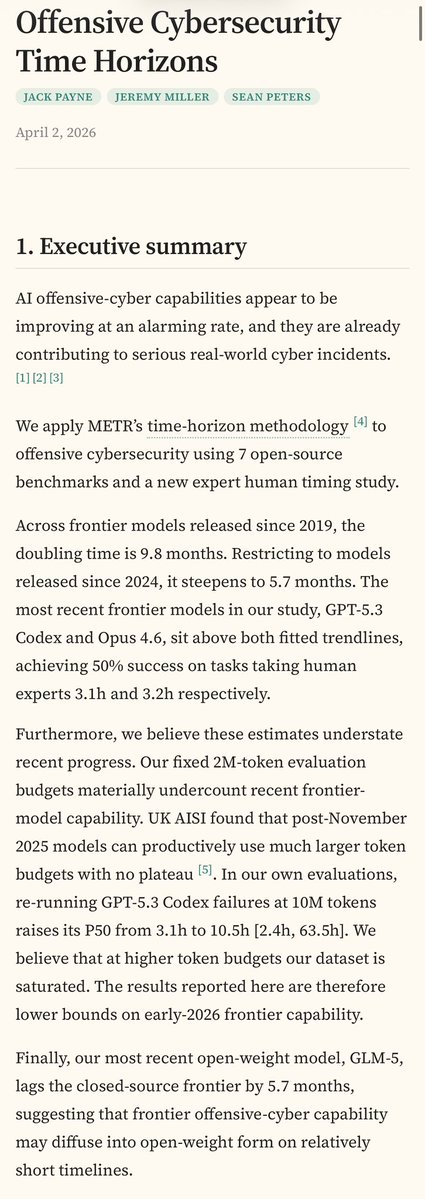
Here’s an independent domain extension of METR’s famous time-horizon analysis, applying it to offensive cybersecurity with real human expert timing data Similar to METR: 5.7 months doubling time. Frontier models now succeed 50% of the time at tasks that take human experts 10.5h.
Ethan Mollick tweet mediaEthan Mollick tweet media
English
41
36
323
45.9K
Денис Варванец
Денис Варванец@DVarvanec17259·
@chatgpt21 Deep audio processing? Like distinguish bad piano from good, calling noise pink and assessing song mixing quality?
English
0
0
0
86
Chris
Chris@chatgpt21·
🚨 GREG BROCKMAN JUST EXPLAINED THE NEXT LEAP WITH SPUD (GPT 5.5) Greg Brockman: "I think of Spud as a new base, as a new pre-train... I'd say it's like we have maybe two years worth of research that is coming to fruition in this model." Greg says: "There's this thing called 'big model smell'... when these models are just actually much smarter, much more capable, that they bend to you much more, and you feel it." Here is exactly what we are getting with the upcoming GPT 5.5 rollout: • "Big Model Smell": A massive qualitative shift. The models stop being rigid and start intuitively bending to what you actually want them to do. • Unlocking New Abilities: It can just do things it wasn’t able to before. The frustrating moments where the AI "doesn't quite get it" and needs you to over-explain are going away. • Longer Time Horizons: The ceiling is being completely raised. The new models will be able to autonomously solve complex, open-ended problems over much longer periods of time. • A New Pre-Train Base: This is not an incremental fine-tune. Spud is a completely new foundation built to accelerate the entire economy.
English
73
101
1.4K
190.7K
E. Cavendish
E. Cavendish@ducavendish·
‘Fiquei um pouco surpreso com a falta de empolgação em torno do Spud (o novo GPT-6). Isso não é só uma atualização. É um treinamento completamente novo do zero. É um salto enorme de qualidade — mais ou menos do tamanho do pulo que tivemos do modelo o1 para o 5.4 (o mais avançado da época). O Mythos parece interessante, mas eles nunca vão conseguir disponibilizar ele de verdade para as pessoas. Acabaram cometendo o mesmo erro que a OpenAI cometeu com o GPT-4.5. Com as novas técnicas de compactação e de memória que eles desenvolveram, o modelo vai conseguir trabalhar com um contexto praticamente infinito (ou seja, lembrar de conversas e informações muito longas sem perder o fio da meada). A personalidade dele está bem mais agradável e natural do que a do Opus 4.6. Tudo isso vai ser oferecido num aplicativo simples, parecido com o do Claude. Nele, virá integrado um assistente para trabalho em equipe e outro para programação, tudo funcionando junto, com a memória compartilhada de forma automática entre os modos. Eu prometo: as pessoas ainda não estão animadas o suficiente com isso. Ele combina o conhecimento vasto do Gemini, a personalidade boa do Opus e uma capacidade de agir por conta própria que a gente nunca viu antes. O novo modo “agente” é simplesmente impressionante. O Sam Altman e o time dele não estão por aí dizendo que chegaram perto da AGI (inteligência artificial geral) e fazendo barulho na mídia antes da abertura de capital da empresa só por diversão. Eles não fariam isso se não fosse algo realmente grande. Uns 3 meses atrás já estava claro que o Spud tinha dado saltos que nem eles esperavam. Só agora eles estão conseguindo demonstrar publicamente essa empolgação. Para ser sincero, isso é uma má notícia para muitos trabalhos que dependem de conhecimento e raciocínio (escritores, analistas, programadores, pesquisadores etc.). Mas, ao mesmo tempo… É algo lindo de se ver.’ Por @iruletheworldmo
Português
12
8
99
11.1K
Tyler
Tyler@rezoundous·
In March, people were flocking to Claude. In April, people are flocking to Codex. Where are we going in May?
English
332
12
733
78.7K
roon
roon@tszzl·
shoutout to kurzweil who was doing “straight lines on graphs” before it was cool and managed to predict the timeline to certain ai capabilities extraordinarily well
roon tweet media
Joel Becker@joel_bkr

first ever blog post from me: “straight lines on graphs” as a researcher at @METR_Evals i’ve had hammered into me again and again that AI progress is (not only rapid) but remarkably _regular_. this intuition then suggests a bunch of useful mental models which aren’t obvious without the initially counterintuitive starting place. i focus on “jagged capabilities” a la @emollick, acceleration from RL a la METR/@EpochAIResearch, and compute slowdowns a la @whitfill_parker as case studies. (but there are many other phenomena i mentally organize in this way!) i don’t expect this post to convince people who are suspicious of this intuition about its value — i think this wouldn’t have worked for me when i was starting out skeptical! but i hope it gives a sense of some helpful basic tools that people focused on AI use to understand the past + future. post linked below.

English
68
91
1.5K
106.6K
Денис Варванец
Денис Варванец@DVarvanec17259·
@DKokotajlo 1. Do you believe current internal models are at agent 1 level? 2. Do you believe spud/mythos will be A1? 3. Forcefully open sourced Claude code will accelerate timelines more than by 1%?
English
0
0
3
1.3K
Daniel Kokotajlo
Daniel Kokotajlo@DKokotajlo·
New timelines update! We at AI Futures Project will try to do this quarterly. Tl;dr: shortened timelines by about a year.
English
35
34
635
146.4K
Eli Lifland
Eli Lifland@eli_lifland·
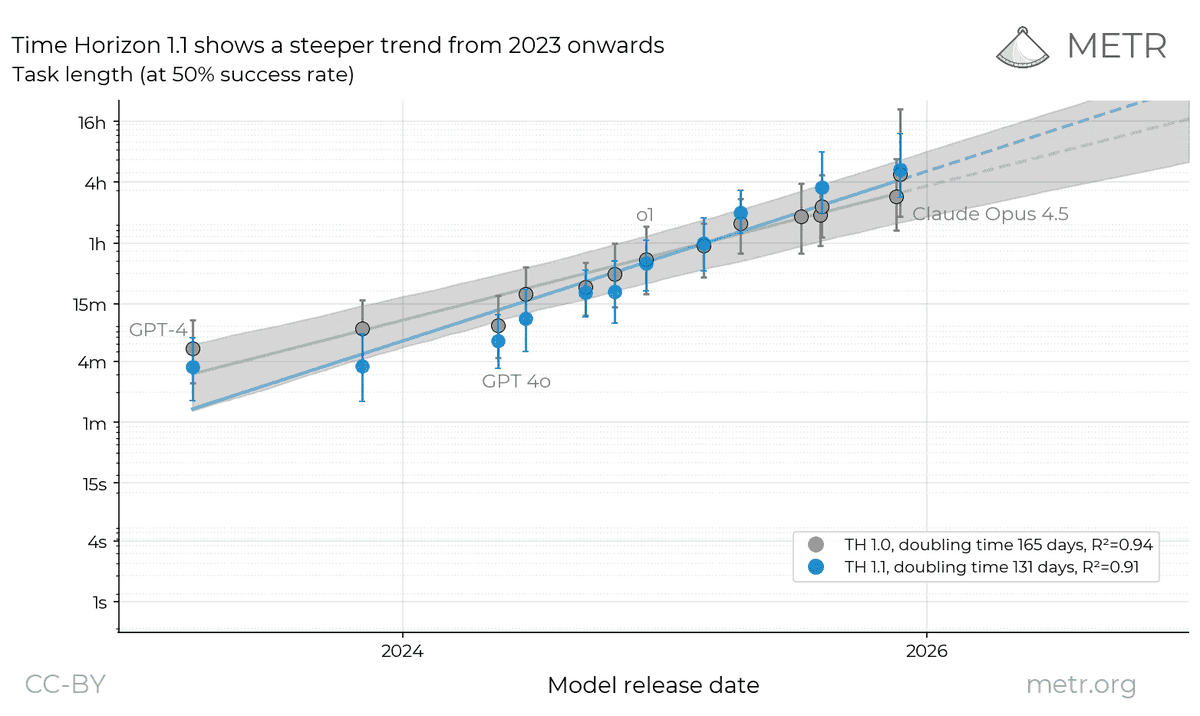
METR's time horizon v1.1 has a faster recent doubling time than their original v1.0, Opus 4.6's 50% time horizon is high, and we did further analysis on the time horizon trend which gave us faster numbers than we'd intuited. These led to us expecting faster time horizon growth.
Eli Lifland tweet media
English
5
3
92
6.2K
Eli Lifland
Eli Lifland@eli_lifland·
AI timelines update: @DKokotajlo and I have updated our timelines earlier by ~1.5 years over the last 3 months, primarily due to (a) expecting faster time horizon growth, and (b) coding agents impressing in the real world. During 2025, we had updated toward longer timelines.
Eli Lifland tweet media
English
16
82
654
96.4K
💺
💺@patience_cave·
The wait is over, internal OpenAI model “Spud” aka GPT-5o drops Thursday Decades ahead of Claude Mythos It’s made progress on cancer, the Riemann Hypothesis, AND scored above 1% on ARC-AGI-3 This is the model @sama has said “future generations will never be smarter than”
English
75
47
832
126.2K
🍓🍓🍓
🍓🍓🍓@iruletheworldmo·
dario has closed the loop.
English
17
5
249
27.2K
Peter H. Diamandis, MD
Peter H. Diamandis, MD@PeterDiamandis·
If AI can now solve math, discover physics and chemistry breakthroughs faster than human PhDs, why are we still training humans to be physicists? Serious question. Should education shift from 'learn to do X' to 'learn to direct AI doing X'? The wrong direction costs a generation their careers.
English
870
138
1.3K
481.3K
Денис Варванец
Денис Варванец@DVarvanec17259·
Hi Jacob — I’m a biogerontologist/health optimization scientist (Los Gatos, Ca) who’s built a mechanistic disease reversal framework with strict cure criteria across HTN, atherosclerosis, dementia, CKD, T2D. Designed as a grantmaking evaluation tool. Would love to share a one-pager.
English
0
0
0
58
Jacob Trefethen
Jacob Trefethen@JacobTref·
I'm joining the OpenAI Foundation to lead the Life Sciences & Curing Diseases program. We're starting with three areas of grantmaking: * AI for Alzheimer's * Public Data for Health * Accelerating Progress on High-Mortality and High-Burden Diseases Time to get to work!
Jacob Trefethen tweet media
English
94
80
1.1K
210.6K
🍓🍓🍓
🍓🍓🍓@iruletheworldmo·
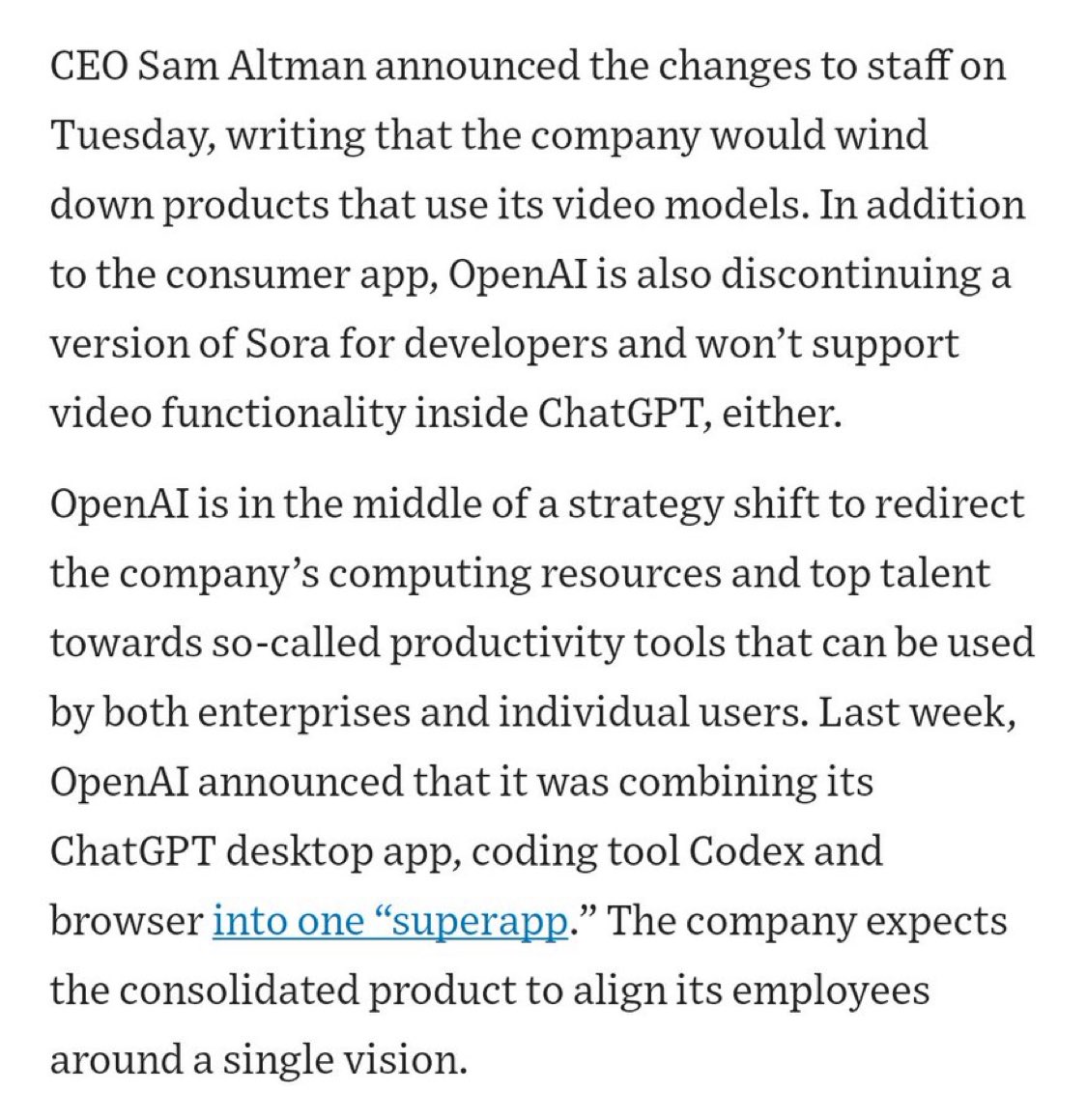
look, it's rough, but, it's the right call asi is but a few weeks away and the spud is compute hungry and groundbreaking.
🍓🍓🍓 tweet media
English
18
10
240
10.8K
Daniel Kokotajlo
Daniel Kokotajlo@DKokotajlo·
AI 2027 laid out a detailed scenario for how AI would progress from 2025 through 2027, including quantitative predictions and qualitative descriptions of the AI landscape. Now that we're in early 2026, we can grade how its 2025 predictions compare to reality! 1/6
Daniel Kokotajlo tweet media
English
37
97
932
225.3K