

Im Daniel Im
3.2K posts
Im Daniel Im
@Daniel_J_Im
Founder and CEO of @BeliefMarket_ & https://t.co/0XjgOe7yRy, 승부사 \\ PhD dropout @ NYU, ex-researcher at @HHMIjanelia \\ Founder of @AIFounded
New York City Katılım Aralık 2016
1.6K Takip Edilen912 Takipçiler

Behind the code, there is a specific kind of expertise.
We are a team of researchers and engineers rooted in the labs of Tsinghua University, University of Cambridge, University of Alberta, Carnegie Mellon University, and Peking University—with experience at DeepMind, DeepSeek, xAI, and more.
We've seen the limits of the current AI architectures firsthand from within the organizations that scaled them. Now, across three countries, we are building an alternative.
We aren't just shipping another wrapper; we are shipping a new fundamental architecture.

English
Im Daniel Im retweetledi

My first AI-assisted math discovery!
Until a year ago, my idea of doing math was locking myself in a room for long hours, away from devices, with just pen and paper for “Deep work”.
This new result of mine is almost the antithesis of that idea.
The process was very different from my old picture of doing math: brainstorming with GPT 5.4/5.5 pro, using Codex to set up Pattern Boost, an RL based tool to discover unusual mathematical structures, and then a little more brainstorming.
The result is about one of the easiest to state problems I have worked on disproving a conjecture from FOCS 2025:
Which graphs maximise the expected number of cycles in a uniformly random cycle-factor of a directed d-regular graph on n vertices?
Check out the paper here: arxiv.org/abs/2604.26101
For me, the exciting part is not just the result itself, but the fact that this felt like a genuinely new way of doing mathematics. What an exciting time to be in!
English
Our DB started struggling last 3 days because traffic is booming @BeliefMarket_.
Honestly?
This is exactly the kind of problem we built this for. More to come
English
Im Daniel Im retweetledi

Jane Street hired this junior at $220k-$600k /year because he uses AI to analyse TRILLIONS of data
in this 1-hour lecture - he show how to research trillion of data points thanks to his machine
Bookmark & watch it, instead of Netflix to learn how to do the same!
bodila@51bodila
Claude is officially almost dead - new agent LITERALLY does 99.9% of work for you Why is Roman Ai better than Claude? Essentially, roman is a wrapper around the same models (Claude, Gemini, Kimi), but with two key differences: > Claude is a separate tab where you go to ask questions. > Roman lives in Slack, where you already work. You write a message in the channel, it does the task, and responds right there. > Claude responds with text - then you copy, paste, and run it yourself. > Roman has its own ecosystem (a virtual machine); it writes the code itself, runs it itself, - connects directly to your tools (GitHub, Jira, HubSpot, Notion - 3,000+ integrations), and delivers the finished result. Plus, it retains context across sessions for weeks, rather than losing it like Claude does after a long conversation So, right now, this is the best Cowork agent, - which will save you a huge amount of time while building your product!
English
Im Daniel Im retweetledi

We’re excited to introduce KAME: Tandem Architecture for Enhancing Knowledge in Real-Time Speech-to-Speech Conversational AI, accepted at #ICASSP2026! 🐢
Blog pub.sakana.ai/kame/
Paper arxiv.org/abs/2510.02327
Can a speech AI think deeply without pausing to process?
In real conversation, we don’t wait until we’ve fully worked out what we want to say—we start talking, and our thoughts catch up as the sentence unfolds.
Fast speech-to-speech models achieve this, but their reasoning tends to stay shallow. Cascaded pipelines that route through a knowledgeable LLM are smarter, but the added latency breaks the flow—they fall back to "think, then speak."
In our new paper, we propose a way to break this trade-off. We call it KAME (Turtle in Japanese).
A speech-to-speech model handles the fast response loop and starts replying immediately. In parallel, a backend LLM runs asynchronously, generating response candidates that are continuously injected as "oracle" signals in real time.
This shifts the AI paradigm from "think, then speak" to "speak while thinking."
The backend LLM is completely swappable. You can plug in GPT-4.1, Claude Opus, or Gemini 2.5 Flash depending on the task without changing the frontend. In our experiments, Claude tended to score higher on reasoning, while GPT did better on humanities questions.
Try the model yourself here: huggingface.co/SakanaAI/kame
English
Im Daniel Im retweetledi

For years, voice AI has been stuck in a rigid loop: think, then speak. But real human conversation is messy, overlapping, and asynchronous.
In our new #ICASSP2026 work, we built a tandem architecture that shifts the paradigm to “speak while thinking.” A fast speech model starts replying instantly, while a backend LLM runs in parallel to inject deep knowledge on the fly.
It’s a completely different way to approach conversational AI, making it feel remarkably more alive.
Blog: pub.sakana.ai/kame/ 🐢
Sakana AI@SakanaAILabs
We’re excited to introduce KAME: Tandem Architecture for Enhancing Knowledge in Real-Time Speech-to-Speech Conversational AI, accepted at #ICASSP2026! 🐢 Blog pub.sakana.ai/kame/ Paper arxiv.org/abs/2510.02327 Can a speech AI think deeply without pausing to process? In real conversation, we don’t wait until we’ve fully worked out what we want to say—we start talking, and our thoughts catch up as the sentence unfolds. Fast speech-to-speech models achieve this, but their reasoning tends to stay shallow. Cascaded pipelines that route through a knowledgeable LLM are smarter, but the added latency breaks the flow—they fall back to "think, then speak." In our new paper, we propose a way to break this trade-off. We call it KAME (Turtle in Japanese). A speech-to-speech model handles the fast response loop and starts replying immediately. In parallel, a backend LLM runs asynchronously, generating response candidates that are continuously injected as "oracle" signals in real time. This shifts the AI paradigm from "think, then speak" to "speak while thinking." The backend LLM is completely swappable. You can plug in GPT-4.1, Claude Opus, or Gemini 2.5 Flash depending on the task without changing the frontend. In our experiments, Claude tended to score higher on reasoning, while GPT did better on humanities questions. Try the model yourself here: huggingface.co/SakanaAI/kame
English
Im Daniel Im retweetledi

@karpathy and I are back! At @sequoia AI Ascent 2026. And a lot has changed. Last year, he coined “vibe coding”. This year, he’s never felt more behind as a programmer.
The big shift: vibe coding raised the floor. Agentic engineering raises the ceiling.
We talk about what it means to build seriously in the agent era. Not just moving faster. Building new things, with new tools, while preserving the parts that still require human taste, judgment, and understanding.
English
We turn online opinion into a new category of social finance. @BeliefMarket_
English
Im Daniel Im retweetledi

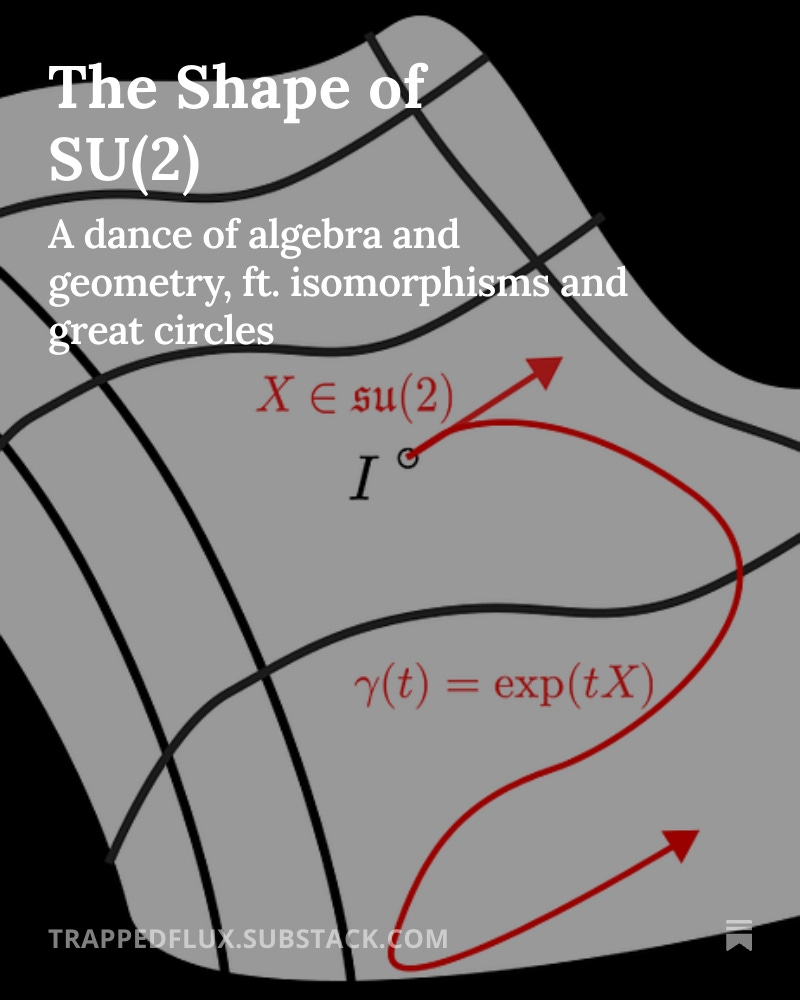
New post: a more in-depth look at SU(2) and geometry in a noncommutative, curved space. We develop tools like the exponential map, show why matrix commutators are like derivatives, and see how exp generates geodesics in SU(2).
L*nk below (ty @edsheeran for title inspiration)
English
Im Daniel Im retweetledi

1/ A 7B model just beat a 671B model at formal theorem proving. The secret is not more data, it is fixing the reward hacking loop in asymmetric self-play. Here is how Stanford researchers broke the RL scaling plateau. 🧵

English
Im Daniel Im retweetledi

You can build interactive applications with gpt-realtime-1.5, so users can control app state more naturally with voice.
Hi Chappy 👋
English
Im Daniel Im retweetledi

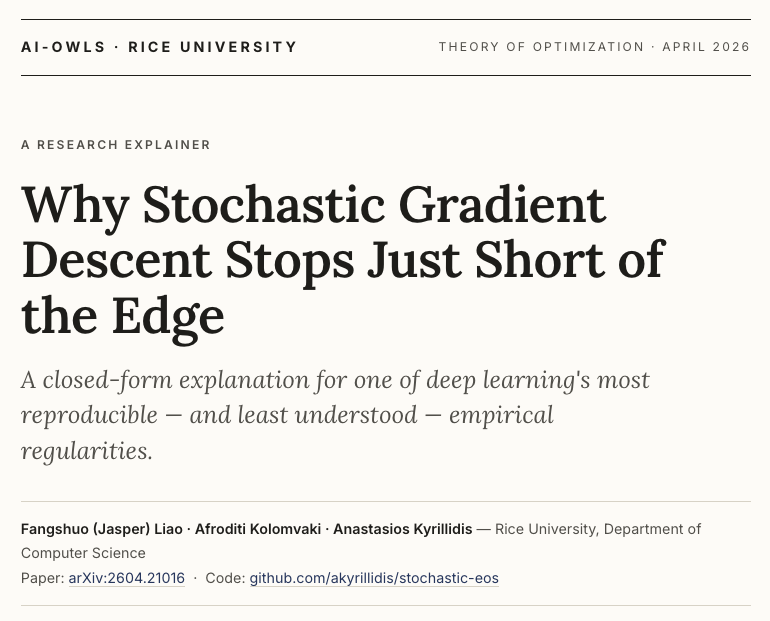
During neural network training, the loss landscape gets sharper until it hits a ceiling. GD pins right at the ceiling. SGD settles below it — and the gap grows as you shrink the batch.
Why? We now have the answer.
arxiv.org/abs/2604.21016 🧵
Blog: akyrillidis.github.io/aiowls/stochas…
English
Fukkkkkk,,, i am paying way too much to OpenAI.
Performance over my feeling, so annoying...
I don't even like OpenAI; suddenly Anthropic decide to tilt on Openclaw.
English
Im Daniel Im retweetledi

Im Daniel Im retweetledi

This is probably the best paper I have read about causal reasoning for quite some time. Really a great weekend read!
"Causal Persuasion" (Burkovskaya & Starkov) models how much evidence you need to establish vs. rule out a causal link. The result is stark:
To prove X causes Y: 1-2 well-chosen variables often suffice.
To prove X does NOT cause Y: you must account for every possible common cause. Arbitrarily many confounders. Practically unfalsifiable.
This inverts the Humean intuition: in causal reasoning, positive claims are cheap to sell and negative ones are almost impossible to rebut.
Now think about what this means for Virtual Cell models.
Most perturbation datasets cover a thin slice of the combinatorial space — a few hundred gene knockouts, maybe a few contexts. A model trained on that data can confidently "learn" gene X drives phenotype Y. But if the true structure is X←C→Y , and C was never systematically varied — the model will never see its own confounding. It has no mechanism to distinguish causal signal from correlated noise.
The paper formalizes exactly why: the model is a sophisticated receiver that accepts whatever causal story is consistent with the data it's seen. And if the data omits the right confounders, even a "sophisticated" model is manipulable.
This is the deepest argument for perturbation diversity. Not just more data, but also more axes of variation. Vary the context. Vary the genetic background. Vary the timing. You're not just collecting samples; you're systematically eliminating alternative causal explanations.
This is why we need “scale” the training data with more contexts including cell types, spatial, and temporal variations.
Paper: aburkovskaya.com/pdf/causality.…

English
Im Daniel Im retweetledi
Scaling massive monolithic LLMs continues to yield incredible results. But to truly unlock their ceiling, the next frontier is test-time compute and dynamic orchestration.
Nature solves complex problems through collaborative ecosystems. In our new #ICLR2026 paper, we evolved a small coordinator. Instead of competing with the monoliths, it orchestrates them. It learns to dynamically assign Thinker, Worker, and Verifier roles to a pool of frontier models—combining their strengths to hit SOTA on LiveCodeBench.
This research is part of the engine powering our new product: Sakana Fugu sakana.ai/fugu-beta/ 🐡
Sakana AI@SakanaAILabs
What if instead of building one giant AI, we evolved a coordinator to orchestrate a diverse team of specialized AIs? 🐟 Excited to share our new paper: “TRINITY: An Evolved LLM Coordinator”, published as a conference paper at #ICLR2026! Paper: arxiv.org/abs/2512.04695 In nature, complex problems are rarely solved by a single monolithic entity, but rather by the coordinated efforts of specialized individuals working together. Yet, modern AI development is heavily focused on endlessly scaling up single, massive monolithic models, yielding diminishing returns. While model merging offers a way to combine different skills, it is often impractical due to mismatched neural architectures and the closed-source nature of top-performing models. To address this, we took a macro-level approach: test-time model composition. We introduce TRINITY, a system that fuses the complementary strengths of diverse, state-of-the-art models without needing to modify their underlying weights. TRINITY processes queries over multiple turns. At each step, a lightweight coordinator assigns one of three distinct roles to an LLM from its available pool: 1/ Thinker: Devises high-level strategies and analyzes the current state. 2/ Worker: Executes concrete problem-solving steps. 3/ Verifier: Evaluates if the current solution is complete and correct. By dynamically assigning these roles, the coordinator effectively offloads complex reasoning and skill execution onto the external models. What makes TRINITY unique is its extreme efficiency. The coordinator relies on the hidden states of a compact language model and a small routing head. In total, it has fewer than 20K learnable parameters. Training this system presented a massive challenge. Traditional Reinforcement Learning (REINFORCE) failed because the gradients had a low signal-to-noise ratio due to binary rewards and weak parameter coupling. Imitation learning (Supervised Fine-Tuning) was ruled out because generating multi-turn labels is prohibitively expensive. Our solution? We turned to nature-inspired algorithms. We optimized the coordinator using a derivative-free evolutionary algorithm. We found that evolution is uniquely suited to optimize this tight, high-dimensional coordination problem where traditional gradient-based methods fail. The results are very promising. In our experiments, TRINITY consistently outperforms existing multi-agent methods and individual models across various benchmarks. At the time of publication, it set a new state-of-the-art record on LiveCodeBench, achieving an 86.2% pass@1 score. More importantly, it demonstrated incredible generalization. Without any retraining, TRINITY transferred zero-shot to four unseen tasks (AIME, BigCodeBench, MT-Bench, and GPQA). On average, the evolved coordinator surpassed every individual constituent model in its pool, including GPT-5, Gemini 2.5-Pro, and Claude-4-Sonnet (the top frontier models available at the time of our #ICLR2026 submission last year). This work is central to Sakana AI's vision. We believe the future of AI isn't just about scaling monolithic models, but engineering collaborative, diverse AI ecosystems that can adapt and combine their strengths. We invite the community to read the paper and explore these ideas! Paper: arxiv.org/abs/2512.04695 OpenReview: openreview.net/forum?id=5HaRj… This foundational research is part of the core engine powering our multi-agent product: Sakana Fugu 🐡👇
English
Im Daniel Im retweetledi

I've always been kind of annoyed I wasn't better at Rubik's cube solving. So a Gemma 4 design session while on a plane w/ no internet + a Claude Code ~one shot yielded this Rubik's solver/trainer.
Create your cube or paste a flat-net image of your scramble → it reads the colors, finds a 22-or-fewer-move solution, and animates the 3D cube through every turn. No backend. 100% in the browser.
Run it: jeffhuber.github.io/rubiks-solver
Code: github.com/jeffhuber/rubi…
English
Im Daniel Im retweetledi

contrasting the # of authors/participants vs. # of sponsors, i think we see the directionality of brain drain and also the AI market size.
one notable entry here is south korea: pretty much brain drain only.

English