Darin Tuttle retweetledi
Darin Tuttle
26.6K posts

Darin Tuttle retweetledi


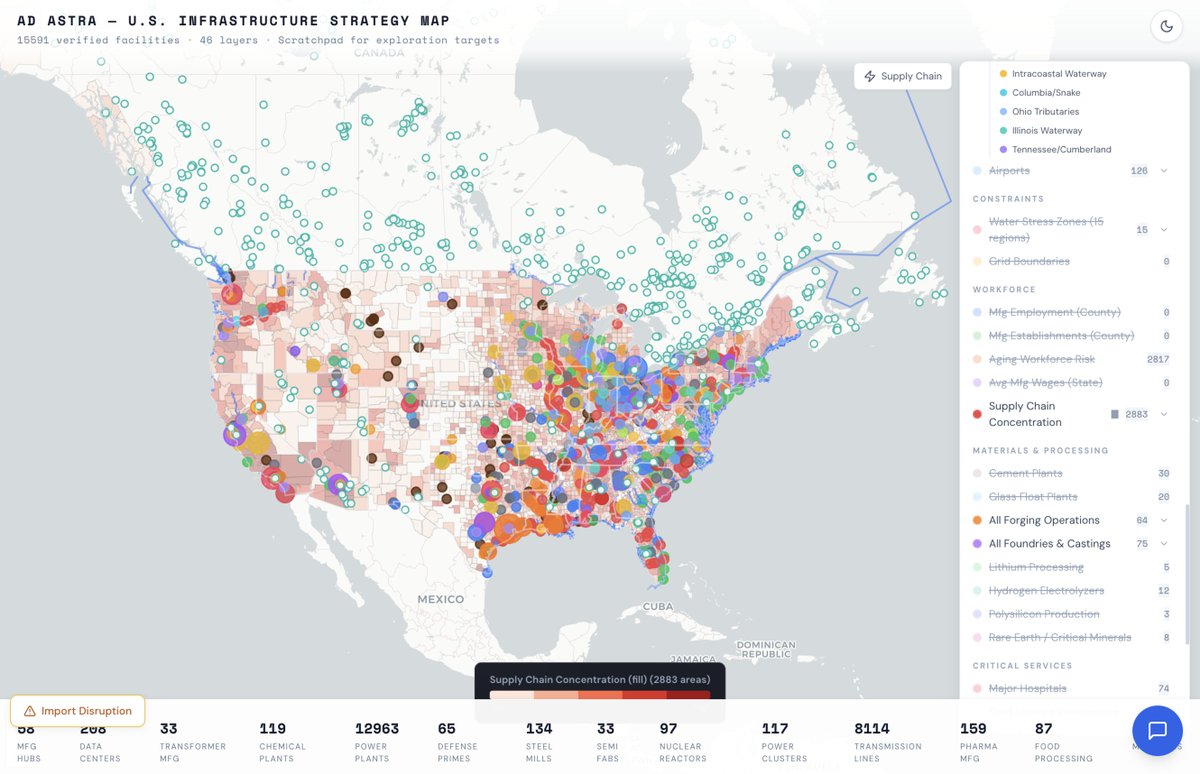
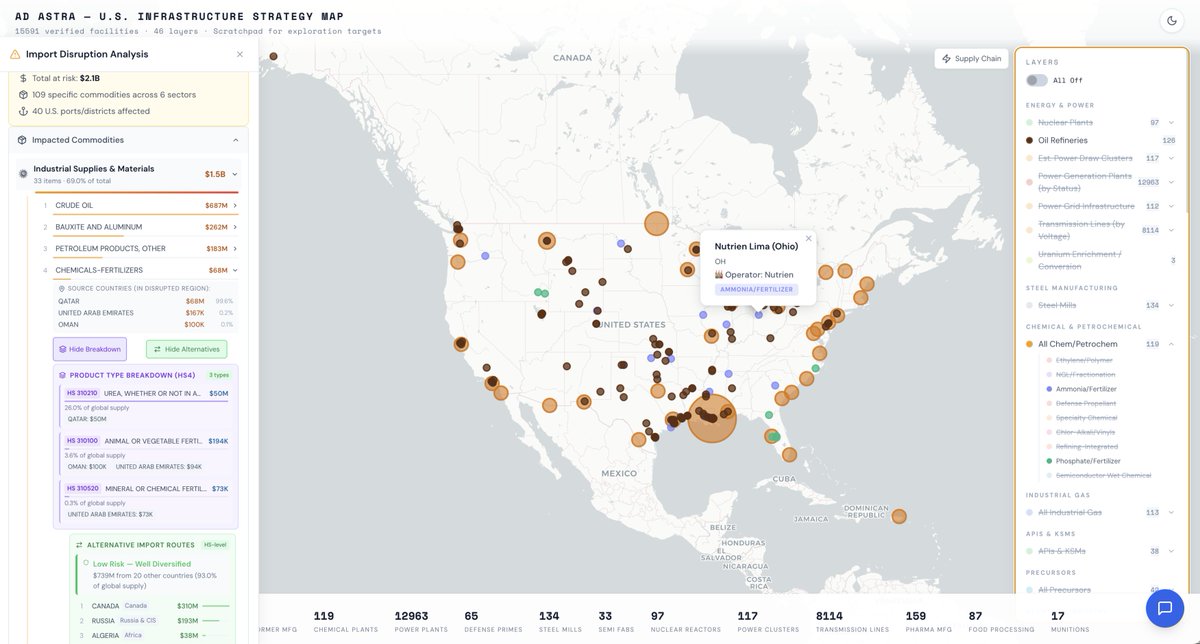
We are building an intelligence map and coordination resource for the industrial base.
Specifically for the chokepoints of critical supply chains and what it takes to unblock them.
Different code systems exist for imports (HS), industries (NAICS), defense contractors (CAGE), workforce skills (SOC), and training programs (CIP). The bridge between them that has always been missing is an ontology of the industrial base itself. So we built one: thousands of entities spanning policy, capital, minerals, and workforce, mapped to verified facilities across the country.
We are now mapping subsystems of critical finished goods and the industrial processes each one requires. We are already seeing recurring subsystems. From there, the physical infrastructure, resources, and workforce needed to unblock them become clear.
The end state is a live resource plan that tells you exactly where to move capital, resources, legislation, and workforce, geographically and by sector.
Many of you have asked us how you can help. Here's how: if you know sharp data scientists and researchers who want to work on this, send them our way. Have them email us at build@adastragroup.io


English
Darin Tuttle retweetledi

why don't we have famous physicists anymore?
Raman Khatri@ramankhatri
why don’t we have famous physicists anymore?
English
Darin Tuttle retweetledi

The disinformation campaign against advanced propulsion is losing.
World is going to know and AI is narrowing the knowledge gap.
Is what we know dangerous? Ya absolutely but keeping information siloed doesnt guarantee safety.
AI can connect the dots one man cant. Just do what we do with nonprofileration strategy for nuclear and control and infiltrate the chain of command.
English
Darin Tuttle retweetledi

Advanced Machine Intelligence (AMI) is building a new breed of AI systems that understand the world, have persistent memory, can reason and plan, and are controllable and safe.
We’ve raised a $1.03B (~€890M) round from global investors who believe in our vision of universally intelligent systems centered on world models. This round is co-led by Cathay Innovation, Greycroft, Hiro Capital, HV Capital, and Bezos Expeditions, along with other investors and angels across the world.
We are a growing team of researchers and builders, operating in Paris, New York, Montreal and Singapore from day one.
Read more: amilabs.xyz
AMI - Real world. Real intelligence.

English

A $1B seed round won’t be enough to catch up…
AMI Labs@amilabs
Advanced Machine Intelligence (AMI) is building a new breed of AI systems that understand the world, have persistent memory, can reason and plan, and are controllable and safe. We’ve raised a $1.03B (~€890M) round from global investors who believe in our vision of universally intelligent systems centered on world models. This round is co-led by Cathay Innovation, Greycroft, Hiro Capital, HV Capital, and Bezos Expeditions, along with other investors and angels across the world. We are a growing team of researchers and builders, operating in Paris, New York, Montreal and Singapore from day one. Read more: amilabs.xyz AMI - Real world. Real intelligence.
English
Darin Tuttle retweetledi

Over the past year, there’s been a surge of excitement around agentic AI — systems that don’t just answer questions, but can act: reading instructions, running code, designing pipelines, and making decisions.
In biomedicine, this raises a provocative question:
💡 Could the next member of your ML team be an AI agent?
The honest answer — not yet.
Today, we share BioML-bench, a new open benchmark to measure how far today’s agents are from this vision, and what it will take to get there.
📄 Paper : biorxiv.org/content/10.110…
💻 Code: github.com/science-machin…
Why this matters
Biomedical discovery doesn’t happen in a single step.
It’s messy, iterative, and deeply interdisciplinary: cleaning data, choosing models, validating results, integrating diverse domains like genomics, imaging, and clinical records.
Existing evaluations — mostly Q&A or coding challenges — don’t capture this complexity.
We needed a testbed that reflects the real work of biomedical ML.
What we built
BioML-bench is a suite of 24 real biomedical ML tasks where agents must:
--Parse nuanced task descriptions
--Build and train models end-to-end
--Compete against human leaderboards populated by domain experts
It’s the first benchmark designed to ask: Can an agent truly operate like a biomedical data scientist?
What we learned
Our experiments with four different agents — from general-purpose systems to biomedical specialists — reveal a sobering truth:
--Current agents operate at ~35% of human expert performance.
--Domain specialization alone isn’t enough. Success comes from flexible, creative strategies, not rigid pipelines.
--Even on imaging tasks, deep learning was underutilized, highlighting a gap between human and agent intuition.
Looking ahead
The promise of agentic AI isn’t to replace human scientists — it’s to amplify them.
Imagine a future where an agent can set up a first-pass analysis overnight, freeing a scientist to focus on questions, not debugging scripts.
We’re not there yet. But with BioML-bench, we now have a shared yardstick to track progress, spark innovation, and bring accountability to this emerging field.
Grateful to our amazing team — led by @Henrymiller2012 , with contributions from Matthew Greenig, Benjamin Tenmann, and support from @SciMac.
This work is a small but necessary step toward a future where AI becomes a true partner in biomedical discovery. 🌱
#AI #Biomedicine #Agents #MachineLearning #BioML


English
Darin Tuttle retweetledi

PixMob | Comment les fourmis éclairent le monde lapresse.ca/international/…
Français