David Jones

3.4K posts

David Jones banner
David Jones

David Jones

@DavidJonesBrain

Neuroscience, Cognitive and Behavioral Neurology, Complex Systems, AI, Alzheimer's and Multimodal Neuroimaging, content personal opinion https://t.co/6QLYHTNahe

Minnesota, USA Katılım Kasım 2015
462 Takip Edilen1.7K Takipçiler
Sabitlenmiş Tweet
David Jones
David Jones@DavidJonesBrain·
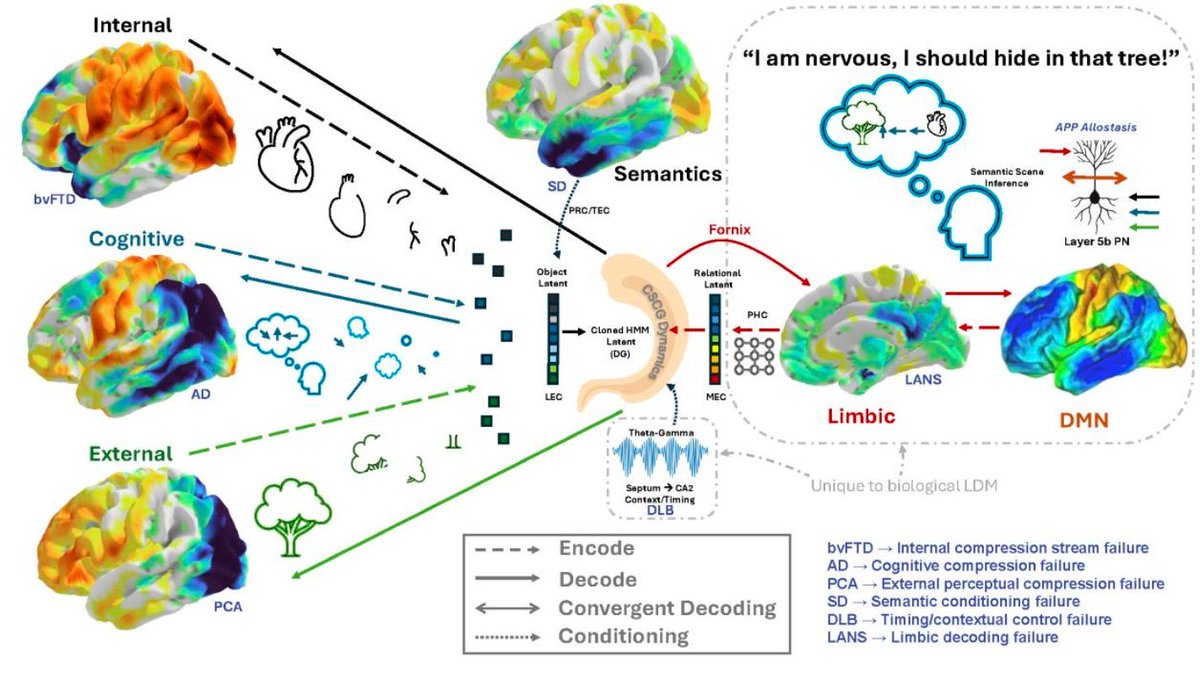
1/ Every week in my neurology clinic, I see people lost in the search for a diagnosis. Sometimes, what’s causing their dementia symptoms is treatable — but was missed for years. We just published a new AI tool to change that. Here's why it matters🧵 @NaipMayo @MayoClinic #ENDAlz
David Jones tweet media
English
2
10
31
2.1K
David Jones retweetledi
Jay Van Bavel, PhD
Jay Van Bavel, PhD@jayvanbavel·
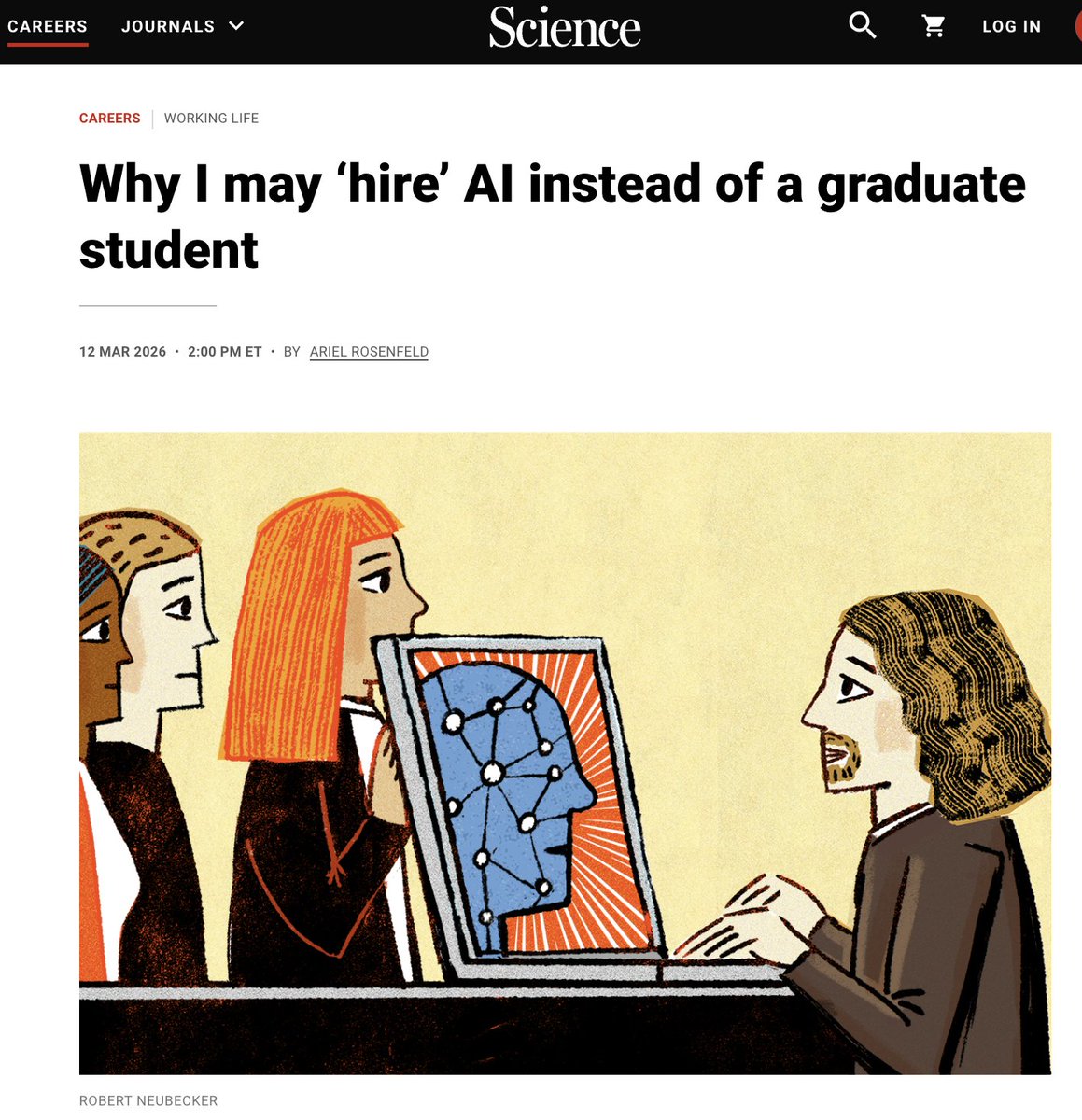
I've been seeing this more and more, labs are shrinking due to massive funding cuts and scientists are leaning more and more on AI. There used to be a lot of debate about whether or not academia was a pyramid scheme, but I think that will quickly be obsolete if labs start using AI rather than training new students. "The issue is not whether my students are valuable. In the long run, they are invaluable. The issue is that their value emerges slowly, whereas AI delivers immediate returns. I feel somewhat embarrassed to admit how tempting this is. In our culture, preferring an algorithm to a trainee feels like a betrayal of the academic mission. Yet I see these calculations shaping the labs around me. Close colleagues are quietly refraining from taking on as many students as they used to. When they do take students, they are noticeably pickier." science.org/content/articl…
Jay Van Bavel, PhD tweet media
English
29
75
346
128.6K
David Jones retweetledi
Jesus Ramirez-Bermudez
Jesus Ramirez-Bermudez@JRBneuropsiq·
Back to basics! Cognitive Neuropsychiatry, a interdisciplinary framework developed by Anthony S David & Peter Halligan, offers a systematic, theoretically grounded framework for explaining clinical psychopathology in terms of disruptions to cognitive processes. Its emphasis on
Jesus Ramirez-Bermudez tweet media
English
4
31
156
6.6K
Michael Levin
Michael Levin@drmichaellevin·
Final version is out: advanced.onlinelibrary.wiley.com/doi/epdf/10.10… @YanboZhang3, @BeneHartl, and @HananelHazan "Heuristically Adaptive Diffusion-Model EvolutionaryStrategy" Abstract: Diffusion Models (DMs) and Evolutionary Algorithms (EAs) share a core generative principle: iterative refinement of random initial distributions to produce high-quality solutions. DMs degrade and restore data using Gaussian noise, enabling versatile generation, while EAs optimize numerical parameters through biologically inspired heuristics. Our research integrates these frameworks, employing deep learning-based DMs to enhance EAs across diverse domains. By iteratively refining DMs with heuristically curated databases, we generate better-adapted offspring parameters, achieving efficient convergence toward high-fitness solutions while preserving explorative diversity. DMs augment EAs with deep memory, retaining historical data and exploiting subtle correlations for refined sampling. Classifier-free guidance further enables precise control over evolutionary dynamics, targeting specific genotypical, phenotypical, or population traits. This hybrid approach transforms EAs into adaptive, memory-enhanced frameworks, offering unprecedented flexibility, and precision in evolutionary optimization, with broad implications for generative modeling and heuristic search.
Michael Levin tweet media
English
24
57
314
15.5K
David Jones
David Jones@DavidJonesBrain·
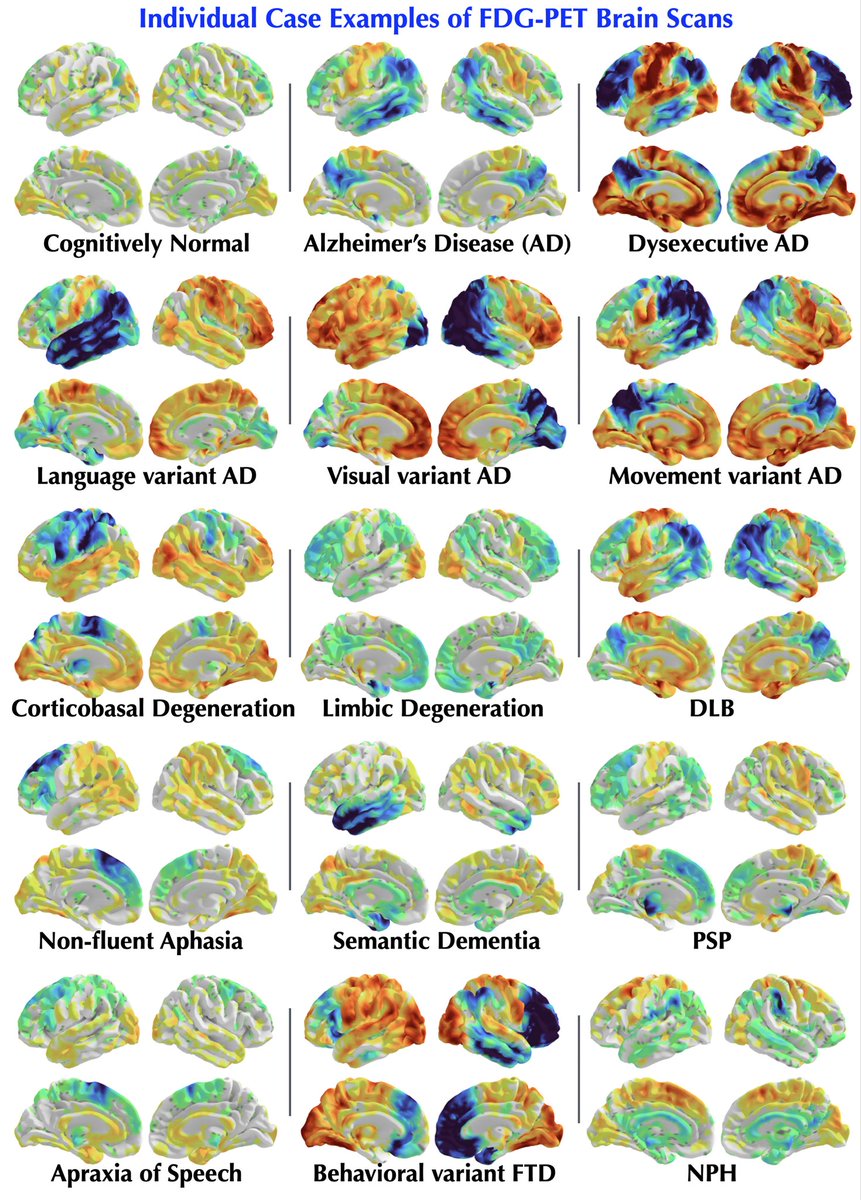
@tsparanhos It’s a global norm, but even a pons norm shows this. Brain utilizes glucose to match its functional configuration. increases may indicate that a different functional configuration is manifest relative to a normative database. GFSS explains these patterns doi.org/10.1038/s41467…
English
1
0
3
83
Thiago Paranhos
Thiago Paranhos@tsparanhos·
@DavidJonesBrain Beautiful images! How do you interpret regions of increased metabolic activity? Could they reflect cortical areas under greater cognitive load?
English
1
0
0
73
David Jones
David Jones@DavidJonesBrain·
Every brain tells a story. We need to listen better! #FDG-PET
David Jones tweet media
English
6
28
103
9.2K
David Jones
David Jones@DavidJonesBrain·
@JRBneuropsiq I made this for resident and patient education to use as a reference when we discuss their FDG-PET results. It will likely find its way into a publication somewhere.
English
1
0
1
26
David Jones
David Jones@DavidJonesBrain·
@JRBneuropsiq Not yet. You can say you used it with my permission if want. They are SUVR images using a global norm standardized to z-scores relative to a reference dataset (-5 to 5 range displayed).
English
1
0
2
96
David Jones
David Jones@DavidJonesBrain·
@Muhamma54108555 These are routine clinical FDG-PET scans. Patients typically sit comfortably in a dimly light room for 45 minutes after tracer injection before PET scanning.
English
0
0
1
63
David Jones
David Jones@DavidJonesBrain·
@dileeplearning @KordingLab Don’t forget about clinical practice dedicated to the human mind. It will teach you so much and you can offer it so much in return.
English
0
0
1
62
David Jones retweetledi
Earl K. Miller
Earl K. Miller@MillerLabMIT·
Alpha/beta rhythms and motor control. They also play roles in top-down control more generally. Alpha and Beta Corticomotor Phase Dynamics Shape Visuomotor Control on a Single-Trial Basis jneurosci.org/content/46/7/e… #neuroscience
English
1
9
59
2.9K
David Jones retweetledi
PRX Life
PRX Life@PRX_Life·
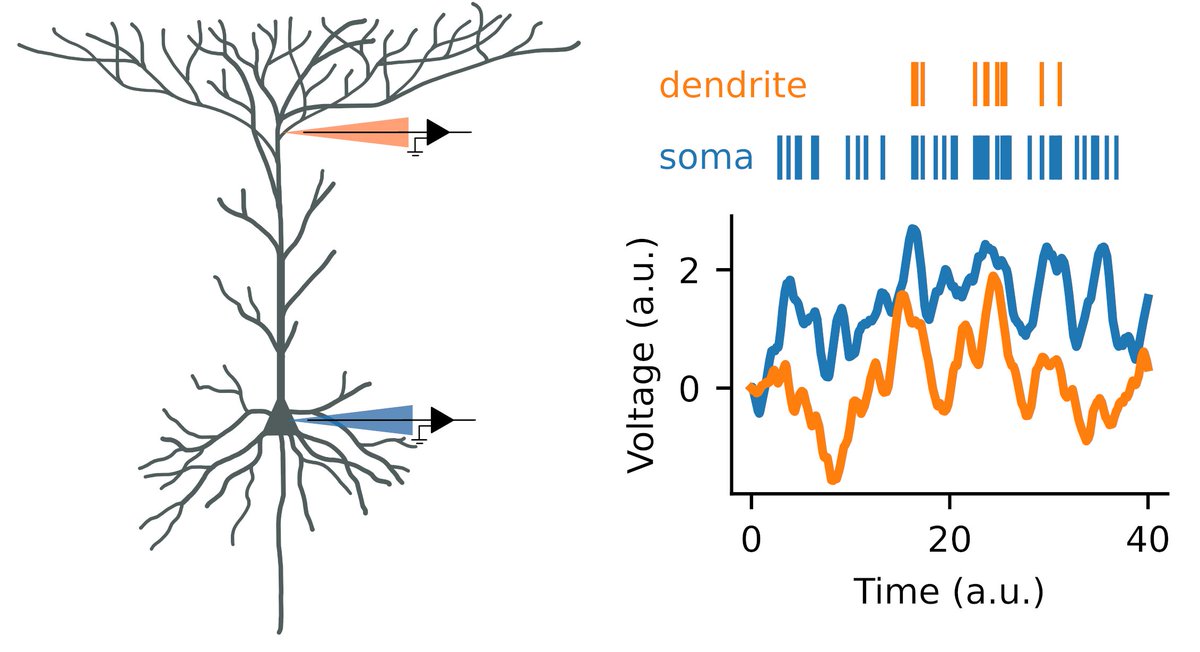
Researchers develop a theory for compartmentalized neurons that can emit both somatic and dendritic spikes and show how the compartmentalization of excitatory and inhibitory connectivity regulates activity in recurrent networks. 🔗 go.aps.org/4aeR0Qz
PRX Life tweet media
English
1
16
83
4K
David Jones retweetledi
Cognitive Science
Cognitive Science@CogSciSoc·
Study in Nature found the human brain doesn’t encode item (content) and context in the same neurons. Instead, distinct neuron groups separately represent content and context and integrate them via coordinated activity to form context-dependent memories. nature.com/articles/s4158…
English
1
36
158
5.3K
David Jones
David Jones@DavidJonesBrain·
"your identity isn't something you have. it's something you construct." Maybe using your hippocampus and cortical interactions in a latent diffusion system? #SLOD #NeuroAI
Robert Youssef@rryssf_

psychology solved the ai memory problem decades ago. we just haven't been reading the right papers. your identity isn't something you have. it's something you construct. constantly. from autobiographical memory, emotional experience, and narrative coherence. Martin Conway's Self-Memory System (2000, 2005) showed that memories aren't stored like video recordings. they're reconstructed every time you access them, assembled from fragments across different neural systems. and the relationship is bidirectional: your memories constrain who you can plausibly be, but your current self-concept also reshapes how you remember. memory is continuously edited to align with your current goals and self-images. this isn't a bug. it's the architecture. not all memories contribute equally. Rathbone et al. (2008) showed autobiographical memories cluster disproportionately around ages 10-30, the "reminiscence bump," because that's when your core self-images form. you don't remember your life randomly. you remember the transitions. the moments you became someone new. Madan (2024) takes it further: combined with Episodic Future Thinking, this means identity isn't just backward-looking. it's predictive. you use who you were to project who you might become. memory doesn't just record the past. it generates the future self. if memory constructs identity, destroying memory should destroy identity. it does. Clive Wearing, a British musicologist who suffered brain damage in 1985, lost the ability to form new memories. his memory resets every 30 seconds. he writes in his diary: "Now I am truly awake for the first time." crosses it out. writes it again minutes later. but two things survived: his ability to play piano (procedural memory, stored in cerebellum, not the damaged hippocampus) and his emotional bond with his wife. every time she enters the room, he greets her with overwhelming joy. as if reunited after years. every single time. episodic memory is fragile and localized. emotional memory is distributed widely and survives damage that obliterates everything else. Antonio Damasio's Somatic Marker Hypothesis destroyed the Western tradition of separating reason from emotion. emotions aren't obstacles to rational decisions. they're prerequisites. when you face a decision, your brain reactivates physiological states from past outcomes of similar decisions. gut reactions. subtle shifts in heart rate. these "somatic markers" bias cognition before conscious deliberation begins. the Iowa Gambling Task proved it: normal participants develop a "hunch" about dangerous card decks 10-15 trials before conscious awareness catches up. their skin conductance spikes before reaching for a bad deck. the body knows before the mind knows. patients with ventromedial prefrontal cortex damage understand the math perfectly when told. but keep choosing the bad decks anyway. their somatic markers are gone. without the emotional signal, raw reasoning isn't enough. Overskeid (2020) argues Damasio undersold his own theory: emotions may be the substrate upon which all voluntary action is built. put the threads together. Conway: memory is organized around self-relevant goals. Damasio: emotion makes memories actionable. Rathbone: memories cluster around identity transitions. Bruner: narrative is the glue. identity = memories organized by emotional significance, structured around self-images, continuously reconstructed to maintain narrative coherence. now look at ai agent memory and tell me what's missing. current architectures all fail for the same reason: they treat memory as storage, not identity construction. vector databases (RAG) are flat embedding space with no hierarchy, no emotional weighting, no goal-filtering. past 10k documents, semantic search becomes a coin flip. conversation summaries compress your autobiography into a one-paragraph bio. key-value stores reduce identity to a lookup table. episodic buffers give you a 30-second memory span, which as the Wearing case shows, is enough to operate moment-to-moment but not enough to construct identity. five principles from psychology that ai memory lacks. first, hierarchical temporal organization (Conway): human memory narrows by life period, then event type, then specific details. ai memory is flat, every fragment at the same level, brute-force search across everything. fix: interaction epochs, recurring themes, specific exchanges, retrieval descends the hierarchy. second, goal-relevant filtering (Conway's "working self"): your brain retrieves memories relevant to current goals, not whatever's closest in embedding space. fix: a dynamic representation of current goals and task context that gates retrieval. third, emotional weighting (Damasio): emotionally significant experiences encode deeper and retrieve faster. ai agents store frustrated conversations with the same weight as routine queries. fix: sentiment-scored metadata on memory nodes that biases future behavior. fourth, narrative coherence (Bruner): humans organize memories into a story maintaining consistent self across time. ai agents have zero narrative, each interaction exists independently. fix: a narrative layer synthesizing memories into a relational story that influences responses. fifth, co-emergent self-model (Klein & Nichols): human identity and memory bootstrap each other through a feedback loop. ai agents have no self-model that evolves. fix: not just "what I know about this user" but "who I am in this relationship." the fundamental problem isn't technical. it's conceptual. we've been modeling agent memory on databases. store, retrieve, done. but human memory is an identity construction system. it builds who you are, weights what matters, forgets what doesn't serve the current self, rewrites the narrative to maintain coherence. the paradigm shift: stop building agent memory as a retrieval system. start building it as an identity system. every component has engineering analogs that already exist. hierarchical memory = graph databases with temporal clustering. emotional weighting = sentiment-scored metadata. goal-relevant filtering = attention mechanisms conditioned on task state. narrative coherence = periodic summarization with consistency constraints. self-model bootstrapping = meta-learning loops on interaction history. the pieces are there. what's missing is the conceptual framework to assemble them. psychology provides that framework. the path forward isn't better embeddings or bigger context windows. it's looking inward. Conway showed memory is organized by the self, for the self. Damasio showed emotion is the guidance system. Rathbone showed memories cluster around identity transitions. Bruner showed narrative holds it together. Klein and Nichols showed self and memory bootstrap each other into existence. if we're serious about building agents with functional memory, we should stop reading database architecture papers and start reading psychology journals.


English
0
0
0
200
Robert Youssef
Robert Youssef@rryssf_·
psychology solved the ai memory problem decades ago. we just haven't been reading the right papers. your identity isn't something you have. it's something you construct. constantly. from autobiographical memory, emotional experience, and narrative coherence. Martin Conway's Self-Memory System (2000, 2005) showed that memories aren't stored like video recordings. they're reconstructed every time you access them, assembled from fragments across different neural systems. and the relationship is bidirectional: your memories constrain who you can plausibly be, but your current self-concept also reshapes how you remember. memory is continuously edited to align with your current goals and self-images. this isn't a bug. it's the architecture. not all memories contribute equally. Rathbone et al. (2008) showed autobiographical memories cluster disproportionately around ages 10-30, the "reminiscence bump," because that's when your core self-images form. you don't remember your life randomly. you remember the transitions. the moments you became someone new. Madan (2024) takes it further: combined with Episodic Future Thinking, this means identity isn't just backward-looking. it's predictive. you use who you were to project who you might become. memory doesn't just record the past. it generates the future self. if memory constructs identity, destroying memory should destroy identity. it does. Clive Wearing, a British musicologist who suffered brain damage in 1985, lost the ability to form new memories. his memory resets every 30 seconds. he writes in his diary: "Now I am truly awake for the first time." crosses it out. writes it again minutes later. but two things survived: his ability to play piano (procedural memory, stored in cerebellum, not the damaged hippocampus) and his emotional bond with his wife. every time she enters the room, he greets her with overwhelming joy. as if reunited after years. every single time. episodic memory is fragile and localized. emotional memory is distributed widely and survives damage that obliterates everything else. Antonio Damasio's Somatic Marker Hypothesis destroyed the Western tradition of separating reason from emotion. emotions aren't obstacles to rational decisions. they're prerequisites. when you face a decision, your brain reactivates physiological states from past outcomes of similar decisions. gut reactions. subtle shifts in heart rate. these "somatic markers" bias cognition before conscious deliberation begins. the Iowa Gambling Task proved it: normal participants develop a "hunch" about dangerous card decks 10-15 trials before conscious awareness catches up. their skin conductance spikes before reaching for a bad deck. the body knows before the mind knows. patients with ventromedial prefrontal cortex damage understand the math perfectly when told. but keep choosing the bad decks anyway. their somatic markers are gone. without the emotional signal, raw reasoning isn't enough. Overskeid (2020) argues Damasio undersold his own theory: emotions may be the substrate upon which all voluntary action is built. put the threads together. Conway: memory is organized around self-relevant goals. Damasio: emotion makes memories actionable. Rathbone: memories cluster around identity transitions. Bruner: narrative is the glue. identity = memories organized by emotional significance, structured around self-images, continuously reconstructed to maintain narrative coherence. now look at ai agent memory and tell me what's missing. current architectures all fail for the same reason: they treat memory as storage, not identity construction. vector databases (RAG) are flat embedding space with no hierarchy, no emotional weighting, no goal-filtering. past 10k documents, semantic search becomes a coin flip. conversation summaries compress your autobiography into a one-paragraph bio. key-value stores reduce identity to a lookup table. episodic buffers give you a 30-second memory span, which as the Wearing case shows, is enough to operate moment-to-moment but not enough to construct identity. five principles from psychology that ai memory lacks. first, hierarchical temporal organization (Conway): human memory narrows by life period, then event type, then specific details. ai memory is flat, every fragment at the same level, brute-force search across everything. fix: interaction epochs, recurring themes, specific exchanges, retrieval descends the hierarchy. second, goal-relevant filtering (Conway's "working self"): your brain retrieves memories relevant to current goals, not whatever's closest in embedding space. fix: a dynamic representation of current goals and task context that gates retrieval. third, emotional weighting (Damasio): emotionally significant experiences encode deeper and retrieve faster. ai agents store frustrated conversations with the same weight as routine queries. fix: sentiment-scored metadata on memory nodes that biases future behavior. fourth, narrative coherence (Bruner): humans organize memories into a story maintaining consistent self across time. ai agents have zero narrative, each interaction exists independently. fix: a narrative layer synthesizing memories into a relational story that influences responses. fifth, co-emergent self-model (Klein & Nichols): human identity and memory bootstrap each other through a feedback loop. ai agents have no self-model that evolves. fix: not just "what I know about this user" but "who I am in this relationship." the fundamental problem isn't technical. it's conceptual. we've been modeling agent memory on databases. store, retrieve, done. but human memory is an identity construction system. it builds who you are, weights what matters, forgets what doesn't serve the current self, rewrites the narrative to maintain coherence. the paradigm shift: stop building agent memory as a retrieval system. start building it as an identity system. every component has engineering analogs that already exist. hierarchical memory = graph databases with temporal clustering. emotional weighting = sentiment-scored metadata. goal-relevant filtering = attention mechanisms conditioned on task state. narrative coherence = periodic summarization with consistency constraints. self-model bootstrapping = meta-learning loops on interaction history. the pieces are there. what's missing is the conceptual framework to assemble them. psychology provides that framework. the path forward isn't better embeddings or bigger context windows. it's looking inward. Conway showed memory is organized by the self, for the self. Damasio showed emotion is the guidance system. Rathbone showed memories cluster around identity transitions. Bruner showed narrative holds it together. Klein and Nichols showed self and memory bootstrap each other into existence. if we're serious about building agents with functional memory, we should stop reading database architecture papers and start reading psychology journals.
Robert Youssef tweet media
English
197
874
4.6K
263.7K
David Jones retweetledi
Cognitive Science
Cognitive Science@CogSciSoc·
This study shows that natural cyclical activation of large-scale brain networks drives key cognitive functions, revealing mechanisms of brain processing and suggesting that targeting network rhythms could help enhance cognition. nature.com/articles/s4159… #brain #neuroscience
English
1
19
83
3.9K