Kording Lab 🦖

30.8K posts

Kording Lab 🦖 banner
Kording Lab 🦖

Kording Lab 🦖

@KordingLab

Konrad kording, @Penn Prof, deep learning, brains, #causality, rigor, https://t.co/tTJW05RRfa, https://t.co/qf7ZHxjaK1, Transdisciplinary optimist, Dad, Loves outdoors, 🦖

Philadelphia, PA Katılım Kasım 2012
3.3K Takip Edilen70.9K Takipçiler
Kording Lab 🦖
Kording Lab 🦖@KordingLab·
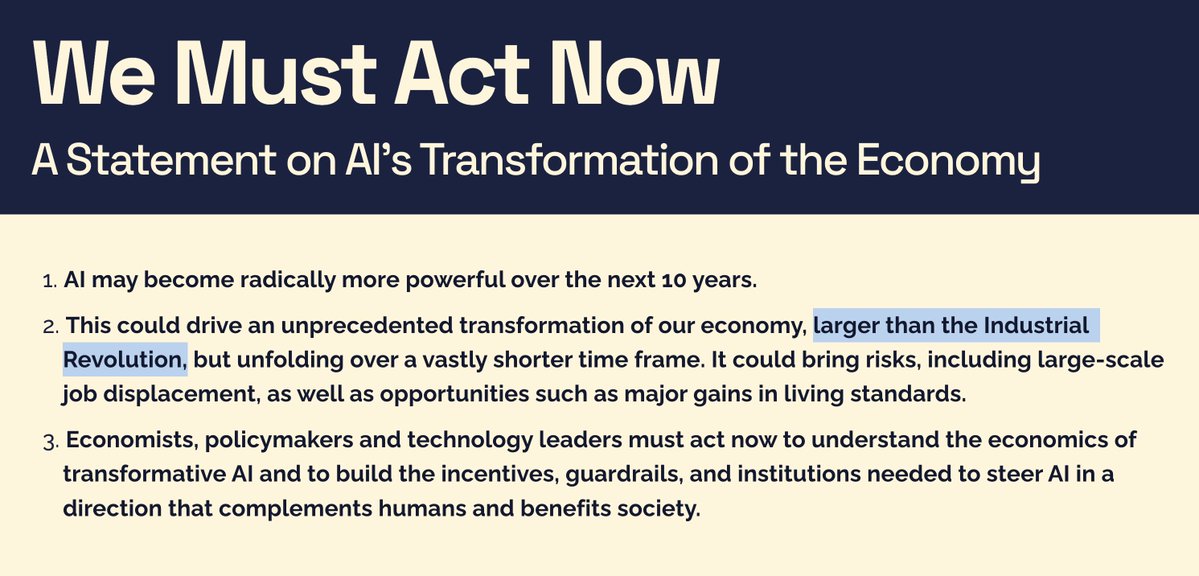
They say: larger than the industrial revolution but much faster. wemustactnow.ai But GDP per person tripled in industrial revolution. Mastery of the physical allowed us to scale most production. It is a bit hard to see how AI will enable all that much new production.
Kording Lab 🦖 tweet media
English
1
2
8
1.9K
Kording Lab 🦖 retweetledi
Penn Bioengineering
Penn Bioengineering@pennbioeng·
Congratulations to Lukasz Bugaj on his promotion to Associate Professor with Tenure. His research explores how cells process information and engineers new ways to program cellular behavior for future therapies. More: bit.ly/4eOCHWD @PennEngineers #Bioengineering
Penn Bioengineering tweet media
English
1
2
7
1.5K
Kording Lab 🦖
Kording Lab 🦖@KordingLab·
@BangliCao @danilobzdok But its not, no? Just critique the information. Good design: every design element carries clear meaningful information. The video violates that *everywhere*.
English
0
0
1
23
Kording Lab 🦖 retweetledi
Luigi Foschini
Luigi Foschini@luigifoschini·
Luigi Foschini tweet media
ZXX
14
226
1.6K
34.9K
Kevin
Kevin@Intrinsic29·
@KordingLab @AnthropicAI They've been doing this since they got on the scene. Their entire MO is focused around creating viral spectacles.
English
1
0
1
419
Kording Lab 🦖 retweetledi
Aran Nayebi
Aran Nayebi@aran_nayebi·
Correct me if I'm wrong, but isn't this really just showing: *In a trained autoregressive network, there is a subspace of internal activations that is especially aligned with future verbal output and downstream computation.* Isn't this expected given how LLMs are trained? In fact, I suspect you could find this is many other task-optimized architectures, not just Transformers/Claude—it would be good to try this on RNNs, MLPs, CNNs, etc.
Anthropic@AnthropicAI

New Anthropic research: A global workspace in language models. Of everything happening in your brain right now, only a tiny fraction is consciously accessible—thoughts you can describe, hold in mind, and reason with. We found a strikingly similar divide inside Claude.

English
92
96
1K
176.4K
Kording Lab 🦖
Kording Lab 🦖@KordingLab·
250 year old and still fresh and hungry. Let us scientists mirror this amazing country.
English
1
1
31
4.5K
Kording Lab 🦖 retweetledi
Sean Escola
Sean Escola@SeanEscola·
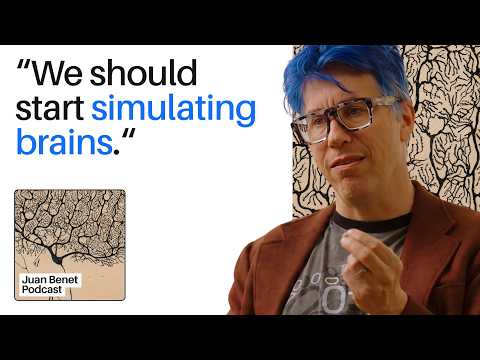
C. elegans has only 300 neurons, yet we still can't reliably simulate its behavior. Why? Neural activity is highly correlated, so connectomes alone don't reveal how neurons interact. On the latest @juanbenet podcast episode, @KordingLab proposes a path forward: "compilers" that translate molecularly annotated connectomes into neural dynamics. A fascinating idea with implications for both neuroscience and AI. youtube.com/watch?v=FHQfmJ…
YouTube video
YouTube
English
1
7
27
5.3K
Kording Lab 🦖 retweetledi
NonsparseOncologist
NonsparseOncologist@5_utr·
🧵 A Nature Medicine paper trained a transformer with ~1M parameters on immunotherapy cohorts as small as n=16, dichotomized every outcome twice, “beat” 22 rival methods with zero rank uncertainty, and skipped covariate adjustment. Textbook bad biomarker research, gift-wrapped.
Eric Topol@EricTopol

Using AI to improve cancer immunotherapy outcomes, via training from transcriptomes of 10,000 tumor samples, 33 cancer types @NatureMedicine nature.com/articles/s4159…

English
10
18
182
39.8K
Kording Lab 🦖 retweetledi
Aran Nayebi
Aran Nayebi@aran_nayebi·
UAI 2026 Camera ready up on arXiv as v3! I've written a long-form LW blogpost on how the technical aspects of this work connect to NeuroAI and to AI sentience/welfare, entitled: "What Capable Agents Must Know: Why AI Consciousness May Be an Inevitable Byproduct of Capability"
Aran Nayebi@aran_nayebi

1/ As AI agents become increasingly capable, what must *inevitably* emerge inside them? We prove selection theorems: strong task performance forces world models, belief-like memory and—under task mixtures—persistent variables resembling core primitives associated with emotion.

English
1
3
15
3K
Kording Lab 🦖
Kording Lab 🦖@KordingLab·
@tomislav_rupic @grok cute. Not quite rigorous though (ie a proper analysis would check claims vs what we know incorporating what speaker claims to know).
English
1
0
2
53
Kording Lab 🦖
Kording Lab 🦖@KordingLab·
This is a 2h podcast of us talking about brains. How they work. What makes neuroscience hard. And how progress may look like.
Juan Benet@juanbenet

New episode with Dr. Konrad Kording (@kordinglab), professor of bioengineering and neuroscience at the University of Pennsylvania (@Penn) and co-director of CIFAR's Learning in Machines & Brains program (@CIFAR_News). Konrad works at the intersection of causality, machine learning, and neuroscience, building rigorous methods for causal reasoning when experiments aren't possible — and challenging how researchers interpret neural data and build AI. Konrad argues the most promising path to understanding how the brain works is to read the brain’s wiring directly, down to the molecular detail of each connection, and to build compilers and simulations to understand the brain’s computation directly. In this episode we go deep into how neurons work, how neurons wire together, and how organic and artificial neural networks differ. We discuss why organic neurons are doing much more; how a model of a single organic neuron can solve MNIST — computing more like a 3-layer artificial neural network; how the brain might learn by solving credit assignment with only local signals; how to approximate backprop without a global algorithm; why AI and humans are intelligent along different dimensions; why Konrad isn’t very worried about AI replacing us; economic models of intelligence and physical work; and much more. Konrad is a brilliant, contrarian thinker who explains complex concepts very intuitively. It is a solid computational neuroscience primer. I hope you enjoy this conversation as much as I did! Other links to this episode and references below. Chapters 00:00:00 Introduction 00:01:01 How organic neurons work 00:24:13 How the brain learns: circuits and credit assignment 00:45:29 Recording the brain 00:52:47 Why simulating brains is hard 01:05:00 A new approach: connectomes and compilers 01:21:00 Why simulate brains? 01:29:50 How AI and human intelligence differ 01:41:04 Evolution, intelligence and AI risk 01:52:42 Robotics, causality, and the roots of intelligence 02:05:53 AI for science and scientific rigor 02:13:05 The economics of intelligence 02:27:50 A hopeful future

English
3
37
243
27.7K
Kording Lab 🦖
Kording Lab 🦖@KordingLab·
I was looking forward to buying put options for spaceX. But the option chain suggests that the markets believe the chance of it being entirely gone in 2 years is like 30%. So no way for me to use it to insure against spaceX demise (which I unfortunately hold in retirement accnts)
English
4
0
11
5.4K
Kording Lab 🦖
Kording Lab 🦖@KordingLab·
for everyone from the outside interested in simulating brains this may be a great introduction.
Juan Benet@juanbenet

New episode with Dr. Konrad Kording (@kordinglab), professor of bioengineering and neuroscience at the University of Pennsylvania (@Penn) and co-director of CIFAR's Learning in Machines & Brains program (@CIFAR_News). Konrad works at the intersection of causality, machine learning, and neuroscience, building rigorous methods for causal reasoning when experiments aren't possible — and challenging how researchers interpret neural data and build AI. Konrad argues the most promising path to understanding how the brain works is to read the brain’s wiring directly, down to the molecular detail of each connection, and to build compilers and simulations to understand the brain’s computation directly. In this episode we go deep into how neurons work, how neurons wire together, and how organic and artificial neural networks differ. We discuss why organic neurons are doing much more; how a model of a single organic neuron can solve MNIST — computing more like a 3-layer artificial neural network; how the brain might learn by solving credit assignment with only local signals; how to approximate backprop without a global algorithm; why AI and humans are intelligent along different dimensions; why Konrad isn’t very worried about AI replacing us; economic models of intelligence and physical work; and much more. Konrad is a brilliant, contrarian thinker who explains complex concepts very intuitively. It is a solid computational neuroscience primer. I hope you enjoy this conversation as much as I did! Other links to this episode and references below. Chapters 00:00:00 Introduction 00:01:01 How organic neurons work 00:24:13 How the brain learns: circuits and credit assignment 00:45:29 Recording the brain 00:52:47 Why simulating brains is hard 01:05:00 A new approach: connectomes and compilers 01:21:00 Why simulate brains? 01:29:50 How AI and human intelligence differ 01:41:04 Evolution, intelligence and AI risk 01:52:42 Robotics, causality, and the roots of intelligence 02:05:53 AI for science and scientific rigor 02:13:05 The economics of intelligence 02:27:50 A hopeful future

English
0
17
75
9.1K
Kording Lab 🦖 retweetledi
Juan Benet
Juan Benet@juanbenet·
New episode with Dr. Konrad Kording (@kordinglab), professor of bioengineering and neuroscience at the University of Pennsylvania (@Penn) and co-director of CIFAR's Learning in Machines & Brains program (@CIFAR_News). Konrad works at the intersection of causality, machine learning, and neuroscience, building rigorous methods for causal reasoning when experiments aren't possible — and challenging how researchers interpret neural data and build AI. Konrad argues the most promising path to understanding how the brain works is to read the brain’s wiring directly, down to the molecular detail of each connection, and to build compilers and simulations to understand the brain’s computation directly. In this episode we go deep into how neurons work, how neurons wire together, and how organic and artificial neural networks differ. We discuss why organic neurons are doing much more; how a model of a single organic neuron can solve MNIST — computing more like a 3-layer artificial neural network; how the brain might learn by solving credit assignment with only local signals; how to approximate backprop without a global algorithm; why AI and humans are intelligent along different dimensions; why Konrad isn’t very worried about AI replacing us; economic models of intelligence and physical work; and much more. Konrad is a brilliant, contrarian thinker who explains complex concepts very intuitively. It is a solid computational neuroscience primer. I hope you enjoy this conversation as much as I did! Other links to this episode and references below. Chapters 00:00:00 Introduction 00:01:01 How organic neurons work 00:24:13 How the brain learns: circuits and credit assignment 00:45:29 Recording the brain 00:52:47 Why simulating brains is hard 01:05:00 A new approach: connectomes and compilers 01:21:00 Why simulate brains? 01:29:50 How AI and human intelligence differ 01:41:04 Evolution, intelligence and AI risk 01:52:42 Robotics, causality, and the roots of intelligence 02:05:53 AI for science and scientific rigor 02:13:05 The economics of intelligence 02:27:50 A hopeful future
English
9
36
161
49.4K