David Prilutsky

45 posts

David Prilutsky banner
David Prilutsky

David Prilutsky

@DavidPrilutsky

NYC Katılım Şubat 2012
566 Takip Edilen280 Takipçiler
Sabitlenmiş Tweet
David Prilutsky
David Prilutsky@DavidPrilutsky·
At Avenir, we’re leaning into the AI value chain – datacenter to applications – while staying mindful of the dynamism that exists in this sector. In this 50-page deck we level set on the core dynamics driving the industry (scaling laws, hyperscaler game theory) and share our opinion on each layer of the value chain. …just in time for OpenAI’s 12 days of ship-mas to test our hypotheses :) docsend.com/v/rk92w/avenir…

David Prilutsky tweet media
English
1
6
54
11.6K
shift
shift@joinshiftX·
Today, we're launching shift. We're starting by cleaning your apartment in New York City, for free. Here's how it works. Book a shift cleaning. A vetted shift operator comes to your home wearing one of our devices. They clean. They leave. You pay nothing. In exchange, we record the cleaning. Robotics is being built on data about how people do daily tasks, and the value of that recording is what funds the service. Anything personal in it is anonymized before the recording is processed. By now, you have heard about the shift to AI more times than you can count. About the shift toward you, the part where you actually feel it, you have heard almost nothing. Shift is what starts to make it concrete, in specific cities, with specific services. Today, cleaning in New York. Soon, handymen, repairs, and errands across the globe. And this is just one side of shift, with more on the way. Comment “shift” and we’ll send you an early access link.
English
1.7K
291
5.7K
6.1M
David Prilutsky retweetledi
Jared Sleeper
Jared Sleeper@JaredSleeper·
We’ve been thinking hard about @AnthropicAI and the white-collar productivity stack. Microsoft is the 800-pound gorilla, winning with a bundling playbook for decades. We made a deck with some primary-research-backed recs on how Anthropic can beat it. Link in replies, enjoy!
English
19
14
179
59.6K
David Prilutsky retweetledi
Andrew Sugrue
Andrew Sugrue@AndrewGSugrue·
@Avenir_Growth is thrilled to lead @hippocraticai's $126M Series C alongside @htaneja @mamoonha and @julesyoo. We believe voice AI is amongst the most exciting frontiers in the Generative AI revolution, and the global healthcare system is one of the largest opportunities to deploy this technology. We are thrilled to back @munjalshah and team as they build the agentic AI platform the global healthcare system needs. Hippocratic’s proprietary voice AI platform and products are the clear clinical market leader and are rapidly being deployed by some of the most respected healthcare providers and payers. We believe AI will be a penetrating technology in healthcare, and Hippocratic is positioned to lead the market due to its focus on clinical safety, the high ROI it drives its customers, and most importantly, because Hippocratic’s AI technology frees nurses and medical professionals to do their most impactful work, while improving the standard of care for patients and driving substantial cost savings for the healthcare system. At Avenir, we have been fortunate to be an early and active investor in AI, backing AI-native companies such as @cognition and @physical_int and scaled AI beneficiaries including @tryramp and @databricks, and we are thrilled to welcome Hippocratic AI to the Avenir family. hippocraticai.com/hippocratic-ai…
English
2
5
30
8K
David Prilutsky
David Prilutsky@DavidPrilutsky·
So excited to be backing Sublime Security in their $150M Series C. Earlier this year, we set out to map how AI would reshape cybersecurity: Sublime stood out. Email remains the top initial access vector for attacks, and GenAI-enabled spear-phishing is making attacks more frequent and convincing. We believe that Sublime delivers what CISOs need to combat this growing threat: market-leading efficacy, enterprise-grade configurability, and now truly agentic detection and response.
Sublime Security@sublime_sec

We’re excited to announce that Sublime has raised $150M in a Series C led by @Georgian_io, joined by new investors @Avenir_Growth, @01Advisors, @jonoberheide, and @nicoleperlroth, and existing investors @IndexVentures, @IVP, @slow, and @CitiVentures. This year we launched ASA and ADÉ, our AI agents that autonomously triage threats and auto-adapt coverage, freeing security teams from repetitive work and delivering rapid, tailored defenses. We’ve grown our customer base 4x since the beginning of the year while maintaining zero enterprise customer churn since company inception. This funding accelerates our vision to deliver autonomous email security that adapts to each organization's unique needs, stopping sophisticated attacks while eliminating the manual work and vendor bottlenecks of legacy solutions. Thank you to our customers, partners, and investors for being on this journey with us. 🔗 Read more: sublime.security/blog/sublime-r…

English
0
0
3
259
David Prilutsky retweetledi
Avenir
Avenir@Avenir_Growth·
The world is saturated with chatter about AI, but we're still in day 0 of everyday people feeling the magic. @SophieStarck and @Theresa_M_Horne wrote this 55-page deck on why we should all be more hyped about consumer AI. docsend.com/v/f86vb/avenir…
English
1
3
19
8.1K
David Prilutsky
David Prilutsky@DavidPrilutsky·
How long will this last? I did some napkin math... It took SpaceX 8 years to successfully launch a medium-lift vehicle (Falcon9) into orbit. It took them 7yrs more to reuse a booster. There's some evidence of Chinese space startups moving faster (building small lift in <4yrs vs. SpaceX's 6yrs for Falcon 1), but not a lot: it's still taking them the same 8yrs to get to medium lift, despite rocket designs eerily similar SpaceX's. Maybe the path to rapid reusability will be faster? SpaceX's once controversial/novel design choices (grid fins, Starship's steel body, chopstick arms) have now been de-risked and Chinese rocket companies (e.g. Landspace, Space Epoch, CALT) are defaulting to them. Ambitiously, let's say it's 2x faster. Then we should expect Chinese companies to: -demonstrate 1st stage reuse in ~3 years -be where SpaceX is today in ~7 years... by which point SpaceX will be flying v3 Starship with 200T to LEO capacity🤯 Long way of saying, I don't think @zebulgar's chart will look much different 5+ years from now
David Prilutsky tweet media
delian@zebulgar

In Q1, SpaceX represented 99%+ of the payload to orbit of the Western World One of the greatest monopolies ever with an incredibly deep technical moat + lead relative to other players Still feel like the market underappreciates how dominant they are

English
0
0
3
281
David Prilutsky
David Prilutsky@DavidPrilutsky·
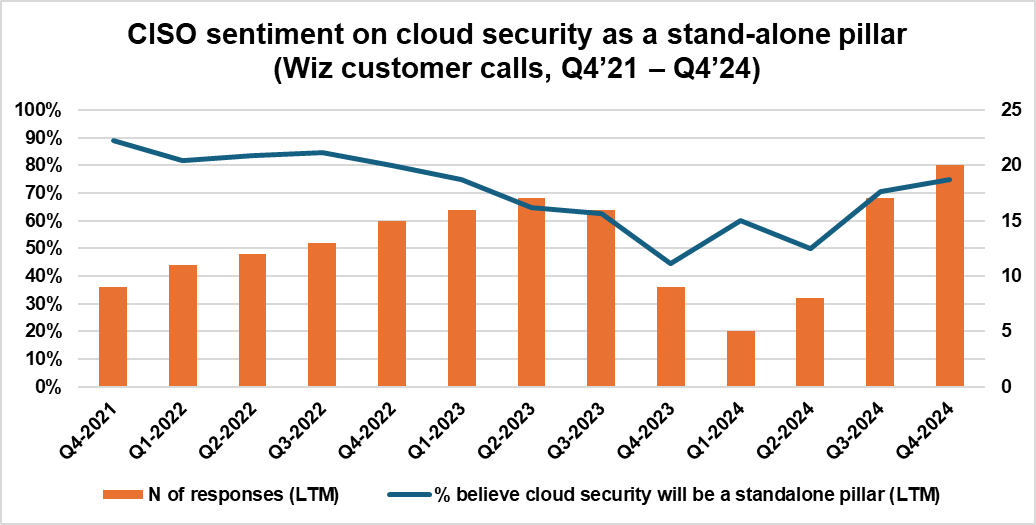
Was curious if CISOs are accurate in predicting which new categories of cyber will/won't emerge as large standalone pillars. Tldr; here's a datapoint that says they are. An analysis of sentiment from 50+ Wiz customer calls over time
David Prilutsky tweet media
English
0
1
2
172
David Prilutsky
David Prilutsky@DavidPrilutsky·
From Red Hat's S1 in 1999: a funny reminder that the best businesses can find ways to weather paradigm tech shifts
David Prilutsky tweet media
English
0
0
8
215
David Prilutsky retweetledi
Proby Shandilya
Proby Shandilya@ProbyShandilya·
Deep services is an underrated aspect of building an enduring enterprise SW company. At $60M of revenue, 46% of Workday’s revenue was services and 47% of Veeva’s revenue was services. A one time (or low volume) fixed investment that pays infinite (or near infinite) dividends.
David Prilutsky@DavidPrilutsky

So what did CrowdStrike do right? CWRD's story parallels Wiz's in many ways - New tech paradigm (cloud // cloud) - New budget category (detection // cloud) - A+ team (ex McAfee // MSFT) - Fastest time to value enabled by new tech (single agent // agentless) - Rapidly built trust (deep services // A+ logos) - Built a multi-module platform

English
0
1
2
1.2K
David Prilutsky
David Prilutsky@DavidPrilutsky·
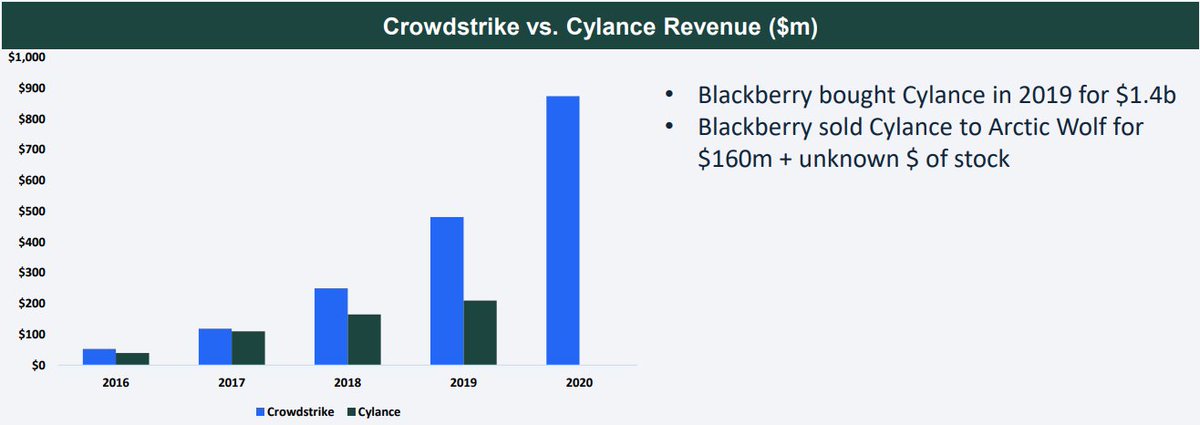
A few other observations below. Nuts to think that George (CRWD) and Stuart (Cylance) were cofounders at Foundstone and then colleagues at McAfee. For the many out there smarter on cyber than me, what'd I miss or get wrong? :)
David Prilutsky tweet media
English
0
0
0
173
David Prilutsky
David Prilutsky@DavidPrilutsky·
A few investor takeaways: - Look for tech paradigm shifts that create new budget lines. This enables hypergrowth - Brand and messaging shockingly matters so much in such a technical category - Having A+ teams with market credibility is critical - Don't frown on services-heavy GTMs. This can really help build trust
English
1
0
0
177
David Prilutsky
David Prilutsky@DavidPrilutsky·
CrowdStrike and Cylance had near-identical founders (former co-founders and coworkers). One now sits at a ~$90B valuation; the other sold for $1.4B. How did CrowdStrike outpace Cylance – and what does it teach investors about backing generational cyber business? A short🧵
David Prilutsky tweet media
English
1
1
5
1.9K
David Prilutsky
David Prilutsky@DavidPrilutsky·
@GavinSBaker If future model improvements come disproportionately from RL during post-training, is this, on the margin, bearish for high-end networking components? ...given they are critical for building coherent training clusters, but less needed for inference clusters
English
0
0
0
661
Gavin Baker
Gavin Baker@GavinSBaker·
This video is worth watching in its entirety. “I’m not particularly in the details of what *they* are investing. All I know, is I am good for my $80 billion. I am going to spend $80 billion building out Azure.” - Satya. “They” are Stargate. Azure is distinct from Stargate. If this is the correct interpretation of his comments, Satya and Amy are likely to clarify that they are not investing in Stargate but are allowing some of Azure’s technology to be used in it hence they are a technology partner not an equity partner. I think Stargate is best understood as Microsoft opting out of providing the pre-training compute capex for their JV past a certain scale and/or time. Instead they will increasingly focus on providing inference compute. Microsoft is one of the more financially disciplined players in this game, so this is an interesting signal. The ROI on AI definitionally has to come from inference. The super impressive o3 and R1 results showed that the biggest future improvements in model capabilities are likely to come from RL during post-training, synthetically generating reasoning traces and test-time compute. These are all essentially inference (ish in the case of RL). Hence Microsoft’s gradual shift in focus away from pre-training compute to inference compute. Inference will increasingly drive everything - both ROI and model improvement. Massive change vs. the past 3 years with significant implications. All just speculation at this point. Time will tell.
English
54
144
1.5K
271.3K
David Prilutsky
David Prilutsky@DavidPrilutsky·
@RnaudBertrand I'm not sure this is a fair comparison. There's lots of speculation that DeepSeek trained its models using GPT-4+ outputs. DeepSeek isn't running a parallel track to OpenAI and opensourcing. It's riding the coattails of OpenAI and benefiting from OpenAI's massive capex
English
0
0
0
245
Arnaud Bertrand
Arnaud Bertrand@RnaudBertrand·
Really interesting how the US and China are taking such different roads on AI. Beyond the PR that this "Stargate Project" is to "create cancer vaccines", what it really seems to be about is doubling down on OpenAI's strategy of building a "money moat" through massive infrastructure investment and centralizing AI on its servers - $500B is an astronomical sum for data centers. The contrast with China's approach couldn't be starker: DeepSeek just demonstrated they matched OpenAI's performance with a fraction of their resources and, more importantly, they're releasing their model in a way that illustrates a much more democratizing vision for AI - AI as a commodity with extremely affordable models (just 3% of OpenAI's cost!) that anyone can use however they want. It's like watching two fundamentally different philosophies collide: one betting that AI's future lies in massive centralized infrastructure controlled by a few players, the other pushing toward a decentralized future where AI becomes a basic utility that anyone can deploy. In a way it's a bit reminiscent of the Apple v Microsoft battle of the 80s and 90s. On one side, Apple's vision of premium, controlled, vertically integrated computing. On the other, Microsoft's strategy of commoditizing the OS and letting anyone build PCs. We know how that played out: Microsoft eventually dominated the market (with Apple carving out a smaller but profitable niche for itself). A fundamental question remains though: what will OpenAI customers be paying for exactly if much cheaper Deepseek matches their latest models' performance? Having spent an indecent amount of money on data centers isn't a customer benefit in and of itself. OpenAI seems to be betting that massive compute infrastructure will enable them to build significantly better models in the future. But that's far from guaranteed - if anything, recent history suggests the opposite and that's why the announcement's timing is particularly ironic, the same day DeepSeek announced they matched OpenAI state-of-the-art performance for a tiny fraction of the cost... This suggests that innovation matters more than raw computing power and that this $500B bet on infrastructure may be OpenAI fighting the last war.
Tsarathustra@tsarnick

Larry Ellison says the Stargate Project will construct the largest computer ever built which will enable AI to create cancer vaccines, personalized medicine and pandemic prevention

English
195
778
3K
329.9K