David T Linker

74 posts

David T Linker banner
David T Linker

David T Linker

@DavidTLinker

Cardiologist @UWMedHeart @UWCardiology FACC FESC FASE New book: "High Quality Transesophageal Echocardiography" pub Jan2022 @[email protected]

University of Washington Katılım Nisan 2021
15 Takip Edilen257 Takipçiler
Sabitlenmiş Tweet
David T Linker
David T Linker@DavidTLinker·
Very excited about publication by Elsevier of my textbook “High Quality Transesophageal Echocardiography” teaching details on how to do the procedure, and tips for an effective, optimized examination. #HighQualityTEE #MindfulEcho #echofirst #echotwitter
English

6
1
30
0
David T Linker
David T Linker@DavidTLinker·
I am speaking at ASE 2023 Scientific Sessions. Please check out my talk if you're attending the event! #ASE2023 @ASE360 - via #Whova event app Note new time
David T Linker tweet media
English
0
1
3
476
David T Linker
David T Linker@DavidTLinker·
@DavidLBrownMD I am not a proponent of calcium screening, but it seems that there are two directions for use: Advising a statin for someone with otherwise low risk but high CAC, or not giving a statin to someone with otherwise high risk but low CAC. I wonder which direction this study leans?
English
0
0
1
211
David T Linker
David T Linker@DavidTLinker·
@Allam93 Significant MR is the answer. The high gradient is ONLY in late systole.
English
0
0
2
41
Chadi Allam
Chadi Allam@Allam93·
@DavidTLinker Two hypotheses: 1/ Mitral regurgitation 2/ Underlying constrictive pericarditis, with doppler flow recorded during expiration.
English
1
0
2
432
David T Linker
David T Linker@DavidTLinker·
@Deya_AlkhatibMD Very good! Shows that the high pressure gradient is ONLY during late systole => Significant MR.
English
0
0
2
59
David T Linker
David T Linker@DavidTLinker·
@VerwerftJan Bingo. Late increase of velocity shows that there is a late increase in LA pressure which can only be due to significant MR.
English
1
0
2
47
David T Linker
David T Linker@DavidTLinker·
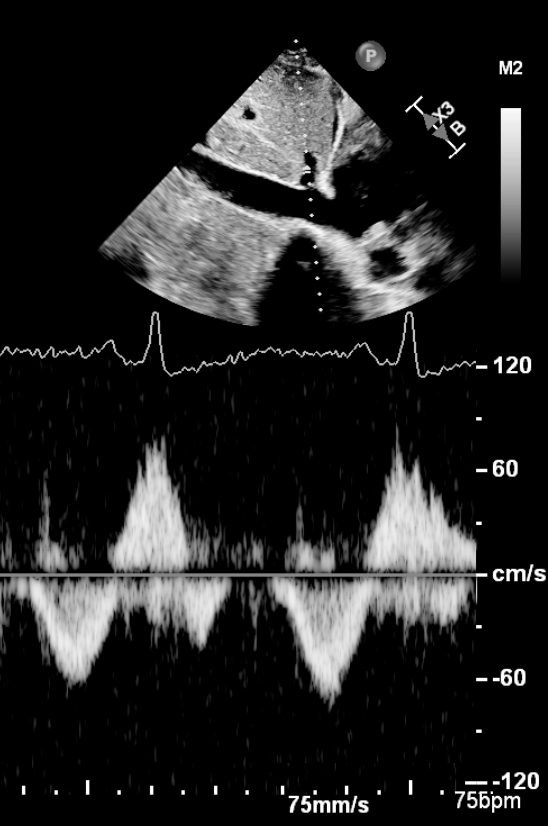
Looks like severe tricuspid regurgitation, with systolic flow reversal into hepatic veins. The flow starts before the QRS, just after the P wave. This is due to the atrial kick. RV dysfunction and elevated filling pressure. Only mild to moderate tricuspid regurgitation.
English
1
0
1
0