David Wiczer

1.4K posts

David Wiczer banner
David Wiczer

David Wiczer

@DavidWiczer

FRB ATL Economist from MN, NM, IL. Simplistic rhythms and vocals that span all the hope and hopelessness of the human condition. My views and not my employer

Brooklyn, NY Katılım Ocak 2021
674 Takip Edilen1K Takipçiler
David Wiczer retweetledi

PILoSSopher
PILoSSopher@pilossopher·
Stuck on a tarmac, so a great time to post about our newly updated MPRD paper (see x.com/davide_melc/st… for a previous summary). What’s new? 1/n
NBER@nberpubs

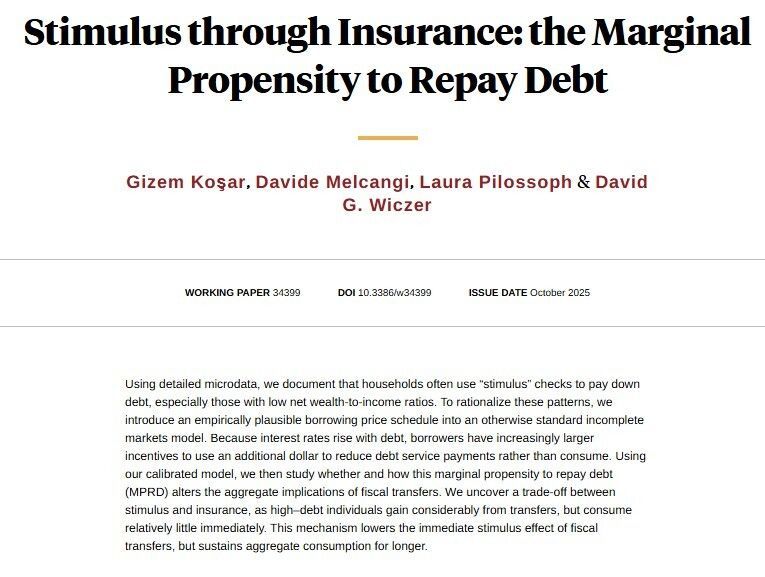
Low net wealth-to-income households repay debt with stimulus checks rather than consume. Debt-price schedules rising with debt explain this, altering the nature of fiscal stimulus, from @gizemkosar, Davide Melcangi, @pilossopher, and @david.wiczer nber.org/papers/w34399

English

1
1
6
616
David Wiczer retweetledi
NBER
NBER@nberpubs·
Low net wealth-to-income households repay debt with stimulus checks rather than consume. Debt-price schedules rising with debt explain this, altering the nature of fiscal stimulus, from @gizemkosar, Davide Melcangi, @pilossopher, and @david.wiczer nber.org/papers/w34399
NBER tweet media
English
1
9
22
5.1K
Sergio Ocampo Díaz
Sergio Ocampo Díaz@socampdi·
Big fan of this paper by @DavidWiczer @LpVisschers and carlos carrillo! We know earnings grow more in expansions and decrease more in recessions. Is that happening to all workers? What about all workers changing jobs? No! Is happening to workers changing *occupations*!
Lisbon Macro Workshop@LisbonMacro

@LpVisschers documents that year-to-year earnings growth is cyclically skewed: flows & their returns shift over the cycle, especially in the tails. Occupational moves matter most and upward mobility is much higher in expansions.

English
4
2
28
2.8K
David Wiczer
David Wiczer@DavidWiczer·
@economoser @socampdi @LpVisschers We actually have this: it was a suggestion by @serdarozkanEN to do this linear decomposition and it's in the appendix (coming forward in the next iteration). Occupation switchers are about 60% of skewness though they're only about 5% of observations Sorry for the slow response!
English
1
1
4
244
Chris Moser
Chris Moser@economoser·
@socampdi @DavidWiczer @LpVisschers Super interesting! What % of cyclical skewness changes are accounted for by occupation transitions? And for what country is this? AFAIK, no good longitudinal admin / LEED records with occupation information in the US 😡
English
1
0
1
208
David Wiczer
David Wiczer@DavidWiczer·
@socampdi I love that piece and kind of thought maybe we were following you guys.
English
0
0
4
73
Sergio Ocampo Díaz
Sergio Ocampo Díaz@socampdi·
Also great application of Shapley-Owen-Shorrocks decomposition! They disentangle the contribution of model parameters across 61(!) counterfactuals of the model using the decomposition!
English
1
0
4
157
David Wiczer
David Wiczer@DavidWiczer·
@Simon_Mongey EXACTLY!! I mean, we're being a bit noisy/ham-handed in how we define a market (an industry) because the data isn't huge, but basically that paper's the whole story: tariffs pass through because of pricing to market.
English
0
0
2
105
David Wiczer
David Wiczer@DavidWiczer·
A fun/important little piece with @AtlantaFed colleagues. Our survey center asked firms how exposed their supply chain was to imports. More import-intensive firms expect to raise prices more *and* the more their competitors import,the more they'll raise atlantafed.org/research/publi…
English
1
4
22
1.3K
David Wiczer
David Wiczer@DavidWiczer·
My co-authors making our work sound sooo good. To quote the video, "in our data, we find that households who are more indebted, instead of spending it immediately they use the stimulus to pay down debt."
Davide Melcangi@davide_melc

Many households used stimulus checks to repay their debts. How does this affect the effectiveness and design of fiscal policy? We discuss our research on the latest @FacultiNet video, based on work with @gizemkosar @DavidWiczer @pilossopher faculti.net/debt-stimulus-…

English
1
0
5
464
Saman Darougheh
Saman Darougheh@DaroughehSaman·
I'm happy to announce that my work on occupational "broadness", mismatch unemployment and the business cycle is forthcoming at the JPE: Macro. This has been a long, long time coming with the help and support of so many people around me. The findings: journals.uchicago.edu/doi/10.1086/73…
English
4
7
66
7.3K
David Wiczer retweetledi
NBER
NBER@nberpubs·
Software substitutes for labor, while equipment complements labor. The rise of software explains higher markups and lower labor share, from Sangmin Aum and Yongseok Shin nber.org/papers/w32591
NBER tweet media
English
5
50
184
31.8K