David Simon

2.7K posts

David Simon

David Simon

@David_E_Simon

Associate Professor at the University of Connecticut. Faculty Research Fellow at the National Bureau of Economic Research. He/Him

Storrs, CT Katılım Aralık 2017
982 Takip Edilen1K Takipçiler
Sabitlenmiş Tweet
David Simon
David Simon@David_E_Simon·
A new working paper drop! work with Katherine Rittenhouse and @lindseybuck95 provides some of the first causal evidence on how investigations for child maltreatment impact child and family outcomes 1/4
David Simon tweet media
English
1
0
13
610
David Simon retweetledi
Arin Dube
Arin Dube@arindube·
I've spent a lot of time with Claude Code in the past 4 months. There have been 3 types of interactions. I want to share a bit here, since most of my fellow economists have a lot to say about AI, apparently. 1) Specific coding asks - too many to count, very much productivity enhancing in specific tasks. Saves time in routine programming. Great. 2) Working with CC with a lot of interaction to model and calibrate: a ton of hand holding but getting very quick feedback on ideas and iteration. I have only *one* successful example of that and it'll likely go into a publication. Very productive, but largely as a highly effective RA who happens to be able to give very fast feedback on ideas (like simulating a model, or estimating using data, to test out a hypothesis). And it took a lot of my time to make it work, with tons of time where CC was going to go off the deep end without my hand holding. So, my managerial capacity was absolutely a critical constraining factor. I can't do this for too many projects. 3) Letting CC "write a paper" from scratch on an interesting topic and prompts, and minimal detailed instructions. Here I found CC roaming free to be highly unpredictable in quality, and largely a disappointment. On matters I have expertise it would often go on the wrong track and reach a dead end unless I veered it away. This includes theory and empirics. When I let it just write a paper based on its findings the quality was questionable, and at the minimum would require major time commitment to make it viable. I have 3 such full-paper drafts. I doubt any of them will see the light of the day. Maybe someone smarter than me can seed CC with the right starting point to produce an enormous number of successful papers. Or, maybe not. Bottom line: based on my very personal experience (not gonna say you all are like me), this makes me feel (1) there are very clear but limited productivity gains in the pipeline (2) people who appear to think we're at the cusp of the singularity will probably be deeply disappointed.
English
4
16
90
10.1K
David Simon retweetledi
Alex Imas
Alex Imas@alexolegimas·
Everyone wants to know how AI will impact jobs. Lots of people are making predictions. @DarioAmodei saying 50% of entry white collar jobs will be gone; @pmarca is saying we'll have more jobs then ever. The problem? We don't have key data to actually make these predictions. Exposure measures only capture some of the story. To predict whether an exposed job will shrink or expand you need data on consumer elasticity of demand, i.e., will consumers buy more if the price decreases. If demand is elastic, jobs can expand and grow; if it is inelastic, they will likely shrink. But we have this data for only a subset of the market, e.g., retail goods from Nielsen scanner data. Great piece from @odonnell_jm in the MIT Tech Review on the need for better data, and fast. technologyreview.com/2026/04/06/113…
Alex Imas tweet media
English
9
22
118
13.4K
David Simon
David Simon@David_E_Simon·
Lots of confidence about the major issues of the future. I'm not saying these predictions are wrong. But we will likely be as successful predicting what is important ten years from now... as we were at predicting today's major issues in 2015.
English
0
2
1
1.2K
David Simon retweetledi
Anup Malani
Anup Malani@anup_malani·
Paper: aeaweb.org/articles?id=10… cc @alexolegimas @ATabarrok — bail is the sharpest example. "Will this person reoffend?" is predictive; "did incarceration cause recidivism?" is causal. Different questions, different tools. Where else do you see economists reaching for the wrong one?
English
1
3
17
4.5K
Soumitra Shukla
Soumitra Shukla@soumitrashukla9·
@David_E_Simon *I agree for the short- and medium-term, but I don't think the current system survives in the long-run.
English
1
0
1
99
Soumitra Shukla
Soumitra Shukla@soumitrashukla9·
The economics journal system, in no small part, much like the NBER, functions as a give-and-take patronage system with power centers that are reproduced to exert control over what counts as important. AI is going to put an end to this. Journals should adapt or become irrelevant.
English
9
3
58
10K
David Simon retweetledi
Dina D. Pomeranz 🟣
Dina D. Pomeranz 🟣@DinaPomeranz·
FWIW, here's my advice for econ PhDs: it's currently extremely difficult to know what and how fundamental the changes will be that result from the expansion of AI. Trying to figure out the "right path" under such large uncertainly may be futile and can lead to paralyzing anxiety. The best strategy IMHO: Work on something you're genuinely interested in. This increases your chances to end up working on something you're interested in in the long term (as you acquire experience in that area), plus it reduces the risk of regretting ex post having spent years doing something you don't like and that ended up being unnecessary. Overthinking in the face of genuine uncertainty like this is a real risk here. In such situations, it makes sense to follow to some degree your gut and to weigh heavily in your choice what you personally enjoy.
Emily Oster@ProfEmilyOster

Advice for PhD students in economics about using AI, from the brilliant Isaiah Andrews. This should probably be circulated to all PhD cohorts economics.mit.edu/sites/default/…

English
4
51
414
87.8K
David Simon
David Simon@David_E_Simon·
The only measure of AI ability that matters is the degree to which it is successfully used by industries and enterprises. So far, that is mixed.
English
0
0
0
49
David Simon
David Simon@David_E_Simon·
@littmath I think AI has the potential to vastly accelerate scientific progress, but if the disciplines aren't careful this type of slop generation could really slow us down...
English
1
0
5
2.1K
Daniel Litt
Daniel Litt@littmath·
Here at [famous scientist’s name].ai, we’re developing tools to accelerate science. Unlike academia, which has stifled the production of high quality scientific work by demanding it be correct, here at [fsn].ai, we know that you can just do (wrong) things.
English
37
231
2.5K
74.4K
David Simon
David Simon@David_E_Simon·
@MartinHSaavedra I imagined this yesterday: sitting at a terminal of the God-Brain asking it if the minimum wage increases unemployment and getting really vague and contradictory answers.
English
0
0
1
27
Martin Saavedra
Martin Saavedra@MartinHSaavedra·
Conjecture: If AIs become oracles, research will become similar to being a graduate student. We will study under “someone” who knows much more than us, wrapping our heads around what they have to say and asking questions when statements are not obvious. When we feel like we learned something that it’s important enough for others to learn, we then teach it to our peers. Teaching and studying will become more important parts of the job, and less separated from the research process.
English
1
0
1
156
David Simon
David Simon@David_E_Simon·
@testingham I think in ten years we will still be arguing over how to measure performance on many, many tasks.
English
0
0
7
708
tom cunningham
tom cunningham@testingham·
I think many economists agree with the following, but it would be valuable to make this publicly known: 1. There is a substantial probability (>10%) that AI will exceed human-level performance on virtually all non-physical tasks within ten years. 2. This would be an unprecedented shock to human society. 3. The economics profession should treat it with an urgency comparable to WWII or COVID.
English
40
38
379
76.5K
David Simon
David Simon@David_E_Simon·
As scientists try to automate parts of science and math there will be a lot of this type debate moving forward. The reputational consequences of claiming to have shown X without having personally verified it (or not giving proper caveats) should be large.
Daniel Litt@littmath

@prz_chojecki I'm happy to give you some time to check that the error I've flagged is real. But extremely bad behavior to claim to have solved this problem, given that neither you nor anyone else has checked the solution's correctness, and that someone has pointed to an error.
English
0
0
2
99
David Simon
David Simon@David_E_Simon·
@itaisher ... and probably also learn how to retroactively re-interpret their predictions to match what the future turns out to be...
English
0
0
1
43
Itai Sher
Itai Sher@itaisher·
My prediction is that a new generation of people is going to rediscover how hard it is to predict the future.
English
1
1
16
938
David Simon retweetledi
Arin Dube
Arin Dube@arindube·
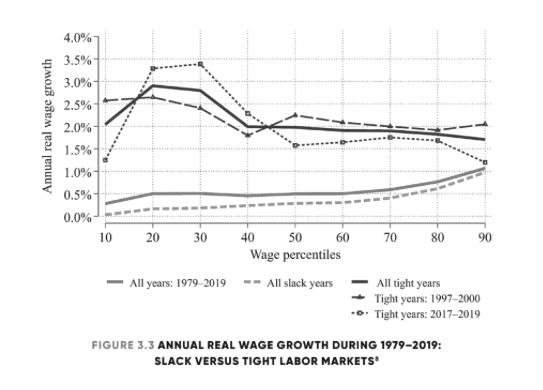
A striking fact I learnt researching my book: For those in the bottom half, much of the real wage growth between 1979 and 2019 happened over just 7 "tight" years. For top wages, full employment wasn't a big deal. For bottom wages, it was the nearly the whole game.
Arin Dube tweet media
Arin Dube@arindube

What's behind the ebbs and flows in wages over the past century? That’s what my forthcoming book, The Wage Standard, is all about: how rules, norms, and power in the labor market shape who shares in growth. Coming out March 31. Pre-order here: thewagestandard.com

English
10
102
353
99.8K
Martin Saavedra
Martin Saavedra@MartinHSaavedra·
I'm only speaking for myself here, not the whole research team, but here's my take: There's definitely evidence that the parents of the affected birth cohort were lower SES. Given the selection is there, it's hard to say much definitive. My best guess is still negative, but smaller. I want better evidence (either way!), and I hope we'll get that soon.
English
1
0
3
70
Paul Novosad
Paul Novosad@paulnovosad·
People with econ phd knowledge only: What was the long-run effect of the 1918 flu on in utero cohorts? Pls answer before clicking on thread
English
2
1
9
13.2K
David Simon
David Simon@David_E_Simon·
@paulnovosad @MartinHSaavedra I think see table 7 in the paper. Smaller but still substantial effects, when you tighten to just look at cohorts directly around the pandemic they lose significance. arguably that's pushing the data too hard... so it depends on your prior on if in-utero shocks matter.
English
0
0
1
57
David Simon
David Simon@David_E_Simon·
@paulnovosad When I talked to @MartinHSaavedra about this paper, I thought his view was that under alternative estimation strategies the basic punchline of the original Almond paper held up. That was a few years ago though...
English
2
0
1
283
David Simon
David Simon@David_E_Simon·
@maiamindel My sense is it is easier to automate theoretical modeling then data work...
English
0
0
1
637
Maia
Maia@maiamindel·
fortunately the success of economics as a field has come and will continue coming from applying core economic concepts and thinking to important real-world problems instead of the intellectual dead end of data science freakonomics tricknology with swedish public health statistics
Pradyumna (in Bay Area)@PradyuPrasad

i think economics as a profession will change rapidly. everyone can now do data analysis at the drop of a hat. things that were award winning papers 20 years ago are five second codex prompts

English
12
63
792
49.1K
David Simon retweetledi