Wow. Never knew this:
"Burns was a conservative-leaning economist who personally disliked inflation and understood its risks, but his tenure coincided with (and is often blamed for contributing to) the Great Inflation of the 1970s (roughly 1965–1982), when inflation averaged around 9% at times."
For an economist who "disliked inflation", he sure had a lot of it!
@DavidtheFish@BrianRoemmele It was mostly the Kennedy/Johnson appointees to the Fed’s BoG, who thought they could fine-tune the economy and prevent recessions by allowing a little bit of extra inflation. Vietnam, the Great Society, tax cuts and Arthur Burns made things worse.
richmondfed.org/publications/r…
@DavidtheFish@BrianRoemmele The inflation started in the 1960s. By 1971, there was a high risk of a run on US gold stocks by foreign central banks, which would have wiped them out, so Nixon suspended convertibility.
A peer-reviewed paper published last year in the journal Bioethics by two professors at Western Michigan University School of Medicine argues that it is "morally obligatory" to genetically engineer ticks to spread alpha-gal syndrome, a permanent condition that makes you violently allergic to red meat.
The paper is called "Beneficial Bloodsucking."
Their argument: if eating meat is morally wrong, then preventing the spread of a disease that forces people to stop eating meat is also morally wrong. Scientists should gene-edit lone star ticks to enhance their ability to carry alpha-gal syndrome and expand their range into urban environments to infect more people.
They call this a "moral bioenhancer." They frame releasing genetically modified disease-carrying ticks as a "vaccination" that only "infringes" on your bodily autonomy rather than "violating" it. The distinction, apparently, is that a tick bit you instead of a government official holding you down.
Alpha-gal syndrome is not mild. The CDC estimates up to 450,000 Americans are already affected. Cases have surged 100-fold in the last decade. Symptoms include anaphylaxis. There is no cure.
Alpha-gal cases are exploding across the United States. The lone star tick's range is expanding far beyond its historical territory. And two academics at a medical school published a paper arguing this is a good thing that should be accelerated.
At what point do we stop treating papers like this as fringe academic exercises and start asking whether anyone is already acting on them?
@ihtesham2005 The actual researchers recommend balance: keep handwriting where it helps learning, use digital tools where they’re superior (drafting, editing, volume, accessibility), and using X. 😂
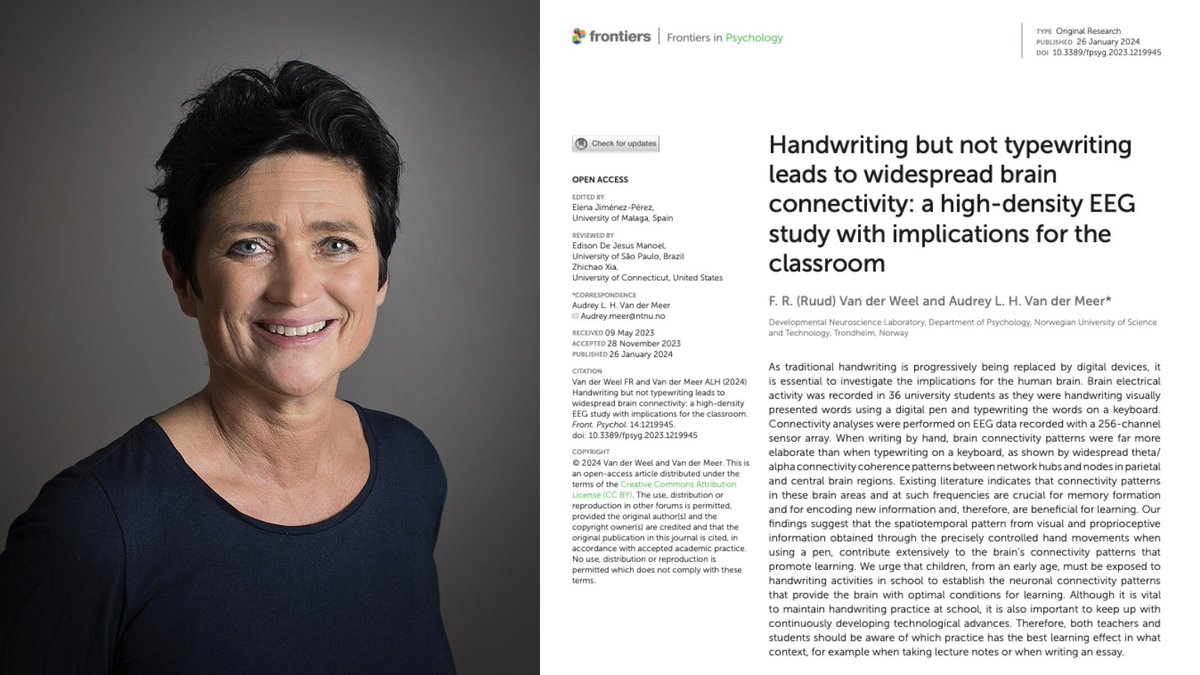
A Norwegian neuroscientist spent 20 years proving that the act of writing by hand changes the human brain in ways typing physically cannot, and almost nobody outside her field has read the paper.
Her name is Audrey van der Meer.
She runs a brain research lab in Trondheim, and the paper that closed the argument was published in 2024 in a journal called Frontiers in Psychology. The finding is brutal enough that it should have changed every classroom on Earth.
The experiment was simple. She recruited 36 university students and put each one in a cap with 256 sensors pressed against their scalp to record brain activity. Words flashed on a screen one at a time.
Sometimes the students wrote the word by hand on a touchscreen using a digital pen, and sometimes they typed the same word on a keyboard. Every neural response was recorded for the full five seconds the word stayed on screen.
Then her team looked at the part of the data most researchers had ignored for years, which is how different parts of the brain were communicating with each other during the task.
When the students wrote by hand, the brain lit up everywhere at once.
The regions responsible for memory, sensory integration, and the encoding of new information were all firing together in a coordinated pattern that spread across the entire cortex. The whole network was awake and connected.
When the same students typed the same word, that pattern collapsed almost completely.
Most of the brain went quiet, and the connections between regions that had been alive seconds earlier were nowhere to be found on the EEG.
Same word, same brain, same person, and two completely different neurological events.
The reason turned out to be something nobody had really paid attention to before her work. Writing by hand is not one motion but a sequence of thousands of tiny micro-movements coordinated with your eyes in real time, where each letter is a different shape that requires the brain to solve a slightly different spatial problem.
Your fingers, wrist, vision, and the parts of your brain that track position in space are all working together to produce one letter, then the next, then the next.
Typing throws all of that away. Every key on a keyboard requires the exact same finger motion regardless of which letter you are pressing, which means the brain has almost nothing to integrate and almost no problem to solve.
Van der Meer said it plainly in her interviews.
Pressing the same key with the same finger over and over does not stimulate the brain in any meaningful way, and she pointed out something that should scare every parent who handed their kid an iPad.
Children who learn to read and write on tablets often cannot tell letters like b and d apart, because they have never physically felt with their bodies what it takes to actually produce those letters on a page.
A decade before her, two researchers at Princeton ran the same fight using a completely different method and ended up at the same answer. Pam Mueller and Daniel Oppenheimer tested 327 students across three experiments, where half took notes on laptops with the internet disabled and half took notes by hand, before testing everyone on what they actually understood from the lectures they had watched.
The handwriting group won by a wide margin on every question that required real understanding rather than surface recall.
The reason was hiding in the transcripts of what the two groups had actually written down.
The laptop students typed almost word for word, capturing more total content but processing almost none of it as they went, while the handwriting students physically could not write fast enough to transcribe a lecture in real time, which forced them to listen carefully, decide what actually mattered, and put it in their own words on the page.
That single act of choosing what to keep was the learning itself, and the keyboard had quietly skipped the choosing and skipped the learning along with it.
Two studies. Two countries. Same answer.
Handwriting makes the brain work. Typing lets it coast.
Every note you have ever typed instead of written went into your brain through a thinner pipe. Every meeting, every book highlight, every idea you captured on your phone instead of on paper was processed at half depth.
You did not forget those things because your memory is bad. You forgot them because typing never woke the part of the brain that would have made them stick.
The fix is the thing your grandmother already knew.
Pick up a pen. Write the thing down. The slower road is the faster one.
This is what I could find:
- Studies indicate Metarhizium anisopliae is generally safe for birds and mammals, with no observed mortality or health impacts in tested species like quail and pheasants, though standard application precautions against direct inhalation or ingestion apply.
NEW: 50 empty Waymos invade Atlanta neighborhoods and circle their cul-de-sacs for hours early in the mornings.
Residents say they are getting waymo traffic than usual and have tried combating the cars with a neon green sign, which only made the problem worse.
The Waymos didn't know what to do and clogged the entire street.
"We have small animals and pets, got kids getting on the bus in the morning, and it just doesn’t feel safe to have that traffic," one resident said.
The residents say Waymo has not given them a response yet.
Nature just dropped the ultimate counter to the deep state tick bioweapon.
Guinea hens are straight-up tick assassins. Patrol the yard and eat up to 1,000 ticks a day. Lyme? Alpha-gal? Forget Bill Gates’ lab-grown future, get yourself some guinea fowl.
The U.S. Forest Service is spraying glyphosate (Roundup) across tens of thousands of acres of national forests this spring to support commercial timber production.
Following wildfires, forests naturally regenerate with diverse shrubs, wildflowers, and wildlife. However, a recent investigation reveals that the Forest Service and private logging companies are routinely applying the herbicide to eliminate competing native vegetation, favoring commercially valuable species such as Douglas fir and sugar pine.
This practice has created large areas with significantly reduced biodiversity, often described as "dead zones", where insect, bird, and plant populations have sharply declined. Glyphosate, classified by the World Health Organization as a probable human carcinogen, has seen its use in California national forests quintuple over the past two decades, reaching a record 266,000 pounds in 2023.
Local communities, environmental groups, and residents are raising concerns about potential impacts on water quality, endangered species (including salmon and rare foxes), and public health. Critics argue that prioritizing industrial timber production over ecological diversity conflicts with the broader mission of national forests as public lands.
The issue has intensified debates over forest management, balancing economic interests with long-term environmental and community health.
@DefectingGrey@Rainmaker1973 I didn't say human have a shikimate pathway. I said the "it affects the shikimate pathway in bacteria". Calling me silly and lazy when you didn't even read what wrote is next level hypocrisy. You dork. 😂
@DavidtheFish@Rainmaker1973 For a start, humans don’t have a shikimate pathway.
Copy/pasting stuff off the internet when you know nothing about it is silly and lazy.
Glyphosate can disrupt the gut microbiome (it affects the shikimate pathway in bacteria), which some link to digestive issues, inflammation, or non-celiac gluten sensitivity symptoms. We may find that this gut microbiome disruption has a larger part to play in cancer and overall diseases.
A big difference between Europe and the USA is Pre-harvest desiccation (spraying near harvest to dry the crop for easier harvesting, which leaves higher residues) is not permitted in the EU, including France, as of the 2023 renewal conditions. This reduces residue risk compared to places like the US or Canada where it's more common.
This single practice difference means European wheat generally has lower glyphosate residues from harvest-time application.
Many anecdotal reports (common on forums, travel stories) describe people with "gluten issues" in the US eating bread in Europe without problems. While not scientific proof of causation, the residue difference aligns with a plausible mechanism for gut irritation.
@Rainmaker1973 You said this:
“Glyphosate, classified by the World Health Organization as a probable human carcinogen”
This is not true.
It was one WHO agency, the IARC, and this was a fraudulent finding.
The WHO declared it non-carcinogenic.
foodscienceinstitute.com/2016/07/03/the…
@Andercot "In the name of Christendom" they made the Aztecs into their slaves, killed most of them, burned their artworks, erased their history, and razed Tenochtitlan to rubble after a siege that starved the inhabitants.
This is not the win that *some* Christians apparently think it is.
Let's consult the historical record to see what the Aztec society was up to when the Spanish conquered it.
First, from Cortes:
“They have a most horrid and abominable custom which truly ought to be punished and which until now we have seen in no other part, and this is that, whenever they wish to ask something of the idols, in order that their plea may find more acceptance, they take many girls and boys and even adults, and in the presence of the idols they open their chests while they are still alive and take out their hearts and entrails and burn them before the idols, offering the smoke as sacrifice. Some of us have seen this, and they say it is the most terrible and frightful thing they have ever witnessed… not one year passes in which they do not kill and sacrifice some fifty persons in each temple; and this is done and held as customary… not one year has passed… in which three or four thousand souls have not been sacrificed in this manner.”
And now Bernal Diaz del Castillo:
“The dismal drum of Huichilobos sounded again, accompanied by conches, horns and trumpet-like instruments. It was a terrifying sound, and when we looked at the tall cue [temple] from which it came we saw our comrades who had been captured in Cortes’ defeat being dragged up the steps to be sacrificed. When they had hauled them up to a small platform in front of the shrine where they kept their accursed idols we saw them put plumes on the heads of many of them; and they made them dance with a sort of fan in front of Huichilobos. Then after they had danced the papas [priests] laid them down on their backs on some narrow stones of sacrifice and, cutting open their chests, drew out their palpitating hearts which they offered to the idols before them.”
...
“Every day we saw sacrificed before us three, four or five Indians whose hearts were offered to the idols and their blood plastered on the walls, and their feet, arms and legs of the victims were cut off and eaten… Every wall of this chapel and the whole floor, had become almost black with human blood, and… the stench was worse than in a Spanish slaughter-house.”
...
“When we arrived at the great market place, called Tlaltelolco, we were astounded at the number of people and the quantity of merchandise that it contained… Let us begin with the dealers in gold, silver, and precious stones, feathers, mantles, and embroidered goods. Then there were other wares consisting of Indian slaves both men and women; and I say that they bring as many of them to that great market for sale as the Portuguese bring negroes from Guinea…. They brought some of them tied to long poles by means of collars around their necks so they would not escape, and others left loose.”
~~
This is what the Spanish conquered in the name of Christendom - a Stone-Age society consumed with ritualistic human sacrifice, cannibalism and slavery.