Nguyễn Tiến Đạt retweetledi
Nguyễn Tiến Đạt
368 posts

Nguyễn Tiến Đạt retweetledi

Harsh Truth: Your big goals are destroying your happiness.
3 reasons why (and what to do about it):
1. Extrinsic Focus
In a meta-analysis of 105 studies covering over 70,000 participants, researchers found that valuing and prioritizing extrinsic goals (over intrinsic goals) is a recipe for lower well-being.
My observation is that Big Goals tend to be extrinsic in nature:
• Promotion, title, or raise
• Financial achievement
• Hitting a specific follower count
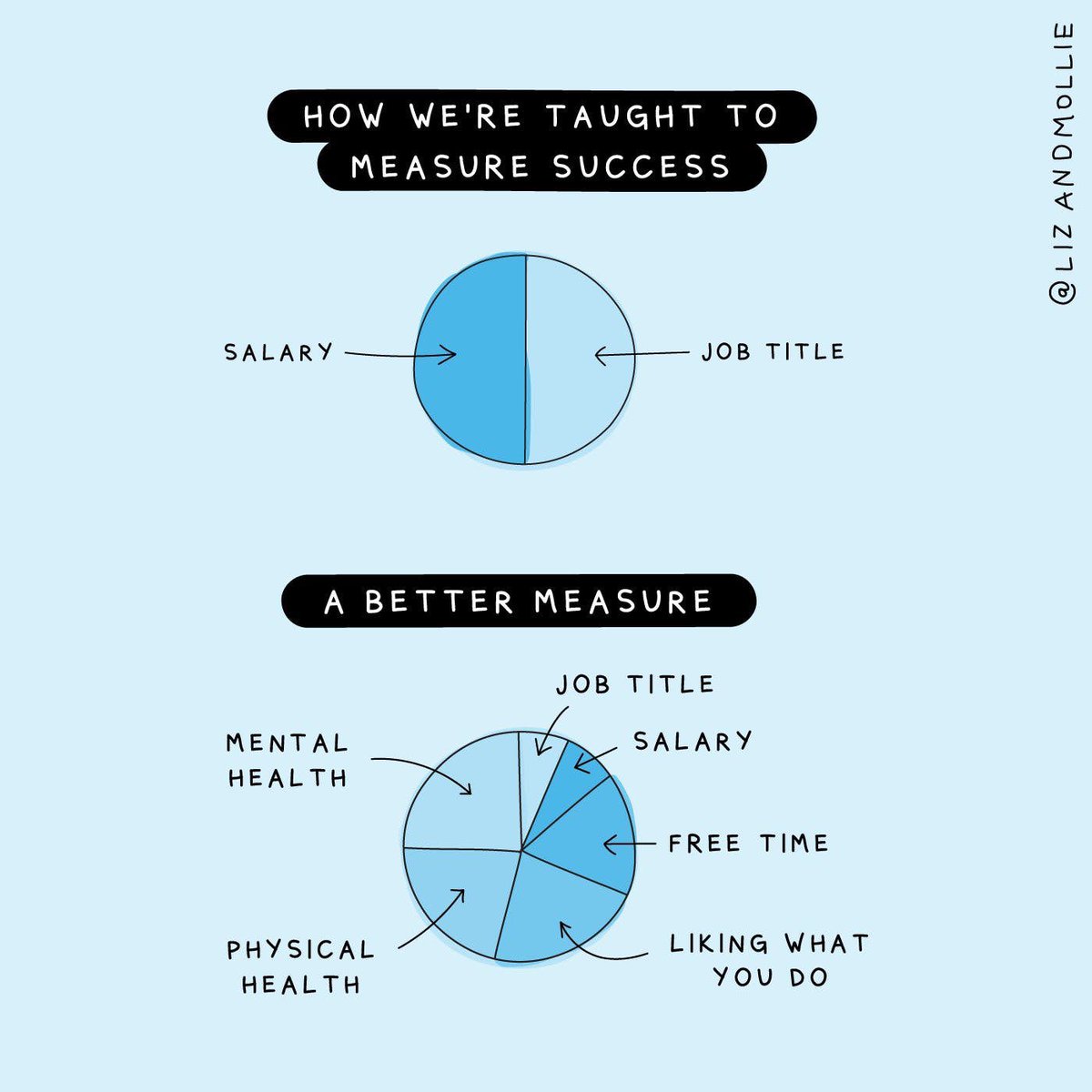
These Big Goals become how we define success for ourselves and our lives.
Achieving the last Big Goal is never enough, as we simply reset our scoreboard and need to achieve the next Big Goal to feel like a success.
By defining our success on the basis of these extrinsic goals, we are setting ourselves up for unhappiness.
2. The Arrival Fallacy
How many times have you assumed that your lasting happiness was on the other side of some Big Goal (a promotion, a pay raise, another degree, etc.)? How many times have you been proven wrong in this assumption?
The Arrival Fallacy is the term used to describe the false assumption that achieving a Big Goal will create that lasting happiness in our lives.
It's a "When, Then" psychology that says "when I achieve X, then I'll be happy." The reality is that achievement is not a lasting source of happiness.
3. Purpose Dissipation
When you are hunting a Big Goal, you wake up with a clear purpose.
After you achieve it, you wake up with no clear reason to push yourself. You feel a bit lost, as you may not know what you're working on or towards that day.
The focus on a singular Big Goal creates a purpose, but also destroys it once the Big Goal is achieved.
Ok, so what can we do about it?
Set direction with Big Goals, but focus on Micro Goals.
Micro Goals are small, incremental growth and development targets. They aren't the giant leaps, but the small steps that happen along the way.
Micro Goals solve the three main pain points of Big Goals:
• More intrinsic by nature—partially because they aren't big enough to share publicly for clout or external affirmation. They refocus you internally.
• Small enough that you don't tie some grand happiness assumptions to their achievement. They keep you motivated to grow, without the pressure that they will individually change your life.
• Continuous vs. discrete. There is no big purpose let down, because there is always another Micro Goal on the near-term horizon that you can use for motivation.
My go-forward approach is as follows:
1. Establish Big Goal to set direction.
2. Establish Micro Goals to set daily focus.
3. Adjust and course correct based on evidence.
Balancing the Big with a focus on the Micro is where I plan to thrive. Small is beautiful. A lot of small wins add up to something spectacular.
Remember: Ordinary becomes extraordinary.
***
If you enjoyed this or learned something, follow me @SahilBloom for more in future!

English
Nguyễn Tiến Đạt retweetledi

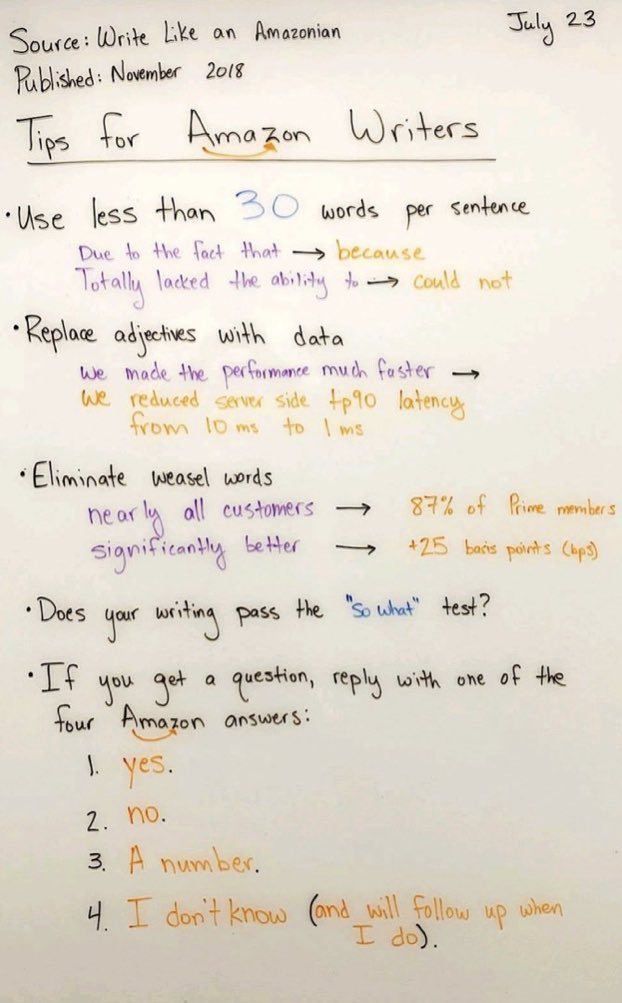
In 2018, an Amazon employee shared the company’s “7 Tips for Business Writing.”
They’re a must-read for anyone who wants to write more clearly.
1. Use fewer than 30 words per sentence
Constraints drive clear thinking.
And the best constraints force you to use less words, not more.
If you can explain something in simple terms, you likely understand it well.
2. Use subject-verb-object sentences
The goal of writing is to transfer your thoughts to another person with as little lost in translation as possible.
It’s a big game of telephone.
The simpler your sentences, the more accurately your ideas will be translated.
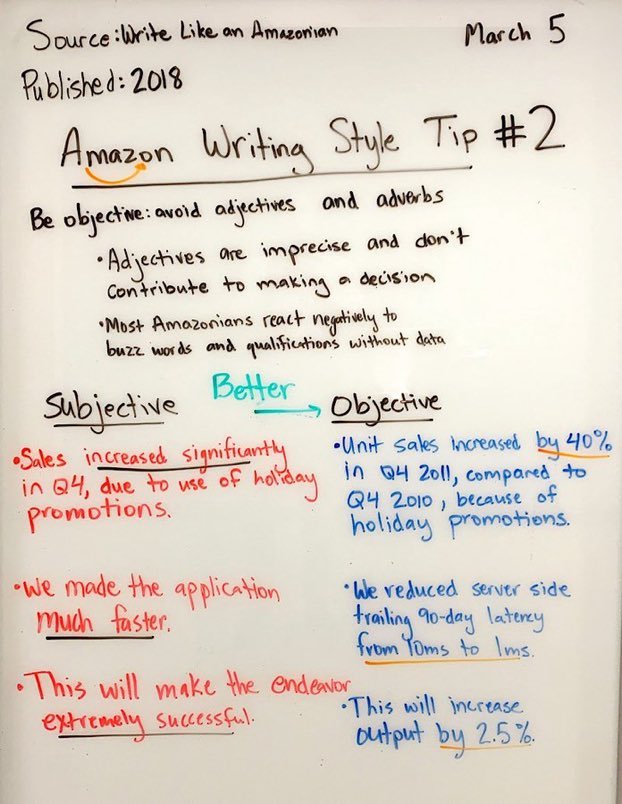
3. Replace adjectives with data
“Customers love Prime.”
“Customers with Prime spend on average 3x more than those without and we retain 90% of them year over year.”
Specificity leads to clear results and quick decision-making.
4. Pass the “so what” test
The reader should immediately know what action you want them to take.
Make sure to answer who, what, and when.
Otherwise, you’ve wasted your time and the reader’s.
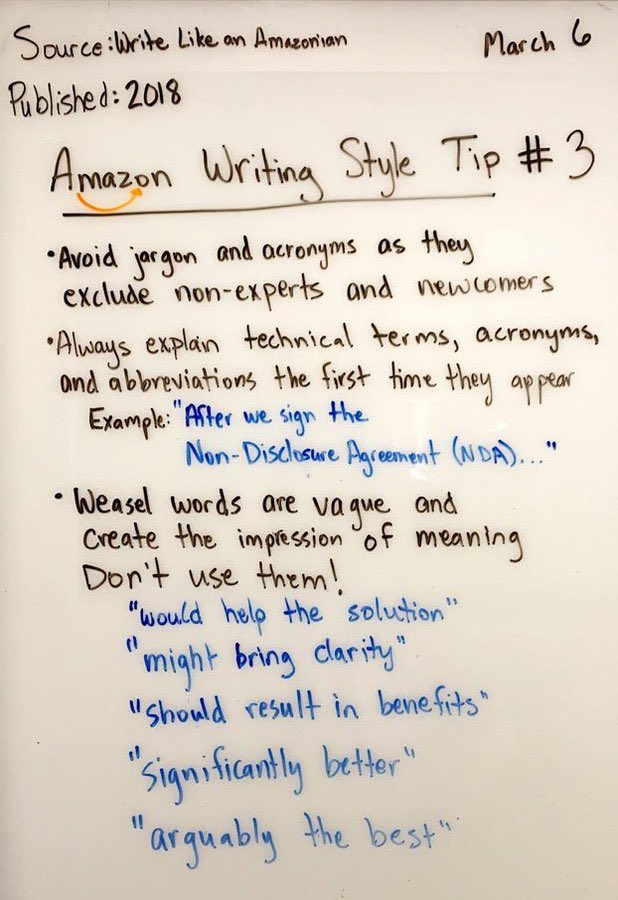
5. Eliminate weasel words
Most weasel words are adverbs.
“Nearly,” “Significantly,” “Almost.”
These words are imprecise. They may mean one thing to you, and another to your boss.
Get rid of them.
6. Avoid clutter words
Utilize → use
In order to → to
Until such time as → until
Due to the fact → because
Getting rid of clutter focuses your message on the parts that matter.
7. Avoid jargon and acronyms
Companies are littered with internal jargon.
But this excludes new employees and anyone external to the company.
When wanting to use an acronym, write it out the first time it’s used in any document.
Clear > clever
***
The best marketers are relationship builders — strong internal alignment separates good from great.
So I got interested in Amazon’s writing.
Because writing is communication and communication is alignment.
Follow @TheMarkJung for more content like this on marketing and media.


English
Nguyễn Tiến Đạt retweetledi

"Decisions:
• If you can’t decide, the answer is no.
• If two equally difficult paths, choose the one more painful in the short term (pain avoidance is creating an illusion of equality).
• Choose the path that leaves you more equanimous in the long term."
@naval
English
Nguyễn Tiến Đạt retweetledi