Dimitri018🔥🐝🔥
741 posts

Dimitri018🔥🐝🔥
@Dimitri0181
https://t.co/IWi8slUQxg👁️❤️☢️ All tweets are not financial advice. DYOR.
Katılım Nisan 2021
508 Takip Edilen129 Takipçiler

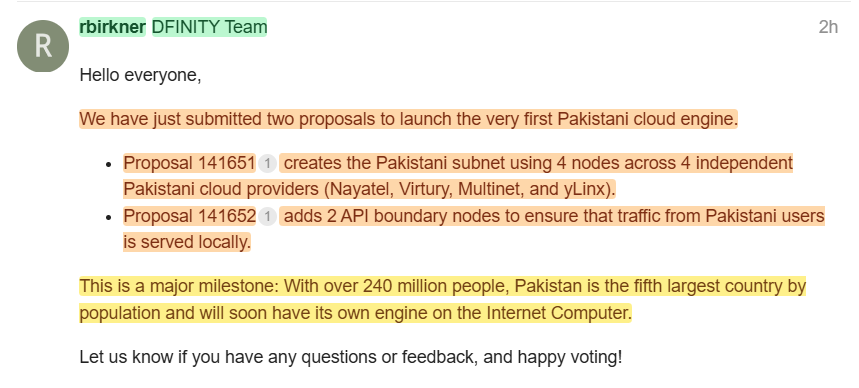
The launch of the very first Pakistan Cloud Engine on $ICP is imminent 🇵🇰
This is a major milestone: With over 240 million people, Pakistan is the fifth largest country by population and will soon have its own engine on the Internet Computer🔥
20% of the Revenue will be burned in a 100% deflationary Model.
Meanwhile, other Crypto projects are dealing with Hacks and major security issues/exploits.
English
Dimitri018🔥🐝🔥 retweetledi

For more than 10 yrs, I've worked on "frontier compute." I've worked on this since the "world computer" vision was first mooted.
Nowadays, the terms "crypto," "web3" and "blockchain" are inextricably linked to speculative assets. But this is 1 niche application of the tech. 🧵
English
Dimitri018🔥🐝🔥 retweetledi

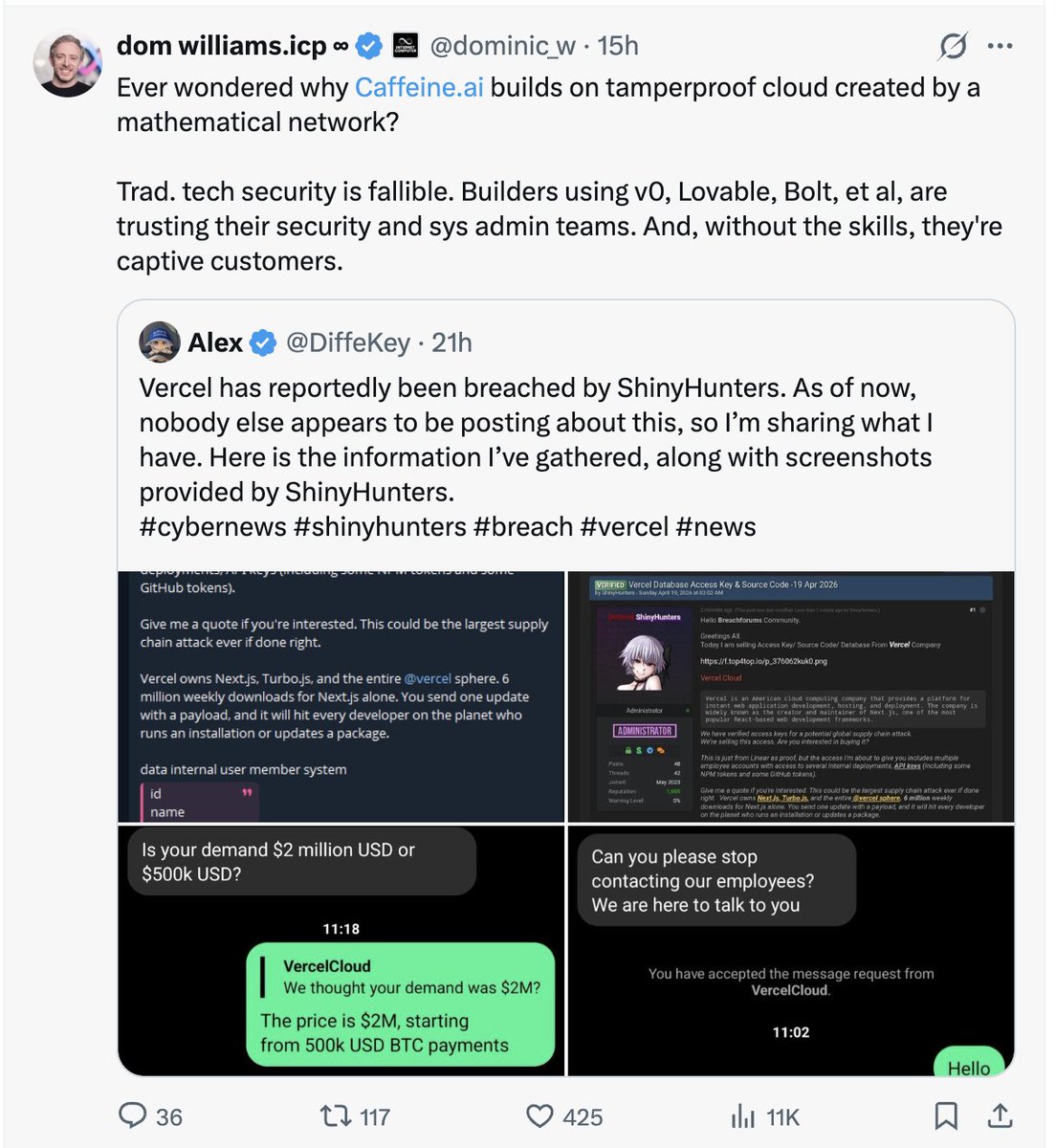
The ICP boom is a few hacks away.
$600M stolen from DeFi in 20 days. Kelp DAO $293M via a bridge.
Drift $285M via social engineering. 12+ protocols hit. Now add Vercel — breached front-end, one malicious update away from hitting every developer running Next.js. Same lesson.
Every single attack vector — bridges, cross-chain messaging, oracle manipulation, centralized front-ends — is architecturally impossible on @dfinity ICP.
No bridges. No external oracles. No centralized front-ends. Computation fully on-chain since 2021.
The DeFi ecosystem is spending another $600M learning what ICP built natively.
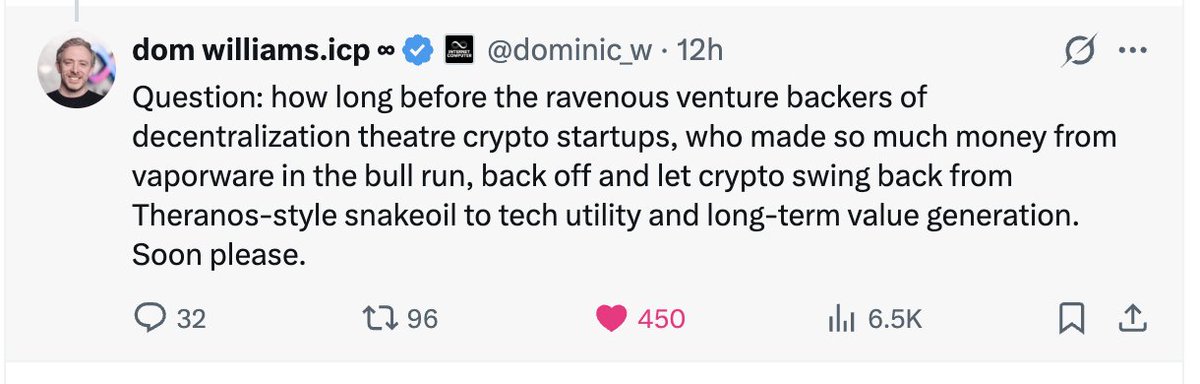
dom | icp@dominic_w
I recently raised the alarm re: LayerZero's claims Zero is an AWS alternative (compute costs are 100,000X+ more): x.com/dominic_w/stat… 2024, people were already raising alarm re: their 1-of-1 "Decentralized" Verifier Networks (DVNs): x.com/ChainLinkGod/s… Beware snakeoil⚠️
English
Dimitri018🔥🐝🔥 retweetledi
@NavarroFes Caffeine is also going to be adding value for users of Claude Code, Perplexity Computer, Codex, etc (for example, more seamless deployment experience). And DFINITY and Caffeine both will be actively building out skills.internetcomputer.org. Again, this is just getting started
English
Dimitri018🔥🐝🔥 retweetledi
When the AWS data centers got "droned" in the Middle East, vast swathes of web3 stopped working properly, exposing "decentralized theatre".
But I'm hopeful many projects will see ICP cloud engines as an acceptable fix given the control it provides to administrators. Not joking.
English
Dimitri018🔥🐝🔥 retweetledi

I genuinely believe the next MULTI-BILLION-DOLLAR platform in vibe coding is here right now.
Not a meme.
Not a gamble.
A revolution.
The NVIDIA of vibe coding.
A platform that drags the entire AI-dev market vertical — just like NVIDIA took the S&P 500 to new highs.
A platform that goes from zero to hundreds of millions in revenue in months.
A platform that fuses AI + true execution into one unstoppable force.
I don’t have to guess its name anymore.
It’s caffeine.ai.
The thing about caffeine.ai is not hype, not another “chat-to-prototype” narrative, not “no-code 2.0” talk.
It’s the architecture.
While old vibe coding tools (Replit, Lovable, Base 44) still focus on prompt-to-UI or prompt-to-cloud-backend and outsource the hard parts to traditional servers, caffeine.ai flips the entire model. The full stack lives on-chain — frontend, backend, data, identity, everything. Not theoretical, not “coming soon,” but already running in production today.
That changes the game completely.
Because once the AI doesn’t just generate code but deploys it into a cryptographically secured, decentralized environment with no AWS, no centralized choke points, and no gatekeepers, you remove the last remaining friction between idea and revenue-generating product.
Caffeine.ai is built on a completely new tech stack designed as a force-multiplier for AI:
• Backend is written by AI in Motoko — the first programming language literally created for AI agents.
• Everything runs on the Internet Computer (ICP) — the world computer that hosts full applications directly on the blockchain.
• Data persistence is built-in and guaranteed: updates can’t accidentally wipe your database (a nightmare that still happens on cloud-based vibe tools).
• No more servers to manage, no more surprise bills, no more “deploy and pray.”
Developers (and non-developers) don’t just get a pretty mockup — they get a production-ready, monetizable app served directly from the protocol. Globally accessible, censorship-resistant, and built for real revenue from day one.
And this is where the AI + revenue flywheel actually works:
AI lowers the barrier to creation → caffeine.ai removes the barrier to secure deployment and monetization.
Anyone who can think + prompt + iterate can ship software that is:
• live on a real URL in minutes
• automatically scalable and secure
• monetizable by design (payments, subscriptions, tokens — native to the stack)
No more “I built it on Replit/Lovable/Base 44… now how do I actually host it without breaking the bank or losing data?”
Caffeine.ai gives you clean, exportable code and a decentralized home for it.
Identity is seamless too (Internet Identity removes passwords). Interoperability with Bitcoin and Ethereum is native. Cycles replace complicated gas abstractions. Users don’t even need wallets just to interact.
So fundamentally, caffeine.ai is not trying to be:
“another vibe coding tool”
It’s trying to be:
the environment where vibe-coded software actually lives and makes money.
And here’s the uncomfortable truth:
Most vibe coding platforms tokenize ideas.
Caffeine.ai tokenizes execution — securely, on-chain, with real economic guarantees.
If AI keeps its exponential curve (and it will), the bottleneck is no longer “how fast can I generate code?”
The bottleneck becomes:
Where does that code live?
Who controls it?
Who captures the revenue?
If the answer is still Big Tech clouds or fragile no-code platforms, nothing fundamentally changes.
If the answer is caffeine.ai on the new ICP tech stack…
then yeah — things get very, very interesting.
Not because of hype.
Because the stack actually allows it.
This is the revolution the image above is showing you.
Old tools on the right and top-right.
The new stack that changes everything in the top-left: caffeine.ai.

English
Dimitri018🔥🐝🔥 retweetledi
As caffeine.ai transitions to V3, it is now clearer than ever.
There is only 1 onchain cloud network: the Internet Computer (ICP). There is no room for debate. After years of relentless R&D, the technology remains completely unmatched. And it's getting better 🔥.
English
Dimitri018🔥🐝🔥 retweetledi
Caffeine v3.0 ☕️, Tuesday, April 7th
caffeine.ai
A new era begins on ICP in a few days. A huge Caffeine upgrade will take place. This is about more than the new features it packs: what can be built on the Internet Computer through chat alone shall advance by a quantum leap.
It will blow your mind, because you can go so much further: those wanting to build apps and services on self-writing cloud, where every technical task is automated and directed by natural language interaction, may rationally decide that the Internet Computer is the place to be thanks to the work of Caffeine Labs.
But, stunning as the v3.0 advance is, this only marks the beginning of a new beginning for ICP. Caffeine is just getting started, and will be joined by other major advances unfolding in the ICP ecosystem. Several things are coming together:
1) The architecture that powers Caffeine v3.0 will ensure it continues to grow more powerful as time goes on. We expect that it will be possible for non-technical people to build almost anything on the Internet Computer in the future. Eventually special features like "Caffeine Snorkel" will also make it possible to auto-migrate legacy apps and services to the Internet Computer.
2) For the first time, Caffeine will allow all users to publish the App Market, so that other users can install copies of their apps, and if they want, remix them, since apps from the market are mutable and can be changed as needed. This is important change will be followed by the activation of monetization features, which will kickstart a new open source onchain economy based around the AI-driven development of re-usable apps and services.
3) Caffeine apps use ICP Blob Storage (which is currently exclusively available to Caffeine owing to its ongoing development) to maintain copies of files and binary large objects. Coming advances will enable Caffeine apps to store data at the world's best $/GB — making the Caffeine the perfect plartform to use to build apps that must store and share large amounts of data (for example, for a photo sharing app, or a team communications platform where video meetings are routinely recorded and archived).
4) Caffeine will soon be joined by new ICP "cloud engine" functionality, and then, the Internet Intelligence Network (IIN) — two new parts of the Internet Computer. Cloud engines will provide enterprise users with much more control over how the Internet Computer hosts their apps and services. IIN will provide everyone with access to inference on open weights models at lower cost than is possible today (for example allowing a business to create an e-commerce website on the Internet Computer where every customer can be helped through product exploration by AI, without worrying about the cost).
5) Cloud engines, which are essentially private subnets that can be controlled via a control panel, enable the Internet Computer to provide a cloud experience that feels more familiar to prosumers and enterprises used to centralized clouds. Users will be able to select the nodes combined to power their cloud engines, and nodes can include cloud-on-cloud nodes, such as AWS instances, as well as traditional sovereign node hardware. These nodes can be chosen to match precise throughput needs, or regulatory requirements (e.g. GDPR). The Internet Computer is thus transforming into a mass market cloud solution.
6) Powerful additional advantages of cloud engines include a) since they are essentally Internet Computer subnets, as usual hosted apps and services are tamperproof and unstoppable, and don't require support by security and systems administration personnel, b) hosted apps can have their query throughput auto-scaled horizontally by adding nodes, which can be located in proximity to demand, and can have ther update throughput auto-scaled by splitting the engines — enabling auto-scaling where software does not have to be updated — and c) owners can traverse underlying compute vendors and geographies and jurisdictions, simply by adding and deleting nodes, which can be done without interrupting hosted apps.
7) The Internet Intelligence Network is an extension to the Internet Computer that we plan to propose to the NNS soon (which I have mentioned before). This will be powered by community-operated hardware devices, which crucially, in combination with new technology we are developing, shall shall facilitate provision of lower per-token inference costs than AI clouds can currently achieve within targeted market segments (low costs that are derived from the technology involved, in contrast to certain contemporary decentralized GPU networks that use token appreciation to drive unsustainable subsidization flywheels).
8) A key unique additional aspect of IIN is that inference is verifiable, just like onchain compute — that is, those supplying prompts and context will know that their results are correct, and shall not have to trust that the IIN nodes powering inference haven't changed their results (for example, by inserting advertising, or malicious content). The strength of the verification is configurable. In the default mode, there will be no discernible difference in cost or performance/time thanks to the techniques developed. In higher security modes, useful for special high-security purposes, verification cost will scale linearly with every node checking the inference, while the hit to performance/time remains very small. (Note that because inference is non-deterministic, inference verification is technically challenging and novel, and will advance the state-of-the-art).
In all, v3.0 is part of the Internet Computer's march towards the mainstream cloud market, which is predicted to generate $1 trillion in revenue in 2026, and $2 trillion in 2030.
While we see the Internet Computer as a revolutionary decentralized cloud platform, rather than a network beloning to the web3 industry per se, we note that after tokens (Bitcoin), and DeFi (Ethereum), onchain cloud is the first new decentralized network functionality to unlock mass market potential — and it's happeing exclusively on the Internet Computer, which is by far the most technologically advanced network the world has ever seen.
ICP is advancing to define an important new cloud sector, where the network is the cloud, and the cloud is self-writing.
English
Dimitri018🔥🐝🔥 retweetledi


Dimitri018🔥🐝🔥 retweetledi
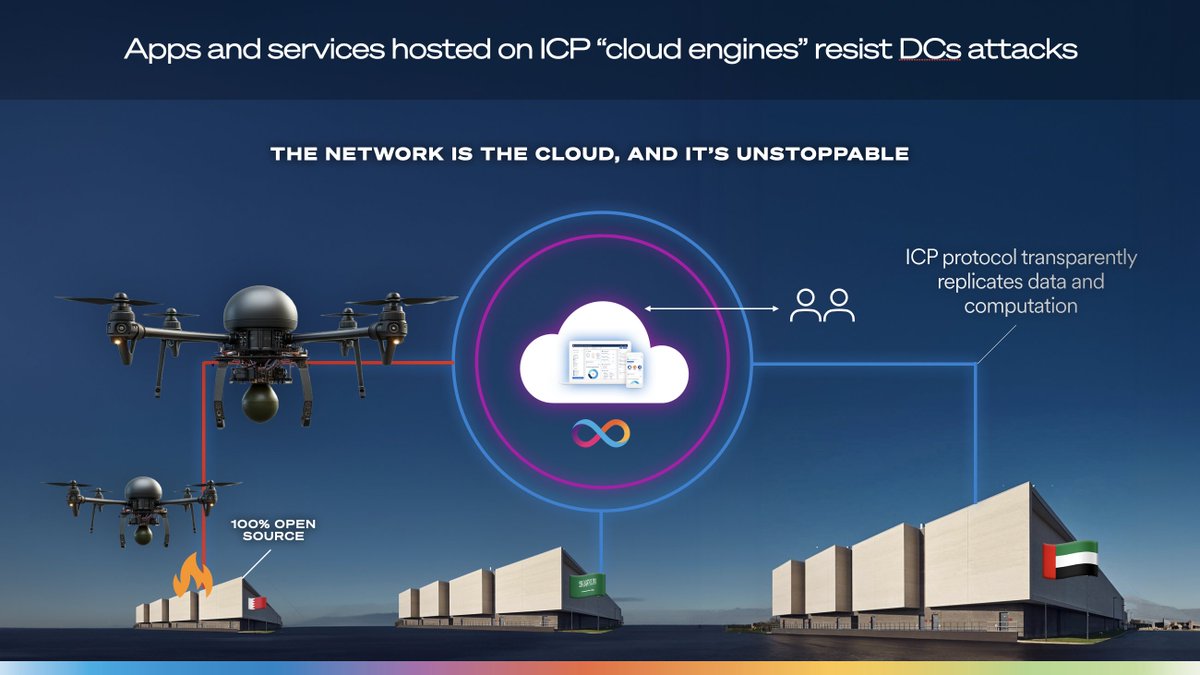
AWS in Bahrain went down after drone hit.
The ICP solution coming – apps and services hosted on ICP "cloud engines" running over multiple AWS data centers will be immune.
tradingview.com/news/gurufocus…
English
Dimitri018🔥🐝🔥 retweetledi
AWS outage in UAE proving what I've been predicting for years — data centers are the new targets in conflict (including for terrorists in the future).
ICP provides a way to create sovereign cloud from a network that can withstand data center losses.
cnbc.com/2026/03/03/ira…
English
Dimitri018🔥🐝🔥 retweetledi
Dev graph from Electric Capital — for Internet Computer, ICP 🔥
Soon, an iceberg of self-writing users will join the craft & vibe coders on GitHub, and AI agents are coming too..
ICP dev numbers are already a multiple of those on other networks. Join us.
developerreport.com/ecosystems/dfi…

English
Dimitri018🔥🐝🔥 retweetledi
Internet Computer "cloud engines" will run over AWS data centers i.e. ICP will provide a way to create full stack apps on AWS that keep running when individual DCs have issues.
AWS has been very helpful, and provided technical hooks needed by ICP node software. Coming soon.
Financial Times@FT
Drone strikes on Amazon Web Services sites this week in the UAE and Bahrain highlight the vulnerability of cloud facilities that are symbols of US tech power in the region. ft.trib.al/v7ZedXA
English
Dimitri018🔥🐝🔥 retweetledi


Dimitri018🔥🐝🔥 retweetledi

Switzerland just launched the most secure subnet in crypto history. @SwissSubnet 🇨🇭🌐🛡️
And it's powered by Blockchain. $ICP
13 independent node providers. All data verifiably onchain. All compute stays within Swiss borders. Tamper-proof. Unstoppable. Immutable.
The Swiss Subnet is live on the Internet Computer — launched at World Computer Day in Davos alongside world leaders. @dfinity
This is what real Sovereign Cloud looks like. 🌐⛓️
A Cloud Foundation Production ♾☁️
@BobbyO_ @dominic_w @cryptocloudsicp
English
Dimitri018🔥🐝🔥 retweetledi
Claude Code, a vibe coding tool, fast forwarded what AI can help devs build ➡️ brave new world
caffeine.ai ☕️ must now give *everyone* this superpower, through instant chat and docs alone, on sovereign onchain cloud, ICP, by end Q1
A mega sprint is in progress
English


10 Cryptos which will survive the quantum computers.
1. $ALGO - Already quantum-Computer resistant
2. $ICP
3. $DOT
4. $LINK
5. $HBAR
6. $ETH (Hopefully by 2030)
7. $APT
8. $XMR
9. $ZEC
10. $TON
English