ehe2202

176 posts

ehe2202

ehe2202

@DollaHanul

Katılım Temmuz 2022
175 Takip Edilen123 Takipçiler
ehe2202
ehe2202@DollaHanul·
@DaveHcontrarian I love your conviction but this sunday night silver price move seem like something that will change your expectation. Going much lower than Feb low. Yes I am nervous since I bought mining stocks heavily. Just want to know your thoughts in PM
English
0
0
0
47
Karel Mercx
Karel Mercx@KarelMercx·
@DollaHanul Those who have knowledge, don't predict. Those who predict, don't have knowledge. Lao Tzu
English
1
0
1
296
ehe2202
ehe2202@DollaHanul·
@DaveHcontrarian Tonight silver drop was big. Now we are close to Feb low .. would it be double bottom or going lower before up?
English
0
0
0
11
ehe2202
ehe2202@DollaHanul·
@pmbug @KarelMercx Is there anything that can stops them from draining SLV vault? Or can they technically drain till 0oz. Then I think we should count SLV holdings as free float too like LBMA does
English
2
0
2
127
pmbug
pmbug@pmbug·
Silver Lease Rates vs SLV Vault Stock With thanks to @KarelMercx for daily 1mo silver lease rate updates, we can see that over the last month or so, the 1mo silver lease rate has tracked the vault stock flow for SLV pretty closely. When SLV adds vault stock, it removes silver from the LBMA's liquid free float and lease rates increase. When SLV drains vault stock, it adds silver to the LBMA's liquid free float and lease rates decrease. Generally anyway. Yesterday, SLV reported a large 3.7M ozt drain and the 1mo lease rate actually increased slightly. The logical conclusion is that the LBMA's free float faced significant pressure from a different source. This could be other London vaulted ETFs adding vault stock, or it could be the LBMA OTC market delivering silver to buyers (like India perhaps). We can't know for sure because the LBMA is run by dinosaurs and they do not report daily or weekly vault flows like every other major precious metals exchange or market in the world.
pmbug tweet media
English
4
9
74
8.5K
ehe2202
ehe2202@DollaHanul·
@KarelMercx @adam702989 What if it’s because industry doesn’t believe they will get delivery from future contracts? I think buying directly from miners paying higher price is kind of insurance.
English
1
0
3
128
Karel Mercx
Karel Mercx@KarelMercx·
@adam702989 Why would industry pay a premium to a mining company? Open a March futures contract and you get silver delivered at a discount.
English
6
0
6
1.4K
Karel Mercx
Karel Mercx@KarelMercx·
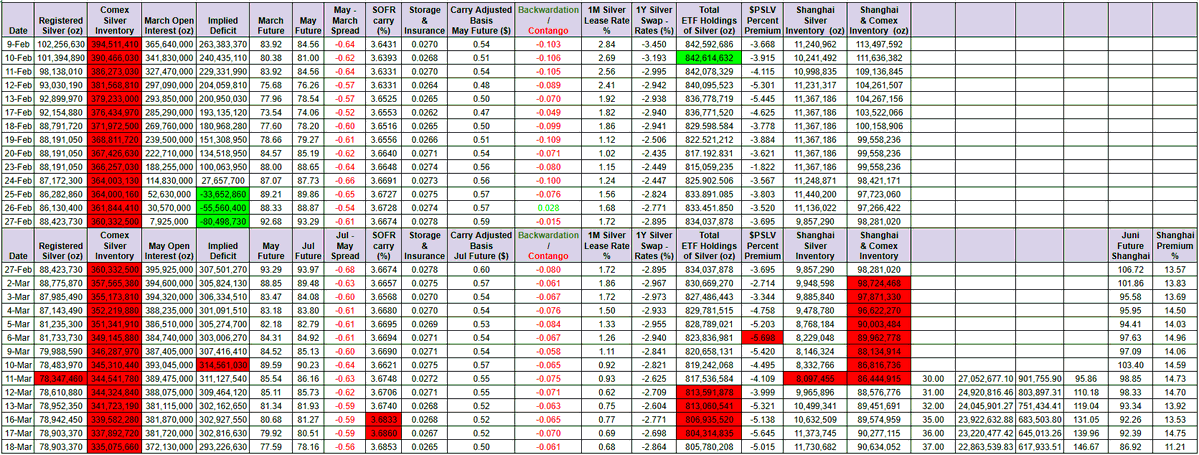
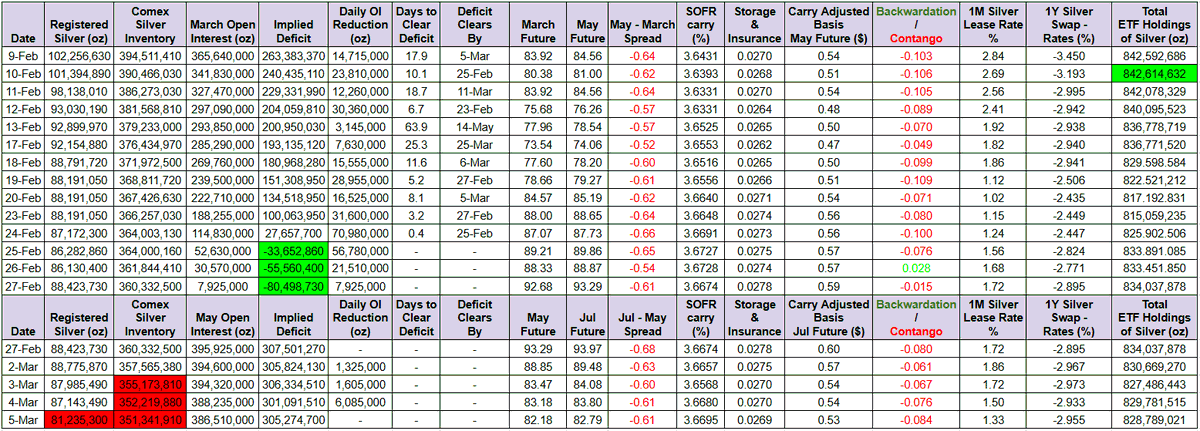
Silver backing futures has been declining by about 20 million ounces a month for six straight months. Every day, the market waits for inflows that still are not coming. From here, only two things can happen: either inflows arrive, or silver moves sharply higher.
Karel Mercx tweet media
Karel Mercx@KarelMercx

x.com/i/article/2020…

English
29
82
584
92.3K
ehe2202
ehe2202@DollaHanul·
@DaveHcontrarian Hi David Do you think silver correction is almost over? Or do you think we will see retest of the low in Feb ?
English
1
0
2
3.6K
ehe2202
ehe2202@DollaHanul·
@DaveHcontrarian Hello David Is silver forming inverse head and shoulder?
English
3
1
9
10.9K
Semper Vigilantes
Semper Vigilantes@SemperVigilant1·
Its like they went on strike.
Semper Vigilantes tweet media
English
2
2
12
1.1K
Bai, Xiaojun
Bai, Xiaojun@oriental_ghost·
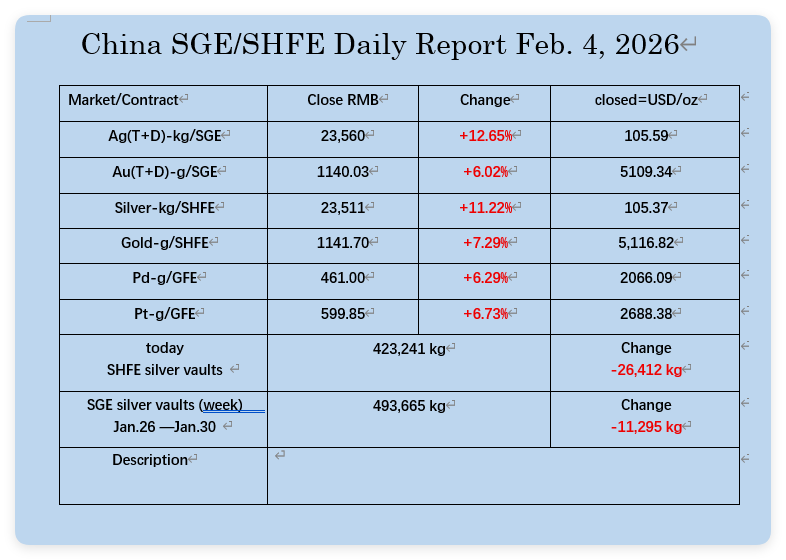
Feb. 4, 2026, the PM markets data in China.
Bai, Xiaojun tweet media
Filipino
32
133
737
158.5K
ehe2202
ehe2202@DollaHanul·
@KarelMercx I always appreciate your insight. Can you please share lease rates and swap rates later?
English
0
0
1
638
Karel Mercx
Karel Mercx@KarelMercx·
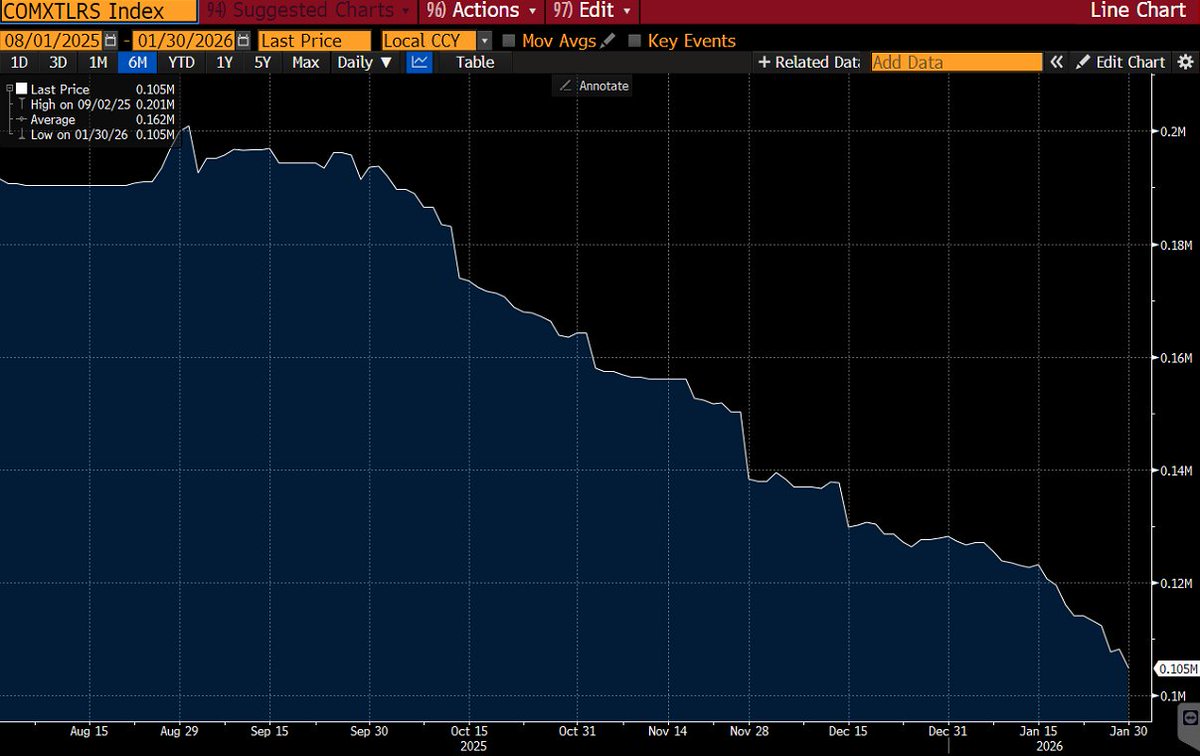
Last Friday was one of the largest silver selloffs of the past 275 years, yet physical silver still left the COMEX. Since early September, COMEX Silver Registered has dropped from 200 million ounces to 100 million ounces. The 3.3 million ounces that left last Friday were not stopped by one of the biggest silver declines ever. Total COMEX inventories fell by 2.4 million ounces. This means COMEX Silver Eligible increased by nearly 1 million ounces. For clarity, the definitions: COMEX Silver Eligible Silver that is physically stored in approved COMEX vaults and meets all requirements (purity, weight) to be traded, but no delivery warrant has been issued. Meaning: This is effectively private storage. It is owned by investors, banks, or refiners, but it is not offered to settle a futures contract. Analogy: A house that is fit to be sold, but without a “For Sale” sign in the yard. COMEX Silver Registered Silver that is explicitly made available for delivery to someone holding a long futures contract until expiration. Meaning: This is the market supply. This is the silver actually available for immediate delivery through the exchange. Analogy: The house with a “For Sale” sign in the yard. You can buy it immediately. Important: A shift from Eligible to Registered (or vice versa) is often purely administrative (a digital push of a button). The silver itself does not physically move an inch inside the vault. The most bearish scenario imaginable is that Registered, Eligible, and Total Inventory all rise. More silver enters the vaults than leaves. There is a surplus and little demand for physical delivery. Inventories build. The very bullish scenario is that Registered, Eligible, and total inventory all fall. Physical silver leaves the vaults entirely. There is strong demand for physical delivery and the silver is not returned to storage, but likely consumed by industry or privately stored outside the exchange. This points to tightness. Where we are now: Registered is falling, Eligible is rising, and total inventory is rising. This means physical outflows from Registered are larger than inflows into Eligible. Silver is being bought and moved into private ownership (Eligible rises), but even more silver is leaving the vaults altogether. The “free” supply is drying up rapidly. In a few hours, trading in the East will reopen and they can react to what happened in the West while the East was already closed last Friday. From here, it is crucial to closely monitor lease rates, swap rates, and inventory data. Last Friday was truly extreme and I will never forget it for the rest of my life. But the idea that silver is done rising just weeks after the US government labeled it a critical material and China tightened export licenses is something I simply do not believe.
Karel Mercx tweet media
Karel Mercx@KarelMercx

I don’t care what the paper price of silver is. I need physical silver. And I need it NOW! This is exactly what the market is saying when you look at the 1-year silver swap minus US interest rates. In a normal market, this line is above zero. That’s called contango. Why? Because owning silver has a cost of carry. If you buy physical silver today and hold it for a year, your money is tied up (you lose interest), and you pay for storage and insurance. Those costs are reflected in the forward price. Signal: There is plenty of physical silver available. No stress. No urgency. When the line drops below zero, the market is in backwardation. That is abnormal for a storable commodity like silver. It means buyers are willing to pay a premium to get the metal NOW rather than later. In silver, this usually happens when lease rates (the rate you earn by lending out silver) are higher than cash interest rates. Signal: There is a shortage of physical silver in the spot market. Fabricators, mints and industrial users need metal immediately and can’t wait. The market is basically saying: “We need your silver so badly that we’ll pay you to sell it now and buy it back later.” Right now, we are not in backwardation. We are in EXTREME backwardation. What this usually means: • Vaults are being drained (LBMA, COMEX, etc.) • Short squeeze dynamics: shorts are being forced to buy back contracts or deliver metal that isn’t there • Decoupling risk: the “paper price” and the real price of a bar in your hand start to separate That negative swap rate is the premium the market is paying for real, physical ownership. This is one of the key reasons why I think the silver rally is far from over. And if you want the other 11 reasons, read the post below. 😉

English
58
167
984
217.4K
ehe2202
ehe2202@DollaHanul·
@BankerWeimar I am not an expert in this topic. How is arb bullish? I imagine banks take out silver bars from SLV and sell them to China for higher price. Doesn't that mean new supply will meet demand in China and drop price there? Do the bars need to go back to SLV later?
English
0
0
0
86
QE Infinity
QE Infinity@StealthQE4·
You know who’s laughing the hardest rn? @DaveHcontrarian Watch and learn. What a boss. Well done sir.
QE Infinity tweet media
English
13
1
124
36K
ehe2202
ehe2202@DollaHanul·
@DaveHcontrarian Hello David, I think you said silver will have sharp correction soon and I remember you said in parabolic phase correction tend to be short and sharp. Do you think PMs correction would last short or months like before?
English
1
0
1
3.2K
ehe2202
ehe2202@DollaHanul·
@KarelMercx Hello Karel, What’s this swap rate now at the moment with silver sell off?
English
0
0
1
122
Karel Mercx
Karel Mercx@KarelMercx·
I don’t care what the paper price of silver is. I need physical silver. And I need it NOW! This is exactly what the market is saying when you look at the 1-year silver swap minus US interest rates. In a normal market, this line is above zero. That’s called contango. Why? Because owning silver has a cost of carry. If you buy physical silver today and hold it for a year, your money is tied up (you lose interest), and you pay for storage and insurance. Those costs are reflected in the forward price. Signal: There is plenty of physical silver available. No stress. No urgency. When the line drops below zero, the market is in backwardation. That is abnormal for a storable commodity like silver. It means buyers are willing to pay a premium to get the metal NOW rather than later. In silver, this usually happens when lease rates (the rate you earn by lending out silver) are higher than cash interest rates. Signal: There is a shortage of physical silver in the spot market. Fabricators, mints and industrial users need metal immediately and can’t wait. The market is basically saying: “We need your silver so badly that we’ll pay you to sell it now and buy it back later.” Right now, we are not in backwardation. We are in EXTREME backwardation. What this usually means: • Vaults are being drained (LBMA, COMEX, etc.) • Short squeeze dynamics: shorts are being forced to buy back contracts or deliver metal that isn’t there • Decoupling risk: the “paper price” and the real price of a bar in your hand start to separate That negative swap rate is the premium the market is paying for real, physical ownership. This is one of the key reasons why I think the silver rally is far from over. And if you want the other 11 reasons, read the post below. 😉
Karel Mercx tweet media
Karel Mercx@KarelMercx

Silver is now trading in triple digits in the West: $103.11. Not just an intraday spike, but a daily close above $100. And not just a daily close, but a weekly close above $100. To celebrate, here are 12 reasons why the silver rally is far from over 🧵

English
47
211
1K
464.2K
ehe2202
ehe2202@DollaHanul·
@KarelMercx Thanks a lot for the detailed explanation!!
English
1
0
1
63
Karel Mercx
Karel Mercx@KarelMercx·
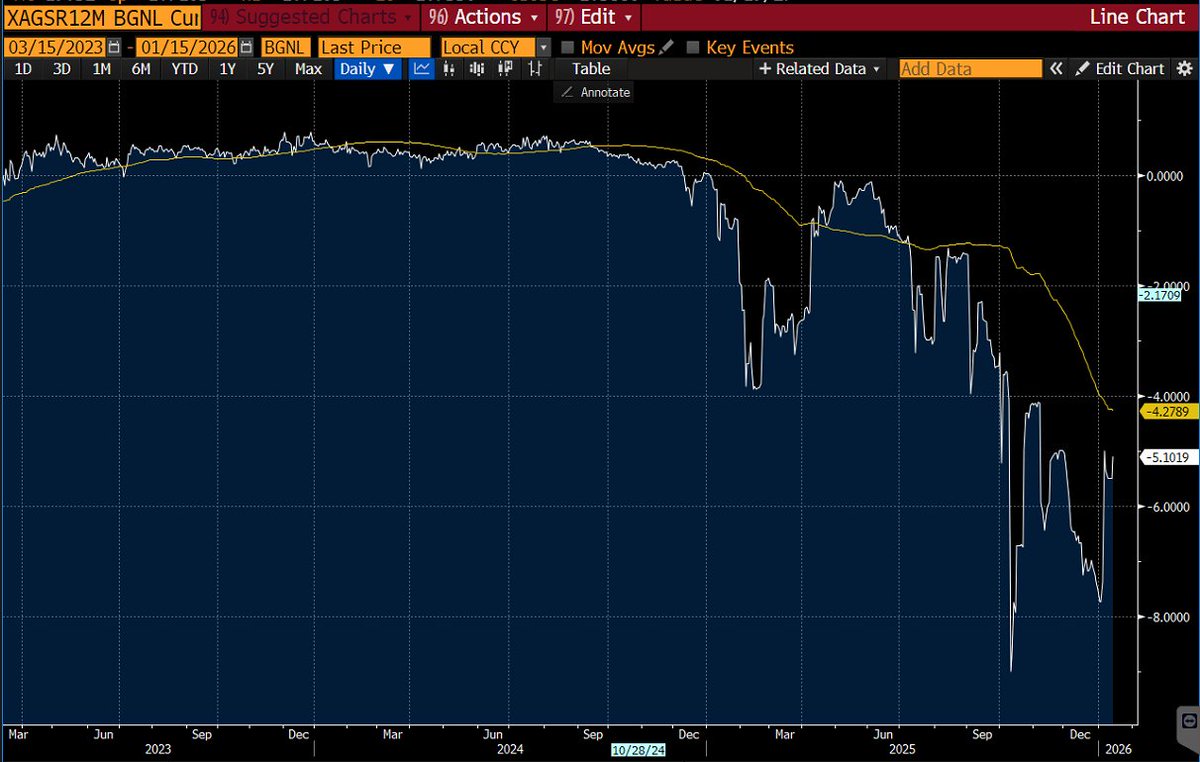
@DollaHanul The white line shows the 1-year silver swap, adjusted for interest rates. The yellow line is the 100-day moving average. The fact that the white line is below the yellow line clearly shows that over the past 100 days, stress in the silver market has only been increasing.
Karel Mercx tweet media
English
1
1
8
461
Karel Mercx
Karel Mercx@KarelMercx·
Silver $93 🚀 With silver moving sharply higher, it’s time to look at COMEX inventories. At the start of 2025, the amount of deliverable silver on COMEX surged. The main reason: fears that President Trump could introduce import tariffs on silver. As a result, large amounts of silver were moved from London to the US, into COMEX vaults. The London market is still extremely tight, which is visible in lease rates that have not normalized. Now COMEX inventories are starting to decline as well. Since autumn, the amount of deliverable silver has already fallen by 39%. No matter where you look, whether it’s lease rates, silver swaps, the Shanghai premium or COMEX deliverable inventories, the pressure on silver is building everywhere.
Karel Mercx tweet media
Karel Mercx@KarelMercx

Three charts explain why the silver rally is not over. All three charts use a 100-day moving average. The goal is simple: remove noise and focus on the signal. The first chart shows the 1-month silver lease rate. In a balanced market, this should sit around 0%, which is marked by the red line. Instead, the 100-day average is currently 6.28%, already an extreme level. Even more telling, the latest reading is 8.53%, which means the average itself is still rising. This reflects how limited the availability of physical silver has become. High and rising lease rates are a classic signal of physical market stress. The second chart shows the 1-year silver swap, adjusted for the US interest rate. This adjustment matters because cash is paid today while silver is delivered one year later, allowing the seller to earn interest in the meantime. After adjusting for that, this number should be positive for two reasons. Silver must be stored and insured for a year, which is not free, and if the swap were negative, arbitrage would normally eliminate it by buying physical silver today and selling it forward. The fact that the 100-day average is roughly 4 percentage points below zero, and that the latest reading was about −7.9%, shows how severe the shortage of physical silver really is. The downtrend in the 100-day average confirms that stress is increasing. The third chart shows the Shanghai silver premium. In normal conditions, this should hover around 0%. Since 2023 it has been structurally higher, with a peak reached in 2024. The sharp rally in Western silver prices temporarily compressed the premium to just over 1%, but it has since started rising again. Just before Christmas, the premium briefly reached 12%, the highest level on record. While the spot premium has not exceeded that peak since, the 100-day moving average has continued to rise. This highlights persistent physical demand in the East. If we zoom out, all three indicators are now above their 100-day moving averages. Taken together, they tell the same story. The silver market still requires meaningfully higher prices to bring supply and demand back into balance.

English
19
30
231
100K