Dott

37 posts

Dott banner
Dott

Dott

@Dott_Chen

A product tinkerer. 📖 https://t.co/4kfxfScVKr $5k/m Chinese-only alt: @DottChen

Katılım Ocak 2026
115 Takip Edilen8 Takipçiler
Dott
Dott@Dott_Chen·
@harshilmathur @Razorpay Exactly like this. People who are complaining really don’t use these tools in their daily lives.
English
0
0
1
266
Harshil Mathur
Harshil Mathur@harshilmathur·
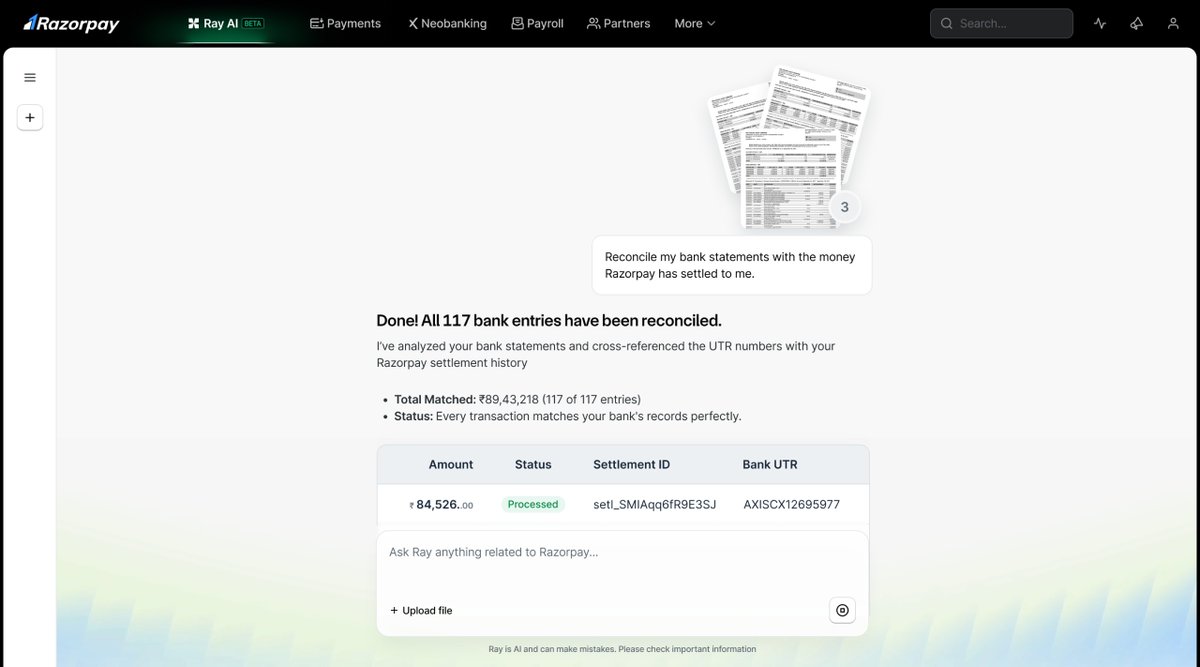
Lot of debates on this shift. Sharing our learnings from building @Razorpay's AI-first dashboard. <5% of B2B users open a dashboard to explore - most come with a question, but spend time figuring out how to get the answer. AI-first flips this: just ask for what you need. We’re starting with a middle path: – chat as primary – common actions below Still beta (opt-in), with ability to switch back. Ultimately, users decide what sticks.
Harshil Mathur tweet mediaHarshil Mathur tweet media
Rabi Shanker Guha@rabi_guha

notice something? Linear, PostHog, Attio - all shipped the same thing in the last few weeks. Homepage is a chat bar - not a dashboard. This is the SaaS industry quietly admitting that traditional UI doesn't work anymore. Every user is different. One homepage can't serve them all. The playbook is shifting: → expose your core APIs → connect an agentic layer → let users use software the way they want SaaS became chat. Chat will become Generative UI - the agent won't just reply in text, it will compose the interface itself. We're closer than people think.

English
23
9
234
52.7K
Dott
Dott@Dott_Chen·
I think there is a market need, but it is hard for a VC-backed company to do this. If this is only built for small teams, there is an obvious revenue ceiling, and VCs are not going to back it. I think, preferably, this is done by a solo founder who understands the pain deeply and is building this product for himself, eventually selling that service to other founders. I would assume that an AI-native layer with great UI, with deep support workflow integration, plugged with a Claude Code subscription, would resolve this problem.
English
0
0
0
7
Nathan Flurry 🔩
Nathan Flurry 🔩@NathanFlurry·
Nope. All support software still sucks. There's a GTM here for "support for busy founders" like Superhuman did: - Great mobile app - Fastest UI in the west - Connect to your GitHub for 1-click AI - AI-assisted, not auto-generated BS - Slack-native - Built for small teams
Nathan Flurry 🔩@NathanFlurry

Who's built Linear for support? We're on Plain. It's the best we've tried, but not there yet. Requirements: - Slack+Discord+GitHub - Native mobile app - Local-first web app - Stable (P is so buggy) - Linear integration (P has their own weird ticket system)

English
20
3
130
21.5K
Karri Saarinen
Karri Saarinen@karrisaarinen·
@Dott_Chen Something new we’re working on. Let us know if you want to try it
English
3
0
0
545
Dott
Dott@Dott_Chen·
@karrisaarinen @slimjimmy I’m sure people who are complaining this change are not heavy users of Linear. If you’re, you’ll know this is the right way. Navigating context in issue tracking tool is a true headache and AI solves that.
English
0
0
0
202
Karri Saarinen
Karri Saarinen@karrisaarinen·
You can type in more complicated commands or flexible. Like a full transcript and say make issues from this from what we discussed in the meeting. Paste in a video and say make an issue based on it. Or say that see if an issue already exists and if not, then create it. Or create an issue and link customer requests. Or create project, milestones and issues based on this plan. The normal composers are still there if you press C but the chat is just a different way.
English
10
0
28
4K
Slim Jimmy
Slim Jimmy@slimjimmy·
slapping a chat bar on your product and calling it an "innovation" is absolute laziness why would i want to type out "show me the issues" when i can click a button? why would i want to type out "add a new issue about x, y and z" when i can just click a button and type out the fields? or, for the developer-aware, a CLI with no mouse at all if you pushed this out because you think this is the future, you should rethink your own future, because you clearly cannot predict it
Rabi Shanker Guha@rabi_guha

notice something? Linear, PostHog, Attio - all shipped the same thing in the last few weeks. Homepage is a chat bar - not a dashboard. This is the SaaS industry quietly admitting that traditional UI doesn't work anymore. Every user is different. One homepage can't serve them all. The playbook is shifting: → expose your core APIs → connect an agentic layer → let users use software the way they want SaaS became chat. Chat will become Generative UI - the agent won't just reply in text, it will compose the interface itself. We're closer than people think.

English
15
3
113
13.4K
Eliana
Eliana@eliana_jordan·
Hot take: Vercel is great when your SaaS is small When it grows… you’ll probably need to move away
English
143
6
283
24.5K
Dott
Dott@Dott_Chen·
Profitability > Growth
English
0
0
0
37
Peter Yang
Peter Yang@petergyang·
Anthropic just sent an email saying that you can no longer run 3rd party harnesses like OpenClaw using Claude subscriptions. Right now, both OpenAI and Anthropic are losing money on power users who run multiple agents 24/7 using their $100-200 subscription plans. This reminds me of when Uber and Lyft were subsidizing rides to win market share. After both companies went public in 2019, ride prices nearly doubled over the next few years. And it took Uber 14 years from its founding before the company posted its first profitable year in 2024. Both OpenAI and Anthropic are likely to go public soon. Once this happens, their margins will be public as well and there will be a lot of scrutiny on the money-losing all-you-can-eat subscriptions. So I think there's a good chance that these subscriptions will either get more expensive or more limited after both companies go public. The counter-argument is that both companies might keep prices low as long as there's still heavy competition and that compute costs will drop as well. But yeah, overall I don't think the unlimited buffet will last forever. Running local models on Mac Minis and Mac Studios is looking more appealing now as a safety net.
Peter Yang@petergyang

Nooooo

English
96
25
354
93K
Dott
Dott@Dott_Chen·
There has been quite a bit of debate on this change. As someone who's been working in an agentic way for the past three months, I can say with confidence that this is the future of what all software will look like, as it should. UI patterns were invented as an interface to explain abstract data layers to creatures (us humans) who don't natively understand data and know what to do with them. We need graphic charts to visualize them, and need buttons to manipulate them. But that's all under the pre-AI era premise that playing directly with data is hard. Things have changed and software should evolve. A pre-defined fixed graphic user interface is a bottleneck when working natively with AI agents. There are numerous intents from users, but for traditional software there are only a few paths to fulfill those intents with fixed UI patterns. It's just not efficient. So kudos to the Linear team @karrisaarinen @thenanyu and I really appreciate your communication on this change. It might not quite be the ideal state yet, but I think you're leading the trend, again.
Rabi Shanker Guha@rabi_guha

notice something? Linear, PostHog, Attio - all shipped the same thing in the last few weeks. Homepage is a chat bar - not a dashboard. This is the SaaS industry quietly admitting that traditional UI doesn't work anymore. Every user is different. One homepage can't serve them all. The playbook is shifting: → expose your core APIs → connect an agentic layer → let users use software the way they want SaaS became chat. Chat will become Generative UI - the agent won't just reply in text, it will compose the interface itself. We're closer than people think.


English
0
0
1
82
Nan Yu
Nan Yu@thenanyu·
@rickpanchal97 @calvinclee The differentiator is the underlying structures and opinions of the system. Its defaults and proclivities. You have to imagine a future where all of these vertical SaaS products act more like employees fulfilling a role
English
1
0
4
88
Dott
Dott@Dott_Chen·
I’m ditching Claude Code and switching to Codex. The code quality of Codex is better now. There is no reason to use Claude Code anymore.
English
1
0
0
40
Dott
Dott@Dott_Chen·
I think best if Linear has more MCP integrations and a shared chat session management interface (like a cloud version of Craft Agents). Now that we do every job on AI chat sessions, why can't we just all use Linear agent to do that? There is still something missing in the current state here.
English
1
0
1
79
Karri Saarinen
Karri Saarinen@karrisaarinen·
Benefits: 1) native part of the system, agent understands the data and system natively, not having to relearn it each time 2) no MCP tax on speed, or tokens 3) native entities are linked and can be previewed 4) system and tooling is shared with the whole organization, not just your personal computer This is just one example and I could do lot of other things, like go directly from this context to execution, creating a project, making a plan, creating issues and assuming it to coding agent. Eventually some of this can be automated on the org level.
English
6
0
28
3.6K
Michael Dubakov
Michael Dubakov@mdubakov·
I wonder more and more why not use Claude for this? It will handle such use cases even better with proper MCP tools. I see close to zero benefits having this right in @linear
Karri Saarinen@karrisaarinen

Quick video on how I use @linear Agent in product work. For feature requests, I want to understand the broader pattern, not just react to one ask. Here, it pulled from 40k+ customer requests to help me think through whether Linear should have team docs.

English
3
0
18
6.3K
Yasser
Yasser@yasser_elsaid_·
This is my playbook for bootstrapping an AI agent business to $9M ARR. The most important thing is that you need something repeatable and scalable, something where if you do more of, you get more money. You need the equation where you can arbitrage every dollar you spend into more dollars on the other end. Here is how you get there: 1. if you're in B2B, just do the B2B stuff. self-serve is very hard to make work in B2B. it's so much easier to build a sales team, teach them the product, and let them sell it, instead of building a very intuitive platform and hoping people figure it out. that's why all these bigger companies are mainly doing "book a demo with us." they charge customers a lot more because there's no public pricing, and they can set the product up for them. you cannot rely on a middle manager at a non-tech company to put in the effort to use your platform, even if it's extremely intuitive. if you're bootstrapping, you can't hire a sales team on day one. so you need momentum from self-serve customers first. but the goal is to layer in sales as fast as possible, get on demo calls, set up the product for bigger customers, and invest in building an intuitive platform at the same time. 2. content is non-negotiable, even if you're sales-led. good content gets you brand visibility and brand awareness, and that makes all the other channels work much more efficiently. paid ads work much better if people recognize your brand. if they click on your page and see content that people are engaging with, good quality content, it compounds everything. here's what that looks like: video: it depends on your ICP, but we all know video is hard to do, and that's a good thing because it makes the barrier to entry much higher. you can signal that you are a serious business if you do good quality video content. be creative within video, but don't get too creative with the kinds of videos. the kinds of videos you should be doing are product videos and customer videos. that's it. you can be creative in telling your customers' story, you can be creative in launching a product, but don't do the stunt thing, the office content, the random skits. they can work, but you only do them after you do the things that you know will work. hire a videographer in-house. agencies are so expensive (this is just a good rule of thumb). text + personal brands: you need personal brands for everyone in the company. EGC (employee-generated content) needs to be a non-negotiable. everyone on the team posting at least twice a week. 3. warm outbound is the lowest-hanging fruit. warm outbound = outbounding people who have already seen your product. people who interacted with your LinkedIn posts. people who visited your site but haven't signed up. people who created an account but never finished onboarding. these people are the lowest-hanging fruit. email them, call them, put them in a sequence until they become customers. you can have very clear KPIs for your team on this. 4. cold outbound, if your ICP is big enough. be good at writing cold emails and managing your own infrastructure. don't go through an agency. build a system where you can send emails profitably. if it works, send more. if that works, send more. scale it until it doesn't make sense to continue. also do this in-house if it's an important channel. 5. SEO and AEO are extremely important. whenever I want to try a new product, I ask Claude. AI search is a non-negotiable channel now. you need to show up there. that means a lot of Reddit, a lot of review websites, a lot of talking to blogs and backlinking sites to make sure they write what you want with the messaging you want. 6. expansion: be friends with your biggest customers. get on a call with them. know them by name. they need to have your number. they need to be advocates for you. build community around the customer. a lot of founders do not see their customers as friends or a community. they just see them as revenue. that's so bad. your customers need to enjoy spending time with you and talking with you. 7. pricing is the fastest lever. you need to find a good sweet spot for packaging and pricing. incentivize people to spend more money and make sure it's a good deal for them. there's no shortcut, you talk to customers, see what they care about, see what they get a lot of value out of, and capture some of that value while making sure they're successful. 8. margins don't matter early on. if you have a $10M ARR business but you spend $10M to run it, that's fine. you can always cut costs. revenue is the most important metric. it's easier to cut costs than to make more money, so in the beginning, focus on making more money. That's how we built @chatbase to where it is today. Most of this will continue to scale with us as we go to 100M ARR.
Yasser@yasser_elsaid_

9M ARR 🥳 So happy! @Chatbase is going to be a $100M ARR company. Some days I feel it's inevitable, we're past the hardest part, it's almost too easy. Some days it feels too hard and I need a miracle. Constantly moving between "I am a genius, how come no one is doing this" to "I don't know anything about anything". Follow to watch the journey, you will never be this early.

English
69
70
1.3K
217.5K
Dott
Dott@Dott_Chen·
Just migrated my Slack bot AI agent server from AWS Lightsail to Hetzner. Same 8GB RAM. Double the CPU cores. 4x the bandwidth. $44/mo → $7/mo. That's $430/year back in my pocket. The whole migration took about an hour. rsync the files, pg_dump the database, update DNS. Done. As an indie dev, Hetzner just makes sense. No confusing pricing tiers. No hidden bandwidth charges. No "oh you need to pay extra for that" surprises. Clean dashboard, spin up a server, ship. AWS is built for enterprises with DevOps teams and money to burn. When you're building solo, every dollar and every minute of attention counts. Stop subsidizing Jeff's yacht and put that $430 toward something that actually grows your product.
English
2
0
0
103
Dott
Dott@Dott_Chen·
The daily work of a programmer: Coding (VS Code) -> Typing (Claude Code) -> Talking (Typeless)
English
0
0
0
111
Dott
Dott@Dott_Chen·
@zeddotdev + Claude Code is my go to choice now.
English
0
0
0
14
Dott
Dott@Dott_Chen·
Sharing some scattered thoughts on AI efficiency from the past month: For individuals to become AI native, the most important thing is a mindset shift. 1) Before doing anything, first consider whether AI can do it; 2) Transform yourself from an IC executor to a manager of AI agents, pushing multiple workstreams forward in parallel; 3) Shift focus from execution efficiency to judgment and taste. For organizations to become AI native, there are three levels: 1) Basic: individuals simply use various AI tools, but information remains siloed, AI still treated as a one-off task delegator, with no intersection between people or between people and tools; 2) Intermediate: establish a centralized information hub that aggregates context scattered across everyone's heads and different tools, enabling centralized AI to answer questions and execute tasks based on all information; 3) Advanced: AI no longer merely acts as a passive task receiver, but actively intervenes in human conversations and decisions, possesses memory, becomes a sentient agent, and becomes a trusted work partner for all team members—ensuring every team decision is evaluated by AI against best decision-making processes and principles, so the floor of any decision matches the ceiling of other organizations. Driving AI adoption requires anthropomorphizing AI. Anthropomorphization solves the trust problem created by evolution—humans trust humans, but don't trust tools. For the experience of "asking an AI agent to do something," successful delivery versus unsuccessful delivery have a completely asymmetric impact on user trust. If we use a progress bar to describe a person's trust level in an AI agent—assuming 90 points means unconditional trust, below 20 points means complete distrust, and initial attempts start at 60 points—then a first-time failed delivery experience directly deducts 50 points down to 10. To get the person to try again, you need to borrow 10 points from someone else to get back to 20, then slowly add back 5 points at a time through successful deliveries. As company leadership, on the path to AI native you should lead by action—use AI in your daily work to truly perceive the changes AI brings. When driving AI adoption in teams, provide tangible support: tool reimbursements, organized training, internal sharing incentives, and free time to experiment with AI tools all help teams embrace AI with a more open mindset. Engineering teams should treat maintaining /CLAUDE.md and other AI context files in code repositories as equally important as onboarding new developers (if not more so)—document repository knowhow in detail, abstract common root causes when AI gives incorrect execution plans, then supplement the context, iterating until AI can fully implement all requirements. The biggest bottleneck for AI-accelerated product iteration is QA. If AI can achieve full QA automation, a two-to-three person AI native dev team can outproduce a two-to-three hundred person team using traditional processes. Having PMs vibe code requirements on production code for devs to review and ship likely won't work. For at least two reasons: 1) Vibe coding PMs cannot provide correct technical direction and guidance in Plan mode, resulting in lower code quality than having devs direct AI themselves; 2) When the person writing AI code and the person reviewing it aren't the same, teams waste effort and energy re-familiarizing themselves with code and context. Team efficiency gains largely depend on parallel requirement implementation—whether PMs use AI to concurrently handle PRDs for multiple requirements, designers use AI to simultaneously explore multiple design options for multiple requirements, or devs use AI to develop multiple requirements at once. Expand each person's work bandwidth rather than trying to make upstream/downstream more nested. Getting people without technical backgrounds to adopt coding agents like Cursor/Claude Code is difficult, but the imagined difficulty is greater than the actual difficulty—and once people become familiar with this new way of working, there's no going back. PMs should no longer write PRDs in document tools; they should go straight to Claude Code. In the AI era, curiosity matters more than experience, and generalists have more advantage than specialists. X remains the best source for AI information.
English
0
0
0
68
Dott
Dott@Dott_Chen·
AI QA agents is the next big thing.
English
0
0
0
54