🚨 Pope Leo has CONDEMNED the availability of smartphones to small children, which often leads to addiction and to the accessing of harmful materials:
'Having a personal mobile device at too early an age and using it without adult supervision can exacerbate young people’s vulnerabilities, foster addiction and expose them to isolation, bullying and cyberbullying, as well as to pressures to share intimate images or sensitive information'
Magnifica Humanitas
Lionsgate, in collaboration with Mel Gibson and Bruce Davey’s Icon Productions, announced Thursday that the highly anticipated film “The Resurrection of the Christ” will be released in theaters in two parts — Part 1 will be released on May 6, 2027, and Part 2 will be released on May 25, 2028.
The production studios also announced that filming concluded ahead of schedule after shooting for 134 days in the cities of Rome, Bari, Ginosa, Craco, Brindisi, and Matera in Italy.
“Mel is a true visionary with an artist’s eye for scale and a storyteller’s instinct for emotional truth,” Adam Fogelson, chair of the Lionsgate Motion Picture Group, said in a press release on May 21. “Every image we’ve seen from set feels like a masterwork painting brought to life. There are very few directors who can operate at this level of epic spectacle while at the same time delivering such depth and conviction. Mel has crafted a film of extraordinary ambition that audiences worldwide have been waiting to experience for over 20 years.”
“The Resurrection of the Christ” is the sequel to Gibson’s famous film “The Passion of the Christ,” which starred Jim Caviezel as Jesus.
While many believed that Caviezel would reprise his role as Jesus, the filmmakers decided to instead select an entirely new cast. Finnish actor Jaakko Ohtonen will portray Jesus, Cuban actress Mariela Garriga will play Mary Magdalene, Kasia Smutniak will play the Blessed Virgin Mary, and Italy’s Pier Luigi Pasino will play Simon Peter.
Released in 2004, “The Passion of the Christ” vividly depicts the final hours of Jesus’ life, from his arrest in the Garden of Gethsemane to his crucifixion.
The film has been the subject of debate since its release. The graphic scenes of Christ’s scourging and crucifixion sparked controversy; some critics considered it excessively violent, while others praised it for its historical authenticity and its ability to realistically convey Christ’s suffering.
In January 2004, Joaquín Navarro-Valls, then-director of the Holy See Press Office, noted that Pope John Paul II had seen the film and gave it a positive review, describing it as “the cinematographic recounting of the historical fact of the passion of Jesus Christ according to the Gospel accounts.”
Despite controversies surrounding the film, it garnered a profit of $370 million domestically with many crediting it as having opened the door to faith-based media in Hollywood.
ewtnnews.com/world/us/relea…
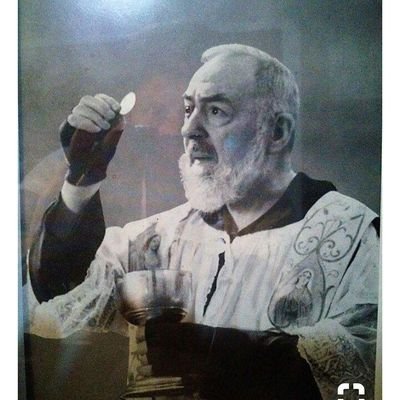
• St. Padre Pio says:
"If certain thoughts bother you, it is the devil who causes you to worry, and not God ~~ Who being the spirit of peace, grants you tranquility."
Claude Monet painted the same stretch of cliff more than ninety times.
The place is Étretat, a small fishing village on the coast of Normandy, where the chalk cliffs fall into the sea in great arches and a single spire of rock, the Aiguille, stands alone in the water.
Monet had known the place since childhood. He grew up in Normandy, and these cliffs were among the first landscapes he ever saw...
He returned to paint them again and again. He worked through the 1880s in front of the same rock formations, and across that time he produced more than ninety canvases of them: the cliffs at dawn, at sunset, under storm, under calm, in winter light and in the gold of a clear evening.
In his letters to Alice, the woman he would later marry, he described the agony of it: the weather turning, the tide rising, the sun moving, the colour he had begun to capture vanishing before he could finish.
He often worked on several canvases at once, switching between them as the conditions changed, racing each one against the hour.
In a letter to his friend Frédéric Bazille he wrote: "It is beautiful here in Etretat. Every day I discover even more beautiful things. It is intoxicating me, and I want to paint it all, my head is bursting. I want to fight, scratch it off, start again, because I start to see and understand. It seems to me as if I can see nature and I can catch it all."
The cliffs of Étretat had stood for millions of years and would look, to most people, the same on any given day. Monet saw that they were never the same even for two minutes. He stood on that shore and tried to hold, on canvas, something that exists only for an instant and then is gone forever.
And that's exactly what those paintings really are: 90 attempts to keep a single, vanishing moment of light from disappearing. As Dylan Thomas once wrote:
"Do not go gentle into that good night.
Rage, rage against the dying of the light."
-- -- --
If you want a deeper dive into the craft of painting, I recently wrote a piece exploring it in detail. You can read it here:
james-lucas.com/p/the-most-imp…
And if you'd like to support my work, a paid subscription is what makes it possible:
James-lucas.com/welcome