Dror David Ifrah

498 posts

Dror David Ifrah banner
Dror David Ifrah

Dror David Ifrah

@DrorDavidIfrah

All about tech & engineering | $TSLA investor | CEO & Founder at ConTechX - Revolutionize high-rise construction

Israel Katılım Nisan 2020
460 Takip Edilen101 Takipçiler
Sabitlenmiş Tweet
Dror David Ifrah
Dror David Ifrah@DrorDavidIfrah·
Looking for Constructor with experience in high rise buildings to discuss the feasibility of an idea to automate the entire process. I'm working on it for the past month or so. Still gathering validation points. Thanks.
English
3
0
6
163
Dror David Ifrah retweetledi
Nuseir Yassin
Nuseir Yassin@nasdaily·
Narrative violation warning: Elders in my Arab village in Israel told me the richest Palestinians sold their land and left first. 80 years later, their grandkids now claim to be displaced victims. I am so allergic to victim mindset. It boils my blood. ~15 million displaced Hindus and Muslims in India-Pakistan around the SAME year. No one is trying to be a victim there. It's time to move on. "You only get to be a victim once. After that, you’re a volunteer."
Mayor Zohran Kwame Mamdani@NYCMayor

Today marks Nakba Day, an annual day of remembrance to commemorate the expulsion of more than 700,000 Palestinians between 1947 and 1949 during the creation of the State of Israel and the year that followed. Inea is a New Yorker and a Nakba survivor. She shared her story with us — one of home, tradition and memory over generations.

English
1.2K
3.3K
17.9K
999.6K
Kiana Ehsani
Kiana Ehsani@ehsanik·
When we were deciding between joining @AnthropicAI or continuing to build independently at @Vercept_ai , we wrote down the pros and cons. One con everyone kept raising: acquisitions slow you down. You get dragged into bureaucracy. There's no way you ship as fast. It's been less than four weeks since we joined, and with the team here behind us and joining forces, we just shipped our first product launch. That speed comes down to the culture here. Everyone moves fast, everyone is incredibly smart, humble and supportive, and it's really easy to get things done. I'm very bullish on this: Anthropic's moat is its people. Starting today, Cowork now supports full computer use, and Dispatch lets you control your machine remotely from anywhere. Four weeks down, many more to come. We're just getting warmed up. 🔥
Claude@claudeai

You can now enable Claude to use your computer to complete tasks. It opens your apps, navigates your browser, fills in spreadsheets—anything you'd do sitting at your desk. Research preview in Claude Cowork and Claude Code, macOS only.

English
67
114
1.7K
189.1K
Dror David Ifrah
Dror David Ifrah@DrorDavidIfrah·
Could it be used to directly manage multiple Claude Code instances, where each one has an agent team running on a specific hard task? The orchestrator that controls the Mac can literally take screenshots, analyze as a user, and then provide the running Claude Code instances for extra instructions on whether they are doing their job right or not.
English
0
0
0
198
Claude
Claude@claudeai·
You can now enable Claude to use your computer to complete tasks. It opens your apps, navigates your browser, fills in spreadsheets—anything you'd do sitting at your desk. Research preview in Claude Cowork and Claude Code, macOS only.
English
4.9K
14.4K
139.1K
78M
Palatial
Palatial@PalatialSim·
A child consumes more data in 1 month than any LLM has ever seen. Embodied agents learn by doing, but the data that teaches them is tactile, sensorial and causal. Such data does not exist. To make physical AGI possible, we need to generate this new data at an industrial scale. Enter Palatial: automated infrastructure that converts raw data into sensory rich playgrounds for robots to learn in. Today, we’re unveiling Palatial PhysReady, the first automated sim asset generator (try it ⬇️) [1/5]
English
56
38
277
57.3K
Robots Digest 🤖
Robots Digest 🤖@robotsdigest·
You can now tell a robot “build me a chair” and it figures out the parts, the structure, and the assembly. Text to 3D to physical build. This paper quietly moves robotics from instructions to creation.
English
8
99
295
12.1K
Dror David Ifrah
Dror David Ifrah@DrorDavidIfrah·
@burkov You think a major IDE like Cursor pays the same rate as you? Lol.. It's probably the biggest or top 10 at least of paying clients... They get special rates... Probably also special priority
English
1
0
0
1.8K
BURKOV
BURKOV@burkov·
I tested Claude Code with an API key where you pay for tokens. Every code update request for my apps costs about $0.80 in token cost. I make a couple hundred requests every day with my Max subscription ($100/month). If I paid for tokens, that would cost me around $80/day. So, Claude sells Max about 30 times cheaper than it sells Opus to third parties. There's no way a third-party IDE company without its own Claude Opus-like model can provide a competing agentic coding service to Anthropic. Cursor? Are you kidding me?
English
198
43
2.2K
368.5K
Robots Digest 🤖
Robots Digest 🤖@robotsdigest·
π0.6 from Physical Intelligence is NOT another robot gimmick. It’s a Vision-Language-Action model trained with real sensory feedback to learn from its own experiences, not just imitate. That’s embodied learning, not scripted motion.
English
23
132
899
41.3K
Ming
Ming@tslaming·
GOOD NEWS 🚨 TESLA HAS SOLVED THE WIRELESS CHARGING PARADOX WITH UNBALANCED DUTY CYCLES ⚡️ When Elon Musk unveiled the Cybercab without a charge port, the automotive world collectively raised an eyebrow. The idea was audacious: a vehicle completely reliant on wireless charging, a technology historically plagued by inefficiency and safety concerns. But with the release of patent US 20250357799 A1 on November 20, 2025, the other shoe has finally dropped. This filing isn't just paperwork; it’s the engineering answer key that explains how Tesla plans to pull off the "no-plug" revolution without frying electronics or wasting massive amounts of energy. We are finally looking at the physics that turns the Robotaxi dream into a viable reality. ⚖️ The problem: The hidden cost of wireless power To understand why this patent matters, you have to understand the messy reality of wireless power. Sending electricity through the air relies on magnetic fields dancing between a pad on the ground and a pad on the car. Ideally, all that energy goes straight into the battery. In reality, big induction coils act like unintended capacitors, allowing "leakage current" to escape and flow into the car's chassis or the ground equipment. It is a classic case of electrical waste, but the consequences are worse than just a slightly higher electric bill. This leakage creates electromagnetic noise that can interfere with sensitive electronics and, in high-power scenarios, pose safety risks. The culprit is usually the control strategy; traditional methods try to regulate power by briefly "shorting" the circuit, which inadvertently causes the common mode voltage—the electrical baseline of the system—to spike wildly. 🔗 Tesla's solution: Unbalanced duty cycles Tesla’s engineers found a way to fix this, and it requires rethinking the rhythm of the charge. Instead of using the industry-standard method that frequently pauses at a "medium" or zero-voltage state to throttle power, Tesla’s new system refuses to sit in the middle. It toggles directly and sharply between a high-voltage state and a low-voltage state. The genius lies in the timing. The system holds these states for unequal durations—an "unbalanced duty cycle." By keeping the circuit in its dominant state for roughly sixty to eighty percent of the time and the secondary state for the remainder, the system can precisely manage power flow without ever entering that problematic zero-voltage state. It’s like finding a specific drumbeat that cancels out the echoing noise in a room; the power gets through, but the leakage conditions are effectively neutralized. 🧠 Logic: Dynamic and conditional activation What makes this system feel truly modern is that it isn't a blunt instrument. The patent describes a "switch control circuit" that acts like a smart conductor. It doesn't force this unbalanced rhythm all the time; instead, it watches the charging session like a hawk. It activates this specific leakage-suppression mode only when necessary—perhaps when the battery voltage hits a certain threshold, the state of charge reaches a specific percentage, or even when the car parks a little crookedly, changing the inductance. The car essentially adapts its electrical heartbeat to the physical reality of the parking job, ensuring peak efficiency when things are perfect and maximizing safety when they aren't. 🛠️ Topologies: Adapting to different circuit architectures Tesla is ensuring this logic works across its entire potential fleet, regardless of what hardware is under the hood. The patent explicitly maps this solution to the two heavyweights of power electronics: the H-bridge and the stacked half-bridge. For the standard H-bridge, the system avoids that "zeroing" state that bridges positive and negative cycles. For the beefier stacked half-bridge—the kind needed for very high voltages—it skips the "medium" voltage step that usually sits halfway between the maximum and minimum. By forcing the voltage to swing fully from rail to rail without lingering in the middle, Tesla ensures the physics of the leakage cancellation hold true regardless of the circuit complexity. ⚡ Voltage: Supporting high-power architectures This is where the patent signals Tesla’s long-term ambitions. The technology is designed to handle a massive voltage range, from one hundred all the way up to one thousand volts. While it mentions standard three-hundred-fifty-volt systems, the explicit support for eight-hundred to one-thousand-volt architectures is a clear nod to the Cybertruck and the Tesla Semi. This means the "no-plug" future isn't just for small, efficient city cars. This leakage reduction technique is robust enough to handle the massive power throughput required to wirelessly charge a heavy-duty truck or a performance vehicle, future-proofing the infrastructure for the next decade of EV development. 📉 Mechanism: Reducing common mode voltage If you could see the electrical waves described in the patent, the difference would be startling. In a standard setup, the common mode voltage—the primary driver of that nasty leakage—looks like a storm, fluctuating wildly between positive and negative two hundred volts. Under Tesla’s new unbalanced scheme, that storm calms into a flat lake. The common mode voltage is effectively flattened, fluctuating only slightly around zero. The simulations are impressive, showing leakage voltage dropping to less than twenty microvolts. That is not just an incremental improvement; it is an orders-of-magnitude reduction that takes wireless charging from "feasible but noisy" to "silent and safe." 🔥 Efficiency: Minimizing switching losses There is a cherry on top for efficiency nerds: this method actually wastes less heat. Every time a transistor switches states, a tiny bit of energy is lost. By transitioning directly between high and low states without stopping at an intermediate step, the system reduces the total number of switching events. Fewer switches mean less "deadtime" loss and less heat generation, ensuring more energy actually ends up in the battery pack. Furthermore, because the electrical noise is so thoroughly dampened, the car becomes quieter in the radio frequency spectrum, making it much easier to pass strict regulatory certifications for electromagnetic interference. 🚀 The grand unification for wireless charging: Safety meets Speed This patent is the shield, but it works in tandem with a previous breakthrough (US20250373083 A1) that acts as the sword. Together, they solve the brutal paradox of wireless engineering: Safety vs. Efficiency. ✅ The "Cruising" Mode ('083): When conditions are safe, the system uses a "partial toggling" technique to cut voltage swings in half. This drastically lowers heat, allowing the Cybercab to charge at blazing speeds (25kW+) without melting its components. ✅ The "Stealth" Mode ('799): When leakage risks rise, this new patent kicks in. It modifies the switching pattern to actively cancel out noise and voltage spikes, prioritizing safety above all else. By combining these two innovations, Tesla has removed the final human bottleneck. The Cybercab can now refuel itself faster than a human could plug it in, safer than a standard wall outlet, and reliably enough to run 24/7 without a single robotic arm in sight. The plug is officially dead.
Ming tweet media
Ming@tslaming

GOOD NEWS 🚨 Published on December.4.2025, patent application US20250373083 A1 reveals the critical "secret sauce" behind Tesla's most ambitious gamble: the PORT-LESS CYBERCAB 💥 📜 Originally secured in May 2024, this breakthrough details a high-efficiency wireless charging system capable of handling wide voltage fluctuations, effectively serving as the key enabler for a fully autonomous Robotaxi fleet. By solving the thermal and efficiency challenges that previously plagued wireless power, this technology removes the final barrier to 24/7 autonomy, allowing Cybercabs to refuel themselves without a single human hand or robotic arm ever needing to intervene. ⚡ The "partial toggling" innovation ⚡ At the core of this innovation is a sophisticated method for controlling the power electronics within a wireless charging system—specifically the "H bridge" circuits found in both the ground pad and the vehicle's receiving pad. Traditionally, wireless charging circuits use a method called bipolar switching, where the circuit toggles all switches in a bridge simultaneously to transmit power. While effective, this standard approach is like pushing a pendulum aggressively from one extreme to the other; it creates a massive "voltage swing" across the resonant tank, causing significant electrical stress and energy loss. Tesla's solution introduces a "partial toggling" technique. Instead of switching every component in the circuit, the system's control unit selectively toggles one half of the bridge circuit while keeping the other half in a static state (either open or closed). By repeatedly switching between specific configurations—for example, toggling the left side of the bridge while holding the right side steady—the system works more like pushing a swing and then letting it coast. This changes the voltage transition significantly: instead of jumping from positive (+400V) to negative (-400V), the system transitions from +400V to 0V (a "freewheeling" state). The result is a dramatic reduction in the voltage swing. By toggling to zero rather than to the opposite polarity, the total voltage swing drops from 2v (e.g., 800V) to just 1v (e.g., 400V)—effectively cutting the electrical stress in half. This "softer" transition is crucial because it minimizes "deadtime loss," a common source of inefficiency in power electronics where switches are momentarily turned off to prevent short circuits. This efficiency gain brings wireless charging closer to the performance of wired connections, making it economically viable for mass adoption. 🚗 The "LCC-LCC" architecture: a suspension system for power 🚗 The patent also details the use of an "LCC-LCC" resonant circuit architecture. In simpler wireless systems, the circuit often uses a basic design that is efficient but very sensitive to distance and alignment. The LCC-LCC architecture adds extra inductors and capacitors to both the ground pad and the vehicle pad, creating a double-sided resonant network that acts like a complex filter. This architecture is effectively the "suspension system" for the charging process. Its primary superiority lies in its incredible tolerance for misalignment. In the real world, an autonomous Robotaxi might not park with millimeter-level precision every single time due to wet surfaces or sensor variance. In a standard system, a few inches of misalignment would cause the charging speed to plummet. However, the LCC-LCC topology maintains a constant current flow even if the magnetic coupling between the pads changes. This creates a much wider "sweet spot" for charging, allowing vehicles to park quickly and naturally without performing time-consuming maneuvers to achieve perfect alignment. 🤖 Universal compatibility and the Cybercab 🤖 The flexibility of this system is a major economic enabler for Tesla's Robotaxi fleet. The patent describes a control circuit that monitors real-time factors such as the load on the system and the current voltage of the vehicle's battery pack. By manipulating the duty cycles, the system can handle battery packs ranging from 200 Volts all the way up to 1000 Volts. This means a single, universal ground pad can service a diverse fleet—from a standard 400V Model 3 to an 800V Cybertruck or Cybercab—without requiring expensive, redundant hardware. This directly addresses the Cybercab's most radical design choice: the complete removal of a physical charge port. Skeptics questioned how a fleet vehicle, which needs to charge rapidly and frequently, could manage the thermal stress of wireless power transfer. This patent provides the answer. By utilizing "partial toggling" to drastically cut switching losses and heat generation, Tesla ensures the Cybercab can accept high-power wireless top-ups repeatedly throughout the day without overheating its receiver pad or degrading its battery. Furthermore, this technology solves the issue of hardware longevity. In a standard plug-in Supercharger network, physical connectors are the most frequent point of failure and would require complex robotic arms for a driverless fleet. By enabling highly efficient wireless charging, Tesla eliminates these mechanical failure points entirely. The reduced voltage swing means the internal electronics generate significantly less heat and stress, allowing the ground pads to operate for years with near-zero maintenance—a crucial requirement for a fleet that needs to run 24/7.

English
132
614
3.6K
402.4K
Miguel | AP
Miguel | AP@angrypenguinPNG·
I gave Claude a skill to create presentations: Nano Banana Pro for the slides, Kling for transitions, and Eleven Labs for voiceover Then I asked it to explain what Skills are. Here's the result:
English
73
130
2.6K
271.3K
Tuo Liu
Tuo Liu@Robo_Tuo·
Humanoids will do the testing and assembly, and eventually robots will make and manufacture themselves. Maybe in 10 years?
English
96
280
1.2K
195.2K
Sam Bhagwat
Sam Bhagwat@calcsam·
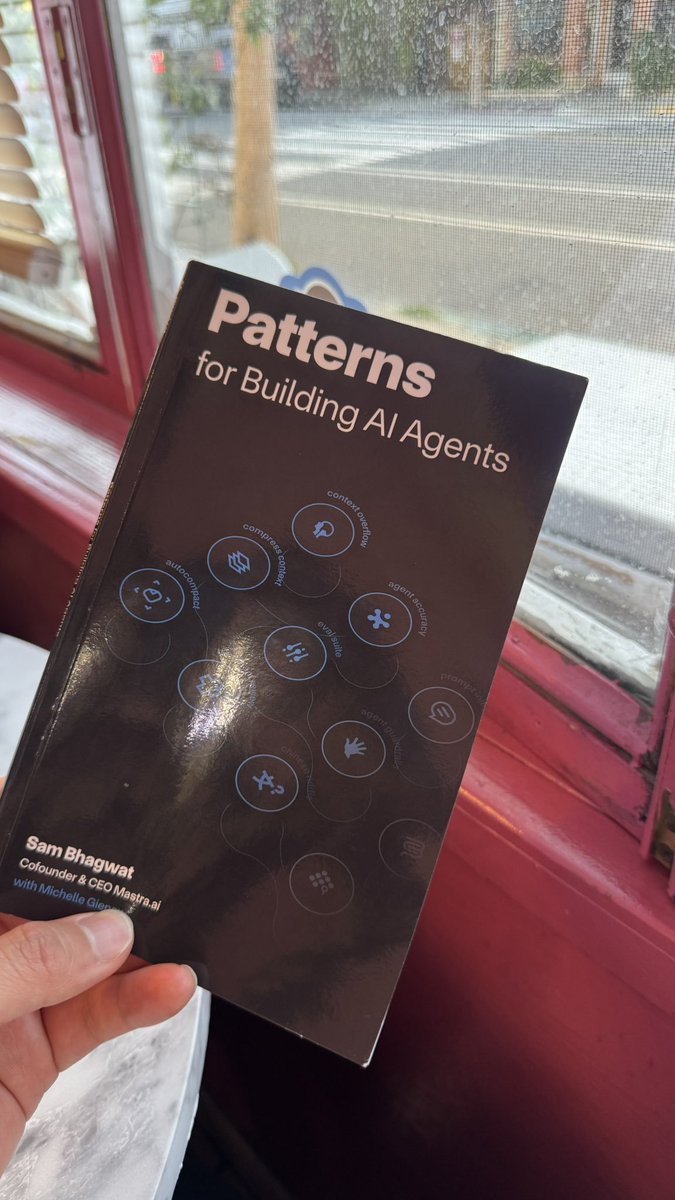
last month we wrote a new agents book: patterns for building ai agents it has everything you need to take your agents from prototype to production, like agent design patterns, the basics of security, etc reply to this tweet with BOOK and we'll dm you so you can get a copy
Sam Bhagwat tweet media
English
4.1K
450
5.1K
589.2K
Arcfunmi
Arcfunmi@Arcfunmi·
What do you think about KITCHEN VINYL WRAPPING? 📹: flowrap.uk
English
3
12
118
38.7K
Dror David Ifrah retweetledi
Hillel Fuld
Hillel Fuld@HilzFuld·
Epic. So good!
English
418
725
3.3K
58.5K
clem 🤗
clem 🤗@ClementDelangue·
This is the first implementation of Grok voice API by @xai on a robot thanks to @atariorbit (not perfect yet)! Feels like this could unlock some fun new use cases for robotics agents given that it ranks #1 on Big Bench Audio, the leading audio reasoning benchmark that measures voice agents’ capabilities to solve complex problems!
English
43
42
355
45.3K
Colin Wright
Colin Wright@SwipeWright·
🚨BREAKING: Canada’s national statistics agency is preparing to publish "gender identity" census data for children—including infants and toddlers—and is now consulting activist groups on how to present it. The consultation guide I obtained encourages parents to infer the "gender identity" of their young children from their behaviors, preferred clothing and hairstyles, and toy preferences, and believes that educating parents about "gender diversity" from birth will allow them to more accurately identify their child's innate gender essence. When a national statistics agency adopts contested metaphysical beliefs as objective data points, it's not simply mismeasuring reality. It is actively distorting people's perception of it. And these perceptions are being used to shape school policies, medical guidelines, and government programs. Read my full assessment in @CityJournal below. 🔗city-journal.org/article/statis…
Colin Wright tweet media
English
232
488
2.1K
308.7K
Elon Musk
Elon Musk@elonmusk·
@heroesahead @wil_da_beast630 My parents didn’t teach me anything academic. I started first grade at age 5 unable to spell a single word. Preschool doesn’t matter.
English
136
51
730
16.1K
Justin Mateen
Justin Mateen@justinmateen·
The “best practices” of productivity are quietly killing your real output. I’ve built my career doing the exact opposite. I operate on instinct. I know within two minutes if I’m going to invest in someone. The rest is just sizing. I don’t have an assistant. I don’t have an analyst. I don’t schedule meetings. If someone wants to connect, I tell them to text me day of and I’ll do my best to make it work. I keep my time open so I can focus on whatever matters most in real time. That’s how I maximize output. I’m a founder first. Some days I’ll spend hours on FaceTime with a founder talking product, KPIs, fundraising, drafting emails, or joining stand-ups. I don’t overcomplicate. I make a decision and move on. I’m rarely at a desk. I do almost everything from my phone. Calls are for things that actually need a call. Most things can be handled with a text. If I’m awake, I’m probably working, but family moments come first. My edge is the flexibility to go deep when needed and the ability to focus on the most important thing at any given time. My days are always full. They’re just never pre planned. The best part is that when you don’t schedule anything, people almost always pick up when you call. Pro tip: If going fully unscheduled feels extreme, ease into it. Start with a couple scheduled meetings per day, then cut down to a few per week. You’ll feel your focus and quality of thought improve quickly. It may not be for everyone, but try it. You might actually like it.
Justin Mateen tweet media
English
31
2
161
35K
NVIDIA Newsroom
NVIDIA Newsroom@nvidianewsroom·
NEWS: NVIDIA announces the NVIDIA Nemotron 3 family of open models, data, and libraries, offering a transparent and efficient foundation for building specialized agentic AI across industries. Nemotron 3 features a hybrid mixture-of-experts (MoE) architecture and new open Nemotron pretraining and post-training datasets, paired with NeMo Gym, an open-source reinforcement learning library that enables scalable, verifiable agent training. Read more: nvda.ws/4oNUTBm
NVIDIA Newsroom tweet media
English
52
204
1.2K
203.9K