.

1.4K posts

.

.

@DufffTrader

Dallas, TX Katılım Ağustos 2014
299 Takip Edilen145 Takipçiler
.
.@DufffTrader·
@TeddyGambino Gonna be interesting how Verdun makes their exit. Too expensive for Crescent? Minimal running room left. Doubt a private could buy and expect to replicate their low D&C, so that turns off many locations. V mngmt rolling in $$$ tho, no rush.
English
0
0
0
131
Teddy “Trican-Jesus” Gambino
With VTX off the board, here’s my list of most eligible pvt bachelors: - Ascent Res, Penn Energy, Arsenal Res - Verdun Oil - Kraken Energy - Verde Energy - Trinity Oil Not including family ops who will never sell.
English
7
0
18
3.8K
.
.@DufffTrader·
@Osint613 Will Pakistan respond in defense of Saudi?
English
0
0
0
133
Open Source Intel
Open Source Intel@Osint613·
Dammam, Saudi Arabia issues an early warning over a potential threat. Iran is now firing toward Saudi Arabia and Bahrain.
English
32
80
582
133.6K
.
.@DufffTrader·
@leadlagreport You have been saying the same shit for the last 4 years
English
0
0
4
2.3K
.
.@DufffTrader·
@FracLost The recoil stuff? I would be extremely impressed if they did. That asset was garbage
English
0
0
6
402
Lost Frac Balls
Lost Frac Balls@FracLost·
Did Warwick make money on the Wilson County deal?
English
6
0
11
3.7K
.
.@DufffTrader·
@BrettErickson28 Ahhhhhh you’re catching on, Brett
English
0
0
1
20
Brett Erickson
Brett Erickson@BrettErickson28·
Does anyone else see the “Iran and the US plan to continue talks” as obvious market manipulation on a Friday before the United States reimposes the blockade of Iran? Just me?
English
42
16
143
4.9K
.
.@DufffTrader·
@ekwufinance What are the chances banks are being pressured by the Trump administration to publish these “quicker than normal” dates? Definitely above 50/50…
English
1
0
4
312
Lukas Ekwueme
Lukas Ekwueme@ekwufinance·
Hormuz normalization estimates of major banks: - Goldman Sachs: End of July - Morgan Stanley: End of August - J.P. Morgan: Q3 - HSBC: August Most expect Gulf exports to normalize quickly, creating an oil surplus of roughly 1-3 mbpd. For perspective, global inventories built by about 2.6 mbpd during the COVID lockdowns... the largest annual inventory build in history. I don't believe Hormuz normalizes this year. The Red Sea is a reminder that shipping disruptions can persist far longer than markets expect. Traffic still hasn't fully normalized.
English
32
22
198
18.9K
SigEStructure
SigEStructure@SigEStructure·
Did you see the delta refiner revenues today? Delta just posted an 86% YoY jump in refinery revenue and flipped from a Q2 loss last year to a meaningful profit this quarter. That’s a jet‑heavy, non‑export refinery. If Delta is printing numbers like that, the US Gulf Coast refiners — PSX, MPC, Valero — with far higher distillate yield and massive diesel export capability are set up for something much bigger. Jet cracks spiked hard in March–April, but diesel cracks outpaced jet by a wide margin for most of the quarter — and export netbacks were even stronger. Delta is the early signal. Gulf Coast refiners look positioned to post historic Q2 profits.
English
1
0
3
161
Tom Kloza
Tom Kloza@TomKloza·
Goldman sees refining fundamentals shining through 2027 - - - projects a 3-2-1 product margin of $27/bbl next year versus the $13/bbl witnessed from 2013-2019.
English
2
2
29
5.6K
.
.@DufffTrader·
How the fucking fuck is wti $72 after all of this?
English
0
0
1
48
.
.@DufffTrader·
@SigEStructure Looks like they’re starting to export again? Would their next step be to start buying crude again?
English
0
0
0
9
SigEStructure
SigEStructure@SigEStructure·
China is more concerned about preserving domestic crude supply and distillate stocks then making money with its refiners. Unlikely Beijing believes this conflict is over - it doesn’t appear stable or resolved on any core issues. Rational for them to stay low throughout and prioritize domestic demand. And very possible for US refiners to crank at max throughout given the huge capacity crunch from Persian Gulf, Russia, Mexico, and now US east coast refiners being offline. You have lost lots of distillate producing capacity with record low distillate inventories and peak summer demand. Cheap crude only drives cracks higher. This can sustain for some time as long as refiners stay offline (likely) and you see even more hit by Ukraine drones or by weather outages. And don’t forget the Russian diesel ban. US refiners are the constraint based trade of this macro cycle. They sit at the place of scarcity (products),
English
1
0
1
141
.
.@DufffTrader·
Am I getting this right? WTI 3-2-1 crack spread doesnt make sense. Either it’s too expensive or WTI is too cheap. China could start exporting to capture more of the spread. If China does this, they need to start up their crude purchases ahead of time, thus helping drive oil $ up
English
4
0
3
230
.
.@DufffTrader·
Iran smoked two ships in the straight last evening and oil is up 1%?
English
0
0
0
25
.
.@DufffTrader·
@xLexemeX @OilCfd @staunovo Haha as an ex banker, I’m ocd about those minor details. I always want visuals to be as straightforward as possible. Don’t make me compare bars for different x axis labels 😆
English
0
0
1
31
.
.@DufffTrader·
@VivuI58294 @SigEStructure @JuneGoh_Sparta Why doesn’t China increase purchases to take advantage of refined product pricing? They could increase exports to realize the high cracks spreads. Or are they worried that would drive oil up too much and it wouldn’t make sense?
English
1
0
0
58
June Goh
June Goh@JuneGoh_Sparta·
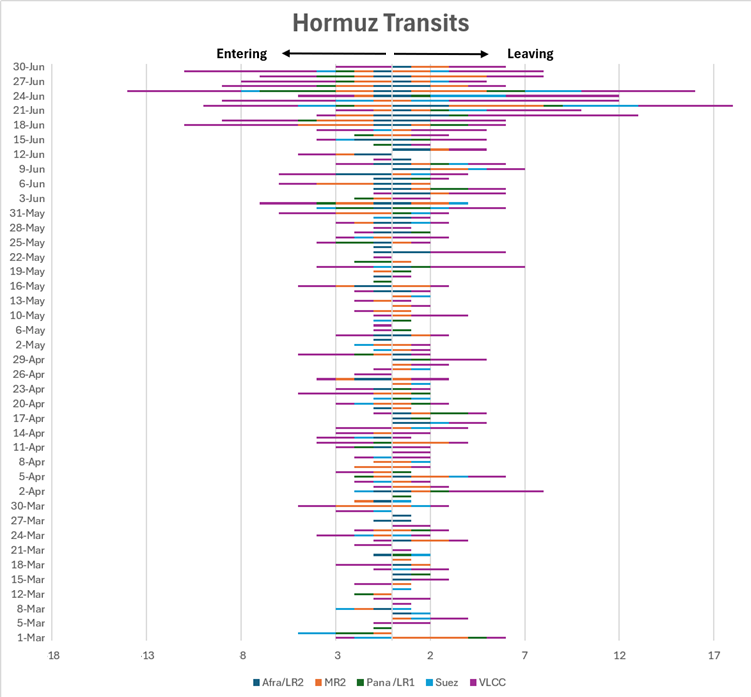
It's now Day 100+ since I wrote this. We first saw about 2 months of very low intake in Asia but arbs did their magic and helped improve operating rates. WTI was used also as a blend with the heavier crudes in Japan's SPR. Thereafter we saw China's crude imports tumble to new lows. That helped support the rest of the Asian refineries pick up cheaper, discounted barrels to run higher. More flows also emerged from telhe Strait of Hormuz in the form of hidden shuttles and finally became official with the signing of the MOU in mid June. We are now in the phase where ships are offloading the high stocks from onshore tanks so you can achieve fairly high offtake levels. The challenge is a sustainable offtake level to enable a sustainable higher production level. This constraint is faced by mainly Kuwait and Iraq. So let's pay attention to the ships on ballast going into the SoH. In the meantime, Asia products position looks ok, Atlantic Basin looks tighter. #oott
June Goh@JuneGoh_Sparta

Day 10: When will oil supply chain will normalize if oil starts flowing again from the Straits of Hormuz? Hint: Not anytime soon 1⃣Let's say the oil flows again from the Straits of Hormuz (which has not and does not seem to be easy to restart). Existing ships will start to load their cargoes from the various terminals in the Gulf. Who gets prioritized first will be a scramble. 2⃣Then all the loading programmes have to be rescheduled. 1 VLCC doesn't just load from a single loadport. It is usually 2 to 3 loadports to fill up the full 2 mb. So another logistics nightmare to deal with at each loadport. 5⃣Although there is production shut in, the onshore tanks are full, so most of the first say 5-7 days of loadings should not have any issue to load. It will highly depend on the timeline of restarting the oil production which could be at least days. 4⃣Meanwhile refineries will need to wait for a better picture of their crude arrival programme to decide what to do and when to start up if they had shutdown already. The first VLCC that arrives is not enough to sustain a feasible run IF they have already shutdown. Read my thread on why refineries simply cannot have a start-stop operation. My view is that refiners will continue to run at low intakes until the crude supply chain looks reliable again (i.e. no more attacks). 5⃣Resupply of crude from other regions into Asia will take between 25 to 50 days. Even then these crudes do not really fit the crude yield and quality requirements of a base AG crude so there will be refineries that will remain down. Also the freight econs need to work - many end users are paralyzed right now on what to buy due to skyhigh freight rates. 6⃣After refineries have achieved a steady state, then only the steam crackers get a fighting chance to resume operations as well. Asia is a nett importer of naphtha and must also see the consistent flow of cargoes heading here before the downstream petchem can run up. My guesstimate of any semblance of a return to a normal supply chain from the onset of point 1 is optimistically 2 months and for petchem, minimum 2.5 months. In summary: 10 days of Straits of Hormuz disruption = at least 60 days of pain to the energy flow in Asia. And I am being optimistic here. #oott

English
9
17
137
33.3K