

Dusk
3.8K posts


So, the only thing that really changed today is that GameStop disclosed a long position in eBay that’s up around $500 million.
$GME -10% totally makes sense
English
@techopsasia @RobertDVis Famously whoppers and chicken nuggets are the only healthy food left.
English

@RobertDVis It's very unhealthy to ban the only healthy food left. What's their big theory or rationale?
English

Prostitution or hamburgers? Which one should Amsterdam ban first?
New regulations ban all meat ads. My city known for its liberty is becoming more controlled than communism.
Why can we do?

English
@RobertDVis Well given that public space advertising for prostitution in Amsterdam hasn’t been legal since the early 90s, that means it was banned first.
And if you really use your brain, you’ll realize that eating meat and driving cars is very much still legal and less restricted.
English




@BobGrayson15 @DuskXBT Up until a few days ago, I didn’t know this university existed…
English
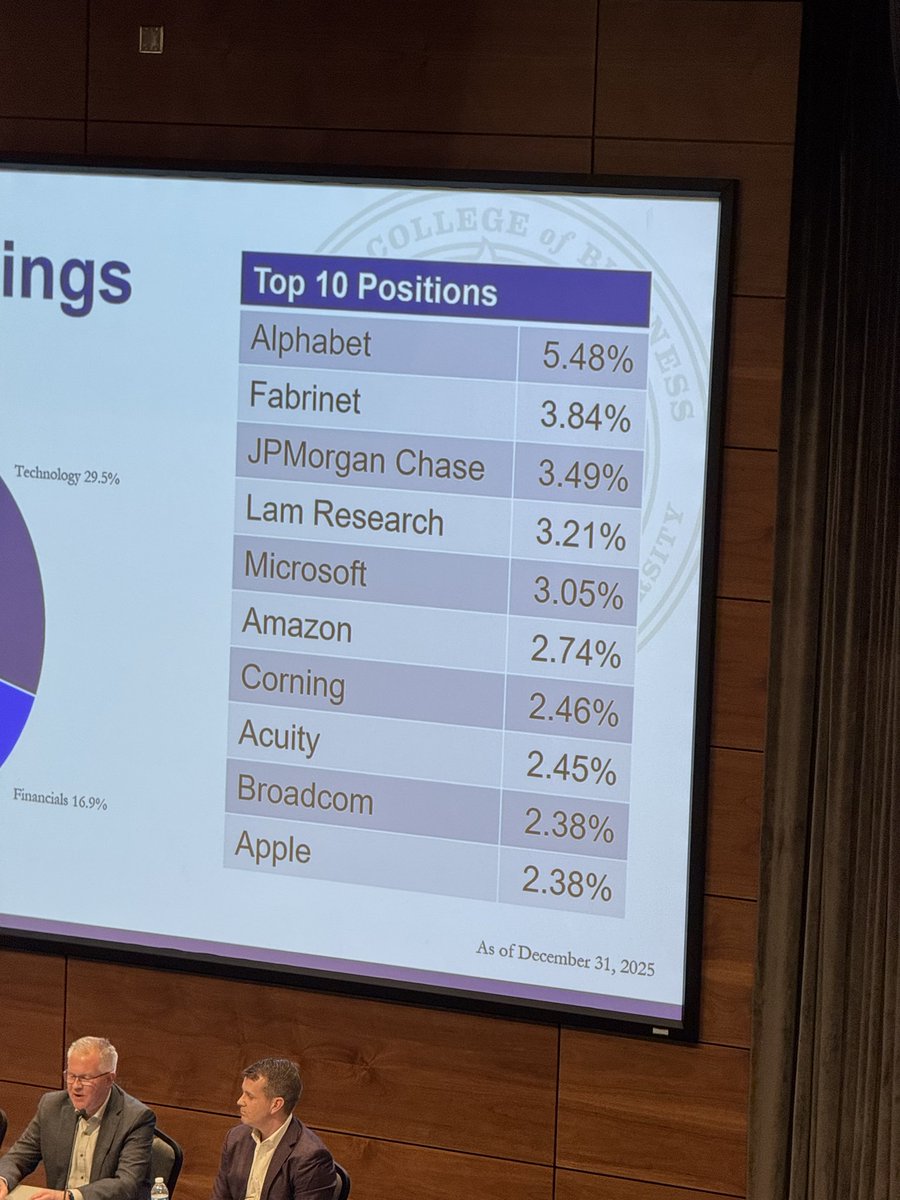
No offence, but this feels like the 2026 consensus
English
@MikeFritzell Just went into a rabbit hole around their intelligent spaces division. Seems like it could be an interesting AI + robotics + data centre play in terms of building management. Hadn't heard of them either.
English
@DuskXBT I didn't know that Acuity was until today. But it does look compelling, I agree
English
@MikeFritzell Acuity is an interesting pick no? What are your thoughts on that?
English
@DuskXBT That's Creighton University's student portfolio
English
@EleanorTerrett @PunchbowlNews The crypto capital of the world now hangs in the balance of whoever gets to create the threshold for equivilant. What a mess.
English

🚨JUST IN: Yep. Here’s the text given to @PunchbowlNews. ⬇️⬇️⬇️
Brendan Pedersen@BrendanPedersen
SCOOP: Sens. Tillis and Alsobrooks have finalized a compromise on stablecoin yield. Punchbowl News has the text - bans rewards that are “economically or functionally equivalent” to deposit interest - balances *can* be used for rewards if companies clear the “equivalent” test
English

$META reportedly told staff in an internal meeting that it is not ruling out further layoffs.
“I’d love to say that there are no more layoffs but I can’t say something we can’t deliver.”

English

@GabGrowth As an investor, an Arc token is the most bearish thing I can imagine. There is no need for a token. Just create a great payments infrastructure company to compete with the Stripe + Bridge combo on the infra side while also having the stablecoin issuance side.
English

$CRCL
Just listened to Jeremy Allaire's (CEO of $CRCL) pitch 2 weeks ago in Seoul, here are my key takeaways:
(As a reminder, my deep dive will be out in a few days)
1. Circle is more than USDC now
Circle’s core remains USDC, but Allaire highlighted a broader stack: USDC, EURC, USYC, Circle Mint, CCTP, wallets, interoperability infrastructure, CPN, Stable FX, and Arc. He wants investors and partners to see Circle as a full-stack financial infrastructure company, not just a stablecoin issuer.
2. Arc is Circle’s biggest platform bet since USDC
Arc is described as an “economic operating system” built for mainstream financial activity. It is meant to support stablecoins, financial contracts, real-world economic activity, privacy, post-quantum capabilities, finality, and institutional-grade assurances. He also said Circle is exploring an Arc token for governance, incentives, and economic alignment.
3. AI agents are a major part of the thesis
Allaire believes a huge share of future economic activity will be conducted by AI agents. Circle is building AI-native wallets, payment rails, nano-payments, MCP servers, and standards such as X402 so agents can transact with each other. The idea is that AI-to-AI transactions may become high-volume and low-value, requiring instant, cheap, programmable payments.
4. CPN is gaining early traction
Allaire said Circle Payments Network has more than 55 financial institutions on the network, over 70 more going through eligibility, and 500+ institutions in the pipeline. Annualised transaction volume reached around $6 billion, up 70% quarter-on-quarter.
5. Regulation is the unlock
A big theme was that stablecoins move from trading collateral to mainstream payments and treasury infrastructure once laws define them as legal, regulated forms of electronic money. He pointed to the US Genius Act as an example of regulation that makes financial institutions, fintechs, households, and businesses more comfortable using stablecoins.
6. Real-world use cases are already expanding
He pushed back against the idea that stablecoins are only for trading. He cited cross-border payments, treasury, remittance, payroll, stablecoin-linked cards, Shopify, Stripe, Deel, Gusto, and global merchant payments as examples of stablecoins moving into real-world financial workflows.
7. Circle wants to partner with local stablecoin issuers
On Korean won stablecoins, Circle’s stance is collaborative. Circle wants to support local issuers with technology, liquidity, distribution, payments infrastructure, and FX infrastructure.
Personal Thoughts:
Circle is trying hard to convince the market that it is not just "USDC + Interest Income", which by all definitions and financials, it currently is.
I think what Allaire is essentially trying to build with $CRCL is really becoming the operating system layer for internet-native money. That is a very ambitious but surely rewarding role.
What I would watch for $CRCL, is that USDC distribution continues growing, regardless of what the crypto market does. This would prove it is becoming a payment/treasury asset, not just a crypto-trading asset.
Regulation is definitely the biggest unlock, no disagreements here. After regulation, banks, fintechs, payment processors, payroll companies, and corporates can actually integrate them (which they are doing now). If stablecoins become recognised payment instruments, Circle’s TAM expands massively. If stablecoins remain mostly crypto-native instruments, Circle is still a good business, but probably not worth a very aggressive multiple.
CPN is growing fast but is still tiny compared with global payments volumes. $6 billion annualised volume is not yet financially meaningful for a company already generating billions in revenue and reserve income. It is more of an option than a core earnings driver today.
It seems Allaire is betting heavily on Arc. He describes Arc as an “economic operating system” for money, contracts, financial agreements, governance, and AI-native economic activity. Circle is also exploring an Arc token for governance, incentives, economic alignment, and eventually proof-of-stake.
This is a hugely ambitious project. If it works, Arc could be extremely valuable because Circle would move from issuing money to owning/operating the infrastructure where that money moves. However, I would personally not underwrite much value to Arc yet. Launching another L1 is easy, many have done so. But getting developers, liquidity, institutions, stablecoin issuers, applications, and real economic activity onto it is hard. There is a reason that over a decade into ERC launch, $ETH and $SOL remain the only 2 consequential players.
I also have a concern about Arc that I don't see many talking about. $CRCL's greatest strength today is its market neutrality, but Arc may create strategic tension. If Circle launches its own chain and token, will neutral blockchain ecosystems still treat Circle as a neutral stablecoin issuer? Maybe yes, because USDC is too important today. But it is a risk.
Curious to hear any questions or thoughts you might have down below!
English