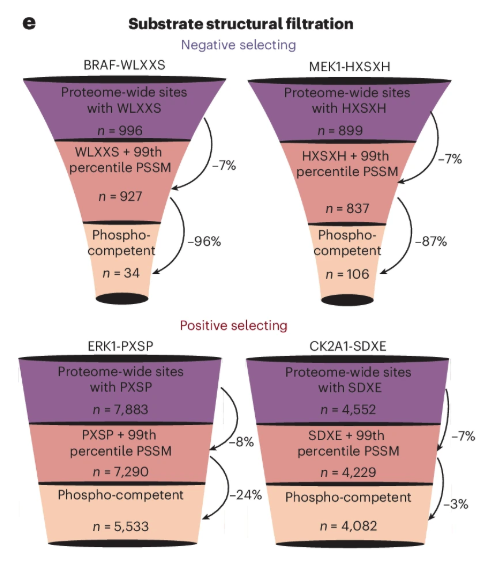
First author here. In building our structural atlas, we set out to answer several questions: (1) How do ~500 kinases find the right targets among 1.8 million potential phospho-acceptors in a heterogeneous cellular milieu? (2) Why do some kinases phosphorylate seemingly thousands of substrates, while others may phosphorylate fewer than ten? (3) Do short recognition motifs encode their own structural presentation, thus conferring predisposition to being phosphorylated? An unexpected organizing principle emerged. Some kinases prefer motifs that naturally occupy exposed, phospho-permissive microenvironments (structural phospho-competency), giving them broad access across the proteome. Others prefer motifs that are typically buried within ordered protein structures, rarely reaching the protein surface let alone the active site of a kinase without significant structural rearrangement. We call this sequence–structure selective coupling: some kinases gain broad activity through structural availability, whereas others achieve exquisite specificity through structural scarcity.