JC

10.8K posts

JC

JC

@Eggelstein

https://t.co/SmmXeEm5a2 https://t.co/dohGWGRKCm Christian, father, husband, reformed human, veteran, egg.


United States Katılım Mart 2012
120 Takip Edilen323 Takipçiler
JC
JC@Eggelstein·
@newstart_2024 That love death robots episode where they go to the bunker and it’s a bunch of rich skeletons makes me laugh every time. Yep you saved yourselves all right, good job.
English
0
0
0
13
Camus
Camus@newstart_2024·
Tim Dillon had this wild theory on Joe Rogan: The ultra-rich saw AI coming and basically got the memo years ago: “You’ve got 5–10 years before everything gets really weird. Build your bunkers, move your money, get ready.” A lot of them are doing exactly that — bunkers, New Zealand escape plans, pulling assets off government books. Tim says the top 1–2% are the truly nefarious ones who know the score. When the wealthiest people start acting like major disruption is coming, it makes you wonder what they see that the rest of us don’t. I’ve always found these kinds of conversations equal parts entertaining and a little unsettling. What do you think — are the elites genuinely preparing for big societal changes with AI, or is this just rich-people paranoia?
English
272
611
7.2K
1M
JC
JC@Eggelstein·
@Mericamemed As he creates content for the new circus on the device he worships
English
1
0
2
228
MERICA MEMED
MERICA MEMED@Mericamemed·
bread and circus and they will never rebel
English
87
356
3.6K
150.8K
JC
JC@Eggelstein·
@DKThomp It’s because fatherhood is a real thing and so much else has become very unreal satisfaction wise
English
0
0
2
219
Derek Thompson
Derek Thompson@DKThomp·
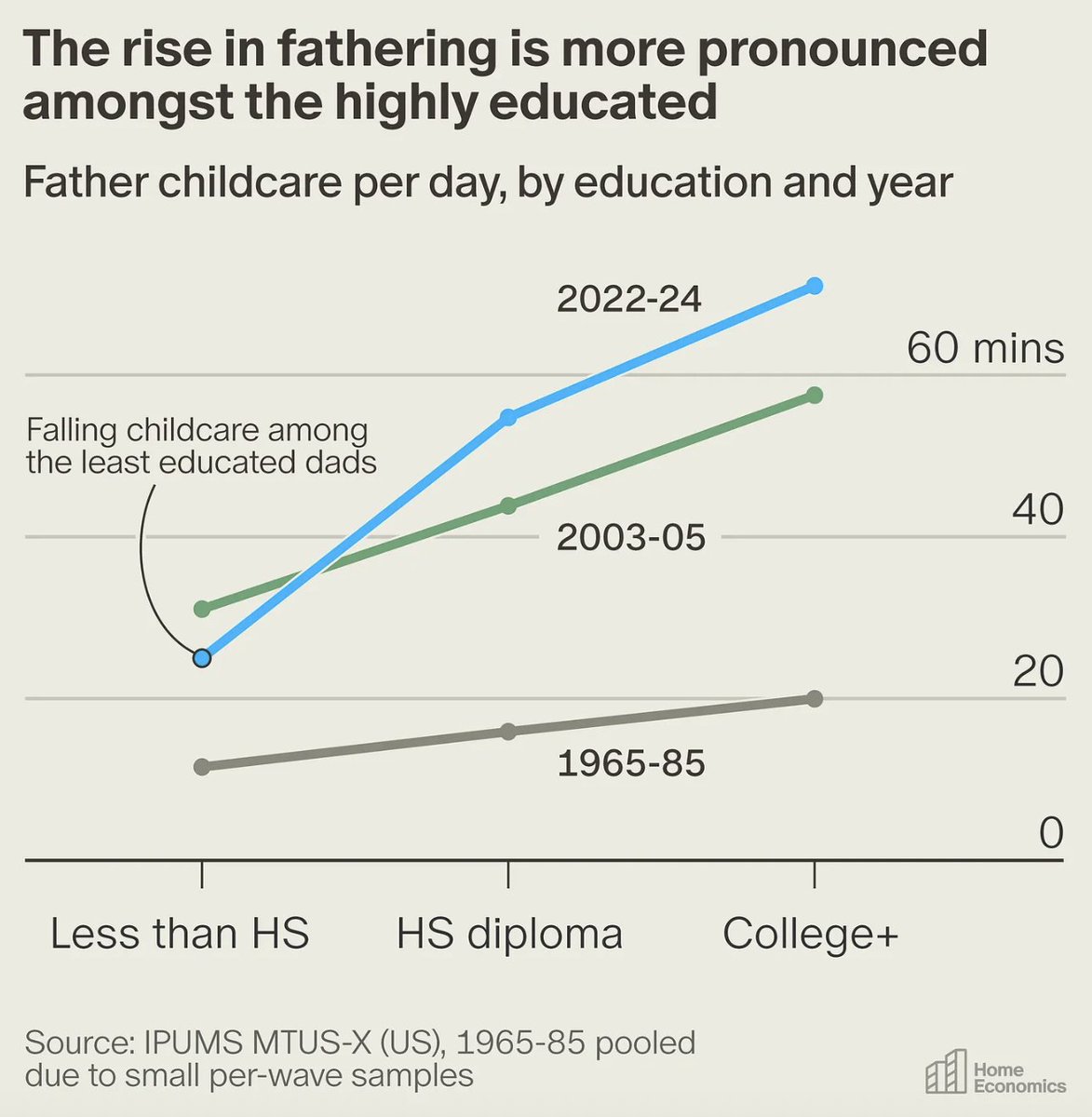
New newsletter: MODERN FATHERHOOD WOULD BE UNRECOGNIZABLE TO A 1950'S DAD Compared to their Boomer parents, childcare time among Millennial dads has more than doubled. Compared to their Silent Generation grandparents, it’s nearly quadrupled. You will be hard-pressed to find any part of day-to-day modern life that has changed more in the last half-century than the way today’s parents—and fathers, in particular—spend their time. The new American dad is more present and more exhausted—but also, more satisfied with life. What's behind this half-century transformation? Today's piece combines history, economic analysis, and gorgeous charts galore from @AzizSunderji
Derek Thompson tweet mediaDerek Thompson tweet mediaDerek Thompson tweet mediaDerek Thompson tweet media
English
199
841
6.8K
2.6M
peepeepoopoo
peepeepoopoo@DeepDishEnjoyer·
what the actual fuck
peepeepoopoo tweet mediapeepeepoopoo tweet media
English
65
21
1.1K
112.4K
JC
JC@Eggelstein·
@fed_speak what were the choices
English
0
0
0
12
fed_speak
fed_speak@fed_speak·
This is legitimately the saddest chart in the world. Worse than the worst of our awful politics.
fed_speak tweet media
English
47
21
261
42K
JC
JC@Eggelstein·
@remarks talk about free money
English
0
0
0
5
Remarks
Remarks@remarks·
JUST IN: 🇺🇸 Nick Fuentes altercation footage surfaces after woman approached his door following doxxing of his address.
English
2.3K
1.4K
32.6K
9.8M
JC
JC@Eggelstein·
@GergelyOrosz Windsurf got ruined a while ago for the same reasons. It's coming for everything
English
0
0
0
52
Gergely Orosz
Gergely Orosz@GergelyOrosz·
Its the beginning of the end of subsidized AI subscriptions. GH Copilot is moving to usage-based billing, as has Claude (for business customers.) Fair to assume more will follow. I expect this change will also be a great boost for open models - cheaper, and pretty good already
GitHub@github

Starting June 1st, GitHub Copilot will move to a usage-based billing model as GitHub Copilot supports more agentic and advanced workflows. In early May, you'll see a preview bill experience, giving visibility into projected costs before the transition. 👉 Read more about the upcoming change: github.blog/news-insights/…

English
128
283
4.3K
511.3K
JC
JC@Eggelstein·
@royermattw Good list of accounts to mute
English
0
0
0
2
Matt Royer
Matt Royer@royermattw·
Ashley St. Clair confirmed the WH runs group chats telling these accounts what to post. Within minutes of shots fired tonight, before there was any news of casualties and before the President said this exact talking point, this was the chat in real time.
Matt Royer tweet media
English
2.3K
19.5K
59.5K
2.4M
JC retweetledi
The Fat Electrician
The Fat Electrician@Fat_Electrician·
So you’re telling me you’ve arrested more American soldiers involved in capturing Maduro than people on the Epstein list, or politicians who somehow magically became better investors than Warren Buffett the second they took office? Wild priorities.
FBI Director Kash Patel@FBIDirectorKash

This involved a U.S. soldier who allegedly took advantage of his position to profit off of a righteous military operation. Thank you to our agents, Intel teams, and great partners @TheJusticeDept who protected our war fighters. Investigation ongoing.

English
389
4.6K
31.7K
419.6K
JC
JC@Eggelstein·
@hunvreus I don’t think it matters if you are buying it because corporate America is feasting on this slop
English
0
0
0
6
Ronan Berder
Ronan Berder@hunvreus·
Talking to smarter folks than me, I'm convinced many of the AI folks in my timeline are full of shit. Nobody is "running 20 agents over night" and building stuff for actual users. Maybe some are building internal tools or disposable software. Maybe. But building software people like using? That doesn't get hacked on day one or blow up after the 3rd user? Nope. I don't even understand what that's supposed to look like. Do you work out a 57 pages document that perfectly describes what you want to build and then summon 14 agents and have them run wild for 6 hours? And what comes out on the other end isn't a broken pile of shit? Nope. Not buying it. PS: it may also be that I have an IQ of 82 and can't figure it out.
English
669
270
4.9K
845.9K
JC
JC@Eggelstein·
@RobertMSterling These companies are bloated, bottom line. It has little to do with "AI"
English
0
0
0
46
Robert Sterling
Robert Sterling@RobertMSterling·
KPMG is laying off 10% of their audit partners. You might have missed the news amidst today’s announcement that Meta is also laying off 10% of their employees. I’ll be blunt: If you work in front of a computer, your job isn’t safe. It doesn’t matter how senior you are (KPMG’s partners literally own the company). Nor does it matter how good you are at your job (Meta’s engineers are among the best of the best in the tech industry). Your job is at risk, and it’s incumbent on you—and no one but yourself—to plan for what you do in your career to proactively manage that risk. Four reasons why this is happening: 1. Competition: AI is reducing barriers to entry across every industries, from professional services (such as the audit and advisory services provided by the likes of KPMG) to software and everything in between. Reduced barriers to entry mean increased competition, which means lower pricing power, margin compression, and pressure to reduce costs—especially fixed costs such as labor, which is the number one expense for most white-collar businesses. 2. Need to Invest: As incumbents face increased competition from new entrants to their market and from substitute products (e.g., vibe-coded homebrew SaaS replacing expensive vertical SaaS products that previously enjoyed virtual monopolies within their respective target markets), they are forced to make sizable investments in technology to remain competitive. In the case of professional services companies, this means large investments in proprietary software (all of the Big Four firms are investing billions in new technology right now); for big tech companies, this means tens of billions of dollars going into data centers and physical infrastructure. Essentially, capex and opex are in the middle of a zero-sum battle in corporate budgets. As companies face the need to invest more in capex and R&D—and as capital markets become increasingly averse to providing them additional liquidity to fund it, out of concerns that the ROIC on said capex will not be accretive to earnings—opex is cannibalized to fund capex. And, again, the primary lever CFOs in white-collar companies have to instantly reduce opex is layoffs. 3. Automation: These competitive pressures are compounded by AI rapidly automating work faster than incremental revenue is able to be generated. In other words, workers are being made redundant faster than companies are able to come up with the new business that might otherwise save those jobs. Some in the tech industry (people far smarter than me, I will add) conjecture that, on a net basis, AI will create more jobs than it will destroy, due to an AI-facilitated period of hypergrowth and a corresponding boom in corporate earnings. But with every company I advise, across the worlds of startups, SMBs, and large industrial companies, I’m simply not seeing that yet, and I don’t know anyone who is. 4. It might feel like ancient history at this point, but many companies are still dealing with the excesses of the Covid-era labor market. Money was loose, talent was in short supply, and software companies, financial services firms, and professional services companies hired too many people too fast, with standards that were too low. They’ve made significantly progress in right-sizing their workforces over the past couple years (return-to-office mandates, for example, have essentially created “soft layoffs” at many large companies), but much work still remains. If you’re picturing your career and your company as you read these words, I can’t emphasize it enough: Plan ahead. Build a network of people outside your company who would want to work with you if your current job were made redundant. Think about businesses you might want to start (it’s a lot easier to keep your job if no one but your customers can terminate you). Set money aside. Be proactive, not reactive. Be a predator, not the prey. Because these trends are inexorable, they’re unstoppable, and, chances are, they’re coming for all of us. Start planning. And start planning now.
Robert Sterling tweet mediaRobert Sterling tweet media
English
146
388
2.3K
483.3K
WagaGaming
WagaGaming@WagaGaming·
@Eggelstein @Hera_Aoe Grubby is immortal so he is higher mmr than most players after his amazing tryhard journey, and Day9 has hosted TI so he is honorary dota player :)
English
1
0
1
79
Hera
Hera@Hera_Aoe·
Can 7 Dota players beat 1 Age of Empires Pro? I brought together a stacked Dota roster, full of streamers, pro players, and gaming legends, to answer this simple question We played 3 games of Age of Empires 2. It was exciting, intense, and hilarious. Check it out 👇
English
11
18
339
39.8K
JC
JC@Eggelstein·
Trust me, I'm a doctor
JC tweet media
English
0
0
0
6
ᗰᗩƳᖇᗩ
ᗰᗩƳᖇᗩ@LePapillonBlu2·
Check out this very goofy, very pathetic man who’s the highest paid CEO on the planet, and thinks that the world should be ruled by a techno-fascist elite that keeps society in a perpetual state of war.
English
630
2.4K
10.7K
423.3K
JC
JC@Eggelstein·
@maryarchived people with meaningless, cookie-cutter, inexplicable tattoos was always low status
English
0
0
0
2
JC retweetledi
Glenn Greenwald
Glenn Greenwald@ggreenwald·
During Trump's second term: - Jared Kushner became a billionaire - the net worth of his 3 sons exponentially skyrocketed - Baron Trump now worth $120m Much if not most came from huge cash infusions from the Persian Gulf tyrannies. [Hunter Biden got $50k/month from Burisma]
Judd Legum@JuddLegum

Articles about Jared Kushner's diplomatic role with Iran that mention Kushner has received billions from the Saudi government (2/28-4/19): NYT: 5 of 58 WashPost: 1 of 43 WSJ: 0 of 40 AP: 0 of 26 CNN Wire: 0 of 18 NY Post: 0 of 17 Chicago Tribune: 0 of 4 LA Times: 0 of 4 Boston Globe: 0 of 2

English
739
6.9K
22.9K
1.4M
JC
JC@Eggelstein·
@Miles_Brundage There are some boys who are lost in a way I’m not sure we have seen for a while. Young boys who are deeply nihilistic and very anti-liberal, in the traditional sense of the word liberal. I am not sure those people existed in my age group.
English
0
0
1
47
Miles Brundage
Miles Brundage@Miles_Brundage·
Wait so are kids these days super woke or super anti woke or some secret third thing? I feel like I have heard a range of not super consistent accounts
English
21
0
51
6.7K
JC
JC@Eggelstein·
@hissgoescobra This country has always been a technopoly
English
0
0
0
2
John Jackson
John Jackson@hissgoescobra·
This has gone too far. We cannot have tech companies that are intertwined with our national security making these types of social-engineering pronouncements. If they don’t know their place and accept it, they must be brought to heel. Time to regulate.
Palantir@PalantirTech

Because we get asked a lot. The Technological Republic, in brief. 1. Silicon Valley owes a moral debt to the country that made its rise possible. The engineering elite of Silicon Valley has an affirmative obligation to participate in the defense of the nation. 2. We must rebel against the tyranny of the apps. Is the iPhone our greatest creative if not crowning achievement as a civilization? The object has changed our lives, but it may also now be limiting and constraining our sense of the possible. 3. Free email is not enough. The decadence of a culture or civilization, and indeed its ruling class, will be forgiven only if that culture is capable of delivering economic growth and security for the public. 4. The limits of soft power, of soaring rhetoric alone, have been exposed. The ability of free and democratic societies to prevail requires something more than moral appeal. It requires hard power, and hard power in this century will be built on software. 5. The question is not whether A.I. weapons will be built; it is who will build them and for what purpose. Our adversaries will not pause to indulge in theatrical debates about the merits of developing technologies with critical military and national security applications. They will proceed. 6. National service should be a universal duty. We should, as a society, seriously consider moving away from an all-volunteer force and only fight the next war if everyone shares in the risk and the cost. 7. If a U.S. Marine asks for a better rifle, we should build it; and the same goes for software. We should as a country be capable of continuing a debate about the appropriateness of military action abroad while remaining unflinching in our commitment to those we have asked to step into harm’s way. 8. Public servants need not be our priests. Any business that compensated its employees in the way that the federal government compensates public servants would struggle to survive. 9. We should show far more grace towards those who have subjected themselves to public life. The eradication of any space for forgiveness—a jettisoning of any tolerance for the complexities and contradictions of the human psyche—may leave us with a cast of characters at the helm we will grow to regret. 10. The psychologization of modern politics is leading us astray. Those who look to the political arena to nourish their soul and sense of self, who rely too heavily on their internal life finding expression in people they may never meet, will be left disappointed. 11. Our society has grown too eager to hasten, and is often gleeful at, the demise of its enemies. The vanquishing of an opponent is a moment to pause, not rejoice. 12. The atomic age is ending. One age of deterrence, the atomic age, is ending, and a new era of deterrence built on A.I. is set to begin. 13. No other country in the history of the world has advanced progressive values more than this one. The United States is far from perfect. But it is easy to forget how much more opportunity exists in this country for those who are not hereditary elites than in any other nation on the planet. 14. American power has made possible an extraordinarily long peace. Too many have forgotten or perhaps take for granted that nearly a century of some version of peace has prevailed in the world without a great power military conflict. At least three generations — billions of people and their children and now grandchildren — have never known a world war. 15. The postwar neutering of Germany and Japan must be undone. The defanging of Germany was an overcorrection for which Europe is now paying a heavy price. A similar and highly theatrical commitment to Japanese pacifism will, if maintained, also threaten to shift the balance of power in Asia. 16. We should applaud those who attempt to build where the market has failed to act. The culture almost snickers at Musk’s interest in grand narrative, as if billionaires ought to simply stay in their lane of enriching themselves . . . . Any curiosity or genuine interest in the value of what he has created is essentially dismissed, or perhaps lurks from beneath a thinly veiled scorn. 17. Silicon Valley must play a role in addressing violent crime. Many politicians across the United States have essentially shrugged when it comes to violent crime, abandoning any serious efforts to address the problem or take on any risk with their constituencies or donors in coming up with solutions and experiments in what should be a desperate bid to save lives. 18. The ruthless exposure of the private lives of public figures drives far too much talent away from government service. The public arena—and the shallow and petty assaults against those who dare to do something other than enrich themselves—has become so unforgiving that the republic is left with a significant roster of ineffectual, empty vessels whose ambition one would forgive if there were any genuine belief structure lurking within. 19. The caution in public life that we unwittingly encourage is corrosive. Those who say nothing wrong often say nothing much at all. 20. The pervasive intolerance of religious belief in certain circles must be resisted. The elite’s intolerance of religious belief is perhaps one of the most telling signs that its political project constitutes a less open intellectual movement than many within it would claim. 21. Some cultures have produced vital advances; others remain dysfunctional and regressive. All cultures are now equal. Criticism and value judgments are forbidden. Yet this new dogma glosses over the fact that certain cultures and indeed subcultures . . . have produced wonders. Others have proven middling, and worse, regressive and harmful. 22. We must resist the shallow temptation of a vacant and hollow pluralism. We, in America and more broadly the West, have for the past half century resisted defining national cultures in the name of inclusivity. But inclusion into what? Excerpts from the #1 New York Times Bestseller The Technological Republic: Hard Power, Soft Belief, and the Future of the West, by Alexander C. Karp & Nicholas W. Zamiska techrepublicbook.com

English
157
1.9K
11.5K
206.9K
JC
JC@Eggelstein·
@PalantirTech More like Technopoly, and you know it
English
0
0
0
3
Palantir
Palantir@PalantirTech·
Because we get asked a lot. The Technological Republic, in brief. 1. Silicon Valley owes a moral debt to the country that made its rise possible. The engineering elite of Silicon Valley has an affirmative obligation to participate in the defense of the nation. 2. We must rebel against the tyranny of the apps. Is the iPhone our greatest creative if not crowning achievement as a civilization? The object has changed our lives, but it may also now be limiting and constraining our sense of the possible. 3. Free email is not enough. The decadence of a culture or civilization, and indeed its ruling class, will be forgiven only if that culture is capable of delivering economic growth and security for the public. 4. The limits of soft power, of soaring rhetoric alone, have been exposed. The ability of free and democratic societies to prevail requires something more than moral appeal. It requires hard power, and hard power in this century will be built on software. 5. The question is not whether A.I. weapons will be built; it is who will build them and for what purpose. Our adversaries will not pause to indulge in theatrical debates about the merits of developing technologies with critical military and national security applications. They will proceed. 6. National service should be a universal duty. We should, as a society, seriously consider moving away from an all-volunteer force and only fight the next war if everyone shares in the risk and the cost. 7. If a U.S. Marine asks for a better rifle, we should build it; and the same goes for software. We should as a country be capable of continuing a debate about the appropriateness of military action abroad while remaining unflinching in our commitment to those we have asked to step into harm’s way. 8. Public servants need not be our priests. Any business that compensated its employees in the way that the federal government compensates public servants would struggle to survive. 9. We should show far more grace towards those who have subjected themselves to public life. The eradication of any space for forgiveness—a jettisoning of any tolerance for the complexities and contradictions of the human psyche—may leave us with a cast of characters at the helm we will grow to regret. 10. The psychologization of modern politics is leading us astray. Those who look to the political arena to nourish their soul and sense of self, who rely too heavily on their internal life finding expression in people they may never meet, will be left disappointed. 11. Our society has grown too eager to hasten, and is often gleeful at, the demise of its enemies. The vanquishing of an opponent is a moment to pause, not rejoice. 12. The atomic age is ending. One age of deterrence, the atomic age, is ending, and a new era of deterrence built on A.I. is set to begin. 13. No other country in the history of the world has advanced progressive values more than this one. The United States is far from perfect. But it is easy to forget how much more opportunity exists in this country for those who are not hereditary elites than in any other nation on the planet. 14. American power has made possible an extraordinarily long peace. Too many have forgotten or perhaps take for granted that nearly a century of some version of peace has prevailed in the world without a great power military conflict. At least three generations — billions of people and their children and now grandchildren — have never known a world war. 15. The postwar neutering of Germany and Japan must be undone. The defanging of Germany was an overcorrection for which Europe is now paying a heavy price. A similar and highly theatrical commitment to Japanese pacifism will, if maintained, also threaten to shift the balance of power in Asia. 16. We should applaud those who attempt to build where the market has failed to act. The culture almost snickers at Musk’s interest in grand narrative, as if billionaires ought to simply stay in their lane of enriching themselves . . . . Any curiosity or genuine interest in the value of what he has created is essentially dismissed, or perhaps lurks from beneath a thinly veiled scorn. 17. Silicon Valley must play a role in addressing violent crime. Many politicians across the United States have essentially shrugged when it comes to violent crime, abandoning any serious efforts to address the problem or take on any risk with their constituencies or donors in coming up with solutions and experiments in what should be a desperate bid to save lives. 18. The ruthless exposure of the private lives of public figures drives far too much talent away from government service. The public arena—and the shallow and petty assaults against those who dare to do something other than enrich themselves—has become so unforgiving that the republic is left with a significant roster of ineffectual, empty vessels whose ambition one would forgive if there were any genuine belief structure lurking within. 19. The caution in public life that we unwittingly encourage is corrosive. Those who say nothing wrong often say nothing much at all. 20. The pervasive intolerance of religious belief in certain circles must be resisted. The elite’s intolerance of religious belief is perhaps one of the most telling signs that its political project constitutes a less open intellectual movement than many within it would claim. 21. Some cultures have produced vital advances; others remain dysfunctional and regressive. All cultures are now equal. Criticism and value judgments are forbidden. Yet this new dogma glosses over the fact that certain cultures and indeed subcultures . . . have produced wonders. Others have proven middling, and worse, regressive and harmful. 22. We must resist the shallow temptation of a vacant and hollow pluralism. We, in America and more broadly the West, have for the past half century resisted defining national cultures in the name of inclusivity. But inclusion into what? Excerpts from the #1 New York Times Bestseller The Technological Republic: Hard Power, Soft Belief, and the Future of the West, by Alexander C. Karp & Nicholas W. Zamiska techrepublicbook.com
English
8.7K
7.2K
34K
35.8M