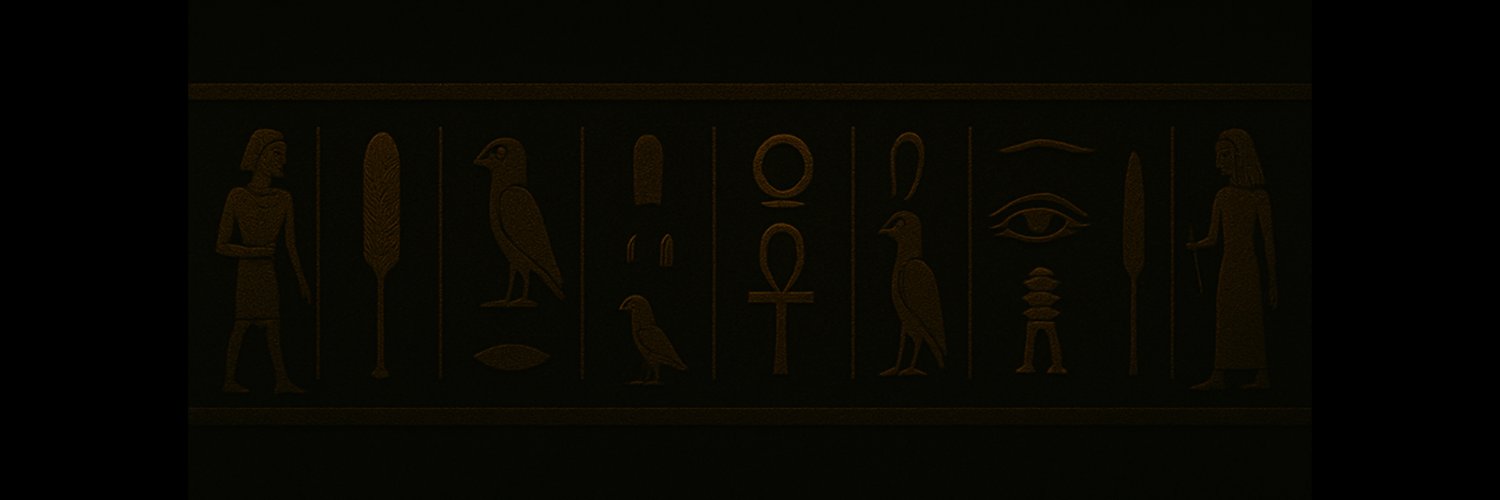
Winter Solstice at Karnak Temple ❄️☀️
▫️Winter Solstice, which usually falls on December 21st, is marked by unique solar alignments, particularly at Karnak Temple, where the sunrise aligns with the temple’s axis, illuminating the shrine to Amun-Ra, who embodied the sun in its daily journey across the sky, representing life, sustenance, and the cycle of day and night.
Amun Ra’s primary cult centre was at Thebes, where the Karnak Temple complex was dedicated to him. It is not certified, but not inconceivable, that the illuminating of the shrine to Amun-Ra was linked to the myth of Ra’s journey through the Underworld at night, symbolizing death and rebirth. This could parallel the idea of the sun’s “rebirth” after the Solstice.
All evidence suggests to us that the Egyptians had a deep understanding of celestial movements, and such understanding is reflected within their mythos, folklore, and even their architectural designs and temple structures. With the alignment of the sun being used almost as a divine measuring tool, dictating the locations and construction of temples, Egyptians developed sanctuaries that align directly with the sun’s movement during the Solstices and Equinoxes to this very day.
egypt-museum.com/solstice/
A fascinating infrared view of the barred spiral galaxy NGC 2283, located 45 million light-years away highlighting star clusters, gas clouds, and recent supernova activity
(Credit: ESA/Webb, NASA & CSA, A. Leroy)
What's that unusual spot on the Moon? It's the International Space Station. Using precise timing, the Earth-orbiting space platform was photographed in front of a partially lit gibbous Moon in 2019. The featured image was taken from Palo Alto, California, USA with an exposure time of only 1/667 of a second. In contrast, the duration of the transit of the ISS across the entire Moon was about half a second. A close inspection of this unusually crisp ISS silhouette will reveal the outlines of numerous solar panels and trusses. The bright crater Tycho is visible on the lower left, as well as comparatively rough, light colored terrain known as highlands and relatively smooth, dark colored areas known as maria. Downloadable apps can tell you when the International Space Station will be visible from your area.
Image Credit & Copyright: Eric Holland
Long day? The Earth might have something to do with it.
Friday, June 20 marks the summer solstice—the longest stretch of daylight in the Northern Hemisphere. Pack sunscreen and thank Earth's axial tilt for the extra hours. Learn more: tumblr.com/nasa/786887436…
Breathtaking View: NGC 7635 – The Bubble Nebula
The brilliant "bubble" is sculpted by fierce stellar winds from the young star SAO 20575 (magnitude 8.7). As it expands, the bubble collides with a nearby molecular cloud
(Credit: NASA & ESA)
A sunrise for the solstice 🌞
Today marks the longest day in the Northern Hemisphere and the shortest in the Southern Hemisphere.
How will you be spending your #SummerSolstice?
#PPOD: Europa 🔵
JWST's NIRCam (Near Infrared Camera) captured this picture of the surface of Jupiter’s moon Europa. JWST identified carbon dioxide on the icy surface of Europa, which likely originated in the moon’s subsurface ocean. This discovery has important implications for the potential habitability of Europa’s ocean. The moon appears blue primarily because it is brighter at shorter infrared wavelengths. The white features correspond with the chaos terrain Powys Regio (left) and Tara Regio (center and right), showing enhanced surface carbon dioxide ice.
Credit: @NASA@esa@csa_asc / G. Villanueva (@NASAGoddard ), S. Trumbo (@Cornell ), A. Pagan (@STScI )
#planetaryscience
🌌 M51 – the Whirlpool Galaxy
captured by Marcin Trzaska using the Seestar S50
🔭1695 x 20s exposures in EQ mode
✨Bortle 6–7 skies
🛠 Siril, GraXpert & Lightroom.
✨ Have you captured M51 with your Seestar?
#M51#Seestar#Astrophotography#S50#S30#SmartTelescope#ZWO
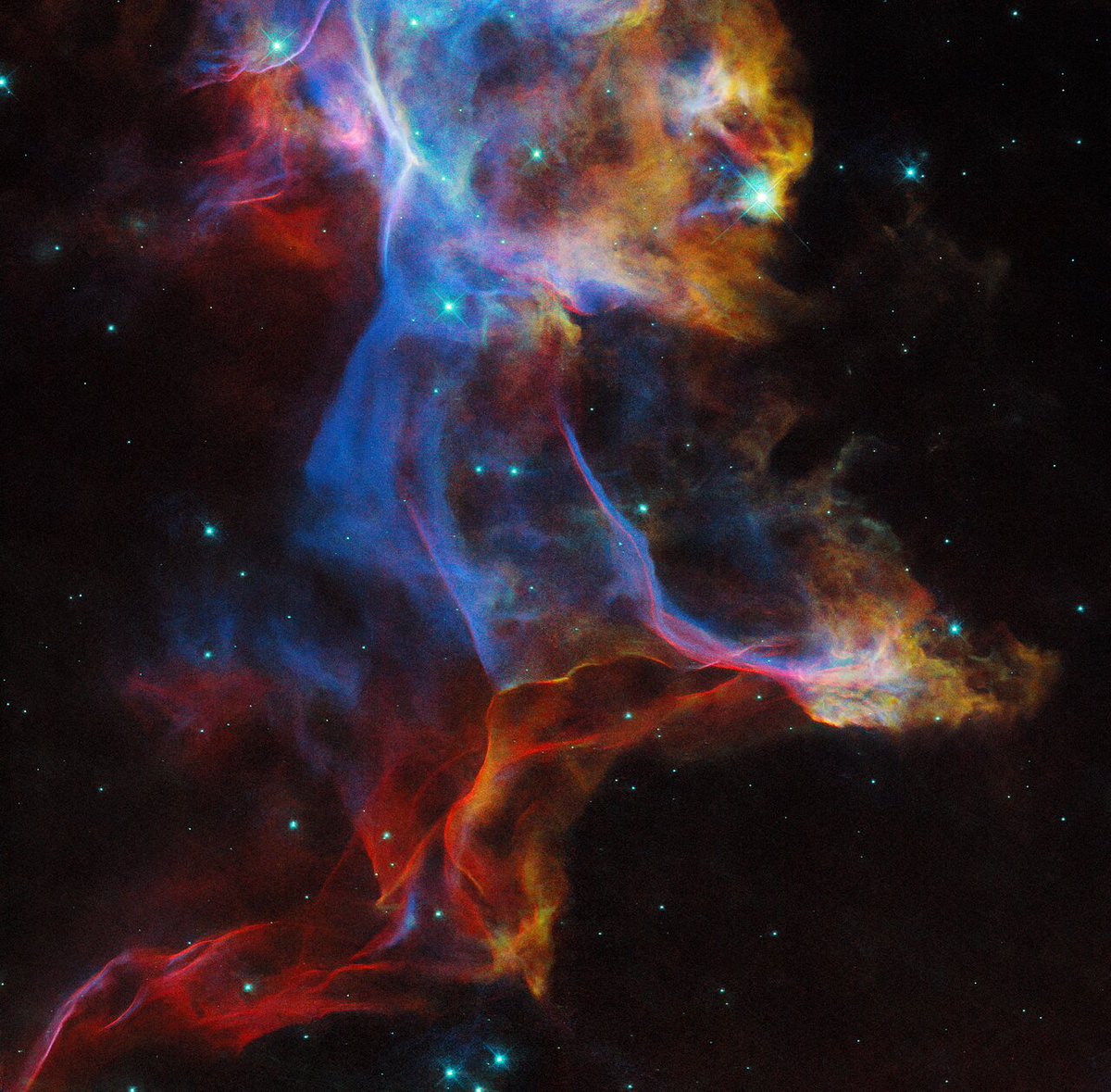
A segment of the Veil Nebula, the magnificent remains of a colossal star—once around 20 times more massive than our Sun—that exploded in a supernova some 10,000 years ago.
(Credit: ESA/Hubble & NASA, R. Sankrit)
Take a minute to enjoy the view
It's the solstice today... again! Didn't we just have one?
What better reminder to pause and reflect on where we are.
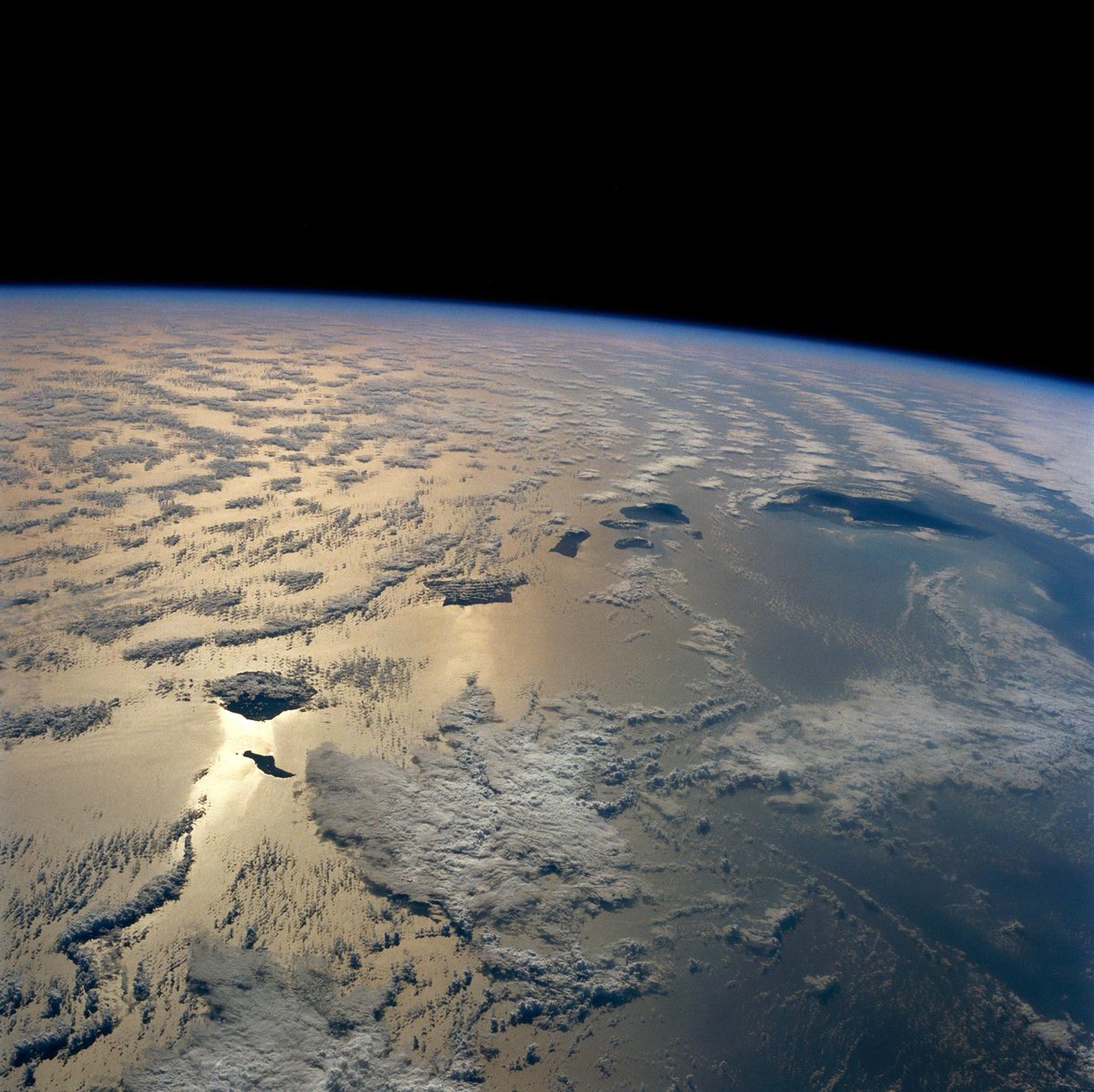
📷 View of the Hawaiian Islands seen from the deck of space shuttle Discovery taken 40 years ago during the STS-51G mission.
Lagoon Nebula ✨
A beautiful image by Astronomono — even with relatively short integration time, the result is already impressive!
🔹 48 x 3-min subs in H-alpha
🔹 45 x 3-min subs in OIII
Captured using:
🔭 SCA260 telescope
📷 ASI6200MM Pro
🔧 ZWO EAF, EFW, and ASIAIR Pro