
Emma Dodd
519 posts


Emma Dodd
@Emma_L_Dodd
Galactic archaeologist with a big love for globular clusters! PhD student at Kapteyn, University of Groningen. MPhys from Lancaster University 🌟
Groningen, Nederland Katılım Ağustos 2018
499 Takip Edilen487 Takipçiler


Emma Dodd retweetledi

The Gaia spacecraft is now successfully passivated. Sharly, the girl from the fairing logo waves Gaia a final goodbye. She also sent her farewell to Gaia: "I waved while you soared up into the sky, now I wave you a proper goodbye." youtube.com/shorts/UmuvxKX…

YouTube
English
Emma Dodd retweetledi

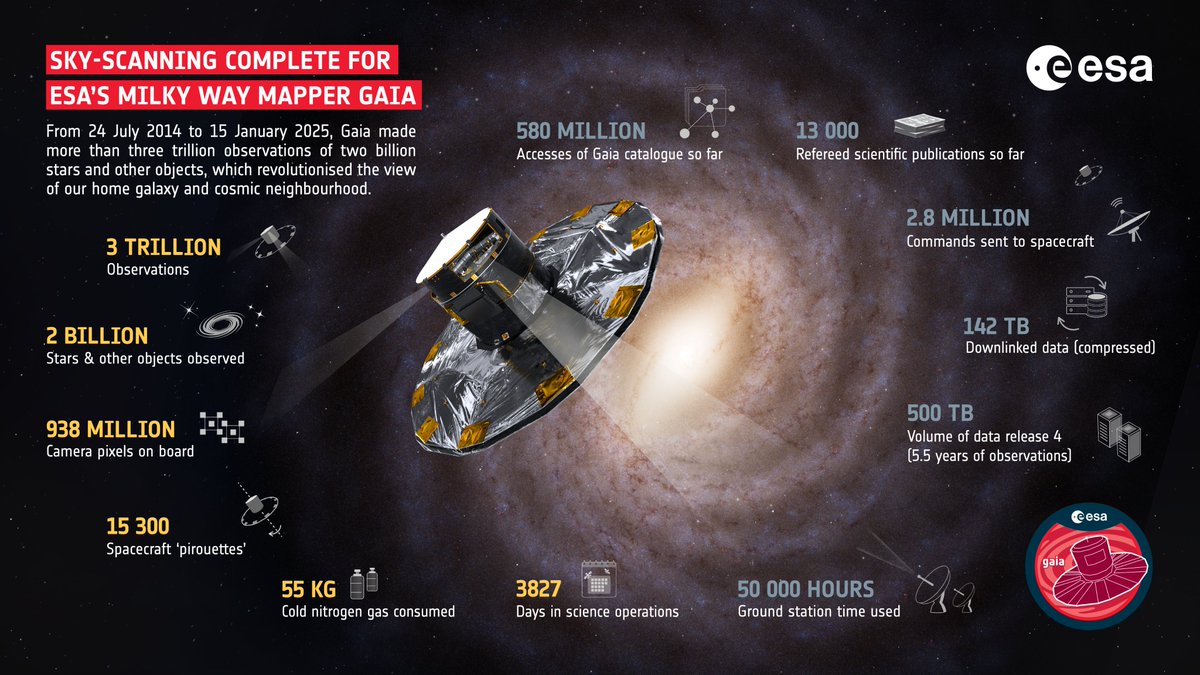
Our Milky Way-mapper @ESAGaia has completed the sky-scanning phase of its mission. Over the last decade, it has made more than three trillion observations of about two billion stars and other objects, revolutionising the view of our home galaxy and cosmic neighbourhood.
English
Emma Dodd retweetledi
So long and thanks for all the fish! I just observed my last star this morning... #GaiaDPAC and @esa Gaia teams will do their best to make some great data releases from all the data I gathered! #GaiaDR4 in 2026, #GaiaDR5 around the end of the decade. Keep posted for our news items today at 10:00 CET.
GIF
English
This work was made possible thanks to Tomás (@owl_astro) & Carme teaching me so much, the team at the IAC making so many advancements to the codes, @callingham_tom too, the funding from @RevealingMWGaia and of course the support and guidance from @amina_helmi! Thank you all! 🌟
English
Our samples are selected from Gaia DR3 5D data (no RV) due to small samples of stars with RVs brighter than the MSTO to be able to perform CMD fitting of e.g. Sequoia! With future Gaia releases this will improve and we can map out the local halo with ages using CMDft-Gaia & 6D!
English
It’s paper day! arxiv.org/abs/2408.13763
We characterise the local halo substructures (Thamnos and Sequoia) as part of the ChronoGal project by fitting their absolute colour-magnitude diagrams using CMDft.Gaia, obtaining age and metallicity distributions! 🌟
English
Emma Dodd retweetledi

My first first-author paper is on ArXiv now!
With Dr. Andrew Cooper, we used the DESI Legacy Survey to study the projected density profiles and number counts of globular clusters around 707 nearby galaxies. Check out the results at arxiv.org/abs/2408.07124
English
Emma Dodd retweetledi

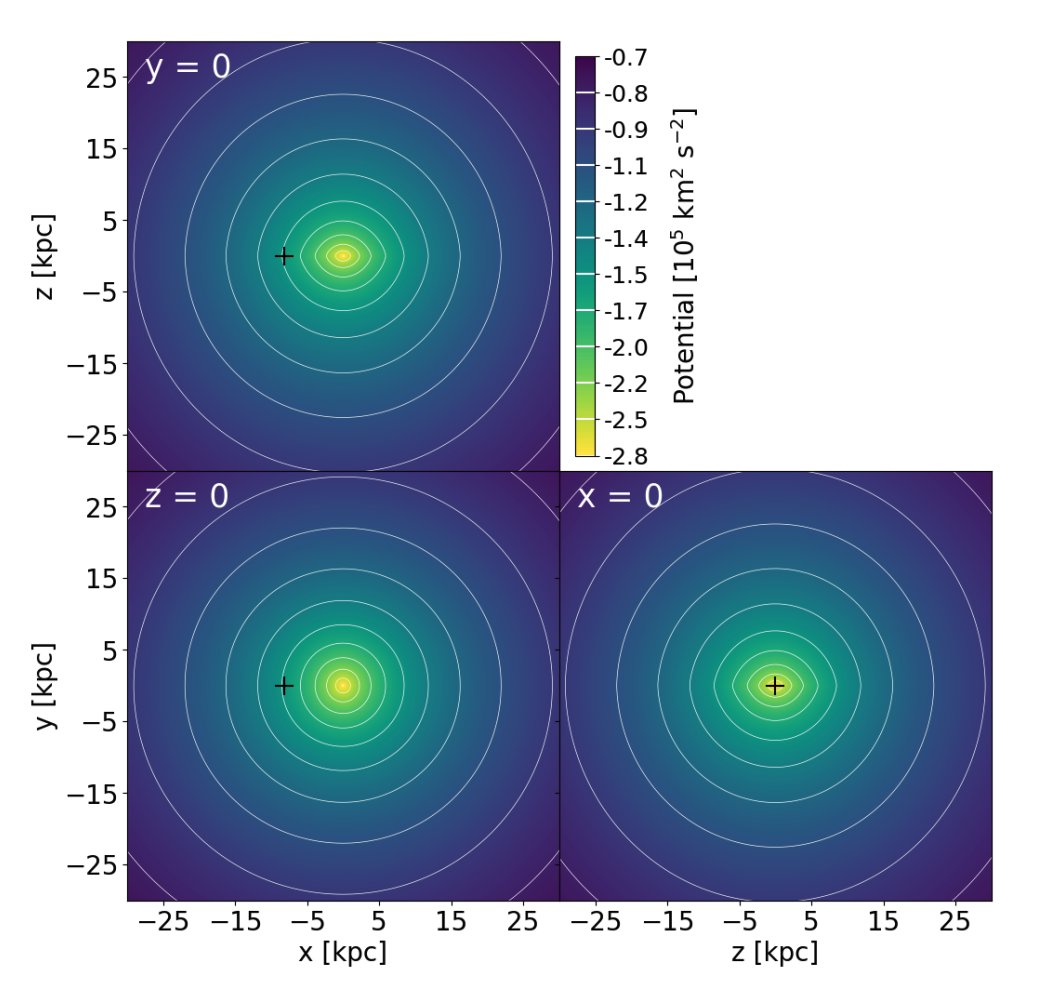
🔭 The ancient accretion of a dwarf galaxy, and the way that its stars still move together, may give a clear indication of the structure of the Milky Way's dark-matter halo, so say Woudenberg & Helmi in my #arXivoftheweek arxiv.org/abs/2407.21790
English
Emma Dodd retweetledi

I made a ppt summary of the awesome @ESO Gaia BH3 results with thoughts on formation of massive BHs and results from @balbinotdd and Amedeo Romagnolo and some bonus fun facts (like the one below): , a PDF is available here: broekgaarden.nl/floor/wordpres…
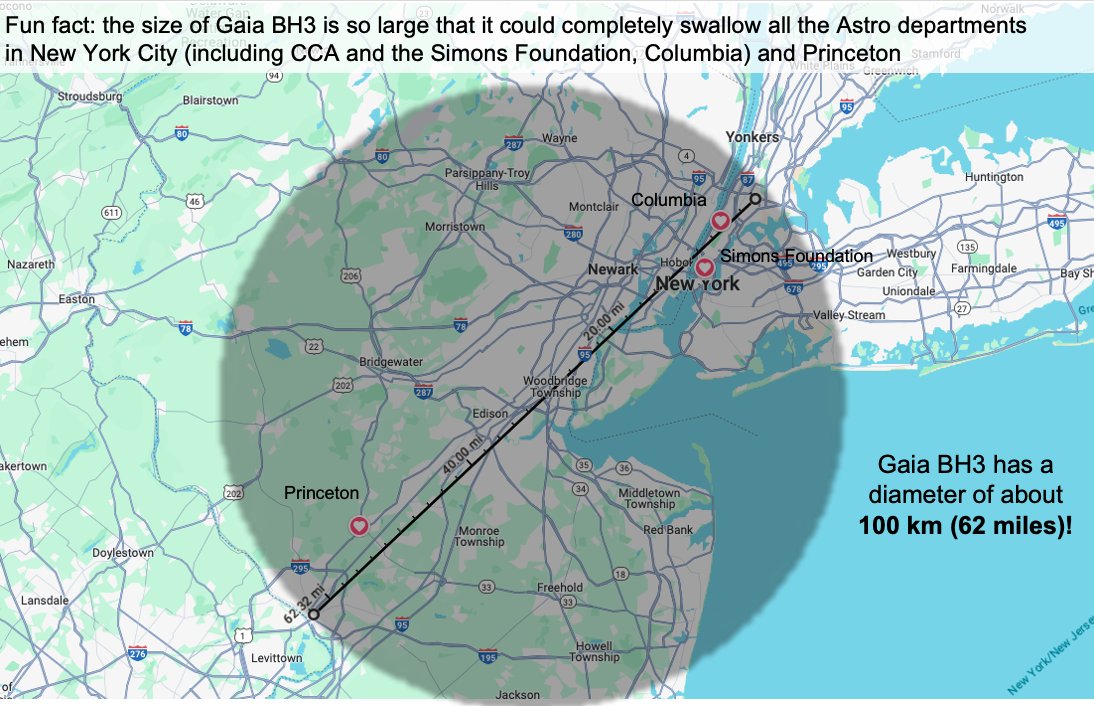
English
We already thought ED-2 was a pretty exciting stream and hosting the Gaia BH3 system really adds to that! 💫
Eduardo Balbinot@balbinotdd
Paper day: arxiv.org/abs/2404.11604 We show that Gaia BH3 is part of the ED-2 star cluster. The update astrometry puts GaiaBH3 in excellent agreement with the orbit of ED-2. Using some @ESO data we got last period we also show that ED-2 is very likely a disrupted globular cluster
Groningen, Nederland 🇳🇱 English
Emma Dodd retweetledi

Absolutely beautiful and amazing work! Sometimes one is truly lucky, I mean what are the odds that the 2nd heaviest BH in the MW (after Sgr A*) is part of a stream (ED-2 for our @Emma_L_Dodd and characterized by @balbinotdd) that we were studying using spectra from @ESO?! 🤩🤩
Eduardo Balbinot@balbinotdd
Paper day: arxiv.org/abs/2404.11604 We show that Gaia BH3 is part of the ED-2 star cluster. The update astrometry puts GaiaBH3 in excellent agreement with the orbit of ED-2. Using some @ESO data we got last period we also show that ED-2 is very likely a disrupted globular cluster
English
Emma Dodd retweetledi

Paper day: arxiv.org/abs/2404.11604
We show that Gaia BH3 is part of the ED-2 star cluster. The update astrometry puts GaiaBH3 in excellent agreement with the orbit of ED-2. Using some @ESO data we got last period we also show that ED-2 is very likely a disrupted globular cluster
English
Emma Dodd retweetledi
Gaia spots Milky Way's most massive black hole of stellar origin! It's 33 solar masses, dormant, 2nd closest to Earth at ~2000 light years away, part of a wide binary with an old giant star, with estimated age of 11 Gyr: youtu.be/cU00B-6DeSQ #GaiaBH3 cosmos.esa.int/web/gaia/iow_2…
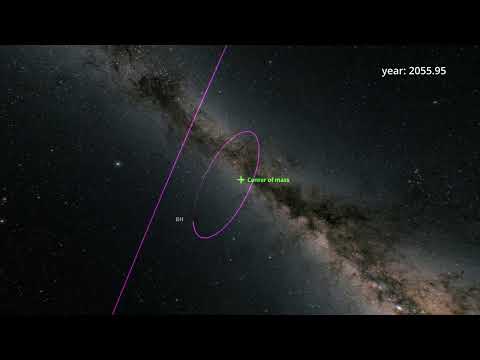
YouTube
English
Emma Dodd retweetledi


Emma Dodd retweetledi

Making it harder for early-career researchers to move to the UK makes it harder for us to do science, and to provide opportunities to British students and postdocs. We're already losing brilliant people who can't pay the fees associated with moving here.
English