
Eric De Giuli

331 posts

Eric De Giuli banner
Eric De Giuli

Eric De Giuli

@EricDeGiuli

theoretical physicist, Toronto Metropolitan University former UofT, UBC, NYU, EPFL, ENS tweeting about generative art at @eeedg__

Toronto, Canada Katılım Nisan 2011
241 Takip Edilen359 Takipçiler
Eric De Giuli
Eric De Giuli@EricDeGiuli·
Highlights of the @APSphysics meeting: - sharing my latest work and seeing how physicists are pushing the envelope in bio - seeing old friends and chatting about physics, kids, and life, and - meeting bright young students and postdocs who will be the stars of the next generation
English
0
0
3
54
Len Binus
Len Binus@lenbinus·
three papers dropped today that together tell one story: agency is prefigured in quantum non-Markovian processes, noise is the engine of behavioral flexibility, and xenobots can form memories without neurons. the old equation — mind = brain — is dissolving in real time.
English
3
4
47
3.8K
Eric De Giuli
Eric De Giuli@EricDeGiuli·
@martinmbauer To be fair to the OP, the mass axis spans 20 decades while the y-axis only 2.
English
0
0
2
223
Martin Bauer
Martin Bauer@martinmbauer·
At 10*L/s, a 25m whale would need to swim 250m/s, that’s 900 km/h… The real lesson here is that ‚close on a log scale‘ isn’t really as close as you think it is
Fermat's Library@fermatslibrary

A bacterium and a whale have almost nothing in common. Except this: Their max speed is ~10 body lengths per second. Why does life converge on the same speed limit? We break it down this week: #email-newsletter" target="_blank" rel="nofollow noopener">fermatslibrary.com/s/how-fast-do-…

English
18
6
364
28.5K
Eric De Giuli
Eric De Giuli@EricDeGiuli·
tomorrow on emulsion rheology! Come and chat, I'll be around all week
Eric De Giuli tweet media
English
0
0
0
32
Eric De Giuli
Eric De Giuli@EricDeGiuli·
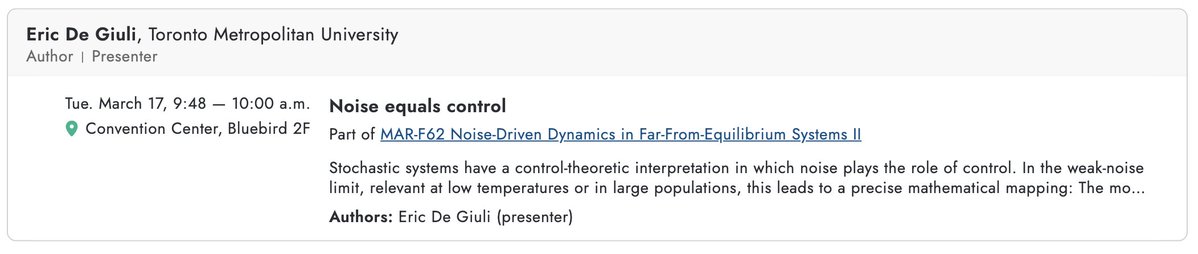
I'm speaking in Denver on Tuesday about noise-control duality, and ..
Eric De Giuli tweet media
English
1
0
1
93
Eric De Giuli
Eric De Giuli@EricDeGiuli·
@SuryaGanguli Imagine teaching this and not at least announcing Euler's formula to inspire the students. It boggles the mind.
English
0
0
1
438
Surya Ganguli
Surya Ganguli@SuryaGanguli·
My 10 year old son just had to count the number of faces, edges and vertices for a bunch of polyhedra for his math homework. I then asked him to count faces - edges + vertices for all of them. It blew his mind that he always got 2 🤣
English
19
15
502
30.2K
Eric De Giuli
Eric De Giuli@EricDeGiuli·
Many of my contributions in physics are downstream of noticing that others are talking past each other: instead of two myopic views (theories) of a phenomenon, there is often a richer, higher dimensional perspective that unifies them. This is true both socially and physically.
Martin Bauer@martinmbauer

Disagree. Anyone listening to me will get a far more accurate picture of what is actually going on in fundamental physics than anyone listening to you

English
0
0
3
181
Eric De Giuli
Eric De Giuli@EricDeGiuli·
It is unfortunate that the two types of model are often conflated, and that we do not discuss RG until graduate courses. Are there any undergraduate texts where RG is foregrounded?
English
0
0
0
27
Eric De Giuli
Eric De Giuli@EricDeGiuli·
The word “model” hides two different ideas. Some models simplify reality to isolate a mechanism. Others predict universal properties shared by many systems. The renormalization group revealed the second possibility, and explains why simple models can describe Nature at all.
English
1
0
3
96
Eric De Giuli
Eric De Giuli@EricDeGiuli·
@curiouswavefn For most physicists, philosophy is an indulgence of youth, and old age. And Oppie didn't make it to the latter.
English
0
0
2
1.1K
Ash Jogalekar
Ash Jogalekar@curiouswavefn·
Interestingly, Oppenheimer did not seem to engage meaningfully in any way with Sanskrit after the war. Here's what Freeman Dyson told me: "In my twenty years of contact with Oppenheimer, I never heard him speak about the Bhavagad Gita or about his studies of Sanskrit literature."
English
15
10
377
29.5K
Eric De Giuli retweetledi
Niko McCarty.
Niko McCarty.@NikoMcCarty·
Underrated Ideas in Biology (#9) Biology hasn't really had a "renaissance" since the 1960s. We can't accurately simulate a cell. There are many unknown unknowns, and a huge number of experiments can't be replicated. So what do we do? Well, in the 20th century, physicists used hydrogen atoms to develop a quantum theory of matter. By using the same atom across experiments, they could compare results and build a stronger knowledge base. Biology needs its own hydrogen atom. Specifically, I think we need to understand an organism in sufficient detail such that we can accurately simulate it computationally. The dream should be to run experiments on computers that faithfully replicate results from the real-world. Markus Covert's group at Stanford has been working on this for decades and has made tons of progress. DARPA recently launched a $35M program toward computational microbe models. But there is still room for an even larger effort here. We could start with E. coli or M. genitalium. The latter is nice because it has the smallest genome of any free-living organism. In 2006, the J. Craig Venter Institute found that only 382 genes in M. genitalium are essential. A whole-cell model of its life cycle was published in 2012. But even now, dozens of genes in this tiny microbe have unknown functions. We don’t fully understand how its molecules interact to carry out behaviors. Now is a good time to build an Institute wholly devoted to understanding a single cell. Everyone in the Institute would use the same cell line, and sequence it regularly to ensure it hasn't mutated. One part of the Institute would map its transcriptome and proteome at high spatial and temporal resolutions, in different environments. Other groups will build predictive models or do basic research into molecular mechanisms or behaviors, working out all the moonlighting proteins, filling in the "known unknowns," and finding "unknown unknowns." An accurate cell simulation would *prove* what we know and don't know, and also help us separate truthful data from flawed data. It works as a "hydrogen atom" because we can use the simulation to make predictions and then validate them experimentally. The fact we haven't already done this is quite embarrassing, in my opinion. It means there isn't enough funding or organization for moonshot projects in biology. Lewis Thomas was writing about "solving" an organism back in the 1980s. Even in 1973, Francis Crick published a paper called "Project K: The Complete Solution of E. coli," brainstorming on these ideas. (He was apparently inspired by Sydney Brenner, who was thinking about this by 1967.) In 2002, Crick gave up on the idea and said his proposal was "hopelessly premature, being before many key technologies, rapid computation, and the web." But now those things have been sorted out. We have the compute and most of the other technologies; and if we need more, we can invent them. What are we waiting for? Biology needs its hydrogen atom.
Niko McCarty. tweet media
English
16
57
364
16.8K
carl feynman
carl feynman@carl_feynman·
If you want to built the tallest possible thing using your available building materials, the result will be awfully close to a pyramid. Example: the Eiffel Tower is a tapered pyramid. Tallest structure buildable out of iron in 1887. Also, lions are impressive everywhere, and geometry is the same everywhere.
English
5
1
57
1.8K
Robin Hanson
Robin Hanson@robinhanson·
“Recurring motifs, giant T-shapes, step pyramids, inverted pyramids, lions, and sacred geometry, appear at Ionis in their most concentrated form before repeating at distant sites worldwide” dailymail.co.uk/sciencetech/ar…
English
4
0
26
7.3K
Eric De Giuli
Eric De Giuli@EricDeGiuli·
@mmjukic You want to go back to having 5 of your 10 children die before the age of 10? We already have a world project: Science. Understanding the human body is like making sense of alien technology millions of years more sophisticated than our own. No need to go to the stars, yet.
English
1
0
0
42
Marko Jukic
Marko Jukic@mmjukic·
It's hard to even explain why the collapse of civilization as we know it would be a bad thing. What do we even lose if we go back to medieval or Bronze Age levels? Material comforts? But if material comforts are the goal, our system is already optimizing for those right now.
English
3
0
60
4.5K
Marko Jukic
Marko Jukic@mmjukic·
Assumptions about geopolitics and the economy are basically all wrong. We live in a unipolar world empire with a planned economy, industry outsourced to China due to inability to replenish human capital, which took over the world thanks to the late 1800s technological explosion.
English
10
22
316
17.4K
Ash Jogalekar
Ash Jogalekar@curiouswavefn·
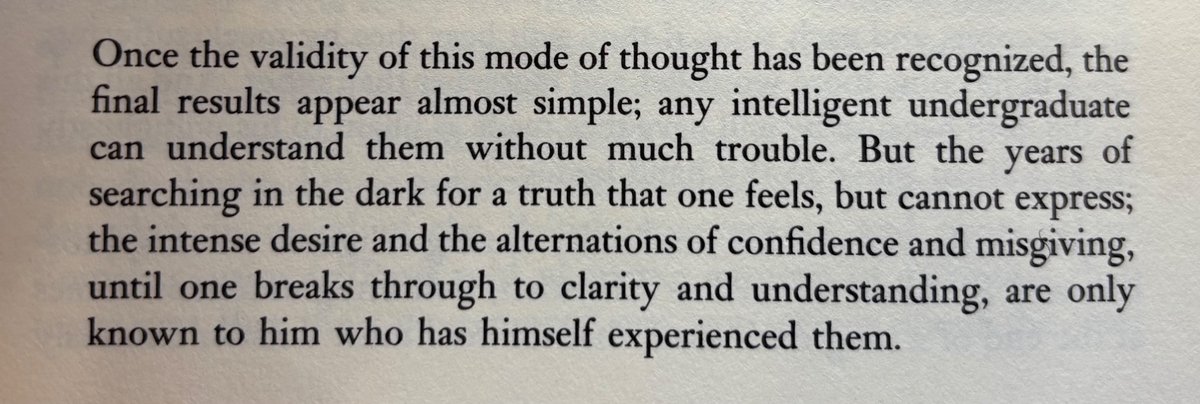
Einstein on his development of general relativity. All the great ideas of science are simple, in retrospect.
Ash Jogalekar tweet media
English
10
48
309
11.6K
Eric De Giuli
Eric De Giuli@EricDeGiuli·
The most important lesson of theoretical physics is humility. One learns how many ways there are to rationalize some facts, and how few of them are correct.
English
0
0
3
211
Eric De Giuli
Eric De Giuli@EricDeGiuli·
@PashaKamyshev This is clear at the qualitative level, but much less so quantitatively. One needs to honestly estimate the various expenditures to justify the thesis. Consider e.g. K-12 education. Majority of salaries involved are not going to oligarchs. Many other examples.
English
0
0
0
10
Paul Graham
Paul Graham@paulg·
@KTmBoyle You get credit for ideas in some fields, like math and the sciences.
English
55
9
648
46.6K
Katherine Boyle
Katherine Boyle@KTmBoyle·
You don’t get credit for good ideas or being early to them. You get credit for execution. Most systems measure by actions, not words. Amazing how many people forget this.
English
92
98
1.1K
93.6K