Erica C Kaye

382 posts

Erica C Kaye banner
Erica C Kaye

Erica C Kaye

@EricaKayeMD

Pediatric oncologist | Palliative medicine physician | Communication researcher | Social justice advocate | Frazzled mom | Opinions my own | She/her/Dr

Katılım Ocak 2021
143 Takip Edilen1.9K Takipçiler
Leigh Kimberg
Leigh Kimberg@LeighKimberg·
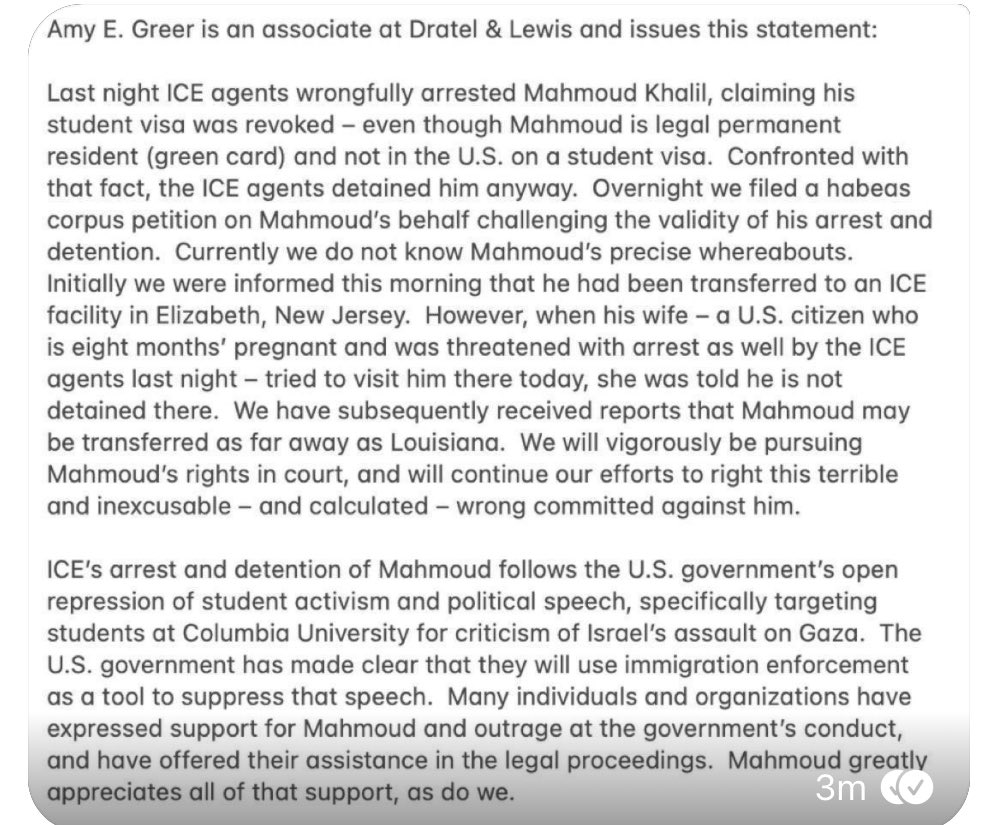
Mahmoud Khalil—legal resident of US and Columbia University student has been illegally detained by the US government and his whereabouts are *unknown* even to his wife and lawyers. Lawyer statement ⬇️ #FreeMahmoudKhalilNow
Leigh Kimberg tweet media
Leigh Kimberg@LeighKimberg

Kidnapping of Palestinian students by Israeli government in Palestine Kidnapping of Palestinian student by US government @Columbia Zionism as a White supremacist, settler-colonial, fascist project is exposed. We will not stop. Palestine will be free. @uctribunal4pali

English
44
101
441
306.1K
Erica C Kaye retweetledi
Catherynne M. Valente
Catherynne M. Valente@catvalente·
Women couldn’t have their own credit until 1974. Marital rape became illegal nationwide in 1994. We are ONE generation into women having a CHANCE at life & it’s proved so intolerable America would rather end itself than allow such a thing to continue.
English
1.1K
16.9K
114.7K
1.9M
Erica C Kaye retweetledi
Elizabeth Warren
Elizabeth Warren@SenWarren·
Sonya Massey should still be alive. Her death is a senseless tragedy and a sickening reality that Black Americans know all too well. Sonya’s family deserves justice. Congress must step up to build more trust and accountability in policing.
The New York Times@nytimes

Illinois State Police have released body camera footage that showed a sheriff’s deputy fatally shooting a Black woman in the head in an exchange over a pot of water. The woman, Sonya Massey, called 911 because she believed there was an intruder in her home.nyti.ms/3LB2tyc


English
58
156
790
152.1K
Charlotte Clymer 🇺🇦
Charlotte Clymer 🇺🇦@cmclymer·
Folks, I have a fun goal for today. Why don't we make sure VP Harris goes way beyond on individual grassroots donors? My starting goal is 1,000 donors. Give $3, $5, $100, max out at $3,300 if you got it. I'll be updating all day. Let's do this! Donate: secure.actblue.com/donate/charlot…
English
116
383
1.2K
332.8K
Erica C Kaye retweetledi
Lee Mordechai
Lee Mordechai@LeeMordechai·
1/ I’m an Israeli historian. My community is still too silent about the horrible war in Gaza. Over 8 months I’ve closely followed the war, reading >1000 articles and viewing >1000 videos/images of the war from all sides. My summary conclusions & full report are in the 🧵:
English
796
10.1K
26.2K
4.6M
Erica C Kaye retweetledi
Ismail (Ish) Aderonmu
Ismail (Ish) Aderonmu@LegalishCA·
This apparently needs to be said.
Ismail (Ish) Aderonmu tweet media
English
94
11.9K
30.7K
1.3M
Erica C Kaye retweetledi
Peter Beinart
Peter Beinart@PeterBeinart·
"If you can protest the sinful conduct of your town and fail do so, you are responsible for the sins of your town. If you can protest the sinful conduct of the whole world and fail to do so, you are responsible for the sins of the whole world.” (BT Shabbat 54b) God bless and protect this heroine of our people
Al Jazeera English@AJEnglish

An Israeli human rights lawyer interrupts her own Al Jazeera interview for a tearful plea condemning Israel’s war on Gaza and Israelis attacking aid trucks headed for Gaza.


English
44
424
1K
119.2K
Erica C Kaye retweetledi
Alon-Lee Green - ألون-لي جرين - אלון-לי גרין 🟣
You won't see it on the news, but thousands of Israelis - Jews and Palestinians - marched together demanding to end the war, to end the occupation and to create an Israeli-Palestinian peace of freedom,equality and independence for all. There is a peace movement in Israel
English
315
3.6K
9.7K
595.8K
Erica C Kaye retweetledi
Tamar Glezerman 🟣
Tamar Glezerman 🟣@TamarGlezerman·
I am an Israeli living in NYC. I lost family on October 7th and have Gazan friends. I am not afraid of the student protestors, even if I deeply disagree with some of their stances. What I’m afraid of is a world that sees thousands of children being blown up and says nothing.
English
396
2.7K
18.2K
635.2K
Erica C Kaye retweetledi
Raphael Mimoun
Raphael Mimoun@RaphMim·
Since October 7th, I've joined protests, fundraising events for Gaza, and students on campuses. As a Jew and someone who has a ton of friends and family in Israel, I want to share some thoughts on claims of antisemitism in the movement and student encampments: 1/29
Raphael Mimoun tweet media
English
29
496
2K
391.8K
Erica C Kaye retweetledi
Ihab Hassan
Ihab Hassan@IhabHassane·
As a Palestinian student in the United States, I wish the message had been written as: "Students will go back home when this war ends, and the children of Gaza will feel safe, and the hostages back to their families." Instead of a message that doesn't benefit anyone but only fuels hatred against Jews and demonizes the legitimate protests of students supporting Palestine in American universities.
Ihab Hassan tweet media
English
300
816
6.3K
702K
Erica C Kaye
Erica C Kaye@EricaKayeMD·
Amen. Chag Sameach.
English
0
0
3
315
Erica C Kaye retweetledi
Ami Dar
Ami Dar@AmiDar·
Another view of the anti-government protests in Tel Aviv tonight. Elections now!
English
53
415
1.3K
85.1K
Erica C Kaye retweetledi
Isaac Saul
Isaac Saul@Ike_Saul·
The Zionist case for a ceasefire. I am a Zionist, and I believe there should be an immediate ceasefire in Gaza. There should be a ceasefire not just to alleviate the humanitarian disaster Palestinians are experiencing, but to create a safer present and future for Israelis and the global Jewry, too. And I think it's worth making the case for a ceasefire on both of those grounds — not one or the other. I believe there is an overwhelming amount of evidence that an immediate ceasefire will make Israelis and Jews safer, while also improving the odds of a longstanding, thriving, and safe Israeli state. Israel's stated goal in its bombing and invasion of Gaza  — the goal of its war cabinet and prime minister — is to destroy Hamas. Its goal is not to inflict mass horror on Palestinians or to destroy them as a people or to permanently displace them. It is to bring an end to the group that won the 2006 elections in Gaza and has been leading it — if you want to call what Hamas has provided leadership — ever since. It is to eliminate the group that committed the largest mass killing of Jews since the Holocaust, and which broadcast and celebrated that killing, then promised to do it again and again to anyone who would listen. Fundamentally, Israel’s offensive is about living next to a neighbor they believe they can live with peacefully. I don’t think Israel is succeeding in its stated objective. In pursuit of its goal, Israel has inflicted mass horror on all two million of the people living in Gaza. It has also made Israelis and Jews less safe, by destabilizing the region and crossing the line of what most of the world views as a proportionate or reasonable response. It has not deterred violence, but drawn its neighbors into more. It has not garnered international support, but driven it away. It has not sown the seeds of peace but has instead ensured that another generation of Palestinians will live through heartbreak and war and watch their friends and family die in front of them, which will make forgiveness or reconciliation with Israel next to impossible. No, the response has not made Israel or Jews safer; it has further isolated and divided not just Israel but Jews across the globe. In December, Israel claimed it had killed about half of Hamas's mid-level commanders — though it has failed to find Yahya Sinwar, the leader of Hamas in Gaza, who has in all likelihood crossed the border and fled. Nor has it killed Mohammed Deif, head of Hamas's armed wing. Netanyahu says his war cabinet is currently approving plans to evacuate Rafah, the Gaza city on the border of Egypt where roughly one million people are currently seeking refuge, in order to invade. He's doing this because, according to Israeli officials, four of the six remaining Hamas battalions are concentrated in Rafah. Up until now, the region surrounding Rafah is where Israel has been telling civilians to go in order to stay safe from their military campaign. "Once we begin the Rafah operation, the intense phase of the fighting is weeks away from completion. Not months," Netanyahu told CBS, in a message that was meant to be reassuring. Here is the reality, though: Destroying Hamas cannot be done with soldiers, bombs, and gunfire alone. Hamas does not get its power from military might. That may seem abstract, but understanding it is critical to lasting peace. Hamas’s power comes from an idea. Specifically, it thrives on the idea that it is standing up for an oppressed people living under an evil occupier that must be eliminated. Then Hamas builds up the next parts of its argument, that armed conflict is required to defeat this occupier, and that the goal for that armed conflict is the destruction of Israel. Israel is fighting Hamas on the battlefield, where Hamas is weak, and it will win that fight if it wants to. But it is not doing anything to fight Hamas in the battle where it is strong — it is not winning the battle against the idea that Hamas depends upon for its survival. It is not winning the battle against the idea Hamas is convincing two million Gazans of (and many millions more across the world), which is that the Palestinian people are living under an evil occupier that must be eliminated. It is losing that battle decisively. Consider how things have changed since October 8, the day after Hamas’s attack. On October 8, the world’s sympathies were with Israel. Though some had already been accusing Israel of war crimes before it even invaded Gaza, across the globe there was a great sense of injustice and mourning for the Israeli people. Hamas was widely, and appropriately, being described as barbaric and evil. It was self-evident to most people that Hamas conducting this attack should be disqualifying to their leadership position in the Middle East — and support for a future where Hamas did not control Gaza was strong, even (perhaps especially) among Arab nations. Today, Israel is being accused of genocide in The Hague and United Nations’ resolutions to end Israel’s military response are receiving near-unanimous approval. Israel’s most important and only consistent partner, the United States, appears to be increasingly upset with how Israel is conducting itself. Meanwhile, Israelis and Jews globally are under a greater threat. Many are being protested on college campuses or in urban areas across the U.S. in a way we have never seen before. The Jewish world is fractured too, as Jews in America were already sharply divided over Israel, and domestic protests in Israel against the government’s response (and to get the hostages home) continue. On October 8, Israel had a clear mission: Get the hostages back and fight Hamas if it had to. Hamas’s attacks generated a shockwave, but the broader regional situation was still mostly stable. Joe Biden’s national security adviser had just said the Middle East region was quieter at that time than it had been in two decades, and he was right. Israel was nearing a normalization of diplomatic relations with Saudi Arabia, and had already made notable progress with other Arab nations. Today, Hamas and the Palestinian Islamic Jihad are still firing rockets into Israel from Gaza. And now so is Hezbollah from Lebanon. The Houthis in Yemen are attacking ships it believes are associated with Israel. Iran and Iraq are warning of a larger-scale, regional war. Israeli relations with Saudi Arabia (and Egypt and Jordan) are worsening. The region is less safe, as is Israel. All parties, including Hamas, expected and accepted the idea that Israel would respond (I’d argue that Hamas is getting exactly what it wanted, which is worth considering), but the current regional situation is a result of Israel going too far — of its decision to maintain this invasion for five months, its insistence on pushing Gazans into smaller and smaller corners, and its unwillingness to avoid causing so many civilian deaths and creating such a far-reaching humanitarian crisis. On October 8, Hamas was ruling over an increasingly disenchanted population in Gaza. In the West Bank, where Hamas does not rule, skepticism of Hamas leadership was already widespread. Back then, just 12% of people in the West Bank supported Hamas. Even now, amid Israel’s invasion, plenty of Gazans are still openly registering their displeasure with Hamas. Today, those dynamics have shifted in important ways. In December, support for Hamas nearly tripled, hitting 44% in the West Bank where settler violence and clashes between Palestinians and Israelis are on the rise. Support for Hamas has gone up in Gaza, too, and support for armed resistance in Gaza has also risen by 10 percentage points. Perhaps most notably, a majority of respondents from the West Bank and Gaza (53%) said they believe Israel’s goal is to destroy the Gaza Strip and kill or expel its population. 42% said it was exacting revenge on Hamas, including 50% of Gazans — showing that half of Gaza believes they’re experiencing an ethnic cleansing while the other half is open to believing Israel’s stated intentions. At least, they were in December. Sympathy for Hamas's cause — a genuinely genocidal one, to kill Jews and destroy Israel — is rising even among American intellectuals. That’s maddening, but not too hard to understand: The brutality of Israel’s army is making many people want to give their wholesale support to the side that is getting brutalized. They don’t see two civilians dead for every military combatant as a good thing. They are seeing that some 30,000 Palestinians have died since October 8, while a few hundred Israelis have. They are seeing photos of dead Palestinian children buried under rubble, reading stories of Palestinian kids with sniper shots to the head, watching videos of Israeli soldiers rifling through Palestinian womens’ underwear, or hearing stories of innocents being killed even when they do exactly what Israel says. They are seeing what looks to them like good and evil. Meanwhile, all anyone in Gaza has to do is look around to feel a strong desire for payback. Israel believes it is winning the important fight by winning on the battlefield, but in reality what it’s doing on the battlefield is ensuring it loses the real battle — the important one, the battle against the idea, the battle where Hamas is strong. To me, it seems quite obvious that a ceasefire is the first step — of many — toward reversing course. When Netanyahu says that Hamas could be destroyed in weeks, not months, he is lying. Hamas won’t be destroyed by killing 20,000 combatants instead of 10,000, and it won’t be destroyed in 2024. Hamas will be destroyed by disproving the premise its ideas are based on, and that will take years. Decades. There are plenty of Palestinians ready to push Hamas out, but that will only be achievable with an actual peace plan, with reconciliation, with generational healing, with leadership on both sides committed to acknowledging the existence and humanity of their long-time enemy. In my opinion, a lasting peace means fully realized Palestinian rights and statehood, but at a minimum it will require what it took for the Germans and the French or the Japanese and the Americans to form a lasting peace — and then some. What Hamas did on October 7, and what Israel has done in Gaza since, has created a new generation of extremists and stoked hatred and division on both sides. And every day that this goes on will be another day longer until anything different can come to fruition, allowing that division and hatred to metastasize. A ceasefire is the very first step. It is the bare minimum. It is mandatory. I’m aware that all ceasefires are not the same, and implementing one now is not some magic solution to resolving every existing tension. And no, I am not suggesting an unconditional ceasefire. Concrete terms are worth discussing. Hamas must release its remaining hostages, and there must be an actual ceasefire — that means one where Hamas and Hezbollah stop indiscriminately firing rockets into Israel from across the border, as they have since October 7. Israel isn’t going to back down when every Israeli living near a border spends half the week scuttling into bomb shelters. In exchange, Israel should commit to leaving Gaza and ending its military operation, but hold its ground on not releasing any more Palestinians convicted of terrorism. Hamas has claimed it would accept terms roughly along those lines, and it’s worth remembering that it takes two parties to agree to a ceasefire — it’s not just up to Israel. But that’s a deal I would take. It’s a deal everyone should take. Finally, let me say this to the many Zionists, Israelis, and Jews I expect to read this piece: I know what many of you are feeling. Anti-Israel sentiment is as high as it's ever been. Jews, Zionists, and Israelis are being conflated constantly, and simultaneously fighting among themselves while being described as a monolith. The most educated people in America seem to be falling for anti-semitic lies, while the world and even many Jews distance themselves from the Israeli cause. Jewish people all across the globe seem simultaneously as united and divided as we’ve ever been. Israel is being run by a leader many now loathe, concern for the remaining hostages in Gaza is acute, no clear future for a safe and secure Jewish state exists, and many of us watch what is happening in Gaza with a deep sense of guilt. All the while, Zionists across the globe are responding the same way Americans did after 9/11: With devotion to their country, to their neighbors, and to their own defense. It's in this environment that Israel's military operation in Gaza is taking place, and it creates an enormous amount of cognitive dissonance in many of us that we feel compelled to defend it. This defensive response is natural. I feel it, too. When I see someone saying something objectively true about the horrors the Palestinians are experiencing, but they do it in a way that frames Israel as the unambiguous bad actor in this arrangement, I feel defensive. When I see people framing all Zionists as evil, racist, Jewish supremacists, it makes me want to switch the focus to Hamas rather than the children in Gaza. When I see people gloss over, ignore, excuse, or downplay the events of October 7, it's easy for the generational trauma of the Jews before me to bubble to the surface. I felt the inheritance of that trauma acutely on October 8. But it is no longer October 8. These feelings are defense mechanisms — tribal and basic and understandable, but defensive nonetheless. We are in the here and now, with decisions to make about what to do to create a better, safer future. What kind of nation do we want Israel to be? What kind of morals do we want our people to represent? What life do we want to imagine for the Israelis, Palestinians, Jews and Muslims who are inevitably going to be living side by side in this very same region for the coming centuries? In 50 years, do we want to remember this period of time like the beginning of the “War on Terrorism” or the beginning of the end of this conflict? Palestinians are pleading for a ceasefire. Jews, Zionists, and Israelis should support one, too. And so should everybody else. The horrors Gazans are experiencing are unconscionable. We should all want those horrors to end for little other reason than empathy for our fellow human beings, and I implore you to genuinely hear and feel what they are living through. But whether you can or not, I think it’s clear that a ceasefire is the right step forward, even through the Zionist lens. Please, join the calls for a ceasefire, and lean into hope for a new era of something different than what we have now.
Isaac Saul@Ike_Saul

It's been a long time since I've published a piece of writing that I was genuinely nervous to share, but this piece is that. Still, I'm proud of it, and I believe every word wholeheartedly. Please consider sharing it: "The Zionist case for a ceasefire" readtangle.com/zionist-case-f…


English
21
50
242
71.7K