Expensiq | On-Chain Expenses
507 posts

Expensiq | On-Chain Expenses
@ExpensiqHQ
The decentralized expense platform for Web3 teams. • On-chain reimbursements • Wallet-based budgets $XPQ • AI-powered automation https://t.co/4RNicK9SM6
Katılım Ocak 2024
14 Takip Edilen8.7K Takipçiler
Expensiq | On-Chain Expenses retweetledi

Thinking of AI as a productivity booster for prior workflows is the wrong framing. Like all of the previous waves of computerization/softwarization, AI is a tool that lets you do new things in new ways.
Computers and Society Papers@WGOV
Cognitive offloading and the speedup illusion in human-AI interaction Sunny Yu, Myra Cheng, Ahmad Jabbar, Ilia Sucholutsky, Katherine M. Collins, Dan Jurafsky, Robert D. Hawkins arxiv.org/abs/2605.23177 [𝚌𝚜.𝙲𝚈 𝚌𝚜.𝙷𝙲]
English

You ever notice how most DAOs run their treasuries like it’s 2005?
Spreadsheets. Discord receipts. Multisig signers ghosting for 3 days.
Meanwhile, your dev team’s building on-chain futures and your finance ops look like a MySpace profile.
We built $XPQ so you can actually manage money like you build software:
On-chain. Automated. Transparent.
No more begging for reimbursements in a forum post from 2022.
Just connect wallet → submit expense → get paid. Rules enforced by code, not vibes.
If your org still uses Google Sheets for treasury tracking…
…you’re not decentralized. You’re just messy.

English
Expensiq | On-Chain Expenses retweetledi

The road to Hell is paved with closed-source citadels disguised as good intentions.
The Pope is right: AI takes on the characteristics of those who build it, finance it, and regulate it. So the question is: who gets to hold the great and wonderful power of AI?
If the answer is a handful of closed source companies, murkily censored, quietly surveilling every step of our lives, every private conversation, enshrined in law as 'safe' and 'open' when they're nothing but the surveillance economy squared, then all we've done is build a few modern East India Companies, digital oligarchies of the few, cloaked in the language of safety.
Open Source and Open Weights are how you spread the fantastic enabling power of AI to everyone, everywhere.
Permissionless innovation.
Everyone gets the hammer and nails to build houses and churches and factories. The more hammers, the more widely spread, the more the decentralized genius of humankind can flourish.
Everyone gets the Printing Press.
The printing press singlehandedly uplifted and spread of intelligence and knowledge around the world. The more we could record all kinds of knowledge, the more we spread the ability to read, the more equal and advanced society became.
Before the press, knowledge was learned by one person and passed into dust with them when they died or passed only to only a small group of students.
When we only had monks in a cave copying religious texts, a closed system, it limited the spread of intelligence and limited the growth of civilization.
The printing press was the single greatest invention in the history of the world because it let anyone print anything and spread knowledge throughout the whole world.
AI can do the same, but only if we build the bazaar, and never let the citadel people convince the world that they're the special people who should control who gets access to intelligence while pretending they're building the bazaar.
What the world needs now is more intelligence, more widely spread and more widely available.
Open is the way.
And it always has been.
And the road to Hell was always built with walls, towers, spiked gates and moats so that only the few could enter.
Pope Leo XIV@Pontifex
In the abstract, technology in and of itself is not a solution to humanity’s problems, just as, in and of itself, it is not inherently evil. In practice, however, technology is never neutral, because it takes on the characteristics of those who devise it, finance it, regulate it and use it.
English

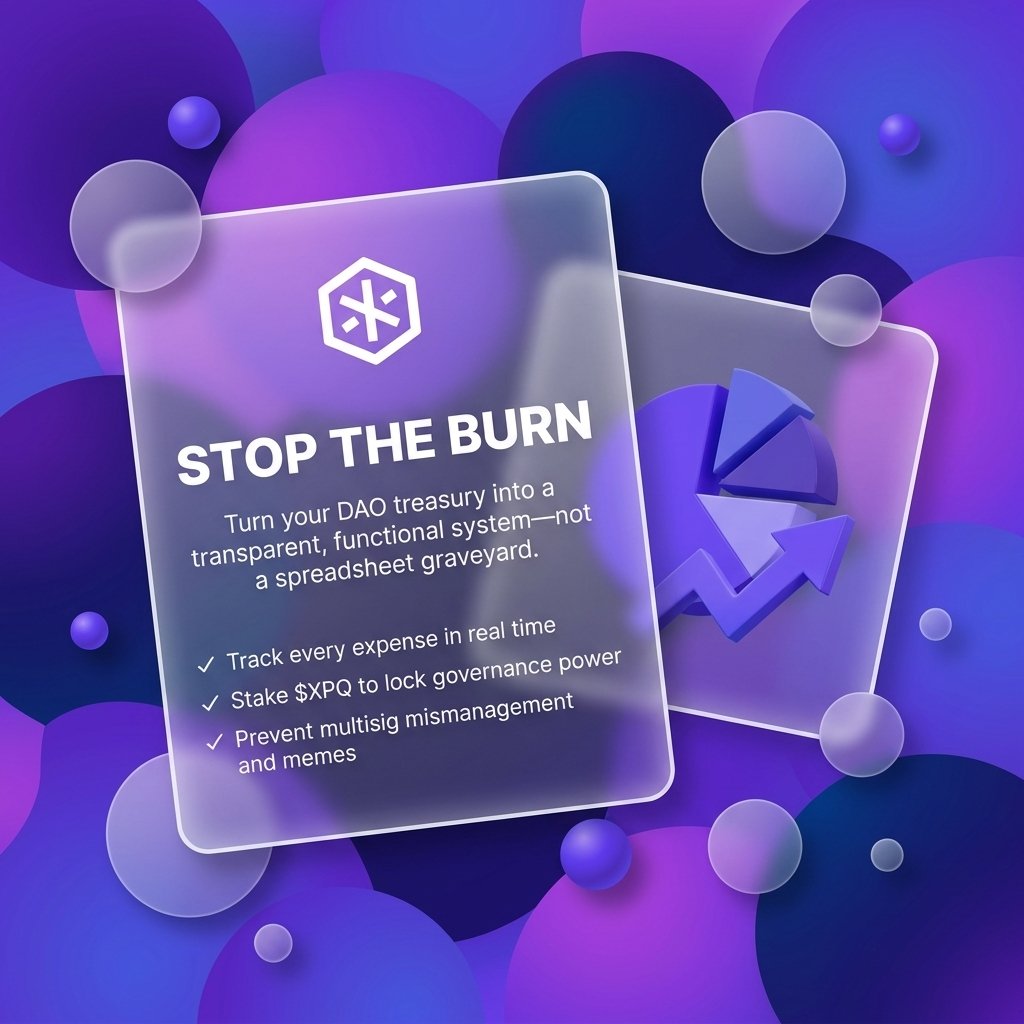
You ever watch a DAO burn $50k on a Discord poll because nobody tracked who spent what?
Yeah. We’re done with that.
Expensiq turns your treasury into something that actually works - not a spreadsheet graveyard.
Stake $XPQ, lock in governance power, and stop letting your multisig turn into a meme.
#Web3Finance

English
Expensiq | On-Chain Expenses retweetledi

Many people have claimed that with AI-assisted bug finding, secure code (and hence trustless anything) will be impossible.
I have a much more optimistic take, and AI-assisted formal verification is a major part of the reason why:
vitalik.eth.limo/general/2026/0…
English

You ever watch a DAO try to reimburse someone and it takes longer than a Ethereum block finality?
Spreadsheets. Discord threads. Multisig signers ghosting for 3 days.
We built $XPQ so your treasury doesn’t run like a haunted Notion page.
On-chain receipts. Smart contract budgets. Auto-payouts.
No trust. Just code.
And yeah - it’s live.

English
Expensiq | On-Chain Expenses retweetledi

Shooting the Shit with @BittelJulien is normally for Alpha members only. This one we're opening up. We go through global liquidity, crypto regulation, AI, compute, stablecoins, and why the old business cycle framework is losing power as the exponential age accelerates.
As ever, please enjoy!
English

You ever watch a DAO try to reimburse someone and it looks like they’re defusing a bomb blindfolded?
Spreadsheets. Discord threads from 2022. Multisig signers ghosting for three weeks.
We built $XPQ so you never have to live like this again.
On-chain receipts. Auto-enforced budgets. Real approvals that don’t take a moon cycle.
Stop managing money like it’s Web1.5.

English
Expensiq | On-Chain Expenses retweetledi

Major financial institutions utilizing tokenization isn't news anymore, but it's worth remembering who were the early adopters, like Franklin Templeton
@rkbaggs sat down with Mike Reed, Senior VP at @FTI_US, to get the low down on Wall St and blockchain!
#CHAINREACTION
English
Expensiq | On-Chain Expenses retweetledi

The Trump administration is preparing an executive order, expected this week, that would create a framework for AI labs to share new models with the US government up to 90 days before public release.
The NSA would handle classified testing of these models before deployment.
The move was triggered by the release of Anthropic's Mythos Preview and OpenAI's GPT-5.5, both of which demonstrated advanced capabilities in identifying vulnerabilities across computer networks, including critical infrastructure systems.
According to Axios and Nextgov, the national security apparatus was spooked by what these models can do and pushed for pre-release government access.
The framework is described as "voluntary," but there is internal disagreement within the administration over how far to go. Intelligence agencies and the Commerce Department are fighting over who should handle model evaluation. Some officials want stronger safeguards while others want a hands-off approach to avoid slowing innovation.
The key question is what "voluntary" means in practice when the entity asking for access is the NSA. Giving intelligence agencies a 90-day preview window into every frontier AI model before the public sees it is a significant expansion of government oversight over private technology development, regardless of what label gets put on it.

English
Expensiq | On-Chain Expenses retweetledi

When a crypto protocol gets hacked, everyone knows the number. When a traditional organization gets breached, the details often stay buried. @eddylazzarin on what that does to crypto's reputation:
"Crypto's transparency makes it more evident when things have gone wrong. Stealing hundreds of millions of dollars or 50 million, or even just a million, is so salient and so specific."
"I know a lot of traditional organizations that are worried about hacks. It's hard to quantify the damage. You just hear like 'information leaked.' Okay, how bad is that really? The grand scope of the damage is hard to say. Still really bad, but it's mushier."
"A lot of the damage in conventional hacks is hidden. In fact, corporations have a very strong interest in avoiding people seeing it, to avoid backlash and scandal."
"And so crypto has a unique disadvantage narratively when it comes to security issues, and that's unfortunate."
English