Ffiona Rrae

511 posts

Ffiona Rrae

Ffiona Rrae

@FfionaRrae

Katılım Mayıs 2019
71 Takip Edilen44 Takipçiler
Ffiona Rrae retweetledi
Jen
Jen@jlpoober·
After 30 years in the classroom, here's what I know: The system bends over backwards for the kid causing the chaos. The 28 kids just trying to learn? They get whatever's left. A mom finally shadowed her son all day, and what happened next says everything. 🧵
English
66
195
4.5K
551.5K
Ffiona Rrae retweetledi
Dana Palubiak
Dana Palubiak@DanaPalubiak·
Teachers don't quit because they don't care. They quit because they're asked to do the work of five professionals for the pay of less than one. And then they're told they didn't do enough.
English
61
140
1.1K
19.9K
Ffiona Rrae retweetledi
Grifty
Grifty@TheGriftReport·
Personally, I think @Miss_Snuffy should be in charge of our education system. She has earned the title "Britain's strictest headmistress", and what she has done in her school should be admired, studied and emulated across the country. She has conservative values, and we need these instilled in schools instead of the Marxist indoctrination we currently have. We have huge problems in our education system, and whoever forms the next government should call her to ask for advice.
Grifty tweet media
English
314
784
3.8K
250.5K
Ffiona Rrae retweetledi
British Thought Leaders
British Thought Leaders@BritishThgtLdrs·
NEW EPISODE: The Case for Traditional Education: Helping British Children Thrive Britain's strictest headmistress, Katharine Birbalsingh CBE (@Miss_Snuffy), tells @LeeAlanHall that it's time to ditch progressive teaching and go back to basics: firm discipline, structure, respect for authority, and clear rules. She says her school Michaela is real-world evidence that a strict, no-nonsense approach delivers outstanding results even in deprived areas. Katharine calls for a full ban on social media for kids, as well as a strict limiting of electronic device access for children, due to the damaging impact. Finally, she emphasises that real courage is required from educators and leaders to embrace these proven traditional methods and truly help Britain's children.
English
10
43
219
27K
Ffiona Rrae retweetledi
Katharine Birbalsingh
Katharine Birbalsingh@Miss_Snuffy·
Parents don’t parent. Teachers don’t teach. It is because we think being an authority is bad. We think it is being Hitler and confuse authority with authoritarianism. We have abandoned our roles as adults and our responsibilities. 😳
The Telegraph@Telegraph

✍️ 'Children have a remarkable capacity to rise above their circumstances and thrive. But not if families evade their basic responsibilities' Read @CamillaTominey's latest column below 👇 telegraph.co.uk/news/2026/02/1…

English
50
271
1.3K
50.5K
Ffiona Rrae retweetledi
Katharine Birbalsingh
Katharine Birbalsingh@Miss_Snuffy·
Came across this from a while ago.👇 How do we build resilience in children? By holding the line and seeming unreasonable to others but sensible to that which is true. Hold your standards high and they will reach up to you. ✊🏾
LBC@LBC

"You get your homework in, no matter what. You can't say 'the bus was late, that's why I'm late'." 'Britain's strictest headteacher' @Miss_Snuffy lays down the law on 'personal responsibility' at her school for @NickFerrariLBC.

English
24
114
962
29.6K
Ffiona Rrae retweetledi
Fixing Education
Fixing Education@FixingEducation·
The more schools take on, the more likely they will fail at all of them.
English
8
20
226
7.7K
Ffiona Rrae retweetledi
Tom Rogers
Tom Rogers@RogersHistory·
A fantastic teacher said to me yesterday ‘the biggest problem in schools today is that too many children don’t care, it’s a growing number, so much effort to get them to do anything (in general terms)’. Pupils are provided an unprecedented standard of teaching and learning, more support and opt out opportunities than ever before. The passivity is a huge problem and this isn’t about teachers and schools IMO.
English
142
87
936
116.1K
Ffiona Rrae retweetledi
Andrew Old
Andrew Old@oldandrewuk·
One of the most damaging ideas in education over the last twenty-five years is the belief that SEND causes poor behaviour, and that enabling that behaviour is a reasonable adjustment.
English
10
12
161
49.5K
Ffiona Rrae retweetledi
Tom Bennett OBE
Tom Bennett OBE@tombennett71·
Schools do not improve because leaders are superheroes or the staff are martyrs and saints; they improve when they create systems of effective behaviour, and stick to them. Supervising and maintaining those routines needs to also be a set of systems.
Lee Woods@LeeWoods0722

Most school leaders are not chasing perfection. They are chasing progress. Quietly. Relentlessly. Under pressure. That is why Better by Atul Gawande resonates so deeply with leadership in schools. It is not about brilliance. It is about systems, habits and the discipline of improvement. In surgery, failure costs lives. In education, it costs opportunity. The lesson is the same in both fields: Care is not enough. Systems matter. That simple truth sits at the heart of Better: A Surgeon’s Notes on Performance by Atul Gawande. Although written through the lens of medicine, it may be one of the most quietly powerful leadership books a leader can read. Because it strips performance back to its essentials. Not vision statements. Not slogans. But habits, systems, humility and the relentless pursuit of improvement. In schools, as in surgery, we often celebrate individual excellence. The outstanding teacher. The inspirational leader. The charismatic head. Gawande dismantles this myth with precision. He shows that even the most talented professionals fail without: •Clear systems •Consistent routines •Feedback that is acted upon •A culture that allows challenge and learning The lesson is uncomfortable but necessary. Performance does not improve because people care more. It improves because systems make the right actions more likely and the wrong ones harder to repeat. One of Gawande’s central arguments is that improvement rarely comes from dramatic breakthroughs. It comes from marginal gains applied consistently. This is profoundly relevant to school leadership. Better attendance rarely comes from one assembly. Better behaviour rarely comes from one policy rewrite. Better teaching rarely comes from one INSET day. It comes from leaders who: •Clarify expectations •Remove ambiguity •Build routines that survive pressure •Accept that good intentions are not enough In Gawande’s world, checklists save lives. In ours, systems save learning time. Perhaps the most striking section of Better is Gawande’s exploration of coaching. Even elite surgeons, at the top of their profession, actively seek feedback from others who can see what they cannot. This is where leadership in schools is often tested. Senior leaders are expected to have answers. Yet the most effective leaders are those who remain open to scrutiny. The parallel is clear. Schools improve fastest when leaders: Invite challenge rather than defend practice Use evidence to refine decisions Model learning rather than certainty Leadership is not diminished by coaching. It is strengthened by it. What makes Better resonate so strongly with education is its realism. Gawande does not argue that failure can be eliminated. He argues that it can be reduced. He does not promise excellence overnight. He commits to progress, relentlessly pursued. This mirrors the reality of schools. We work in complex systems, serving diverse communities, under constant pressure. Improvement is rarely neat. But it is possible. The leaders who make the biggest difference are those who ask, repeatedly: What worked today? What did not? What one thing can we do better tomorrow? That mindset is not glamorous. It is transformative. Better is not a book about medicine. It is a book about responsibility. Responsibility to design systems that protect people. Responsibility to reflect honestly on performance. Responsibility to keep improving even when progress feels slow. For school leaders, that message could not be more relevant. Because the work is not about being flawless. It is about being better. Every day.

English
10
32
181
33.7K
Ffiona Rrae retweetledi
New York Magazine
New York Magazine@NYMag·
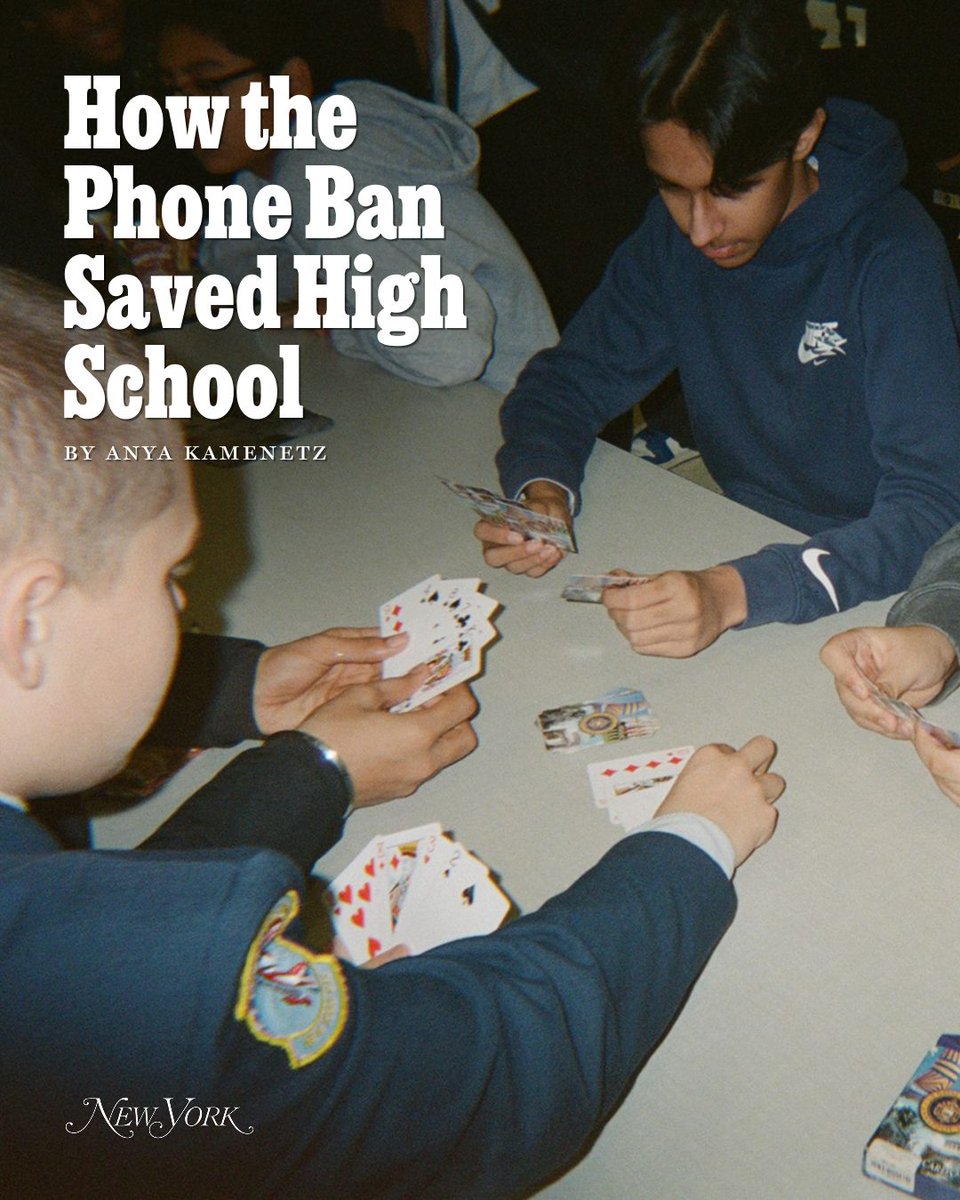
When New York State banned phones in public schools from bell to bell this past September, the goal was undistracted learning. But within weeks of the Great Phone Lockup, teachers began to notice an incidental (and arguably even more compelling) benefit: The teens were talking to one another as if they were in a Brat Pack movie. Sure, there’s been grumbling and some burner phones and scrolling in the bathroom. But generally, with phones off-limits, the atmosphere feels different. There’s a pleasant buzz in the lunchroom, chatter in the hallways, and an alphabet of new analog hobbies popping up just about everywhere. “We’ve had a lot more school spirit,” said one senior at a charter school in Harlem. “People are more willing to do stuff.” What stuff are they doing? At many schools, teachers have made cards, board games, and sports equipment available during free time, and the kids have deigned to use them. Aidan Amin, a ninth-grader at Hunter College High School, is in a friend group that congregates in the school foyer to stack ‘OK Play’ tiles and compete at ‘Sorry!’ and other tabletop games during lunch. “I’d say it’s made us closer. Honestly, half the people I’m playing board games with I didn’t know at all before this,” Aidan says. Read more about how the state’s device ban has shifted the atmosphere in New York public schools: nymag.visitlink.me/R2A4ds
New York Magazine tweet media
English
59
1K
4.4K
1.1M
Ffiona Rrae retweetledi
Fixing Education
Fixing Education@FixingEducation·
Schools exist to support families, not replace parents. That means parents need to actually parent, and the govt & communities need to stop treating schools as the fix for bad parenting. If you’re an educator who thinks otherwise, you’ve watched too many teacher hero movies.
English
22
121
817
26.4K
Ffiona Rrae retweetledi
Fixing Education
Fixing Education@FixingEducation·
Schools spend hours trying to “reach” the kid who openly doesn’t care, while the kid who tries every day quietly gets ignored. We’re exhausting ourselves chasing resistance instead of investing in effort.
English
226
1.1K
11.2K
275.3K
Ffiona Rrae retweetledi
Tom Bennett OBE
Tom Bennett OBE@tombennett71·
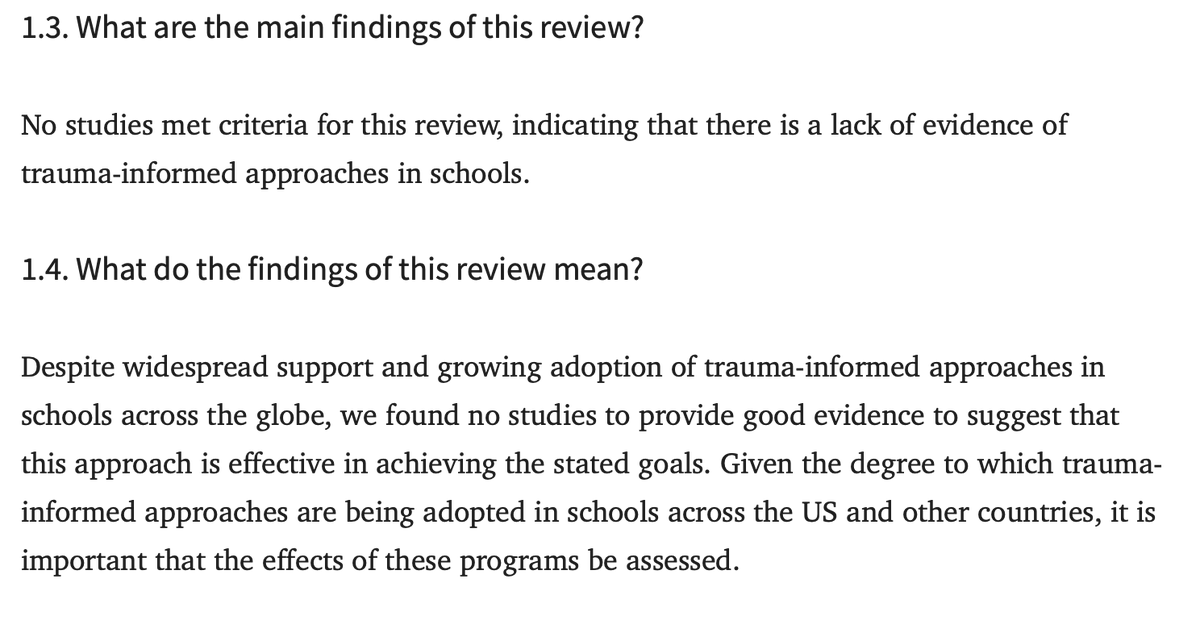
Interesting review, a few years old now. Trauma-informed approaches are very popular right now, but sadly there is still a dearth of substantial evidence that they actually work as described. Trauma itself is real, and devastating, but there is a tendency for some practitioners to mistakenly assume all misbehaviour is a symptom of trauma, which is clearly wrong. Tread carefully. pmc.ncbi.nlm.nih.gov/articles/PMC83…
Tom Bennett OBE tweet mediaTom Bennett OBE tweet media
English
6
15
84
9.9K
Ffiona Rrae retweetledi
Tom Bennett OBE
Tom Bennett OBE@tombennett71·
Restorative practice has been rolled out at scale in many schools and regions. Unfortunately there are lots of reasons why educators should use extreme caution before adopting RP: 1. Lack of demonstrated effectiveness 2. High costs 3. Decline in adult authority 4. Reduction in safety, calm and ironically, dignity That’s not to say it’s not useful in many situations, but as a whole school system replacing other systems (eg boundaries, taught behaviours, consequences) it usually leads to terrible outcomes. See New York for details. An interesting study here: manhattan.institute/article/the-co…
English
12
43
171
32.2K