Jonathan Zettler 🇨🇦

10.3K posts

Jonathan Zettler 🇨🇦 banner
Jonathan Zettler 🇨🇦

Jonathan Zettler 🇨🇦

@FieldwalkerAg

I post about field crops | CCA-ON | Benchmarking Yield Potential | @TheCropwalker Newsletter, SWAT Maps, Crop Planning, Metos Weather Stations

Ontario, Canada Katılım Ocak 2013
2.4K Takip Edilen3.2K Takipçiler
Jonathan Zettler 🇨🇦 retweetledi
RealAgriculture
RealAgriculture@realagriculture·
Tune in this Monday to The Agronomists with your host Lyndsey Smith! On this Monday’s show, Smith is joined by Guy Ash of @Metos_Canada & @FieldwalkerAg for a conversation about using weather data to drive agronomic decisions! Tune in at 8 pm E this Monday Click here to watch RealAgriculture.com/live/
RealAgriculture tweet media
English
0
1
0
548
Shawn Schill 🇨🇦🇨🇦
Bare wheat fields.....saturated soils.....-15 deg C......70-80kph winds.......did I ever tell you folks I lost more winter wheat in late March/early April then I ever lost in January?
GIF
English
3
0
47
4.1K
Jonathan Zettler 🇨🇦
Jonathan Zettler 🇨🇦@FieldwalkerAg·
Wanted to share one article from this week's issue. Measuring Sprayer Effectiveness – JZ Lots of chatter this winter on sprayer productivity or efficiency, but very little on effectiveness. There are three key pieces you can measure when it comes to determining sprayer effectiveness or performance. · Ability to get the product to the plant – assess weather status · Ability to get product on the plant – assess coverage · Ability of get the product in the plant – assess plant status While some of these tools have been available for a while, I had not understood how easy it is to incorporate them into your day-to-day decision making. A few metrics you could check before heading to the field. · Delta T can provide an indication of how fast the spray droplets are going to evaporate before they hit the plant. · For spray coverage, water sensitive paper or the use of spray dyes can help assess ability of the nozzle to get product effectively on the leaf. My preference is to use dyes, as you assessing the actual leaf rather than a proxy. · Vapour Pressure Deficit – can be used to determine the ease of getting material into the leaf.
The Cropwalker@TheCropwalker

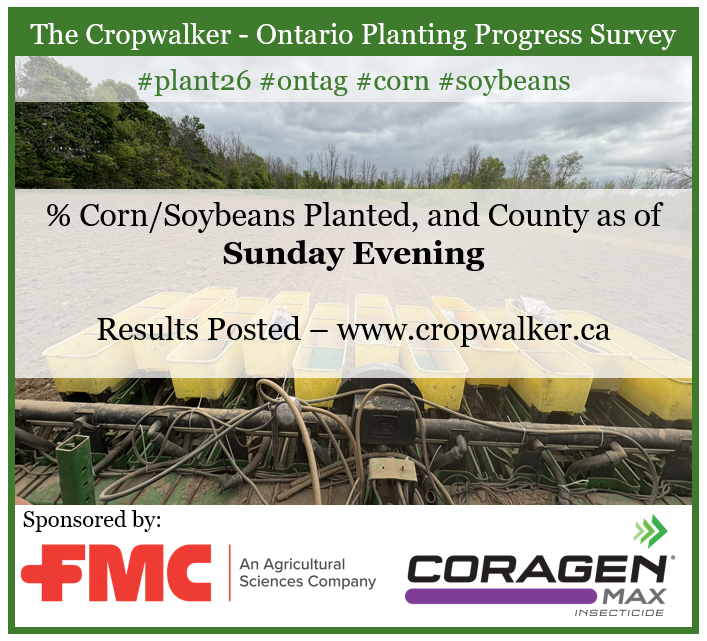
The Cropwalker Newsletter - V9 I9 In this week's issue: Snow Mould/Powdery Mildew in Wheat, Nitrogen Timing in Winter Wheat, Pat's History of Dicamba use in Corn and more... To take our last free issue for a ride, visit: cropwalker.ca/the-cropwalker…

English
0
1
3
1.5K
Jonathan Zettler 🇨🇦
Jonathan Zettler 🇨🇦@FieldwalkerAg·
Going to @GrainFarmers March Classic? Stop by the Fieldwalker booth to meet Ontario SWAT Maps providers and discover how to manage crop-driven landscape variability.
Jonathan Zettler 🇨🇦 tweet media
English
0
0
4
465
Jonathan Zettler 🇨🇦
Jonathan Zettler 🇨🇦@FieldwalkerAg·
Applicable to agriculture.
Big Brain Business@BigBrainBizness

Jeff Bezos on why too many ideas can destroy a company, and the discipline that built Amazon's inventive edge: "Jeff, you have enough ideas to destroy Amazon." That's what senior executive Jeff Wilke told Bezos after just one year of working together. Bezos was confused. He pushed back: "What do you mean?" Wilke was a manufacturing expert. He explained it simply: Every new idea Bezos released created a backlog. Work piling up, adding no value, creating distraction instead. The fix wasn't to stop having ideas. It was to control when they came out: "You have to release the work at the right rate that the organisation can accept it." So @JeffBezos changed how he operated. He started keeping lists, holding ideas back, and waiting until the organisation had the bandwidth to absorb them. But then he flipped the problem entirely. He asked: "How do I build an organisation that's ready for more ideas?" His answer was structural: get the right senior team, give leaders real executive bandwidth, and build a company capable of running multiple bets at once. And there's a benefit he didn't expect. Slowing down made the ideas themselves better: "If you are releasing the ideas through time, it forces you to prioritise them better. You end up sharpening the ideas better." The constraint becomes a filter. The ideas that survive the wait are the ones worth acting on. The result? Faster execution, less distraction, and better ideas.

English
0
0
4
631
Shay Foulk
Shay Foulk@FoulkShay·
farming until I’m 102
Shay Foulk tweet media
English
23
11
221
18.6K
Jonathan Zettler 🇨🇦
Jonathan Zettler 🇨🇦@FieldwalkerAg·
@burnhamfarms Part of the reason soybean population adjusts by row width is to keep spacing tight enough to help with plants pushing for emergence.
English
1
0
1
291
Mark Burnham
Mark Burnham@burnhamfarms·
What is the ideal in row soybean plant spacing? I'm aware I didn't specify row spacing, but does it really make that much difference when talking in row spacing? My first thought was likely in the 2in range. Little fun #agronomy chat.
English
3
0
8
2.2K
Jonathan Zettler 🇨🇦
Jonathan Zettler 🇨🇦@FieldwalkerAg·
I’m not sure I would consider most farmers/business owners CEOs, CEOs typically report to a board and are not the primary business owner. They are similar as far as being the primary day to day business decision maker, can have a misalignment when it comes incentives for the primary ownership. Usually not the case on most farms.
English
0
0
1
486
Grant Wiese
Grant Wiese@gwiesefarms·
Farmers are CEOs. But CEOs who track the wrong scoreboard still go broke. Equity might look impressive on paper, but working capital is what keeps the farm alive day to day.
English
3
1
28
5.7K