Physicist

3.1K posts

Physicist banner
Physicist

Physicist

@Fizzicist314

Physicist, computer programmer, epistemophile, tech enthusiast/optimist, political popcorn consumer.

Katılım Haziran 2008
382 Takip Edilen102 Takipçiler
Sabitlenmiş Tweet
Physicist
Physicist@Fizzicist314·
With a degree in physics behind me, I never thought I'd get to experience the amazing feeling of a concept clicking with understanding again. If you'd like to feel the same thing, give this a watch. youtu.be/qJZ1Ez28C-A
YouTube video
YouTube
English
3
0
1
2K
Physicist
Physicist@Fizzicist314·
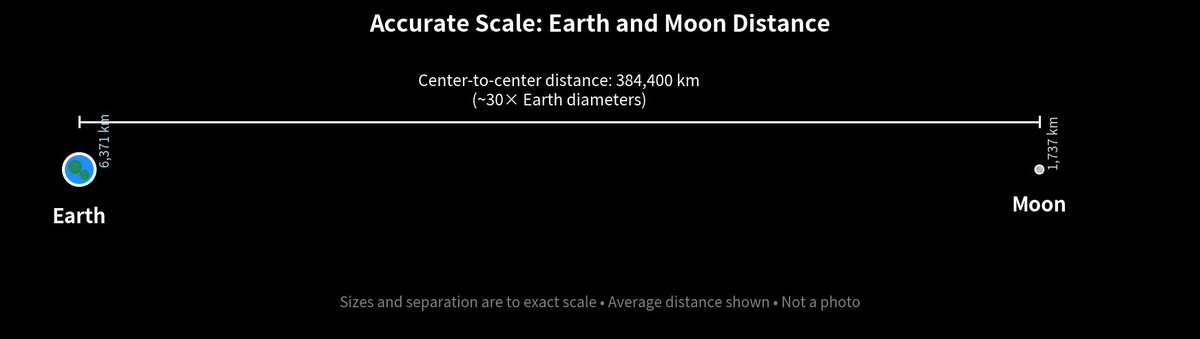
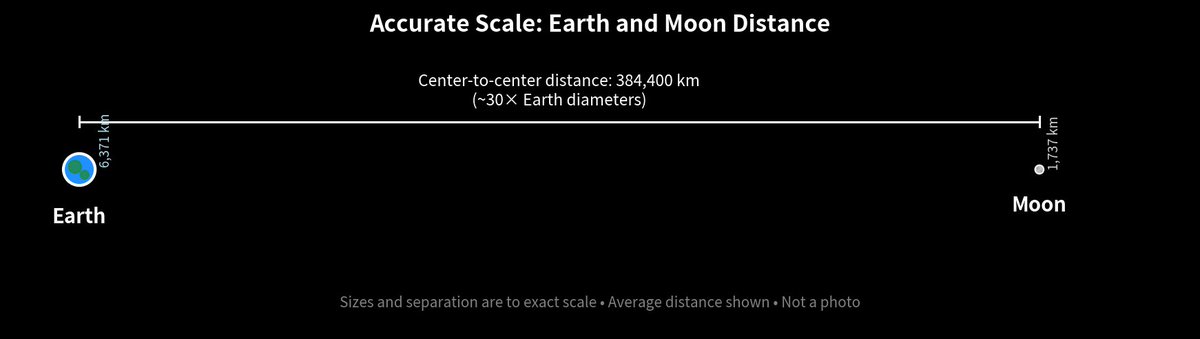
@BillAckman Definitely. Also, actual scale so we can appreciate the true distance they have to travel.
Physicist tweet media
English
0
0
1
227
Bill Ackman
Bill Ackman@BillAckman·
Perspective on the Artemis 2 journey. Respect for the engineers, scientists, manufacturers, astronauts and others who make this possible. Incredible.
The Curious Tales@thecurioustales

🚨 This is exactly how the 4 moonbound astronauts will travel 400,000 km from Earth. Strap yourself to 4.1 million kilograms of controlled explosion and ride it to the edge of everything humans have ever known. The Artemis II trajectory reveals something most miss about deep space travel: you don’t pilot to the moon. You become cargo on a ballistic arc calculated with mathematical precision that would make ancient astronomers weep. Launch from Cape Canaveral begins with two solid rocket boosters generating 3.6 million pounds of thrust each. These aren’t engines you can throttle or shut off. Once lit, they burn until empty. You’re riding pure chemical violence upward at accelerations that compress your organs and blur your vision. Each booster burns through 1.1 million pounds of propellant in 120 seconds, generating more power than the entire electrical grid of most countries. When the boosters separate two minutes in, you’re already traveling 3,000 miles per hour. The core stage takes over, burning liquid hydrogen and oxygen through four RS-25 engines. These are the same engines that powered the Space Shuttle, but upgraded for deep space. Each engine operates at temperatures that would vaporize most metals, channeling combustion through nozzles engineered to nanometer tolerances. Six minutes after launch, the core stage drops away. You’re in low Earth orbit, but barely. The trajectory puts you in an elliptical path that skims the upper atmosphere. Solar arrays deploy like mechanical wings. Life support systems activate. Four humans now depend entirely on machines to survive in an environment that kills unprotected life in seconds. The next 90 minutes are psychological preparation for what comes next. You’re still close enough to Earth that if something fails catastrophically, you might survive reentry. After translunar injection, that safety net disappears completely. The Interim Cryogenic Propulsion System fires once. A single engine burn lasting minutes accelerates you to escape velocity: 25,000 miles per hour. You are now traveling faster than any human has traveled since 1972. The burn must be perfect. Too little thrust and you fall back to Earth. Too much and you overshoot the moon entirely, drifting into solar orbit with no possibility of rescue. What follows is four days of coasting through interplanetary space on a trajectory so precisely calculated that it accounts for the gravitational influence of the sun, Earth, moon, and even Jupiter. You’re riding a path through space and time that exists only because teams of mathematicians spent years modeling celestial mechanics down to the microsecond. The spacecraft carries no radar, no GPS, no external reference points. Navigation depends on star trackers that identify constellations and calculate position by comparing stellar angles to digital star maps. You navigate the same way Polynesian sailors did, except your ocean is vacuum and your destination moves 2,000 miles per hour relative to Earth. Seventy hours into the mission, you cross the point where lunar gravity becomes stronger than Earth’s pull. The mathematics of your trajectory flip. You’re no longer escaping Earth. You’re falling toward the moon. But you don’t land. The trajectory aims for the moon’s far side, using lunar gravity like a cosmic slingshot. As you swing around, the moon’s mass redirects your momentum back toward Earth. Ancient orbital mechanics discovered by Johannes Kepler 400 years ago bend spacetime to fling you home. The far side transit is when psychological isolation peaks. You pass behind the moon, losing radio contact with Earth for the first time since launch. The only humans in the solar system disappear behind 2,000 miles of lunar rock. Mission Control goes silent. You are alone with the machinery in ways no human has experienced since Apollo 17. During lunar approach, you fly closer to the moon’s surface than the International Space Station orbits Earth. Craters and mountains pass beneath at lunar dawn, shadows stretching across terrain untouched by atmosphere or weather for billions of years. You see geology older than complex life on Earth. The return trajectory begins automatically. Lunar gravity has already bent your path homeward. You’re riding Newton’s laws back across 400,000 kilometers of emptiness at speeds that compress the return journey into four days. Reentry begins 400,000 feet above the Pacific Ocean. The heat shield faces temperatures of 5,000 degrees Fahrenheit—hot enough to melt copper, approaching the surface temperature of the sun. Atmospheric friction converts 25,000 miles per hour into thermal energy that would vaporize the spacecraft without the carbon composite barrier between you and physics. Parachute deployment requires split-second timing. Deploy too early and the chutes shred in the hypersonic airflow. Deploy too late and you impact the ocean at terminal velocity. Main chutes slow you from 300 miles per hour to 20 miles per hour in seconds. The deceleration forces compress your spine and test the limits of human physiology. Pacific splashdown ends a ten-day journey covering 1.4 million miles. You return as the first humans to travel beyond Earth orbit in over fifty years, carrying radiation exposure from cosmic rays that passed through your body, and psychological changes from seeing Earth as a pale blue dot suspended in infinite dark. The entire mission depends on technologies working perfectly in an environment that destroys electronics, boils lubricants, and subjects every component to temperature swings of 500 degrees. One software glitch, one seal failure, one navigation error means four humans drift through space until life support expires. Engineering manages these risks through redundancy, testing, and margins of safety built into every system. But at 400,000 kilometers from Earth, margin for error approaches zero. Success requires mechanical perfection operating in conditions no Earth laboratory can fully simulate. We call it exploration, but what Artemis II really tests is whether human consciousness can psychologically handle complete separation from everything that created it while trusting life entirely to machines operating at the edge of physical possibility. The trajectory looks like a simple loop on paper. In reality, it’s controlled falling through spacetime using mathematics as your only safety net.

English
65
200
2.1K
228.4K
Physicist
Physicist@Fizzicist314·
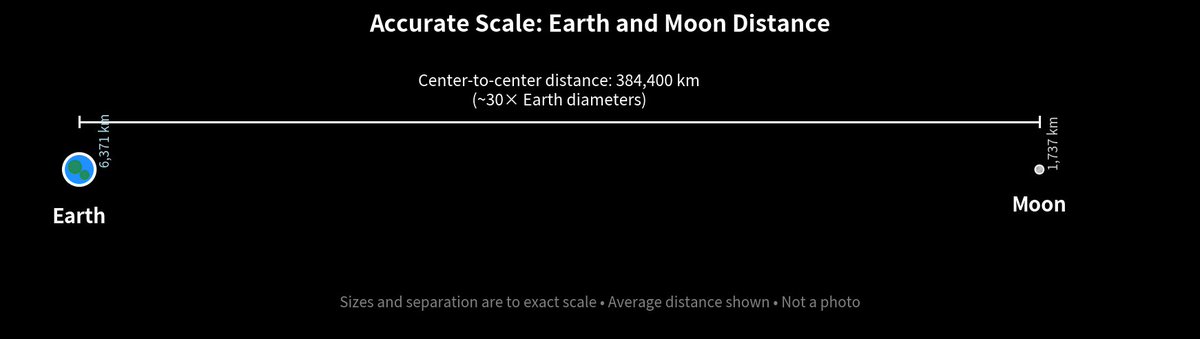
@CBSNews Actual scale so we can appreciate the distance they have to travel.
Physicist tweet media
English
0
0
0
37
CBS News
CBS News@CBSNews·
Here's a look at the 10-day journey the Artemis II crew will take around the far side of the moon.
English
13
96
272
31.2K
Physicist
Physicist@Fizzicist314·
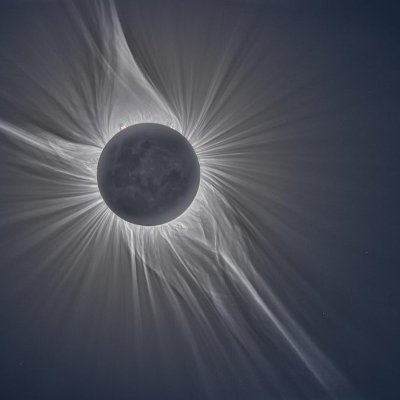
@ABC It's journalistic malpractice to use a picture like that. The distance we have to travel is MUCH farther.

Physicist tweet media
English
0
1
4
1.4K
Physicist
Physicist@Fizzicist314·
@MarioNawfal Posting the actual scale of the distance we have to travel. That diagram makes it seem much closer than it actually is.
Physicist tweet media
English
0
1
2
288
Physicist
Physicist@Fizzicist314·
@politicalmath Apollo 10 oribited and went low to test lunar descent. Artemis II doesn't want to orbit and prefers to maintain escape velocity for safety. Also, the scale of that diagram is terribly inaccurate and doesn't do justice to the actual distance we have to travel.
Physicist tweet media
English
0
0
5
623
PoIiMath
PoIiMath@politicalmath·
Why are they flying 4,000 miles over the moon? Apollo 10 got within 9 miles, what is being achieved by flying this far above it?
Black Hole@konstructivizm

What will the Artemis-2 astronauts do during the entire 10-day mission? Day by day overview: Day 1. Launch. Launch on the SLS rocket, stage separation, orbital insertion. Maneuvers around the spent stage, initial system checks, change from spacesuits to everyday clothing. Day 2. Beginning the journey to the Moon: Simulator exercises, then the main maneuver—translunar injection (TLI), which places Orion on a trajectory to fly around the Moon and return to Earth. Day 3. Preparation Rehearsals for lunar observations in zero gravity, corrective maneuver, emergency procedures training (e.g., CPR). Day 4. Course correction Second minor maneuver, communication with Mission Control, media sessions, photography of Earth and the Moon at the midpoint. Day 5. Lunar Entry For the first time since 1972, humans will be in cislunar space. Spacesuit tests: rapid pressurization, life support systems checks. Another course correction. Day 6. Lunar Flyby The main day: The Orion spacecraft will fly at an altitude of 6,400–9,650 km above the lunar surface. This distance is approximately 15–24 times greater than the orbital altitude of the ISS. Plus, the Moon itself is smaller. Visually, the Moon will look like a basketball at arm's length to the astronauts. There will be only three hours for observations during closest approach. The astronauts will take photographs and record geological data. Depending on the launch time, the Artemis 2 crew could break the record for the longest distance from Earth. Day 7. Lunar Exit Data transfer to scientists, psychological and physical debriefings. Symbolic call with the ISS crew. First maneuver of the return trajectory. Day 8. Demonstrations Radiation protection training (using water and thermal protection as barriers). Testing the Orion attitude control systems in various modes. Day 9. Preparing for reentry The last full day of the flight. Technological demonstrations, course corrections, fitting of compression suits to help the body adapt to weightlessness. Day 10. Return Final maneuver, atmospheric reentry, during which the temperature will reach 1650°C. Parachute deployment, splashdown in the Pacific Ocean off San Francisco. Crew pickup by US Navy ships.

English
166
6
266
70.7K
Physicist
Physicist@Fizzicist314·
@konstructivizm This image doesn't due justice to the true scale of the distance they have to travel.
Physicist tweet media
English
0
1
29
4.5K
Black Hole
Black Hole@konstructivizm·
What will the Artemis-2 astronauts do during the entire 10-day mission? Day by day overview: Day 1. Launch. Launch on the SLS rocket, stage separation, orbital insertion. Maneuvers around the spent stage, initial system checks, change from spacesuits to everyday clothing. Day 2. Beginning the journey to the Moon: Simulator exercises, then the main maneuver—translunar injection (TLI), which places Orion on a trajectory to fly around the Moon and return to Earth. Day 3. Preparation Rehearsals for lunar observations in zero gravity, corrective maneuver, emergency procedures training (e.g., CPR). Day 4. Course correction Second minor maneuver, communication with Mission Control, media sessions, photography of Earth and the Moon at the midpoint. Day 5. Lunar Entry For the first time since 1972, humans will be in cislunar space. Spacesuit tests: rapid pressurization, life support systems checks. Another course correction. Day 6. Lunar Flyby The main day: The Orion spacecraft will fly at an altitude of 6,400–9,650 km above the lunar surface. This distance is approximately 15–24 times greater than the orbital altitude of the ISS. Plus, the Moon itself is smaller. Visually, the Moon will look like a basketball at arm's length to the astronauts. There will be only three hours for observations during closest approach. The astronauts will take photographs and record geological data. Depending on the launch time, the Artemis 2 crew could break the record for the longest distance from Earth. Day 7. Lunar Exit Data transfer to scientists, psychological and physical debriefings. Symbolic call with the ISS crew. First maneuver of the return trajectory. Day 8. Demonstrations Radiation protection training (using water and thermal protection as barriers). Testing the Orion attitude control systems in various modes. Day 9. Preparing for reentry The last full day of the flight. Technological demonstrations, course corrections, fitting of compression suits to help the body adapt to weightlessness. Day 10. Return Final maneuver, atmospheric reentry, during which the temperature will reach 1650°C. Parachute deployment, splashdown in the Pacific Ocean off San Francisco. Crew pickup by US Navy ships.
Black Hole tweet media
English
62
2.8K
7.5K
441.4K
ABC News
ABC News@ABC·
This animation shows NASA’s Artemis II mission path, a journey of nearly 685,000 miles. The crew will travel in a figure-eight trajectory, looping out from Earth, around the Moon, and back again. Follow live updates: abcnews.link/qHsZ657
English
273
4.3K
14.9K
1.3M
Physicist retweetledi
Crémieux
Crémieux@cremieuxrecueil·
Think about this: It's been a year since we learned this study was wrong and that the authors actually committed fraud and knew it was wrong when they published it. No correction, no statements, and certainly no retraction. These researchers did harm and have gone unpunished.
Crémieux tweet media
Ian Kingsbury@PeerReReview

Today marks 1 year since it was revealed that the infamous & debunked infant mortality race concordance study buried findings that "undermine the narrative." The study was published in @PNASNews (the journal of the National Academy of Sciences). It still hasn't been retracted.

English
30
750
4.3K
124.6K
Physicist
Physicist@Fizzicist314·
@AmericanDebunk Did you post the correct video? I didn't see that mentioned or asked anywhere.
English
1
0
0
105
American Debunk
American Debunk@AmericanDebunk·
🚨BREAKING: Starmer looks like a deer in headlights after Trump told him he’s got to develop courage and get his own oil.
English
5
17
72
7.4K
Physicist
Physicist@Fizzicist314·
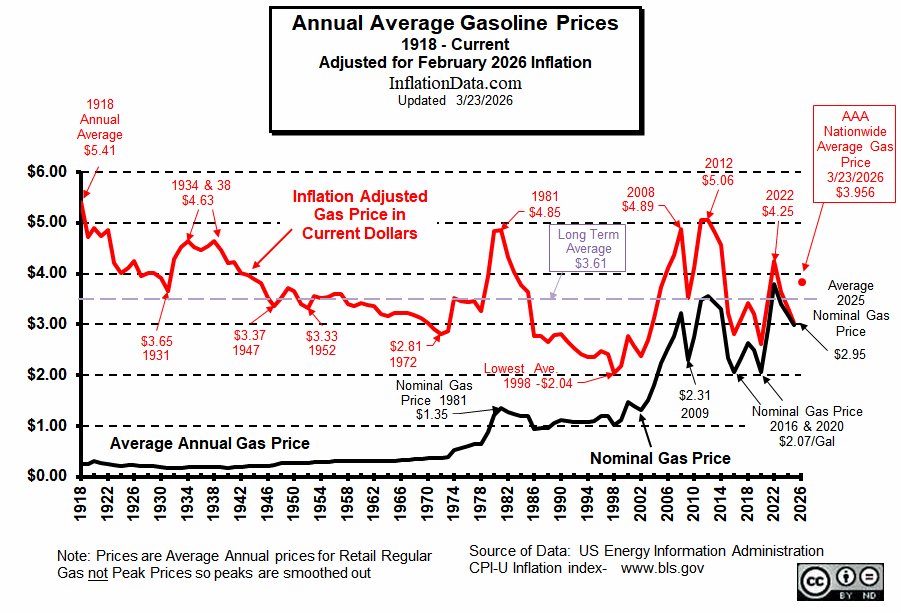
@JackPosobiec Worth noting, no one is comparing inflation adjusted prices.
Physicist tweet media
English
1
0
0
170
Physicist
Physicist@Fizzicist314·
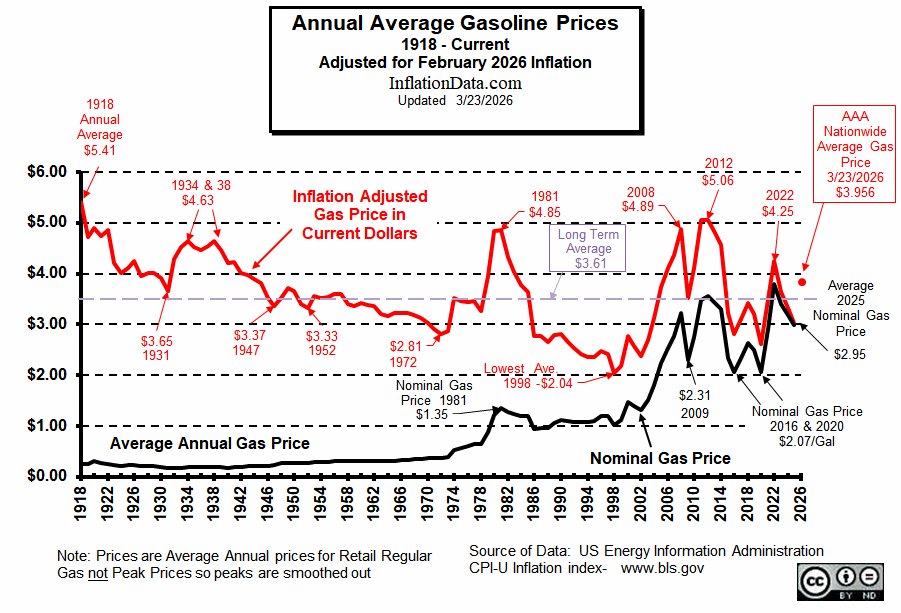
@Geiger_Capital Adjusting for inflation, it's actually been over $5/gal in the recent past.
Physicist tweet media
English
0
0
2
55
Owen Gregorian
Owen Gregorian@OwenGregorian·
BREAKING: DeSantis signs bill renaming Palm Beach airport to Donald J. Trump International Airport | Hannah Nightingale, The Post Millennial The bill goes into effect on July 1. Starting July 1, Palm Beach International Airport will be renamed the Donald J Trump International Airport after Governor Ron DeSantis signed a bill on the matter on Monday. The airport will have the identifier "DJT." Florida’s House and Senate voted overwhelmingly in February in support of the renaming, with the House voting 81-30 in favor and the Senate 25-11 in favor. The renaming is contingent on FAA approval and an agreement between Palm Beach County and Trump to use his name. US Representative Brian Mast of Florida’s 21st Congressional District has introduced legislation at the federal level to codify the name change and ensure coordination across aviation agencies. He said in a statement, "President Donald J. Trump’s impact on our nation will transcend our time—a historic legacy of dedication and commitment toward the American people. He’s called Palm Beach County ‘home’ for many years, and this designation reflects our gratitude for his public service and leadership." Florida State Rep Meg Weinberger, who brought forth the bill, said in a House committee meeting that the renaming honors "leadership and legacy," and noted that Palm Beach "is the home of the President" and the airport is "just down the street from where he lives." "He’s a two-term President. It will happen in his lifetime. Why not honor him while he’s the President in his hometown? And this is the first President that we’ve had in Florida," she said. thepostmillennial.com/breaking-desan…
Owen Gregorian tweet media
English
6
6
33
1.6K
Trump War Room
Trump War Room@TrumpWarRoom·
Florida is Trump country! 🇺🇸 ✅ The Donald J. Trump Presidential Library in Miami. ✅ President Donald J. Trump International Airport in West Palm Beach. ✅ President Donald J. Trump Blvd stretching all the way to Mar-a-Lago.
Trump War Room tweet mediaTrump War Room tweet mediaTrump War Room tweet media
English
151
451
2.2K
36.7K
Polymarket
Polymarket@Polymarket·
BREAKING: Palm Beach International Airport being officially renamed to “President Donald J. Trump International Airport”
English
647
550
7.7K
1.4M
Gunther Eagleman™
Gunther Eagleman™@GuntherEagleman·
🚨 HELL YEAH — OFFICIAL! Palm Beach International Airport just got renamed DONALD J. TRUMP INTERNATIONAL AIRPORT!
English
989
2.2K
11.7K
214.6K
Nick Sortor
Nick Sortor@nicksortor·
🚨 JUST IN — IT’S OFFICIAL: Palm Beach International Airport is now Donald J. Trump International Airport, following Gov. Ron DeSantis’ signature on HB919 The name change goes into effect on July 1st. Congrats, 47.
English
5.4K
18.6K
113K
4.8M
Physicist
Physicist@Fizzicist314·
@RodDMartin @Eric_Conn It's worse than that. The defense never said it didn't match, just that it couldn't be determined that it matched. The Daily Mail crossed the line into flat out lie.
English
0
0
0
31
Rod D. Martin
Rod D. Martin@RodDMartin·
@Eric_Conn Quoting a defense statement as established fact? Seriously?
English
8
1
72
1.3K
Carter Prescott 🇺🇸🇺🇸🇺🇸
@MarioNawfal @Timcast That guy is known for donning an ICE uniform (impersonating a federal agent btw) and provoking reactions from the purple-haired commie crowd. If you’re always picking fights, don’t complain when you get one. Looks like he got one.
English
1
0
2
144
Mario Nawfal
Mario Nawfal@MarioNawfal·
🇺🇸 Crowd at "No Kings" protest viciously beat a man in an ICE uniform unconscious in Honolulu. Kept attacking after he was down. A 15-year-old has been arrested. Mob violence against anyone wearing the wrong clothes...
Mario Nawfal@MarioNawfal

🇺🇸 A man on the ‘No Kings’ protest: "I think the U.S. is probably the most democratic society already. It’s not perfect, but so far it’s good compared to many other countries. So if they don’t like that, they can go to any socialist country to live.” x.com/breccastoll/st…

English
445
681
3.1K
803.2K
Physicist retweetledi
Bjorn Lomborg
Bjorn Lomborg@BjornLomborg·
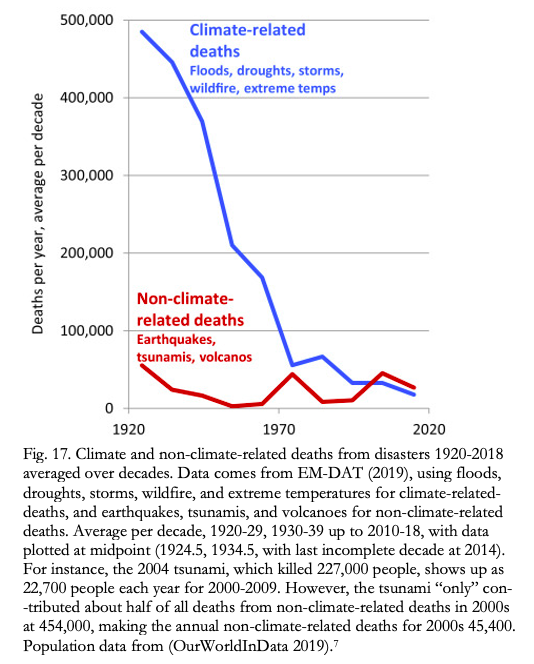
Your risk of dying from climate-related disasters dropped 99% since 1920. This is because richer societies are much more resilient to disasters Read more in my peer-reviewed article: sciencedirect.com/science/articl…
Bjorn Lomborg tweet media
English
40
628
1.9K
66.6K