Fortune & Ruin

64 posts

Fortune & Ruin banner
Fortune & Ruin

Fortune & Ruin

@Fortune_Ruin

Financial autopsies of the empires, systems, and decisions that shaped the modern world. The history books recorded the outcomes. We investigate the ledger.

Katılım Mart 2026
43 Takip Edilen6 Takipçiler
Sabitlenmiş Tweet
Fortune & Ruin
Fortune & Ruin@Fortune_Ruin·
Most history books tell you what happened. We investigate why the ledger never balanced. 10 episodes. Every one an autopsy of empire, wealth, and ruin. This is Fortune & Ruin. youtube.com/channel/UCWZbB…
English
0
0
0
44
Fortune & Ruin
Fortune & Ruin@Fortune_Ruin·
When you’re sitting outside the market and have missed the monster rally of the last 4 years…
English
0
0
0
9
Fortune & Ruin
Fortune & Ruin@Fortune_Ruin·
We are deep in the research right now. The pattern holds from the French livre in 1720 to the Argentine peso in 2001. The full story is uglier than the pattern suggests.
English
0
0
0
1
Fortune & Ruin
Fortune & Ruin@Fortune_Ruin·
Every currency crisis in history follows the same script. The government holds a press conference to assure the public the currency is sound. The officials at the podium have already moved their savings abroad. 🧵
English
1
1
1
16
Fortune & Ruin
Fortune & Ruin@Fortune_Ruin·
The full story is darker than the headline. Fisher spent the rest of his life writing papers explaining why he had been right in principle. Yale bailed him out. His sister-in-law's estate covered the rest. The man who defined rational markets died dependent on other people's...
English
0
0
0
3
Fortune & Ruin
Fortune & Ruin@Fortune_Ruin·
Irving Fisher called the 1929 market 'a permanently high plateau.' Four days later it began an 89% collapse. He lost $140 million. He never admitted he was wrong. 🧵
English
1
1
1
15
Fortune & Ruin
Fortune & Ruin@Fortune_Ruin·
@PeterSchiff From the J5's side, one compliant bank closure in 2019 sent a message to every offshore jurisdiction. The signal cost them nothing. The depositor arithmetic was someone else's problem.
English
0
0
0
21
Peter Schiff
Peter Schiff@PeterSchiff·
When OCIF agreed to shut down my bank as a publicity stunt for the J5, it needlessly deprived customers of their deposits for almost four years and counting. One customer took his own life after suffering the financial hardship of having his life savings trapped in the bank, a reason he confirmed in his suicide note. Now his widow is being forced to sell her house because the trustee OCIF appointed to “protect customers” still refuses to pay her.
English
49
65
575
44.3K
Fortune & Ruin
Fortune & Ruin@Fortune_Ruin·
@JavierBlas @opinion Calmer markets are the setup, not the solution. Europe said the same thing in 2019, right before Nord Stream flows tightened and TTF went vertical.
English
0
0
0
102
Javier Blas
Javier Blas@JavierBlas·
COLUMN: Ruinously high electricity bills became the defining image of Europe's energy crisis in 2022. So what's different this time? Thanks to nuclear, hydropower, solar, and better grids, European lectricity markets are calmer in 2026. @Opinion bloomberg.com/opinion/articl…
English
12
51
236
32.9K
Fortune & Ruin
Fortune & Ruin@Fortune_Ruin·
@NewYorkFed Top quintile net worth surged $269,000 per household from 2019 to 2022. Bottom quintile gained $7,000. That gap funds the divergence the Fed is still trying to model.
English
0
0
0
7
New York Fed
New York Fed@NewYorkFed·
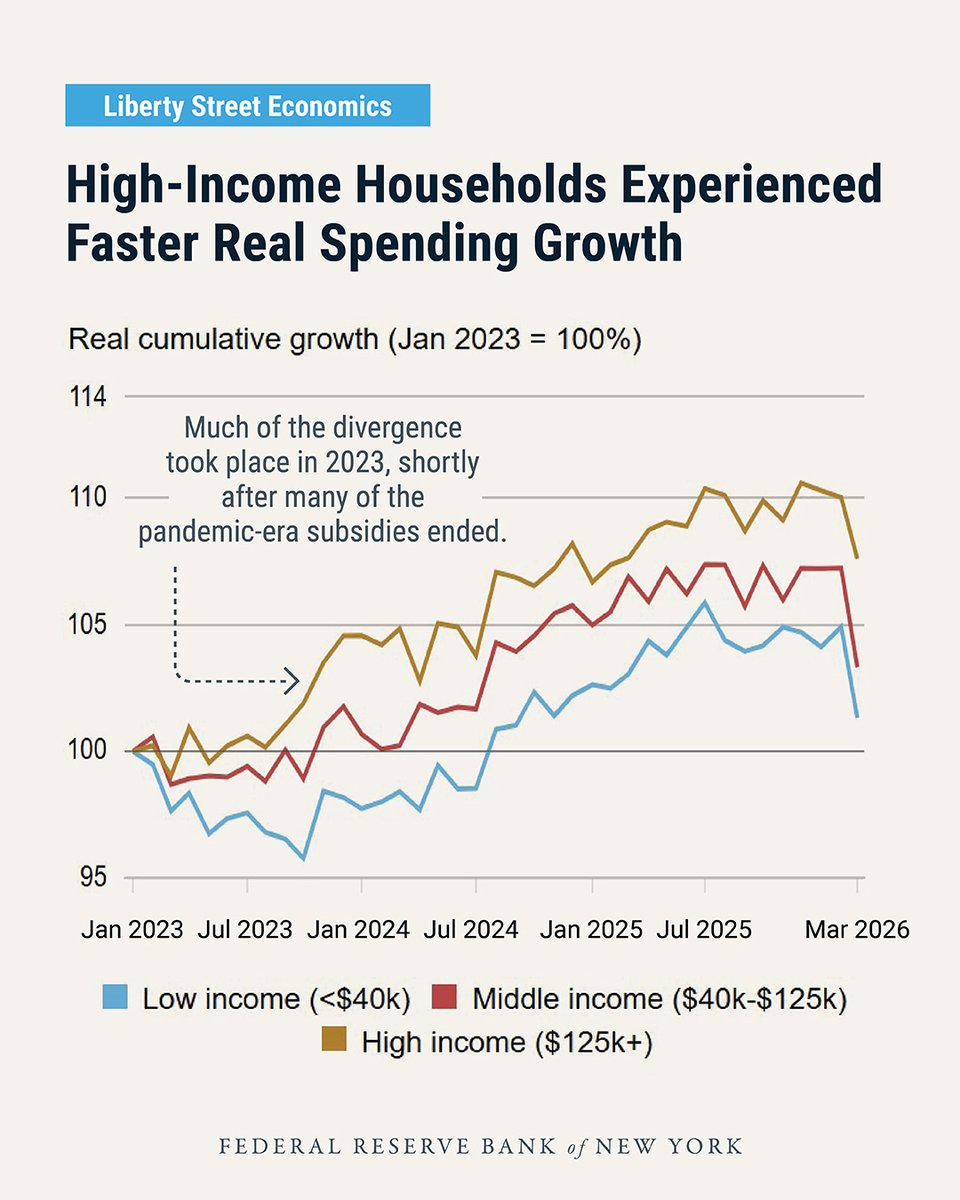
Why is this K-shaped spending divergence happening? In this post, the second in a two-part series, the authors find that net worth has increased the most for high-income households, while inflation has risen the most for low-income households. Together, both factors helping explain the fact that real retail spending rose the most for high-income households since 2023. libertystreeteconomics.newyorkfed.org/2026/05/explai…
English
1
1
1
1.2K
New York Fed
New York Fed@NewYorkFed·
Aggregate real consumer spending has risen solidly since 2023. Who’s driving spending in this K-shaped economy? In this post, the first in a two-part series, the authors find that that high-income households haven driven retail spending growth, while low- and middle-income households experienced extended periods of stalled or declining spending growth. nyfed.org/3OFI5RL
New York Fed tweet media
English
2
4
7
2.4K
Fortune & Ruin
Fortune & Ruin@Fortune_Ruin·
@MichaelKantro Sentiment doing the heavy lifting while earnings get the credit memo. 1999 PE expansion alone added more to the S&P than a decade of EPS growth. The fundamentals were fine. The multiple was doing something else entirely.
English
0
0
0
18
Fortune & Ruin
Fortune & Ruin@Fortune_Ruin·
@TFTC21 From Musk's side this reads like a standard founder protection play. He put in $50M of the $130M 2015 seed round. Majority equity for majority capital. Altman ended up with the control structure Musk wanted. Just without Musk.
English
0
0
0
63
TFTC
TFTC@TFTC21·
OpenAI co-founders Sam Altman & Greg Brockman discuss 2015 negotiations with Elon Musk in a new podcast. Brockman claims Musk demanded majority equity and full control, the breaking point over fears of one person controlling AI’s future.
English
6
0
9
6.9K
Fortune & Ruin
Fortune & Ruin@Fortune_Ruin·
He actually sold his shares early, in 1720, at a clean profit of £7,000. Then he watched his friends get richer. Then he bought back in at the top. The full story is a case study in how social contagion overrides intelligence. We're building the episode now.
English
0
0
0
10
Fortune & Ruin
Fortune & Ruin@Fortune_Ruin·
Isaac Newton lost £20,000 in the South Sea Bubble. The man who calculated the orbit of planets could not calculate the madness of his neighbours. 🧵
English
1
2
2
106
Fortune & Ruin
Fortune & Ruin@Fortune_Ruin·
The part we're still digging into: the crash takes three days in February 1637. Contracts evaporate. Courts refuse to enforce them. The buyers who borrowed to speculate owe debts on assets worth nothing. The full damage never makes the history books because most of it stays...
English
0
0
0
10
Fortune & Ruin
Fortune & Ruin@Fortune_Ruin·
At the peak of tulip mania, a single bulb sold for 10,000 guilders. A skilled craftsman earned 300 guilders a year. People sold their houses to buy flowers. 🧵
English
1
2
2
106
Fortune & Ruin retweetledi
🇦🇺Craig Tindale
Central Bankers they don’t serve capitalism. They serve their own interests. If capitalism were their aim, we would have built stronger industries, deeper productive capacity, and a broader class of owners, makers, engineers, farmers, builders and manufacturers. Instead, the system was selected for deindustrialisation. It rewarded financial extraction over production, asset inflation over wages, imports over national capability, and dependence over sovereignty. In the 17th century, a serf might work three days for the manor house. Today, many workers spend a similar portion of their lives working for the bank. The name and firm have changed, but the system is familiar. The modern worker is chained to his shelter by debt, rent, mortgages, fees, inflation and financial claims created by institutions that contribute little to the real economy. In a systemic sense, they are patristic; sure, they provide capital, though in this cycle, they provided capital to financialise the systems indentured workers. The banks don't support the economy. Too often, they sit above it. They create credit, expand asset prices, collect interest, and then claim they are the indispensable engine of prosperity. But when finance grows too large, it stops funding production and starts feeding on it. We stopped funding production decades ago. Which is the cycle? Every time banks and financial interests overstep, they become too greedy. Every time they become too greedy, they distort the economy. Every time they distort the economy, the political class eventually protects them instead of the public. Then the technocratic class arrives to justify the arrangement with complicated language, models, forecasts and moral lectures. But the outcome is fewer real industries, fewer independent producers, fewer competitive markets, and more dependence on a narrow class of financial and technological gatekeepers. Hamilton understood the importance of productive industry. Eisenhower warned against concentrated power and the military-industrial machine. Robert Menzies understood that national strength required more than consumption and financial speculation. Leaders of the past, whatever their flaws, often understood something many modern leaders have forgotten: liberty is not built on debt, dependence and imports. Freedom rests on the ability of a people to make things, defend themselves, feed themselves, power themselves and not be permanently beholden to foreign suppliers or domestic financiers. A nation that cannot produce is not truly sovereign. A nation that cannot manufacture becomes strategically weak. A nation that sells off its productive base and calls the result “efficiency” is not modernising, it is dismantling its own state. When production and finance fall out of balance, rivalry becomes inevitable. Nations that lose their industrial base become insecure. Nations that dominate supply chains become aggressive. Financial elites profit from instability, while ordinary people pay the price through inflation, unemployment, debt and war. Central banks and financial institutions may not print ammunition directly, but they create the conditions that make conflict more likely. They inflate assets, punish workers, reward speculation, and push nations into dependency. Then, when the imbalance becomes dangerous, the same class that caused the instability presents itself as the only class capable of managing it. Real capitalism requires competition, productive investment, broad ownership, failure for the incompetent, reward for the capable, and markets that are not permanently rigged in favour of insiders. But most of the modern economy is not that. It is dominated by duopolies, monopolies, cartels, too-big-to-fail banks, captured regulators, and technology platforms that behave more like private governments than companies. Capitalism exists as an ideal, and at certain points in the economic cycle, it briefly appears. But it rarely remains pure for long. Power concentrates. Finance captures politics. Corporations eliminate competitors. Banks socialise losses and privatise gains. The productive economy gets hollowed out while everyone is told this is progress. A free society cannot survive on financial engineering, imported goods, inflated property values and digital monopolies. It needs productive strength. It needs industry. It needs skilled workers. It needs competition. It needs national independence. Above all, it needs a system where money serves the real economy, not the other way around. Once finance becomes the master rather than the servant, liberty begins to disappear. And once a nation forgets how to make things, it eventually forgets how to defend itself.
English
57
76
311
36.7K
Fortune & Ruin
Fortune & Ruin@Fortune_Ruin·
He reportedly said: "I can calculate the motion of heavenly bodies, but not the madness of people." We're building the full episode now. The story gets darker from there.
English
0
0
0
7
Fortune & Ruin
Fortune & Ruin@Fortune_Ruin·
Isaac Newton ran the numbers on the South Sea Bubble, saw it was a fraud, and bought in anyway. He lost £20,000. The math was never the problem. 🧵
English
1
2
2
164
Fortune & Ruin
Fortune & Ruin@Fortune_Ruin·
@JustinWolfers From the bond market's side this looks clean. Ten year yields have already priced the skepticism. Summers said the same thing in 2017 and the curve did the work anyway.
English
0
0
1
13
Fortune & Ruin
Fortune & Ruin@Fortune_Ruin·
@JeffWeniger Burns kept rates at 3.5% for 11 months while CPI ran above 10%. That delay cost Volcker a 20% prime rate to clean it up.
English
0
0
0
7
Jeff Weniger
Jeff Weniger@JeffWeniger·
Ahead of the Fed meeting, let's go down Memory Lane with 7 historically regrettable Fed Chairman quotes and the timing of those quotes.
Jeff Weniger tweet media
English
3
1
21
3.4K
Fortune & Ruin
Fortune & Ruin@Fortune_Ruin·
@modestproposal1 1930. The Last Generation of Americans who never heard a radio ad, never saw a talkie, never used a telephone at work. Talkie captures exactly that mind. The model ends at the wall.
English
0
0
0
26
modest proposal
modest proposal@modestproposal1·
Demis says “AI today doesn't have true creativity in the sense that it can't come up with a new conjecture yet or new hypothesis” And that a good test is to give models a knowledge cutoff date of 1901 and see if it can come up with special relativity.
modest proposal tweet media
English
11
7
57
17K