Founder Tribune

15.6K posts

Founder Tribune banner
Founder Tribune

Founder Tribune

@Founder_Tribune

“Here's to the crazy ones, the round pegs in the square holes, and the ones who see things differently”

Katılım Mayıs 2021
134 Takip Edilen329.1K Takipçiler
Founder Tribune retweetledi
Big Brain AI
Big Brain AI@realBigBrainAI·
Jensen Huang on why AI won't give workers more free time but will make them busier than ever: He explains it by separating two ideas most people conflate: task versus purpose. He starts by drawing a critical distinction: "The purpose versus the task of a job has to be separated. The task of a radiologist includes studying scans, but the purpose of the job is to work with clinicians and doctors and patients to help diagnose disease." When AI handles tasks faster, the purpose expands to fill the new capacity. Jensen uses radiologists as a real-world example: "The fact that these radiologists can now study scans so fast, they order more scans from more modalities. As a result, they're able to onboard patients a lot more quickly. The number of patients in a hospital can go up. The hospital is making more money taking care of more patients. Radiologists busier than ever." He sees the exact same pattern playing out with his own engineering team: "Our company 100% of software engineers are now supported by agents. They're busier than ever because their experimentation is coming back a lot more quickly. Every single idea expressed in the code instantaneously." The result is greater ambition rather than less work: "We're exploring more ideas, more software engineers are working with each other, coming up with new ideas, new problems that we never even think of solving before because we just didn't have the time to do before." His conclusion challenges the popular narrative around AI and free time: "I think most people have this wrong. I think that the fact that we're now so productive, we can experiment, iterate so fast, we're going to be busier than ever."
English

10
19
42
4K
Founder Tribune retweetledi
Big Brain Business
Big Brain Business@BigBrainBizness·
JL Collins, financial expert and author, uses a beer analogy to explain what really drives stock prices: He pours a beer right down the middle of a glass to create a thick head of foam, then explains: "The analogy is the stock market. So the value in a stock, whatever the stock is, what makes up the price of that stock is a combination of two things. It is the beer and it is the foam." The challenge is that stocks don't come in a transparent glass. As @JLCollinsNH puts it: "It's hard to see exactly how much beer there is as opposed to how much foam there is." So what does each part represent? "The beer is the fundamental operating value of the company, right? The sales and the expenses and the money that's left over that you call profits." The foam is something else entirely: "The foam is what the market determines that's worth at any given moment based on emotion and hype and speculation and fear and greed." The total price you see quoted for any stock is the beer plus the foam combined. But here's the catch. The foam can disappear fast. This framework also explains what made Warren Buffett legendary. According to JL: "Warren Buffett's greatness, if I've interpreted his writing correctly, and why he was often considered as the greatest investor of all time, was he was able to pay for stocks where it was mainly beer. And he paid at the price of the beer, not for the foam." In fact, Buffett went even further: "He looked for times where the sentiment was so negative that he was actually paying a little less than the price of the beer." But JL is realistic about replicating this approach today: "It's going to be very, very hard in this day and age, even when they started back in the '60s, to find companies where you can actually buy it for less than the actual beer value. So, don't try to do that." Instead, he offers a more practical strategy: "Just try to find companies that you can pay a fair price for that have a lot of beer in the mix, that are mostly beer. Because if you buy those companies, they are by definition very well-run companies, strong brands, big moats around them, which makes them hard to compete."
English
1
12
44
4.5K
Founder Tribune retweetledi
Big Brain Business
Big Brain Business@BigBrainBizness·
Mark Cuban: "A billion dollars can't even buy a sports team anymore."
English
0
10
69
19.3K
Founder Tribune retweetledi
Manu Sisti
Manu Sisti@Manu_Sisti·
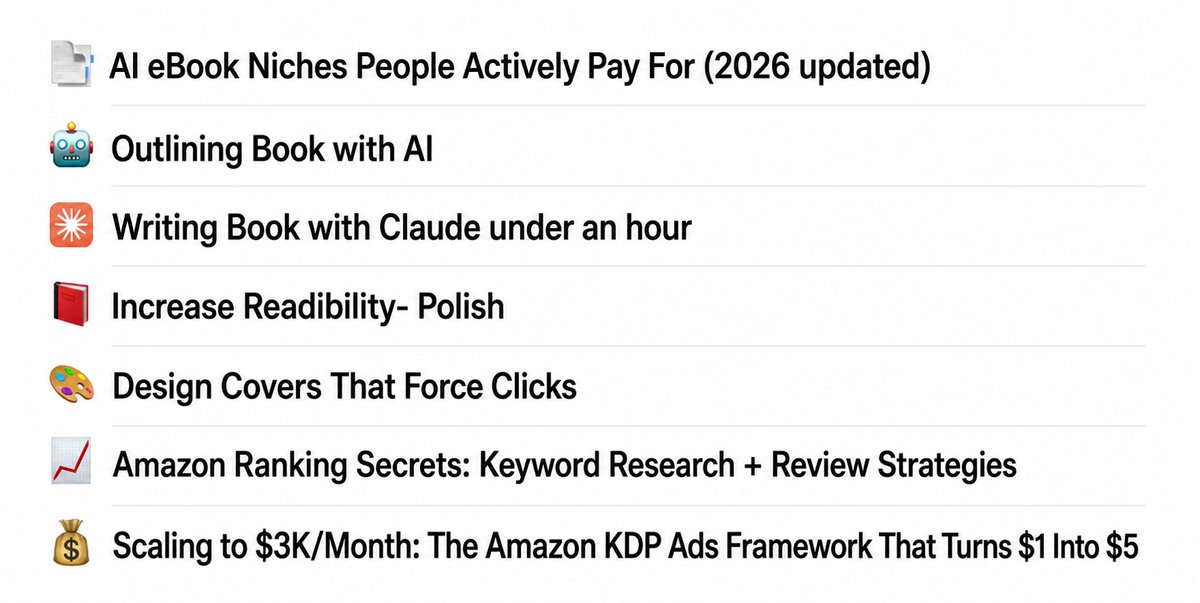
Repeat after me. AI eBooks are THE most reliable path to $10k a month in 2026. You can do it by simply working a few hours a week from anywhere in the world. Follow + reply 'Book' and I’ll send the full system for FREE ⏳ Limited to the first 500 comments.
Manu Sisti tweet media
English
251
46
165
23.9K
Founder Tribune retweetledi
Big Brain AI
Big Brain AI@realBigBrainAI·
Sam Altman reacts to Joe Rogan's wild idea of an AI president making every government decision:
English
6
9
19
4.5K
Founder Tribune retweetledi
Big Brain Business
Big Brain Business@BigBrainBizness·
Facebook VP of Growth Alex Schultz on the single most important metric for startups: Alex has advised multiple startups throughout his career, including Airbnb and Coursera. Across all of them, one pattern keeps repeating itself. "Retention is the single most important thing for growth." He explains how to measure it: "If you look at this curve, percent monthly active versus number of days from acquisition, if you end up with a retention curve that asymptotes to a line parallel to the x-axis, you have a viable business and you have product market fit for some subset of market." In other words: plot your monthly active users against the number of days since they signed up. If that curve eventually flattens out into a horizontal line, you've found product-market fit with at least one segment of users. If it doesn't flatten? Alex is blunt about what to do next: "Don't go and do growth tactics. Don't go and do virality. Don't hire a growth hacker. Focus on getting product market fit. If you don't have a great product, there's no point executing well on growing it because it won't grow." This is the trap Alex sees founders fall into again and again: "Number one problem I've seen inside Facebook for new products, number one problem I've seen for a startups I've advised has been they don't actually have product market fit when they think they do." The lesson? Before you spend a dollar on growth, look at your retention curve. If it's still trending toward zero, no amount of clever marketing will save the business. Fix the product first, then pour fuel on the fire.
English
4
18
36
4.5K
Founder Tribune retweetledi
Big Brain AI
Big Brain AI@realBigBrainAI·
Eric Schmidt, former CEO of Google: "The AI revolution is underhyped. None of us is prepared for the implications of this." He opens with a warning: "The arrival of this new intelligence will profoundly change our country and the world in ways we cannot fully understand." He explains what's happening right now in the industry: "We're very very quickly developing AI programmers. And these AI programmers will replace traditional software programmers. We're building in the next year AI mathematicians that are as good as the top level graduate students in math. This is happening very quickly." Schmidt argues most people fundamentally misunderstand what AI has become: "Today you think of AI as ChatGPT, but what it really is is a reasoning and planning system that we've never seen before." The implications, he warns, extend far beyond software. These new systems demand resources at an industrial scale we've never encountered. "They're going to need a lot more computation than we've ever had. They're going to need a lot more energy." To illustrate the scale of the energy crisis ahead, Schmidt offers a sobering comparison: "People are planning 10 gigawatt data centers. Now just to do the translation, an average nuclear power plant in the United States is 1 gigawatt. How many nuclear power plants can we make in one year where we're planning this 10 gigawatt data center? Gives you a sense of how big this crisis is." @ericschmidt shares an estimate he finds most likely: "Data centers will require an additional 29 gigawatts of power by 2027 and 67 more gigawatts by 2030. These things are industrial at a scale I have never seen in my life." Schmidt says the industry needs high skills immigration, light touch regulation around cyber and bio threats, and most critically, energy in all forms. He's personally investing in fusion, but acknowledges it won't arrive in time. He closes with the stakes: "When you build these systems, you have intelligence in the computer and then eventually human level intelligence. Some people think it's within 3 to four years. Then after that, you have something called super intelligence, the intelligence that's higher than of humans. We believe as an industry that this could occur within a decade. It is crucial that America get there first."
English
26
40
128
11.9K
Founder Tribune retweetledi
Big Brain Business
Big Brain Business@BigBrainBizness·
Elon Musk's boldest long-term bet yet: Tesla factories on the Moon by 2046.
English
4
19
96
6.6K
Founder Tribune retweetledi
Tommi Pedruzzi
Tommi Pedruzzi@TommiPedruzzi·
I’m convinced: Claude is the most powerful AI tool for making money right now. I shared my system with a banker, he's now making $60,000/year. I’ve compiled all my workflows I use into a 43-page PDF. Plus my personal prompts to help you start today. Free (for now). Like + Comment "Claude” I’ll send it to you. (Follow so I can DM) ⏳ Taking this down in 24 hours.
Tommi Pedruzzi tweet media
English
1.3K
108
1.4K
118.9K
Founder Tribune retweetledi
Big Brain AI
Big Brain AI@realBigBrainAI·
An interactive time-lapse of San Francisco parking activity, vibecoded by a random person on X, no engineering team required.
English
2
11
23
4.9K
Founder Tribune retweetledi
Big Brain Business
Big Brain Business@BigBrainBizness·
CorDx founder Aiiso Yufeng Li gave a stranger who painted his house 1% of his biotech company.
English
2
16
54
6K
Founder Tribune retweetledi
Big Brain AI
Big Brain AI@realBigBrainAI·
Meta's Chief AI Scientist Yann LeCun: building agentic systems on LLMs is a recipe for disaster.
English
130
171
878
168K
Founder Tribune retweetledi
Manu Sisti
Manu Sisti@Manu_Sisti·
I've never shared this before, but screw it. I'm finally sharing my Claude Cowork Workflows that makes me $50,000 per month selling eBooks. Like, RT and Comment ‘NEED’ & I’ll DM you the full guide for FREE. Follow me first so I can DM. FREE for 48 hours only.
English
384
222
455
35.1K
Founder Tribune retweetledi
Big Brain AI
Big Brain AI@realBigBrainAI·
Demis Hassabis, CEO of Google DeepMind, explains how young founders can build billion-dollar companies using AI tools the labs themselves haven't fully explored: He argues that the frontier of opportunity in AI is shifting away from building models and toward applying them. His advice to young founders: "You've got to just go with the flow of the direction. I would immerse myself in every tool available and just become almost like superpowered." Even at the frontier labs, the team can only scratch the surface of what's possible with their own technology. @demishassabis states: "So for us like Veo and Nano Banana and Gemini, even we can only explore a fraction of what the applied things you could do with it, the applications you could make with it." And the pace of new releases is making this even harder to keep up with: "I think that gap's getting bigger and bigger in terms of the overhang of the capabilities, all the cool stuff from the latest models, and the release schedules are getting faster and faster on that." This creates an enormous opening for outsiders willing to go deep on the tools. His conclusion is striking: "A kid these days could probably start a multi-billion dollar business in some ways using these tools in some new way that no one had thought about."
English
12
64
214
20.9K
Founder Tribune retweetledi
Big Brain Business
Big Brain Business@BigBrainBizness·
Mark Cuban on why critical thinking is the one skill AI can't replace in the future of jobs and business: He acknowledges that AI will displace workers, but he pushes back on the more extreme predictions about mass unemployment. "There's going to be displacement. There's no question about it. But I'm not one of those people that says jobs will be optional or 50% unemployment. No." He explains who's actually at risk: "Um there's things that if all you're doing is reformatting, you know, or you're answering a question yes or no, then you know you're there's a good chance you're going to be replaced by AI." But for those willing to think and adapt, Cuban sees a very different future: "If you're a critical thinker, you're there's always going to be a need for you. If you're critical thinker and you understand how to use the tools so that you understand where best to use an agent, where best not to use an agent, where best to do, you know, vibe coding, where best not to." @mcuban shared the same advice with his own daughter: "It's like I was telling my daughter, if you learn how to use these tools and you know how to think critically, you're curious, so you're always learning, you're always going to have a job because, as I said, AI doesn't know the consequences of its action."
English
10
16
46
7.8K
Founder Tribune retweetledi
Big Brain Business
Big Brain Business@BigBrainBizness·
The one interview question Steve Ballmer used at Microsoft to spot real problem solvers:
English
3
13
53
15.6K
Founder Tribune retweetledi
Big Brain Business
Big Brain Business@BigBrainBizness·
Mark Zuckerberg on the real reason he walked away from Yahoo's $1 billion offer for Facebook in 2006: Reflecting on the decision, Mark admits he didn't have the financial chops to properly debate the advisors who were laying out projections for him at the time. "I don't know at the time that I was sophisticated enough to do that analysis. I had all these people around me who were making all these arguments for how a billion dollars was…" So instead of trying to win the spreadsheet argument, he ran a different test on himself. "I sort of deep down believed in what we were doing and I did some analysis. I was like, 'Okay, well, what would I go do if I wasn't doing this?' It's like, 'Well, I really like building things and I like helping people communicate and I like understanding what's going on with people and the dynamics between people. So, I think if I sold this company, I'd just go build another company like this. And I kind of like the one I have.'" That simple thought experiment, if I sold this, I'd just rebuild the same thing, was enough to settle it. Mark then zooms out on what this decision taught him about big calls in general: "A lot of the biggest bets that people make are often just based on conviction and values. It's actually usually very hard to do the analyses trying to connect the dots forward."
English
3
22
89
31.5K