Fr. Harrison Ayre

34.5K posts

Fr. Harrison Ayre

Fr. Harrison Ayre

@FrHarrison

Pastor of St Peter's in Nanaimo, BC. Doctoral Candidate @MaryvaleInst. Amazon Wishlist for Doctoral Studies in the link. Co-host of Clerically Speaking

Nanaimo, British Columbia Katılım Kasım 2011
679 Takip Edilen36.4K Takipçiler
Sabitlenmiş Tweet
Fr. Harrison Ayre
Fr. Harrison Ayre@FrHarrison·
gonna post a thread of the Rivendell Lego set. Took a break for a while because doing Lego with a sling became too hard. so some of these are older. Fun way to keep track of progress
Fr. Harrison Ayre tweet mediaFr. Harrison Ayre tweet mediaFr. Harrison Ayre tweet mediaFr. Harrison Ayre tweet media
English
16
7
96
44.8K
Fr. Harrison Ayre
Fr. Harrison Ayre@FrHarrison·
@ShelleyBreaud that is amazing, in part because Fr. Champagne did my diaconal retreat! so maybe it's a graced insight from the connection all those years ago!
English
1
0
3
252
Fr. Harrison Ayre
Fr. Harrison Ayre@FrHarrison·
Just came up with the best name for a Catholic food truck. Friar Truck
English
108
65
1.4K
25.8K
Ed
Ed@MyDailyCross·
@FrHarrison Should that not be Fryer Truck
English
4
0
23
360
Fr. Harrison Ayre retweetledi
they/them might be giants ☭
they/them might be giants ☭@babadookspinoza·
I guarantee you’re a better writer than ChatGPT. Never butcher your own writing or relinquish your own voice to put your name on the dead-eyed, mechanical hallucinations of a bunch of 1s and 0s. People who know good writing and AI have no trouble recognizing AI-generated garbage.
English
20
746
3.7K
112K
Fr. Harrison Ayre
Fr. Harrison Ayre@FrHarrison·
@SimonSimplicio @agostino_harry Blondel actually came to love Thomas later in life. He was fed up with the manualists. But when he read Thomas later in his career, he devoured him and loved his philosophy and found it to be in line with his thought.
English
2
0
3
78
Simple
Simple@SimonSimplicio·
@agostino_harry And for that reason I'm sort of contractually obliged to take digs at Thomism even if I still have some fondness for it.
English
1
0
2
72
Simple
Simple@SimonSimplicio·
Blondel has been called "the philosopher or Vatican II." He influenced virtually every important 20th century Catholic theologian. Wojtyla, Rahner, De Lubac, Von Balthasar. The encyclical 'Fides et Ratio' bears a Blondelian imprint, and not a Thomistic one.
Enzo Stilianidi@enzo_stilianidi

@SimonSimplicio To a greater or lesser extent, much of contemporary Catholic thought has passed through the horizon opened by Blondel. Gregory Baum speaks of a “Blondelian turn” in Catholic theology. Meanwhile, Lagrange only retains influence within circles of neo-scholastic nostalgists.

English
4
1
36
2.5K
Fr. Harrison Ayre
Fr. Harrison Ayre@FrHarrison·
what makes this movie interesting to me is the meeting of modern form and ancient substance. whether nolan pulls it off is another question. he doesnt in every film.
English
2
0
3
422
Fr. Harrison Ayre
Fr. Harrison Ayre@FrHarrison·
this fundamentally misunderstands Nolan. Because it approaches myth as form, but does not get myth in substance. Myth attends to man searching to pierce the limits of the immanent frame, and fail. That is thematic to Nolan’s films. It is myth in modern form, ancient in substance.
Alain Astruc@alainastruc

I think I finally understand what is wrong with Nolan: his universe is adverse to myth. It is made entirely of causality, and causality alone. He may be the most gifted filmmaker working in big-budget Hollywood today. But he is going to crash on myth the way sailors crashed on the rocks below the Sirens. When I criticized the teaser, I was told: wait for the trailer. When I criticized the trailer, I was told: wait for the film. Then I read the two-hour interview Nolan gave to Time Magazine, and something clicked. The tell is in a detail Nolan offers with obvious pride. He found a solution to what he saw as a narrative problem: why would the Trojans believe the horse was empty and drag it inside their city? His answer is to make the horse half-submerged, sinking into the sea, so the Trojans would rescue it rather than accept it as a gift. It is a solution to a problem that never was one because it is a myth. The Trojans bring the horse inside because it is a gift and it has wheels. The poet tells you something plainly impossible with the same tone he uses to describe the sunrise, and in doing so he is signaling that the level of reality goes beyond mere causality and exists on other levels. He is the kind of guy who would explain that Santa can fit through the chimney because he designed it wide enough from the start, using proper construction methods and reliable materials. And then explain how the reindeer are fed to sustain that much effort in a single night, and how Santa elaborated a clever logistics route to deliver all the gifts on time. Watch him justify the armor despite its fantastical look, or explain the absence of orchestra because there was no orchestra in Ancient Greece. There were no IMAX cameras either, Christopher. A simple authorial act would have sufficed: because I like it better that way. That honesty might have opened a door out of causality. This narrative prison is precisely why people eventually seek out avant-garde and experimental cinema, why they feel something release when causality finally breaks. Because causality is already the weight of our ordinary lives. As long as Nolan stayed away from myth, his causal world of mirrors and clever tricks and puzzles worked beautifully, sometimes brilliantly. But this is something else. This is the gut of myth. This is the Dionysian spirit of mud and blood and the salt of the sea. This is the beautiful lie that makes you erupt with sacred joy.

English
1
2
12
1.7K
Fr. Harrison Ayre
Fr. Harrison Ayre@FrHarrison·
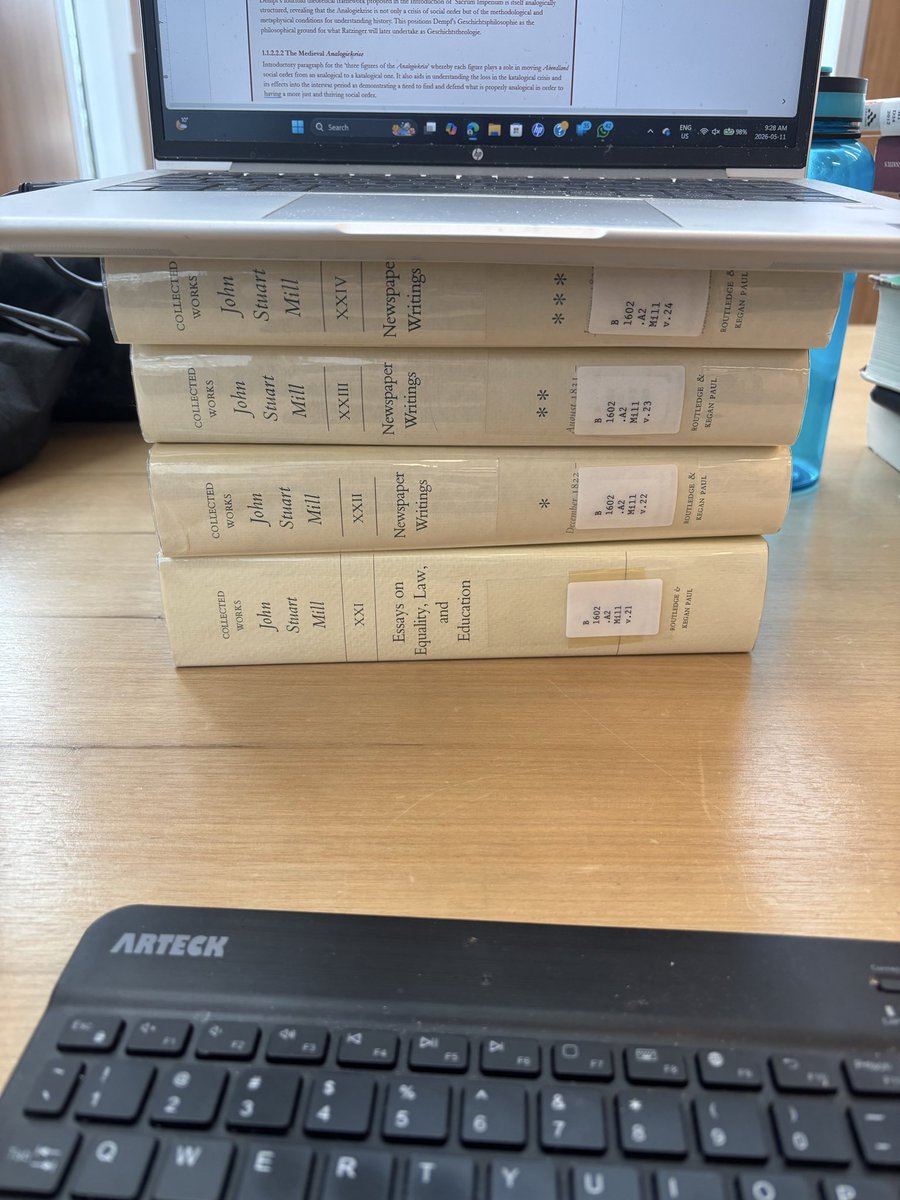
John Stuart Mill was all about utility after all…
Fr. Harrison Ayre tweet media
English
2
0
30
975
Fr. Harrison Ayre retweetledi
Darshak Rana ⚡️
Darshak Rana ⚡️@thedarshakrana·
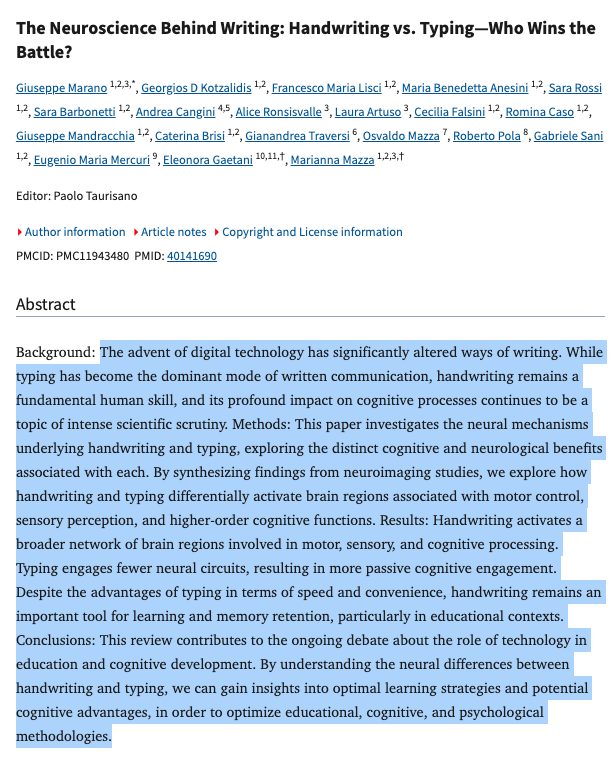
Your brain physically rewrites itself every time you pick up a pen. Neuroscientists at Norwegian University scanned students' brains while they handwrote letters versus typing the same letters on a keyboard. The results shattered decades of assumptions about how we process information. Handwriting activated massive networks in the sensorimotor cortex, the visual processing centers, and the hippocampus simultaneously. Complex neural symphonies lit up across multiple brain regions, creating rich interconnected pathways between motor control, visual recognition, and memory formation. Typing the same letters? The brain activity looked like someone had dimmed the lights across entire cognitive districts. The neural networks that flourished during handwriting simply went dark. The difference? When you form letters by hand, your brain constructs elaborate spatial maps of each character. The motor cortex learns the precise pressure, angle, and trajectory needed to create an 'A' versus a 'B.' Your visual system tracks the ink flowing from pen to paper in real time. Your parietal lobe integrates hand position with eye movement. Your hippocampus encodes not just what you wrote, but how the writing felt, where you paused, which words required more pressure. Typing activates almost none of that circuitry. You press a key, a letter appears. The motor movement is binary. The visual feedback is uniform. The spatial relationship between thought and symbol gets mediated by a machine that standardizes every character into identical fonts and spacing. Your brain treats these as fundamentally different cognitive tasks. The evolutionary context makes this obvious once you see it. Human hands developed for manipulation, creation, and fine motor control over millions of years. We painted on cave walls, carved bone tools, and shaped clay vessels long before we invented written language. When writing emerged 5,000 years ago, it built on top of existing neural infrastructure that already connected hand movement with symbolic thinking. Keyboards appeared 150 years ago. Touchscreen typing maybe 20 years ago. From an evolutionary timeline perspective, we started using them approximately yesterday. Our brains are still running ancient software that expects physical engagement with symbols. That software produces dramatically different learning outcomes. Students who take handwritten notes consistently outperform students who type the same information on memory tests, comprehension assessments, and creative applications of the material. The difference persists even when researchers account for typing speed, note length, and time spent studying. The act of forming letters by hand forces deeper processing at the moment of information encounter. You cannot handwrite as fast as someone speaks, so your brain must actively filter, summarize, and prioritize information in real time. The motor effort required to form each word creates additional memory traces that typing does not generate. Children who learn to write letters by hand develop reading skills faster than children who learn letters primarily through typing or screen interaction. The sensorimotor experience of creating letterforms helps their brains recognize those same letterforms when they encounter them in text. Adults who handwrite shopping lists, daily schedules, or meeting notes remember the information better than adults who type identical lists into phones or computers. The spatial memory of where you wrote something on a page provides retrieval cues that digital text does not offer. These findings collide directly with how education and work environments have evolved over the past two decades. Schools replaced handwriting instruction with typing classes. Offices converted from paper systems to fully digital workflows. Students take notes on laptops. Professionals draft documents on screens. We optimized for speed and efficiency while accidentally severing the neural pathways that evolution spent millions of years developing. The implications reach beyond memory and learning into fundamental questions about human cognition. If the physical act of forming symbols changes how your brain processes ideas, what happens to thinking itself when you remove the physical component? Digital text is infinitely searchable, instantly editable, and perfectly shareable. But it may be creating brains that process information more superficially, store memories less durably, and connect ideas more weakly than brains that regularly engage in handwriting. The neuroscience suggests we traded cognitive depth for technological convenience without realizing what we were giving up. Some of the most innovative thinkers across history were obsessive handwriters. Darwin kept detailed handwritten journals. Einstein worked through complex theories in handwritten notebooks. Virginia Woolf wrote her novels by hand before transcribing them. Steve Jobs famously took handwritten notes during Apple meetings even as he was building the most advanced computers on Earth. Perhaps they intuited something about the relationship between hand, brain, and insight that we measured in brain scanners but somehow forgot in practice. Your pen is literally a cognitive enhancement device that activates neural networks digital keyboards cannot reach.
Darshak Rana ⚡️ tweet media
English
101
1.4K
4.2K
169.9K
Fr. Harrison Ayre
Fr. Harrison Ayre@FrHarrison·
I am editing chapter 3. I realized I over did it on biography of Dempf. like…by 15-20 pages. I went through 5 minutes of “but I worked so hard on this” then came to and am ok with cutting (pending supervisors thumbs up obviously)
English
3
0
5
801