Frax Force

1.2K posts

Frax Force banner
Frax Force

Frax Force

@FraxForce

The social engine of @fraxfinance.

Fraxtal Katılım Eylül 2025
252 Takip Edilen420 Takipçiler
Sabitlenmiş Tweet
Frax Force
Frax Force@FraxForce·
The Summer interview with @samkazemian is live. @Bjirke sat down with Sam to talk leadership, hard lessons from a decade in crypto, and where he sees the market heading into 2027. An interesting look into the thinking behind @Frax / @fraxfinance. 1:09 – How He Became a Leader 8:12 – The Korean Air Crash Lesson 22:41 – "Cockroaching" Through the Bear Market 28:50 – Crypto's Next Step Function 45:40 – Diamond Hands will win
English
4
12
35
2.7K
ether.fi
ether.fi@ether_fi·
Introducing custom Affiliate Cards. You can now design your own EtherFi Cash card from scratch. Let your creativity go wild and make a card that’s uniquely yours. Apply below ↓
English
31
12
192
24.9K
Frax Force
Frax Force@FraxForce·
📡The new @Fraxfinance bi-weekly update just hit our radar... and it’s loaded! Some Highlights: ¤ $frxUSD keeps cementing itself as a default DeFi stablecoin, from @Alto_money’s DUSD ecosystem to white-label solutions like @Somnia_Network’s USDso, @Soniclabs USSD, and expanding frxUSD.B liquidity across @CantonNetwork. ¤ Governance moved decisively: FPI is being wound down so resources can focus on higher-demand products like frxUSD / sfrxUSD, and 42k wFRAX was approved for the @Echo_Market creator & distribution program to scale the Frax content flywheel. ¤ On the integrations side, frxUSD is now at the center of more yield and liquidity routes: PegKeeper pools doing $200M+ volume in June, new USD3/frxUSD and VUSD/frxUSD pools, Aave V4 and Beefy vaults, Hydrex “Forex with Frax,” plus routing spotlights from Odos and others. ¤ Infra keeps get shipped: FraxNet state machine upgrades, SimpleRedeem for T+1 redemptions, improved OFT rate limits and multichain routing, Solana bridging prep, and even a DeFi credit-card module in the works. We’re also proud that Frax Force shows up multiple times in this cycle, from our long-form sit-down with Sam, to coverage across the broader ecosystem and macro backdrop with our ONCHAIN CA$H show. We remain bullish on FRAX 📰🐂
Frax Force tweet media
English
2
3
19
349
Frax Force retweetledi
captnhayz ¤
captnhayz ¤@captnhayz·
Imagine having a token completely aligned to the underlying business in the most promising market adopting wise. ethereum:0x3432b6a60d23ca0dfca7761b7ab56459d9c964d0 is the vehicle to capture all value coming from the product/rails and overall infrastructure 📈 As an investor, market participant or whatever you wanna call it ,if you see a team creating their own PMF over a long period of time while maintaining the overall vision then you should pay closer attention 👀
Frax@Frax

Source: theblock.co/post/407988/sb… ¤ Frax take: We see enormous potential in Japan and Frax will be at @WebX_Asia in Tokyo this week to meet with partners.

English
0
3
21
1.8K
Frax Force retweetledi
Frax Finance ¤⛓️¤
Frax Finance ¤⛓️¤@fraxfinance·
Welcome to the Forex with Frax family, @TetraDigitalGrp base:0x16f93ebc5320c89efc8701577efe49d14a276a06 🇨🇦 frxUSD continues to expand its FX pairs globally, as the most trusted and productive stablecoin for liquidity.
Hydrex@HydrexFi

[RWA Day 13/31: CADD] ██████░░░░░░░░░░░░░░░ $CADD from @TetraDigitalGrp is live on Hydrex as part of Forex with @fraxfinance. Stake & earn with the Canadian Dollar stablecoin now.

English
7
4
40
5.6K
Diphunter ¤
Diphunter ¤@Diphunter18·
Looking back, the Curve Wars were probably one of the most fascinating governance battles DeFi has ever seen. Ironically, they were never planned. Curve simply wanted a better way to distribute liquidity incentives. But once veCRV holders gained the ability to decide where CRV emissions flowed, governance stopped being just a voting mechanism. It became a way to influence where liquidity across DeFi would grow. That changed everything. At the center of the Curve Wars was a surprisingly simple idea. If your protocol could direct more CRV emissions toward its own liquidity pools, those pools became more attractive for LPs. More liquidity meant lower slippage. Lower slippage attracted more trading volume. More volume generated more fees. In other words, controlling Gauge votes meant influencing where capital naturally accumulated. For stablecoin protocols especially, this was incredibly valuable. Deep liquidity wasn't just a nice feature. It was part of the product itself. Without liquid markets, maintaining adoption and confidence became significantly harder. That's why the Curve Wars weren't really about CRV. They were about liquidity. The first major protocol to recognize this was @yearnfi. Through its Backscratcher vault, Yearn began aggregating user CRV, locking it as veCRV and using that collective voting power to strengthen its own Curve strategies. Not long after, @StakeDAOHQ entered with a very similar vision. Both protocols competed to attract CRV deposits because more locked CRV meant more influence over Gauge votes. For the first time, governance itself had become something protocols actively competed to accumulate. Then came the real turning point. @ConvexFinance didn't simply compete for veCRV. It completely changed how the game was played. Instead of asking every user to lock CRV for up to four years and participate in governance themselves, Convex aggregated that entire process. Users deposited CRV. Convex permanently locked it. In return, users received cvxCRV while Convex accumulated an ever-growing share of the protocol's veCRV voting power. Within a remarkably short period, Convex became the dominant force in Curve governance, fundamentally shifting the balance of power away from individual participants and toward governance aggregators. As Curve became the primary liquidity venue for many stable assets, more protocols realized that governance wasn't optional anymore. It had become strategic infrastructure. @fraxfinance was one of the clearest examples. Rather than viewing Curve simply as another DEX, Frax treated access to Curve liquidity as a core component of its stablecoin strategy. Over time, it accumulated significant influence through the broader Curve ecosystem while consistently competing for Gauge votes to strengthen FRAX liquidity. As competition intensified, another innovation emerged. Protocols no longer needed to accumulate all the voting power themselves. Instead, they could directly incentivize existing voters. If a protocol wanted more emissions for its pool, it simply offered additional rewards to whoever voted in its favor. These became known as bribes. Despite the name, they weren't hidden deals. They were transparent, on-chain incentive markets where governance attention itself became something protocols could compete for. Platforms like @VotiumProtocol made this process significantly more efficient by connecting protocols seeking liquidity with holders controlling voting power. Looking back, the Curve Wars were never really about winning governance. They were about winning liquidity. Curve accidentally created a market where voting power could influence capital allocation, and once that happened, governance itself became an economic asset. What started as a mechanism for distributing CRV emissions evolved into one of the most influential coordination systems DeFi has ever seen.
Diphunter ¤ tweet media
Diphunter ¤@Diphunter18

In the previous post, we explored how $veCRV transformed governance by rewarding long-term commitment instead of short-term ownership. But once voting power existed, a much bigger question emerged. What exactly should that voting power control? At first, the obvious answer would have been protocol governance. Voting on upgrades. Voting on parameters. Voting on administrative decisions. @CurveFinance certainly supports those forms of governance, but they were never the most important use of veCRV. Instead, Curve used governance to solve an entirely different problem, How should new liquidity incentives be distributed? Every protocol that distributes token emissions faces the same challenge. Should every liquidity pool receive the same rewards? Probably not. Should rewards be decided by a small group of developers? That would create centralization. Should emissions simply follow TVL? That would reinforce existing capital instead of responding to changing market demand. Curve chose a different approach. Rather than hardcoding where $CRV emissions should go, it delegated that decision to veCRV holders. This is where Gauges enter the picture. A Gauge is a mechanism that tracks liquidity for a specific pool and determines how many CRV emissions that pool is eligible to receive. Not every pool receives the same allocation. Instead, each Gauge competes for a share of the protocol's weekly CRV emissions. The distribution depends on Gauge Weight. Gauge Weight is determined through voting by veCRV holders. If more voting power is directed toward a particular Gauge, a larger share of future CRV emissions flows to that pool. If fewer votes are allocated, emissions gradually decrease. This changes the role of governance entirely. veCRV holders are no longer deciding abstract protocol parameters. They are deciding where the protocol directs its economic incentives. That distinction is incredibly important. This creates what is often referred to as a flywheel effect. When a pool receives higher CRV emissions, providing liquidity to that pool becomes more attractive. As more liquidity enters, trading conditions improve. Deeper liquidity reduces slippage. Lower slippage attracts more trading volume. Higher trading volume generates more fees. Those fees make the pool even more attractive for liquidity providers. What begins as a governance vote eventually influences the entire economic activity of the protocol. Curve therefore doesn't allocate liquidity directly. It allocates incentives. The market then responds to those incentives. This creates a feedback mechanism between governance, emissions, liquidity and trading activity. Instead of relying on a centralized team to decide which markets deserve support, Curve allows that decision to evolve continuously through the collective preferences of veCRV holders. In many ways, Gauges became the bridge between governance and liquidity. Without them, veCRV would simply be another governance token with voting rights. With them, governance gained direct influence over the distribution of capital across the protocol. And that single mechanism proved to be far more valuable than many people initially realized. Because once controlling Gauge votes meant controlling liquidity, voting power itself became a scarce economic resource. Protocols no longer wanted veCRV merely to participate in governance. They wanted it to direct liquidity toward their own markets. That realization marked the beginning of one of the most fascinating competitive dynamics in DeFi history. The Curve Wars.

English
8
16
81
12.6K
Charmander
Charmander@CharmanderX81·
Here's my full Market Memo from this week's ONCHAIN CA$H 📊 Markets continued to trade largely within the ranges we've been tracking, with ETH holding key support while FRAX remained inside its current consolidation structure. Sharing the full breakdown for anyone who missed the live show👇
Frax Force@FraxForce

💲ONCHAIN CA$H — 6pm UTC💲 Our sections are loaded for tonight's live show: ¤ Onchain Pulse: @CoinGecko chart shows where stablecoin gravity really sits across top EVM chains, with only a small slice of tokenized equities actually active in DeFi. ¤ Market Briefing: @Ripple secures a full MiCA CASP license, @Circle gets an OCC trust bank charter for USDC. Europe pushes for cash + digital euro to be accepted everywhere. @Aave's stable vaults went live, while @StaniKulechov says: DeFi must become “the backbone financial infrastructure”. ¤ Rumors / FUD: Did @Robinhood’s “memes too” comment risks their RWA narrative? While the failed absolute majority against Chat Control raises new questions about how much privacy users can realistically expect in Europe. We will sort through what is real structural risk. ¤ @Fraxfinance Ecosystem Update Frax’s quarterly report is expected to be released soon, While @samkazemian appeared twice on podcasts this week. $frxUSD is already in real‑world use via @Ether_fi, with users earning cashbacks on everyday spend. ¤ DeFi Yield Radar @llamalend lets you use $sfrxUSD as collateral, keep earning yield on it, and borrow $crvUSD at a slightly negative rate so your debt slowly pays itself. ¤ @CharmanderX81 Corner – Live Market TA ¤ MORE ☎️ Big week onchain with regulation, infra shifts, FUD and new yield primitives. See you in 30mins, here on X.

English
1
0
8
432
Frax Force
Frax Force@FraxForce·
💲ONCHAIN CA$H — 6pm UTC💲 Our sections are loaded for tonight's live show: ¤ Onchain Pulse: @CoinGecko chart shows where stablecoin gravity really sits across top EVM chains, with only a small slice of tokenized equities actually active in DeFi. ¤ Market Briefing: @Ripple secures a full MiCA CASP license, @Circle gets an OCC trust bank charter for USDC. Europe pushes for cash + digital euro to be accepted everywhere. @Aave's stable vaults went live, while @StaniKulechov says: DeFi must become “the backbone financial infrastructure”. ¤ Rumors / FUD: Did @Robinhood’s “memes too” comment risks their RWA narrative? While the failed absolute majority against Chat Control raises new questions about how much privacy users can realistically expect in Europe. We will sort through what is real structural risk. ¤ @Fraxfinance Ecosystem Update Frax’s quarterly report is expected to be released soon, While @samkazemian appeared twice on podcasts this week. $frxUSD is already in real‑world use via @Ether_fi, with users earning cashbacks on everyday spend. ¤ DeFi Yield Radar @llamalend lets you use $sfrxUSD as collateral, keep earning yield on it, and borrow $crvUSD at a slightly negative rate so your debt slowly pays itself. ¤ @CharmanderX81 Corner – Live Market TA ¤ MORE ☎️ Big week onchain with regulation, infra shifts, FUD and new yield primitives. See you in 30mins, here on X.
English
2
4
18
1.2K
Frax Force
Frax Force@FraxForce·
When company payrolls, supplier invoices, consumer subscriptions and retail payments finally move onchain, everything changes. We believe that right now, the music isn’t even really playing yet. People look at today’s numbers and forget how fast it changes once banks and fintechs start bringing their everyday payments onchain. While offering customers better rails for their daily spending/earning, with real benefits on both sides. If you believe that future is coming, you can’t wait for the crowd to catch up, you have to understand things before the masses do. Study the rails now so that when Real-world throughput moves onchain, you’re already positioned where the money settles, and able to participate in the growth. ¤ @FraxFinance
Frax Force tweet media
English
1
3
18
861
Frax Force retweetledi
Frax Finance ¤⛓️¤
Frax Finance ¤⛓️¤@fraxfinance·
Don’t miss this pod. Full circle as @defidave, former host of the Flywheel podcast, sits down again with our founder and CEO @samkazemian, alongside @patfscott. Fully Vested is brought to you by @DefiLlama. We’ll be working more closely with them in the future, so stay tuned.
Fully Vested Podcast by DefiLlama@FullyVested_Pod

On the newest episode of the Fully Vested Pod by DefiLlama, @samkazemian, Founder & CEO of @fraxfinance, joined us to talk building in DeFi, the token vs equity debate, and what Frax is building next. 0:00 Intro 2:57 Frax's Longevity & the Business of Stablecoins 7:26 Prediction Markets 10:24 Token Equity Splits 26:25 Clarity Act and if it Matters 27:12 Why Crypto is Underperforming 32:03 Frax's Upcoming Partnerships & Initiatives

English
18
12
75
9.6K
Diphunter ¤
Diphunter ¤@Diphunter18·
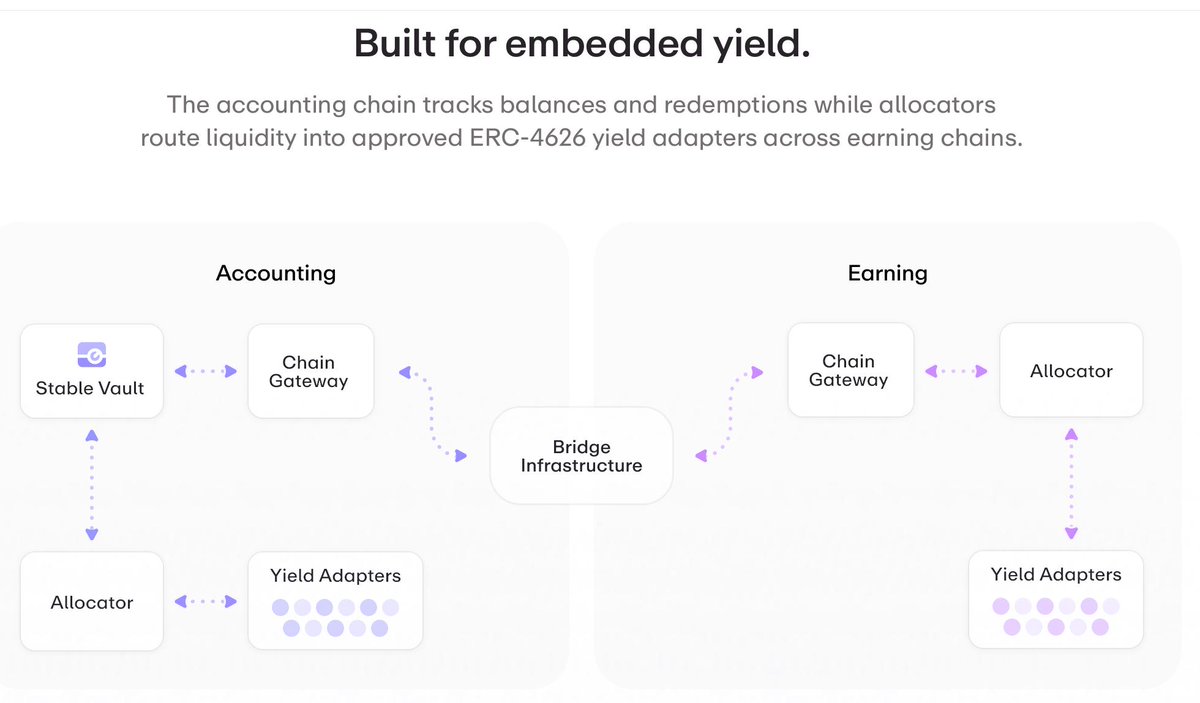
One thing I really like about @aave's new Stable Vaults is that they solve one of the biggest problems that's been holding real-world adoption back. For years, if you wanted to build a savings product on top of DeFi, you had to deal with variable yields, fragmented liquidity across chains, constant rebalancing, bridging, treasury management... and somehow still deliver a simple experience to your users. That's a lot of complexity for something that should feel as easy as opening a savings account. Stable Vaults abstract most of that away. Instead of every fintech, wallet or exchange building its own yield infrastructure, they can choose the assets they want to support, plug into Aave (or any ERC-4626 strategy), offer a fixed yield to users, and let the vault handle the operational side. I think that's the real story here. Consumers don't care whether their yield comes from Ethereum, Base, Arbitrum or somewhere else. They don't want to watch APYs fluctuate every day either. They want predictable returns and a product they can trust. Under the hood, integrations like @chainlink CCIP and Price Feeds help make that cross-chain experience and pricing reliable, while remaining invisible to the end user. For builders, predictability is just as important. Being able to define your own fixed rate while keeping the spread as revenue creates a much more sustainable business model than simply exposing users to raw on-chain rates. To me, this feels like the infrastructure that makes it easier for traditional fintech UX and on-chain finance to finally meet in the middle. That's exactly the kind of tooling the ecosystem needs if we want DeFi to reach the next millions of users and billions in capital. Curious to see what ambitious builders will ship with it.
Diphunter ¤ tweet mediaDiphunter ¤ tweet media
Aave@aave

Introducing Stable Vaults, an all-in-one solution for embedding fixed-rate stablecoin yield into any financial product.

English
2
2
24
2.4K
Frax Force
Frax Force@FraxForce·
The Summer interview with @samkazemian is live. @Bjirke sat down with Sam to talk leadership, hard lessons from a decade in crypto, and where he sees the market heading into 2027. An interesting look into the thinking behind @Frax / @fraxfinance. 1:09 – How He Became a Leader 8:12 – The Korean Air Crash Lesson 22:41 – "Cockroaching" Through the Bear Market 28:50 – Crypto's Next Step Function 45:40 – Diamond Hands will win
English
4
12
35
2.7K
jenny.frax
jenny.frax@JennyFrax·
long-term thinking, true leadership, and the courage to navigate difficult times - these are the conversations that move a community forward ⚔️ it’s well worth a listen if you’re interested in the long-term vision 🔥👇
Frax Force@FraxForce

The Summer interview with @samkazemian is live. @Bjirke sat down with Sam to talk leadership, hard lessons from a decade in crypto, and where he sees the market heading into 2027. An interesting look into the thinking behind @Frax / @fraxfinance. 1:09 – How He Became a Leader 8:12 – The Korean Air Crash Lesson 22:41 – "Cockroaching" Through the Bear Market 28:50 – Crypto's Next Step Function 45:40 – Diamond Hands will win

English
1
0
5
153
Frax Force
Frax Force@FraxForce·
We at FraxForce are extremely bullish on the Frax team and how they operate, that's exactly why we're even more driven to build our part of it, block by block. Missed the last episode with Sam? Must watch: x.com/FraxFeed/statu…
FraxFeed@FraxFeed

The Christmas interview with @samkazemian is live. Listen to Sam talk about lessons from when he was a child, how he found his values and what is important in his life. A interesting view into the thoughts that helped form @Frax / @fraxfinance. Thank you again for a great conversation! Already looking forward to the next one.

English
0
1
15
287