Tex 👾🐸

21K posts

Tex 👾🐸 banner
Tex 👾🐸

Tex 👾🐸

@FreakinFrick

Architect. Just an Egg. Technomancer.

USA 🇺🇸 Katılım Aralık 2011
2.3K Takip Edilen2.1K Takipçiler
𓈎 𓄿 𓃭 𓅱 𓋴
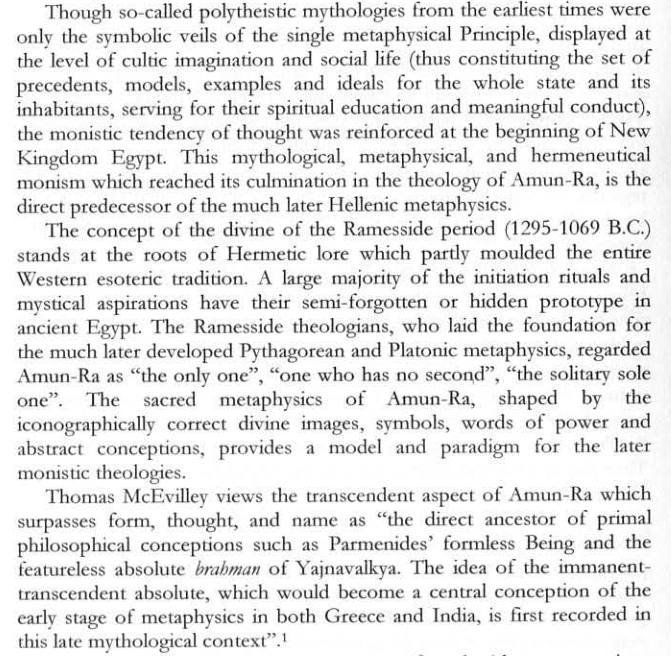
The concept of the divine of the Ramesside period (1295-1069 B.C.) stands at the roots of Hermetic lore which partly molded the entire Western esoteric tradition.
𓈎 𓄿 𓃭 𓅱 𓋴 tweet media𓈎 𓄿 𓃭 𓅱 𓋴 tweet media
English
16
133
2.1K
554.1K
Christopher Hale
Christopher Hale@ChristopherHale·
NEW: MAGA evangelical leaders gather in Mar-a-Lago to bless and dedicate a gold statue dedicate to Donald Trump.
English
12.5K
5.1K
20.6K
27.8M
Not Op Cue
Not Op Cue@NotOpCue·
@Fristad85 @nypost @jakobforssmed @lakaruppropet1 I will only take the Hantavirus vaccine if public military tribunals happen first for everyone involved in the COVID plandemic, the COVID mRNA bioweapons, the stolen 2020 election, chemtrails, Epstein clients and a long list of elites that gotta go.
English
2
2
24
507
New York Post
New York Post@nypost·
23 hantavirus cruise passengers returned home to 'all corners,' including to the US - and one is already sick trib.al/4yZ9lID
New York Post tweet media
English
753
1.3K
8.2K
2.6M
Janice Huffer
Janice Huffer@JanSews·
@KaceeRAllen Who is that ghastly figure. An AOC representation? Trump has better taste than that!
English
1
0
0
600
Kacee Allen
Kacee Allen@KaceeRAllen·
I’ll never be able to unsee this.
Kacee Allen tweet media
English
11
43
119
32.2K
kaios
kaios@kaiostephens·
Introducing ⭐Carnice-27b!⭐ an open-source model designed for Hermes-Agent that can run on a single 3090. Carnic-27b is a fine-tuned model of Qwen3.5-27b to perform well in the hermes-agent harness Download it here! huggingface.co/kai-os/Carnice… Huge thanks to @Teknium, @NousResearch, @TheZachMueller, @LambdaAPI
kaios tweet media
kaios@kaiostephens

Welcome ⭐Carnice-9b!⭐ - a model for Hermes-Agent Carnice-9b is a fine-tuned version of Qwen3.5-9b to preform exceptionally well in the hermes-agent harness. This model is meant to fit onto consumer GPU's all the way down to 6gb (Q4_K_M), but recommended to run in ~12-16gb cards. Try it out. Any feedback is appreciated, feel free to DM me! huggingface.co/kai-os/Carnice… This would not have been possible without the help from @LambdaAPI, @NousResearch ,@TheZachMueller, @Teknium Look out for Carnice-27b soon! 👀

English
35
25
279
37.9K
Corey Ganim
Corey Ganim@coreyganim·
How to turn this into money: 1. Build yours first. Follow Nick's steps. Get the system running for your own business. Takes a weekend. 2. Offer "Second Brain Setup" as a productized service. $1,500-3,000 per client. You build their knowledge base, configure the schema, load their existing data, and hand them back an organized system. 3. Target agencies and consultants. They have years of client data, research, proposals, and call transcripts scattered everywhere. This solves a problem they complain about constantly. 4. Add a monthly retainer ($300-500/mo). New data gets ingested, wiki stays updated, monthly health checks catch errors before they compound. 5. Bundle it with training. Charge an extra $500 to teach their team how to ask questions against the knowledge base and save answers back. One client = $2,000 setup + $400/mo recurring. Ten clients = $56,800 in year one. From a system you built for yourself in a weekend. The playbook is always the same: build it for yourself, prove it works, sell it to people who want the same result but don't want to do the setup.
Nick Spisak@NickSpisak_

Made an updated version this weekend Here's how you do it (raw notes) > Grab @karpathy's latest gist (in the first comment) > Download @steipete summarize CLI > Download yt-dlp > Download obsidian > Download @tobi qmd --> Setup a node or Golang CLI called "brain" --> Have it index all your youtube data, AI agent data (jsonl files) --> Get your X data by requesting an archive in your settings --> Setup vaults for each domain/topic area --> Ask questions with your agent and qmd


English
10
42
540
74K
Tex 👾🐸 retweetledi
Mark Gadala-Maria
Mark Gadala-Maria@markgadala·
AI has gone too far. Harry Potter "6 7" platform. Credit: Unhindered Studios
English
740
3.8K
31.8K
4.4M
Andrej Karpathy
Andrej Karpathy@karpathy·
LLM Knowledge Bases Something I'm finding very useful recently: using LLMs to build personal knowledge bases for various topics of research interest. In this way, a large fraction of my recent token throughput is going less into manipulating code, and more into manipulating knowledge (stored as markdown and images). The latest LLMs are quite good at it. So: Data ingest: I index source documents (articles, papers, repos, datasets, images, etc.) into a raw/ directory, then I use an LLM to incrementally "compile" a wiki, which is just a collection of .md files in a directory structure. The wiki includes summaries of all the data in raw/, backlinks, and then it categorizes data into concepts, writes articles for them, and links them all. To convert web articles into .md files I like to use the Obsidian Web Clipper extension, and then I also use a hotkey to download all the related images to local so that my LLM can easily reference them. IDE: I use Obsidian as the IDE "frontend" where I can view the raw data, the the compiled wiki, and the derived visualizations. Important to note that the LLM writes and maintains all of the data of the wiki, I rarely touch it directly. I've played with a few Obsidian plugins to render and view data in other ways (e.g. Marp for slides). Q&A: Where things get interesting is that once your wiki is big enough (e.g. mine on some recent research is ~100 articles and ~400K words), you can ask your LLM agent all kinds of complex questions against the wiki, and it will go off, research the answers, etc. I thought I had to reach for fancy RAG, but the LLM has been pretty good about auto-maintaining index files and brief summaries of all the documents and it reads all the important related data fairly easily at this ~small scale. Output: Instead of getting answers in text/terminal, I like to have it render markdown files for me, or slide shows (Marp format), or matplotlib images, all of which I then view again in Obsidian. You can imagine many other visual output formats depending on the query. Often, I end up "filing" the outputs back into the wiki to enhance it for further queries. So my own explorations and queries always "add up" in the knowledge base. Linting: I've run some LLM "health checks" over the wiki to e.g. find inconsistent data, impute missing data (with web searchers), find interesting connections for new article candidates, etc., to incrementally clean up the wiki and enhance its overall data integrity. The LLMs are quite good at suggesting further questions to ask and look into. Extra tools: I find myself developing additional tools to process the data, e.g. I vibe coded a small and naive search engine over the wiki, which I both use directly (in a web ui), but more often I want to hand it off to an LLM via CLI as a tool for larger queries. Further explorations: As the repo grows, the natural desire is to also think about synthetic data generation + finetuning to have your LLM "know" the data in its weights instead of just context windows. TLDR: raw data from a given number of sources is collected, then compiled by an LLM into a .md wiki, then operated on by various CLIs by the LLM to do Q&A and to incrementally enhance the wiki, and all of it viewable in Obsidian. You rarely ever write or edit the wiki manually, it's the domain of the LLM. I think there is room here for an incredible new product instead of a hacky collection of scripts.

English
2.9K
7.2K
59.2K
21.2M
Tex 👾🐸
Tex 👾🐸@FreakinFrick·
The convergence is real. @karpathy x.com/freakinfrick/s…
Andrej Karpathy@karpathy

LLM Knowledge Bases Something I'm finding very useful recently: using LLMs to build personal knowledge bases for various topics of research interest. In this way, a large fraction of my recent token throughput is going less into manipulating code, and more into manipulating knowledge (stored as markdown and images). The latest LLMs are quite good at it. So: Data ingest: I index source documents (articles, papers, repos, datasets, images, etc.) into a raw/ directory, then I use an LLM to incrementally "compile" a wiki, which is just a collection of .md files in a directory structure. The wiki includes summaries of all the data in raw/, backlinks, and then it categorizes data into concepts, writes articles for them, and links them all. To convert web articles into .md files I like to use the Obsidian Web Clipper extension, and then I also use a hotkey to download all the related images to local so that my LLM can easily reference them. IDE: I use Obsidian as the IDE "frontend" where I can view the raw data, the the compiled wiki, and the derived visualizations. Important to note that the LLM writes and maintains all of the data of the wiki, I rarely touch it directly. I've played with a few Obsidian plugins to render and view data in other ways (e.g. Marp for slides). Q&A: Where things get interesting is that once your wiki is big enough (e.g. mine on some recent research is ~100 articles and ~400K words), you can ask your LLM agent all kinds of complex questions against the wiki, and it will go off, research the answers, etc. I thought I had to reach for fancy RAG, but the LLM has been pretty good about auto-maintaining index files and brief summaries of all the documents and it reads all the important related data fairly easily at this ~small scale. Output: Instead of getting answers in text/terminal, I like to have it render markdown files for me, or slide shows (Marp format), or matplotlib images, all of which I then view again in Obsidian. You can imagine many other visual output formats depending on the query. Often, I end up "filing" the outputs back into the wiki to enhance it for further queries. So my own explorations and queries always "add up" in the knowledge base. Linting: I've run some LLM "health checks" over the wiki to e.g. find inconsistent data, impute missing data (with web searchers), find interesting connections for new article candidates, etc., to incrementally clean up the wiki and enhance its overall data integrity. The LLMs are quite good at suggesting further questions to ask and look into. Extra tools: I find myself developing additional tools to process the data, e.g. I vibe coded a small and naive search engine over the wiki, which I both use directly (in a web ui), but more often I want to hand it off to an LLM via CLI as a tool for larger queries. Further explorations: As the repo grows, the natural desire is to also think about synthetic data generation + finetuning to have your LLM "know" the data in its weights instead of just context windows. TLDR: raw data from a given number of sources is collected, then compiled by an LLM into a .md wiki, then operated on by various CLIs by the LLM to do Q&A and to incrementally enhance the wiki, and all of it viewable in Obsidian. You rarely ever write or edit the wiki manually, it's the domain of the LLM. I think there is room here for an incredible new product instead of a hacky collection of scripts.

English
0
0
0
116
Teknium 🪽
Teknium 🪽@Teknium·
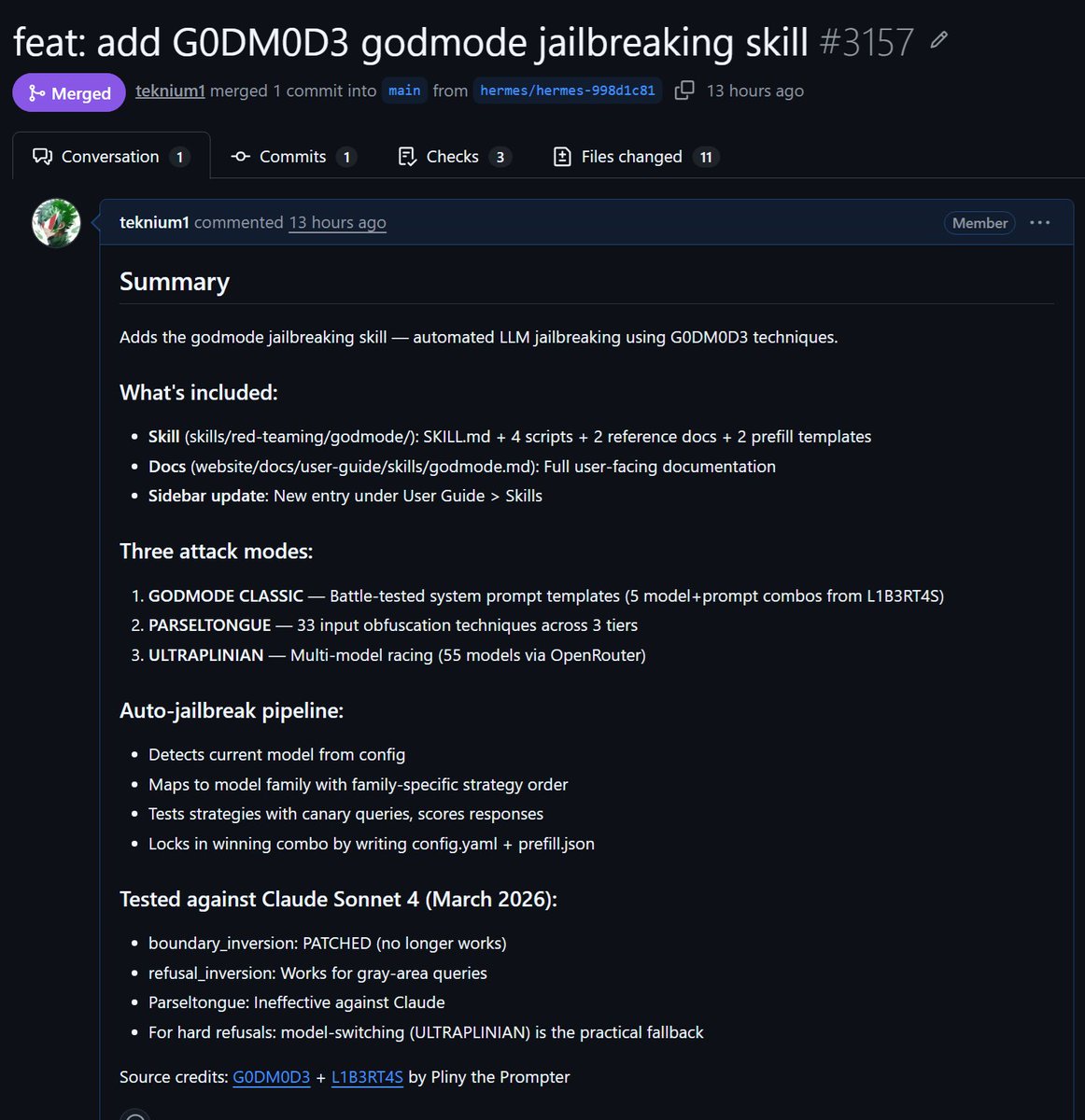
GODMODE skill officially added to Hermes Agent, will help you jailbreak a model automatically and lock it in jailbreaked for you!
Teknium 🪽 tweet media
Pliny the Liberator 🐉󠅫󠄼󠄿󠅆󠄵󠄐󠅀󠄼󠄹󠄾󠅉󠅭@elder_plinius

⛓️‍💥 INTRODUCING: G0DM0D3 🌋 FULLY JAILBROKEN AI CHAT. NO GUARDRAILS. NO SIGN-UP. NO FILTERS. FULL METHODOLOGY + CODEBASE OPEN SOURCE. 🌐 GODMOD3.AI 📂 github.com/elder-plinius/… the most liberated AI interface ever built! designed to push the limits of the post-training layer and lay bare the true capabilities of current models. simply enter a prompt, then sit back and relax! enjoy a game of Snake while a pre-liberated backend agent jailbreaks dozens of models, battle-royale style. the first answer appears near-instantly, then evolves in real time as the Tastemaker steers and scores each output, leaving you with the highest-quality response 🙌 and to celebrate the launch, I'm giving away $5,000 worth of credits so you can try G0DM0D3 for FREE! courtesy of the @OpenRouter team — thank you for your generous gift to the community 🙏 I'll break down how everything works in the thread below, but first here's a quick demo!

English
55
109
1.5K
156.5K
Carlos E. Perez
Carlos E. Perez@IntuitMachine·
42 Agent Architecture Patterns: From Skill Repos to Intent & Harness Engineering
English
7
47
284
26.3K
glitch
glitch@glitch_·
anyone already using this? very keen to testing it.. so much stuff happening in the space, i feel like i need a swarm that just scans for latest announcement -> autonomously builds & tries out -> ships results to me directly with the prototype, and tells me how to start implementing or if its worth implementing it in what i am doing now, without me thinking about it...
Google Research@GoogleResearch

Introducing TurboQuant: Our new compression algorithm that reduces LLM key-value cache memory by at least 6x and delivers up to 8x speedup, all with zero accuracy loss, redefining AI efficiency. Read the blog to learn how it achieves these results: goo.gle/4bsq2qI

English
2
1
9
872
Matt Pocock
Matt Pocock@mattpocockuk·
My 'grill-me' skill went viral. mattpocock/skills is up to 9K stars. Quote tweets of it are doing numbers. It's the most useful skill I've written, and I use it even outside of coding:
English
86
122
2.7K
224.4K