T.O.

1K posts

T.O.

T.O.

@FreeMarketTom

Focused on startups, health, family, friends.

San Francisco Bay Area Katılım Ekim 2013
108 Takip Edilen146 Takipçiler
T.O. retweetledi
david friedberg
david friedberg@friedberg·
it’s not political and should not be partisan to ask “where did all the money go?” California’s functional bankruptcy threatens the nation and should be a front-and-center state and national discussion. ignore the bs. this is what matters.
Molly O’Shea@MollySOShea

BREAKING: David @friedberg says "California is functionally bankrupt" "People don't realize how screwed California is, & I worry that if California falls, so does the union. "$250 billion to $1 trillion short." "This is because for California to get rescued would be a big cost to red states, & I think it creates in the years ahead a lot of tension." "California's functional bankruptcy is a major risk to the country. & I think we need to figure out what we can change to fix it." How we got here: "California has a public pension system, & that public pension system retirees have paid into it & they get some benefits out, & the amount that they're owed back out is somewhere between $250 billion - $1 trillion dollars more than has been paid in. $250 billion to $1 trillion short. If it was the federal government, it would be like, okay, we'll just print more money. California doesn't have the ability to print money, so California has to pay this out, and you can't restructure retirement benefits. There is a Supreme Court case in California that said that once an employee has been offered retirement benefits, even if they're currently an employee, you can never restructure their retirement benefits. It has to stay forever, and the state cannot declare bankruptcy. There's no way for the state to functionally declare bankruptcy. There's no law to allow it. No state has ever declared bankruptcy, and the retirement benefits sit senior to the bonds in California. So you have to pay out the retirement benefits before you pay out all the bond holders that have loaned California the money that they use to run all their programs and services." Hill & Valley Forum 2026 (@HillValleyForum)

English
169
411
4.2K
138.4K
T.O. retweetledi
Peter Mallouk
Peter Mallouk@PeterMallouk·
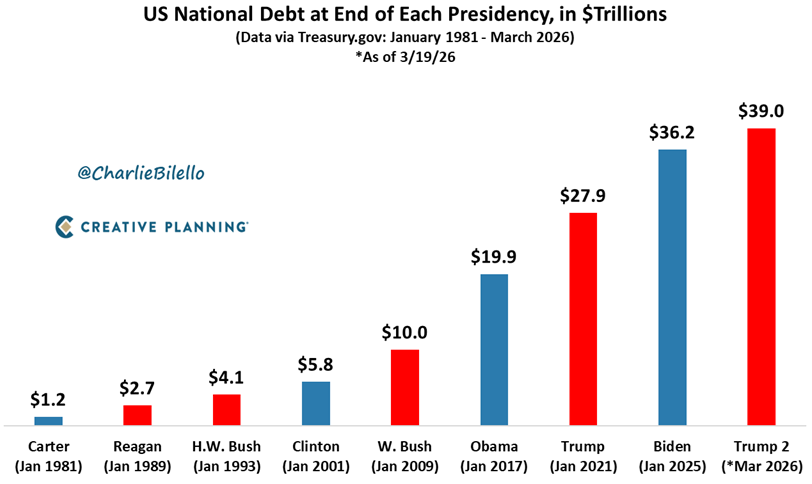
Red or Blue, the national debt goes up. The only thing both parties can agree on is sending the bill to future generations. Next stop: $40 trillion.
Peter Mallouk tweet media
English
125
178
715
47.9K
T.O. retweetledi
Katie Miller
Katie Miller@KatieMiller·
Twelve years ago, San Francisco killed 8th-grade Algebra in the name of equity. Advanced math enrollment (including AP Calculus) dropped, and racial gaps expanded. China graduates ~1.3 million engineers yearly vs. just 130,000 in the U.S. Last night, the SF school board finally voted 4-3 to bring math back. When DEI overrides academic standards, America falls behind. nytimes.com/2026/03/24/us/…
English
185
968
4.2K
329.5K
T.O.
T.O.@FreeMarketTom·
@drterrysimpson @hjluks curious because I see your statin reposts but not clear to me where you shake out. For someone with minor, elevated bad cholesterol and otherwise good health, do you advocate statins? Or are you more like Taleb who advocates them only in more extreme cases?
English
1
0
1
192
T.O. retweetledi
Nick Sortor
Nick Sortor@nicksortor·
🚨 JUST IN: CMS Director Dr. Oz DIRECTLY calls out the ABSURD scale of Medicaid fraud in LA, following @nickshirleyy's exposé "Los Angeles has ONE THIRD of all hospice centers in the ENTIRE COUNTRY. Is EVERYONE dying in LA?! Impossible numbers!" This is on YOU, @GavinNewsom KEEP EXPOSING!
English
140
1.9K
6.1K
132K
T.O. retweetledi
Ken Langdon
Ken Langdon@Ken_Langdon·
Great analysis
Steven Fiorillo@stevenfiorillo

My post on Friday regarding the estate tax proposal in New York got 600,000+ views, so clearly this struck a nerve. Some individuals asked me to back up what I said so I am going to discuss what happens when states push tax policy past the breaking point. Here is what the data shows and it’s worse than most people realize. According to IRS migration data, New York has lost $111 billion in net adjusted gross income over the last decade from residents moving to other states. That’s not hypothetical, that’s $111 billion in taxable income that used to fund schools, subways, police, and infrastructure that is now funding those things in Florida and Texas rather than New York. California lost $102 billion over the same period. Florida gained $196 billion. Texas gained $54 billion. That’s not a coincidence, it’s a pattern. Between 2018 and 2024, 561 companies relocated their headquarters across the country. The San Francisco Bay Area lost 156 corporate headquarters. Los Angeles lost 106. New York City lost 27. Meanwhile Dallas alone gained 100, Austin gained 81, and Nashville gained 35. This didn’t come to a halt in 2025 or 2026. Palantir $PLTR which was the largest publicly traded company in Colorado, announced in February that it was moving its headquarters from Denver to Miami. It was PLTR’s second move in six years after leaving Silicon Valley in 2020. The governor of Colorado said he found out through a social media post. ExxonMobil’s $XOM board unanimously recommended that shareholders approve reincorporating the company from New Jersey to Texas after 144 years at the vote in May. Exxon has physically operated out of Texas since 1989, and its CEO said Texas has created a policy environment that allows them to maximize shareholder value. Chevron $CVX completed its move from California to Houston. In-N-Out Burger is opening a 100,000-square-foot eastern headquarters near Nashville and is leaving California. These aren’t outliers anymore as this is becoming the new normal. It’s not just corporate headquarters moving. Entire financial ecosystems are relocating. Citadel, one of the most profitable hedge funds in the world, moved its headquarters from Chicago to Miami in 2022 and has been building out aggressively ever since. They’re constructing a massive new waterfront headquarters in Miami’s Brickell financial district. Elliott Management moved to West Palm Beach. Carl Icahn moved Icahn Enterprises from New York to Sunny Isles Beach. Cathie Wood’s ARK Investment Management relocated to St. Petersburg. Goldman Sachs $GS is building a $500 million campus in Dallas designed to house over 5,000 employees. JPMorgan Chase $JPM and Wells Fargo $WFC have both invested hundreds of millions into massive new campuses in the Dallas-Fort Worth area. Wells Fargo is also moving its wealth management division from San Francisco to West Palm Beach. NYSE Texas a reincorporation of the 143-year old Chicago Stock Exchange officially launched in Dallas in early 2025. The Texas Stock Exchange which is a brand new national securities exchange backed by over $160 million from BlackRock $BLK , Citadel Securities, and Charles Schwab $SCHW is set to begin trading by the end of this year. Nasdaq has also expanded its Texas presence with operations in Irving. When you have that level of financial infrastructure being built in a single metro area, that’s not a trend it’s an ecosystem being constructed from scratch to compete directly with New York. Each of these moves represents not just a company but thousands of high-paying jobs, billions in local economic activity, and a signal to every other firm still on the fence that states with competitive rather than restrictive policy are creating enticing operating environments. Currently over 1 million residents have left New York for other states since 2020 according to the latest Census estimates. International immigration has partially offset the population headcount, but it hasn’t replaced the tax base. The people leaving earn significantly more on average than the people arriving. Almost 1,700 millionaires changed their address out of New York in 2024 alone. Millionaires paid 44.6% of all personal income tax collected in the state last year. The proposed response to this fragility is to drop the estate tax threshold from $7.1 million to $750,000, raise the top rate to 50%, add a new 2% income tax surcharge on millionaires, increase corporate taxes, and add a capital gains surcharge. Under these proposals, the combined federal, state, and city top marginal rate on high earners in New York City would approach 54%. That’s a policy framework that ignores everything the last decade of data has told us. The Dallas mayor just publicly predicted an “avalanche” of NYC financial firms heading to Texas under these policies. Florida realtors are seeing a surge of inquiries from wealthy New Yorkers. Cities like Miami, Austin, and Nashville are building entire ecosystems including schools, cultural centers, and financial services clusters which are designed specifically to attract the people New York is pushing out. Ken Griffin and Stephen Ross just launched a $10 million campaign called “Ambitious Accelerated” to recruit more businesses to what they’re calling Florida’s “Tech Gold Coast.” They’re not waiting for New York to figure it out. They’re actively recruiting our talent, our capital, and our tax base. That’s what makes this moment so critical. We are in the middle of the most competitive environment for jobs, businesses, and investment that this country has ever seen. States are actively building infrastructure to attract employers and high earners. This is the time to compete, not to double down on the same policy approach that has been pushing wealth and businesses to lower-tax states for a decade. Texas entered its latest legislative session with a $24 billion surplus while having no personal or corporate income tax. Think about that for a moment, no personal or corporate income tax and they have a $24 billion surplus. Florida added more new businesses than any other state in 2024, with over 266,000 formed in a single year. These states didn’t create an attractive business landscape out of thin air. They made deliberate policy choices to create environments where businesses want to operate, where employers want to hire, and where working people can actually build something without the ground shifting underneath them every budget cycle. This matters because of what it means for everyday people. When a company relocates its headquarters, it doesn’t just move a sign, the entire company leaves, from the executive team to the support staff. It doesn’t stop there because that's only internal. Externally, all of the trades that may do work for the company will no longer receive those phone calls. The restaurants will no longer see those repeat customers. The tax revenue from those paychecks won’t be collected, and future job growth in the community from that company will cease to exist. When Dallas gained 100 corporate headquarters over six years, that meant tens of thousands of new jobs, new residents spending money, new homes being purchased, new small businesses opening to serve those people. That’s how local economies actually grow. That’s how neighborhoods stay alive, and when a corporate headquarters leaves a city, the exact opposite happens. The jobs thin out, the spending dries up, the small businesses that depended on that foot traffic start closing, and the tax base that funded public services shrinks. New York has every natural advantage in the world. The talent, infrastructure, culture, and institutions are all here, but it won’t be enough if the policy environment drives away the employers and investors who create opportunities for everyone else. The states that are growing right now aren’t growing by accident. They made a decision to be competitive. They kept tax burdens manageable, they created regulatory clarity for businesses, and they built an environment where employers want to expand and hire. New York has every tool to do the same thing. The question is whether the people making the decisions recognize that we’re in a competition and right now, we’re not acting like it. Here’s the part nobody in Albany wants to hear. The people who leave don’t just take their tax returns with them. They take their fundraising networks, philanthropy, job creation, and spending to a new economy. A city that once attracted the world’s most ambitious people risks becoming a place they leave once they’ve made it, or worse, a place they never lay down roots. That’s not ideology. It’s an economic reality that the IRS, Census, and corporate relocation data have been telling us. I said it in my first post, and I’ll say it again. When you tax people past the point where the math makes sense, they leave. When they leave, the burden falls on everyone who doesn’t have the resources to relocate. It’s time to take a common-sense approach to policy and make the great state of New York competitive again. New York has a decision to make. Either it continues down this path and alienates more taxpayers or it becomes more competitive. I love this state, but I am extremely worried for it’s future. We should be building a thriving ecosystem with an abundance of opportunities for New Yorkers, but instead we are pushing entrepreneurs and businesses to states that are more competitive with policy. Is this really the path we want to take not only for the current residents but for the next generation? @amitisinvesting @basispointpod @chamath @Jason @BillAckman @kevinolearytv @patrickbetdavid @PBDsPodcast

English
0
1
1
22
T.O.
T.O.@FreeMarketTom·
@hjluks @DrNeilStone I like that he's transparent with his terrible thinking. Refreshing relative to politicians who go to great lengths to hide their positions.
English
0
0
1
55
Neil Stone
Neil Stone@DrNeilStone·
This may lose me followers but I really dislike Bernie Sanders
English
851
536
8.2K
178.5K
T.O.
T.O.@FreeMarketTom·
@nntaleb Yet another reason to ignore the media.
English
0
0
0
461
Nassim Nicholas Taleb
Nassim Nicholas Taleb@nntaleb·
3- There must be loss of memory from filtering; you get more information/entropy as you age, so needs to eliminate some. Intelligence is about what you decide to eliminate.
English
15
48
604
50.5K
Nassim Nicholas Taleb
Nassim Nicholas Taleb@nntaleb·
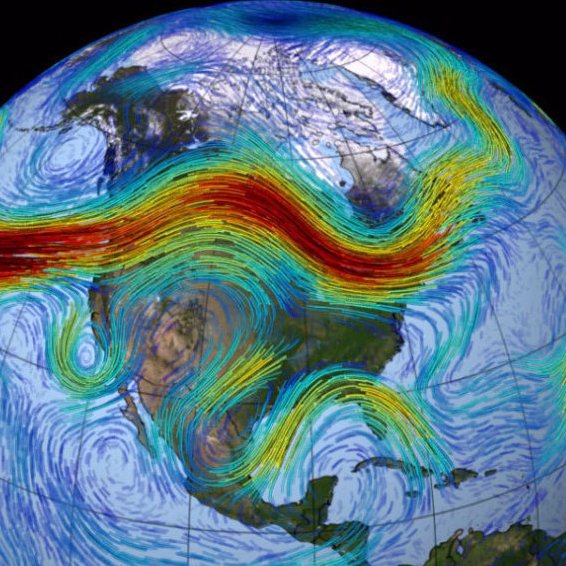
1-In science you meet tons of older people who function like youngsters, retaining ~all their mathematical abilities; pbm: their body doesn't follow: sarcopenia, low endurance (cyclist friend tells me). 2-Decline in the formation of new memories must happen earlier in life.
Nassim Nicholas Taleb tweet media
English
29
110
1.6K
204.2K
T.O. retweetledi
Moses Kagan
Moses Kagan@moseskagan·
Yet another example of a socialist obsessed with splitting up the pie that exists, while totally ignoring what makes the pie grow. This *exact* line of thinking leads to Cubans squatting in the ruins of buildings the capitalists built in the '40 and '50s, which the communists can no longer maintain, let alone replace.
Joshua Rauh@joshrauh

Let this sink in. California wealth tax architect Saez admits it here: he would let 80% of billionaires leave CA, liquidating Silicon Valley and its jobs, for an extra $2 billion per year in revenues. This is in a state that spends $325 billion per year, up by 68% since 2019.

English
81
183
1.8K
238.5K
T.O.
T.O.@FreeMarketTom·
@thatsKAIZEN The risk is you will want to stay. Enjoy & keep us posted!
English
0
0
5
296
Kaizen D. Asiedu
Kaizen D. Asiedu@thatsKAIZEN·
Guess I’m moving to Colombia for a bit
English
105
49
1.4K
44.8K
T.O. retweetledi
Nassim Nicholas Taleb
Nassim Nicholas Taleb@nntaleb·
Someone asked me "what is China's optimal strategy?" My answer: having a cup of tea to kill time.
English
168
628
6.1K
362K
T.O.
T.O.@FreeMarketTom·
Perhaps I'm in a minority for thinking this, but I find the degree of closeup unnerving. I'd back the camera up. For a good example, see the video posts by @thatsKAIZEN (which feel for me more like listening to a person, as opposed to your videos, where I feel like I'm interacting with your teeth). I love your work, so I hope you find this comment in the spirit of constructive and not an attempt to tease.
English
1
0
0
33
Derek Sivers
Derek Sivers@sivers·
I hope this slower pace of one sive.rs/u video per day is more appealing.
English
4
0
69
6K
T.O. retweetledi
Handre
Handre@Handre·
Central planners still can't grasp what Hayek understood decades ago — the most sophisticated systems emerge precisely because no bureaucrat is pulling the strings. Language, markets, cities, the internet. All spontaneous orders that no government committee could design if they tried for a thousand years. And yet these same politicians think they can micromanage healthcare, education, and monetary policy. The hubris is breathtaking. But here's the part that really drives them insane: spontaneous order doesn't just work better than their top-down schemes — it makes their entire profession obsolete. No wonder they fight it so hard. When complex coordination happens without their permission, what exactly are we paying them for?
English
74
481
2.3K
150.5K
T.O. retweetledi
Chamath Palihapitiya
Chamath Palihapitiya@chamath·
So it turns out that the sitting local Democratic congressman in Silicon Valley, @RoKhanna, is the most un-entrepreneurial, creative or innovative person possible. He is: 1) In favor of California’s Property Seizure tax that he calls a “Billionaire” Tax. It’s already led to half of California’s Billionaire wealth to flee the state which will leave the middle class to pay for the lost revenues. 2) Despite this, he then teamed up with Bernie Sanders to propose an additional national 5% wealth tax to spend on God knows what. 3) Despite all the virtue signaling on inequality, he is also one of the most prolific traders in Congress where just last year he traded $55.7m of stock. With everything he learns in Congress to help him, he beat the market by 13%. Ro’s ambition is what matters most to him and he will flop from dumb idea to dumb idea if he thinks it will serve his broader political ambitions. Currently that means being a quasi socialist to win favor with the extreme left of his Party. He doesn’t deserve to represent Silicon Valley and I hope he loses badly in his re-election.
English
1K
2.4K
17.6K
1.8M
T.O. retweetledi
Nassim Nicholas Taleb
Nassim Nicholas Taleb@nntaleb·
Wars: you always know how, why, and when they start. You never know how, why, and when they end.
English
121
722
5K
307.1K
T.O.
T.O.@FreeMarketTom·
I agree Gore monetized fear. But I don't think he said what you say. He qualified it with "if Greenland broke up and melted, or if half of Greenland and half of West Antarctica broke up and melted, this is what would happen to the sea level in Florida." And I don't think he's a billionaire. Private jet wealthy but not a B.
English
0
0
1
43
Electroverse
Electroverse@Electroversenet·
In 2006, Al Gore released An Inconvenient Truth, a film that defined modern climate alarm. In it, he warned Greenland and Antarctica's ice would melt, driving seas high enough to put major cities underwater, with entire coastlines redrawn. Eighteen years later though, none of it has happened. Not even close. Meanwhile, Gore got very rich. While ordinary people were told to feel guilty and cut back, he built a fortune. Gore became the first climate billionaire. His wealth came from green investment funds, such as board seats and advisory roles, 200k+ speaking fees and carbon credit trading. Al Gore didn't save the planet. He monetized fear.
English
339
2.4K
6.7K
218K