Freedom Movement Uganda

3.4K posts

Freedom Movement Uganda banner
Freedom Movement Uganda

Freedom Movement Uganda

@FreedomMove_Ug

A Youth led movement building new and just communities free from; social, economic & class oppression. Join us in the fight against systemic oppression.

Uganda Katılım Mayıs 2022
455 Takip Edilen1.1K Takipçiler
Freedom Movement Uganda retweetledi
East and Horn Of Africa Observation Network
EHORN wishes you a blessed Ramadhan! May this holy month bring peace, reflection, and blessings to you and your loved ones.
East and Horn Of Africa Observation Network tweet media
English
0
1
4
120
Freedom Movement Uganda retweetledi
Winnie Byanyima
Winnie Byanyima@Winnie_Byanyima·
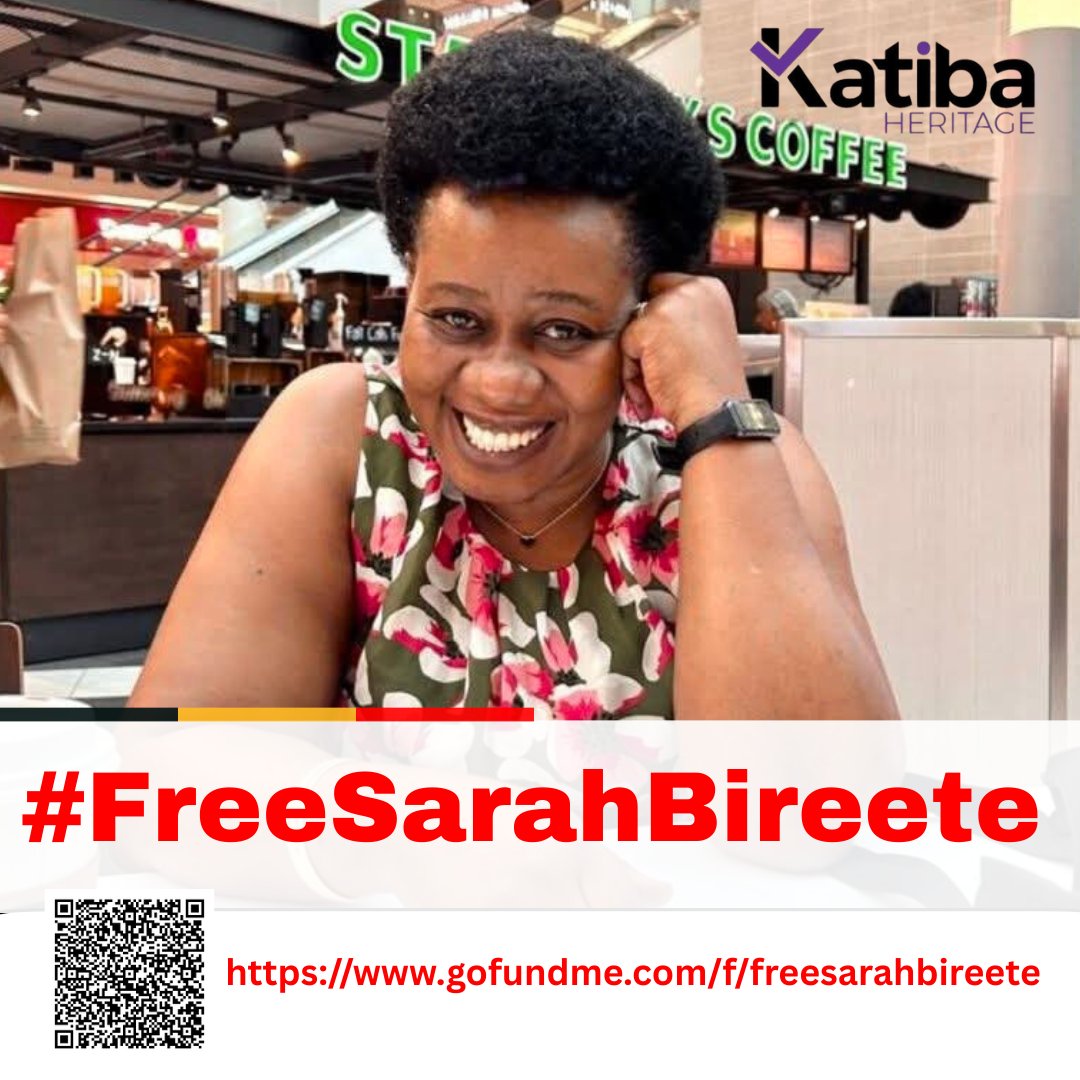
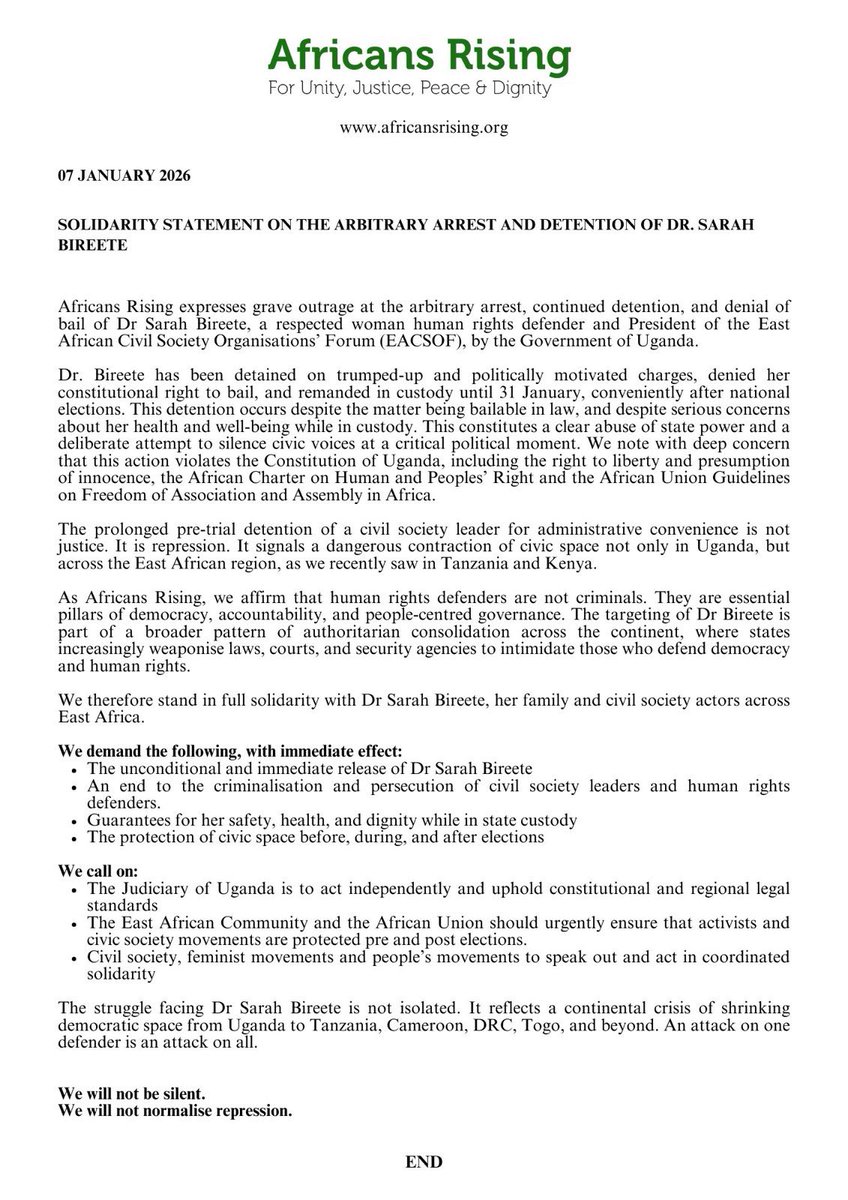
Strength in standing together against oppression, violation of human rights and state sponsored violence. Thank you for joining us. #FreeSarahBireete #FreeKizzaBesigye #FreeAllPoliticalPrisonersinUganda
Angella Asiimwe@AAssimwe

I am deeply grateful to @Winnie_Byanyima for opening her home &heart to host prayers for @kizzabesigye1 , @SarahBireete &all political prisoners whose freedom has been unjustly taken. This was a moment of collective hope. @HEBobiwine #FreeAllPoliticalPrisoners #FreeSarahBireete
English
5
35
202
6.1K
Freedom Movement Uganda
Freedom Movement Uganda@FreedomMove_Ug·
100 FALLEN DICTATORSHIPS Case 27: Chileans overthrow the Pinochet regime. Demands 1. Democratic elections 2. Resignation of the Pinochet regime. 3. End to human rights abuses and economic hardship. PART ONE After the coup, Augusto Pinochet established himself as the leader of Chile and set up a military dictatorship with the heavy involvement of his army. During this regime, Pinochet used repressive measures to suppress opposition to his rule and supported politics that divided any opposition groups. While Pinochet presided over a large economic recovery, the regime also disappeared thousands of dissenters to the dictatorship. The National Directorate of Intelligence, which later became the National Centre for Intelligence (CNI), was the regime’s security apparatus and targeted journalists, union leaders, and student activists. In order to bolster the appearance of popular support, it organized its supporters for pro-government rallies. Nonetheless, an economic crisis beginning in 1982 and 1983 led to increasingly widespread dissent, especially with the lack of democracy in Chile. Despite the dictatorship’s attempts to weaken the country’s trade unions, organizations, and unions organized the growing popular dissent into protest against the regime. In mid-1983, union leaders met to establish a list of demands for the government. On May 11, 1983, the CTC called for the first major protest, which had the support of the National Workers’ Command and several opposition party leaders. Originally planned as a national strike but changed to a National Day of Protest. In this first action, the people of Santiago slowed down all activities during the day and then let loose a barrage of noise at 8 o’clock in the evening. They banged on pots and pans and honked horns to express solidarity with one another. After the success of this initial protest, the organizing groups began to call monthly protests. Participation grew with each protest as students and poor Chileans from around the country joined the campaign. The opposition political parties and the Catholic Church helped to mobilize this growing population of dissenters. Despite repression, groups of journalists openly spread news about protests through newspapers, magazines, and radio. In addition to the monthly protests, campaigners also used lightning protests, which consisted of short, spontaneous actions with small amounts of people that dispersed before police could arrive. They were begun by small groups of people chanting slogans or by leaflets dropped from upper stories of tall buildings. As the regime increased its repressive violence, it simultaneously attempted to foster limited liberalization. The government slightly increased freedom of the press, allowed political exiles to return to the country, and held meetings with political opposition groups. In 1983 and 1984, the Democratic Alliance took advantage of Pinochet’s permission for two mass demonstrations. The opposition alliance mobilized hundreds of thousands of citizens to participate in these two major displays of opposition to the government. Nonetheless, repressive violence continued to occur and undermined the legitimacy of the Pinochet regime. Furthermore, as police forces removed themselves from acts of repression, the army took over the state sanctioned violence. This army presence gained international attention when a National Workers’ Command-led strike coincided with the Assembly of the International Parliamentary Union in Santiago in May 1986. Journalists for international media sources further spread information about resistance within Chile, Europe and North America began to call more fervently for a transition to democracy within Chile. #DictatorshipsFall #FreeUgandaNow #IChooseANewUganda
English
0
0
0
51
Freedom Movement Uganda retweetledi
Harimah Smart Hajjati
Harimah Smart Hajjati@HajjatiSmart·
Reckless driving by M7’s men in uniforms was caught on camera. Imagine these are men in uniforms driving recklessly and trying to knock ordinary Ugandans who are standing on road side. #FreeUganda🇺🇬🙆🏽‍♀️ #ANewUgandaNow
English
12
76
314
27.2K
Freedom Movement Uganda
Freedom Movement Uganda@FreedomMove_Ug·
Case 26: Malawians bring down a 30-year dictator 1993 Demands 1. To legalize political parties. 2. End single-party rule 3. To get political prisoners released. By the early 1990s, President Hastings Kamuzu Banda of the Malawi Congress Party (MCP) had been president of Malawi for 30 years. At the time, Malawi was a single-party state in which political parties were illegal. After Pope John Paul II meeting with them in Rome and insisting again that they (bishops) do something to alter Malawi’s poor political and human rights conditions.Upon returning from Rome, the bishops began the new campaign. On 8 March 1992, Malawi’s 8 Catholic bishops wrote a pastoral letter which was read in churches throughout Malawi. The letter denounced the govt’s censorship of mass media, infringement on education, and illegal imprisonment of Malawians. 2 days later, the bishops were arrested. Inspired by the letter, students began demonstrations that spread to other areas of Malawi. Junior army officers protected the students from the police and encouraged them to protest. A month later, senior and middle ranking army officials told Banda that they would not take part in any suppression of Malawians who wanted multipartyism. From 20 March to 23 March, 80 exiled activists met in Zambia, as the United Front for Multi party Democracy. Following the conference, Chikufwa Chihana returned from exile and was arrested that day after making a speech calling for multiparty politics. Upon his arrest, pro-democracy campaigners held more protests. When President Banda asked for foreign aid from World Bank, his request for $800 million was denied. The aid donors told Banda that aid would remain suspended until the human rights and political conditions in his country changed. Due to the pressure, Banda released 88 political prisoners. On 4 May, 3000 textile factory workers went on strike. They demanded that Chihana be released from prison and that Malawi becomes a multiparty state. The strike was disbanded that same day, but the workers returned on 6 May to march to the city centre. They were joined by unemployed youth, students, and other workers. The police violently responded to crackdown the strike, instigating violence. In August, more churches joined the push for multipartyism. Initially, the Church created a committee to press for a referendum on multiparty politics. Then, an open letter was sent out by the Christian Council of Malawi with the approval of its churches. The Muslim community also supported the campaign. In October, the Alliance for Democracy (AFORD) formed with the intention of stopping Banda’s dictatorship. AFORD embodied a nonviolent strategy. Throughout this period of time, the Young Pioneers (a militant youth group created by Banda) constantly intimidated protestors. On 18 Oct 1992, Banda announced that a referendum would be held regarding multiparty politics. Meanwhile, in Dec, Chihana was sentenced to 2 years in prison, which caused more demonstrations. On 31 Dec 1992, Banda decreed that the referendum would be held on 15 March 1993. Members of the opposition complained that the date was too soon and would not allow them sufficient time to campaign. Finally, the UN sent Banda a letter, which convinced him to move the referendum to 15 June 1993. Of the total number of registered voters, 67% voted that day, and of those voters, 63.5% voted for multiparty politics. In response to the referendum’s outcome, a 14-person committee was set up to determine the constitution amendment. Parliament officially amended the constitution on 29 June 1993, turning Malawi into a country with multiparty politics where political parties were legal.At this time, the army, which had remained neutral, disbanded the Young Pioneers. The next election was set for May 1994. The UDF candidate Bakili Muluzi was elected president, and Banda relinquished his position as president. #DictatorshipsFall #FreeUgandaNow #IChooseANewUganda
Freedom Movement Uganda tweet media
English
0
1
1
112
Freedom Movement Uganda
Freedom Movement Uganda@FreedomMove_Ug·
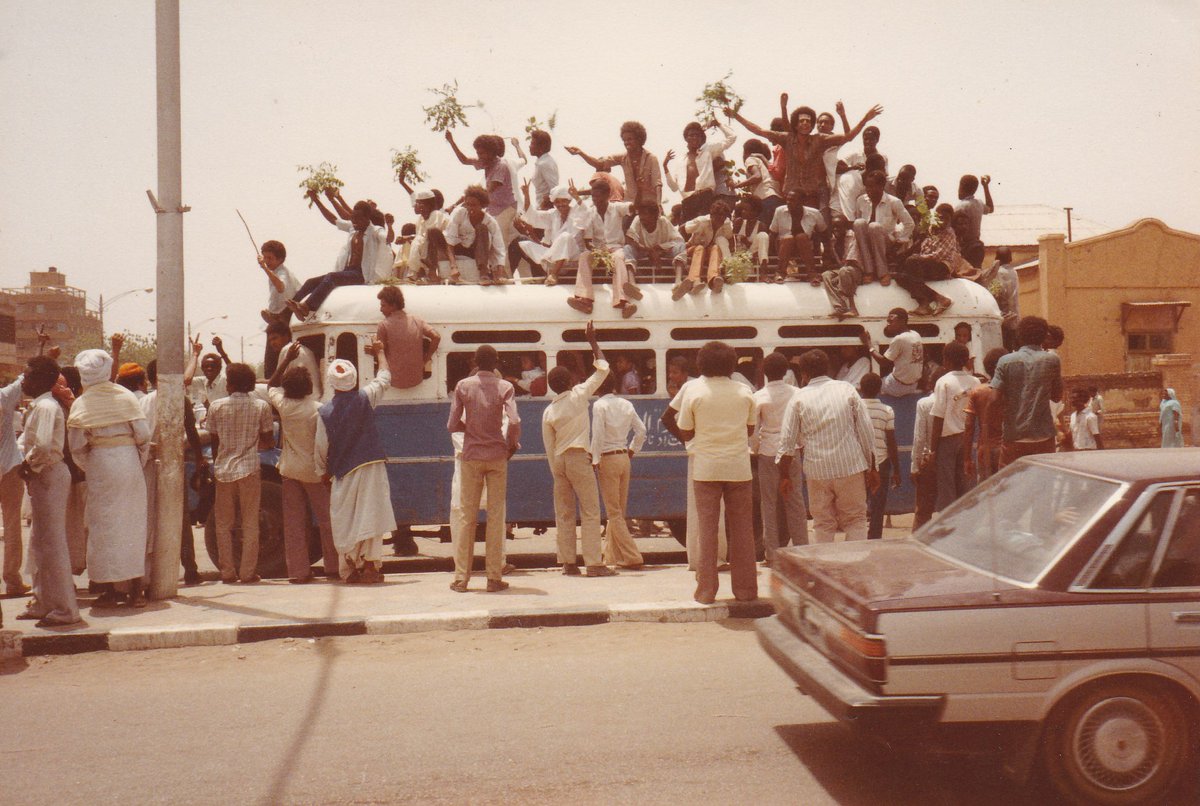
100 FALLEN DICTATORSHIPS Case 25: Sudanese students, workers, bring down Numeiri dictatorship in 1985. PART TWO Demands 1. To bring down the Numeiri-led government 2. Instate a civilian-led and multi-party system. 3. End of sharia law in the country 4. liberate the economy 5. Judicial independence. PART TWO The following day, 3 April, was the largest demonstration in Sudanese history, bigger than those of both the October revolution and the 1956 celebration of independence. Between one and two million people marched through Khartoum to express their discontent with Numeiri’s regime and call for an end to the repressive government. In the face of such a massive movement of people, the security forces and military retreated peacefully. The next day, General al-Dahab met with the opposition leadership. He accepted their demands that he not declare a state of emergency or use armed force to put down the popular uprising. No action was taken to halt the demonstrations. In the meantime, leaders within the groups of the political parties, trade unionists, and professional associations met to draft up a unified leadership and program with common goals. They adopted this national charter on the night of 5 April, bringing it into operation on 6 April as President Numeiri returned to Sudan. The military generals, now working alongside the political opposition, instigated a coup and installed a military junta with the total cooperation of General al-Dahab. Thousands of Sudanese who had been occupying the streets of Khartoum since the early morning expressed joy and celebration. On 6 April 1985, the coalition of political opposition groups, professionals, and trade unionists established the Transitional Military Council (TMC), headed by General al-Dahab and a civilian cabinet of non party professionals. They would rule jointly for a one-year transitional period, at the end of which free elections would be held to determine the new government. The TMC also promptly demobilized the internal security force set up by President Numeiri, confiscating their weapons and removing close to 400 officers from their posts. Upon his return to the country, finding his Defence Minister and first vice president to have sided with the opposition, Numeiri fled to Cairo, where he remained in exile. #DictatorshipsFall #FreeUgandaNow #IChooseANewUganda
Freedom Movement Uganda tweet media
English
0
0
0
37