GFADP

3.3K posts

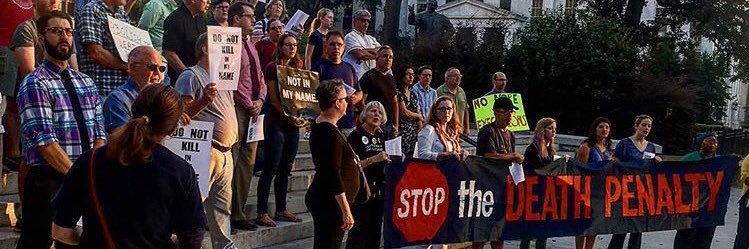
GFADP banner
GFADP

GFADP

@GFADP

Georgians for Alternatives to the Death Penalty (GFADP) is our statewide coalition working for an end to capital punishment and a more fair system.

Atlanta, GA Katılım Nisan 2009
728 Takip Edilen1.8K Takipçiler
GFADP retweetledi
Lee Hedgepeth
Lee Hedgepeth@lee_hedgepeth·
Sonny Burton’s eyes filled with tears as I read him the AG's statement. Sonny Burton took a breath. He remembered all the men he’d known on death row who’d been killed by the state. 73 since he arrived there. 25 since Marshall became AG. Full story: treadbylee.com/p/sonny
Lee Hedgepeth tweet media
English
2
3
14
715
GFADP retweetledi
FADP
FADP@FADPorg·
FADP just delivered thousands of petition signatures, in collaboration with @DeathPenaltyAct and @CMNEndtheDP, to Governor DeSantis and the Florida Board of Executive Clemency urging them to stop Michael King’s execution, scheduled for 6 pm tonight. bit.ly/SpareMichael
English
0
6
10
243
GFADP retweetledi
FADP
FADP@FADPorg·
Statement on the Execution of Michael King STARKE, Fla. — Tonight, on the Feast of St. Patrick, during the Lenten Season, We the People of the State of Florida, executed devout Catholic Michael King. Michael was executed tonight for the 2008 murder of Denise Amber Lee, a devoted wife, loving mother, and valued member of her community. Her death devastated her family, shocked communities across the country, and also exposed serious failures in the emergency response system that allowed for five people, including Denise herself, to call 911 before help was coordinated and emergency vehicles were dispatched. We grieve for Denise and for everyone whose lives were forever changed by her death. In the years since, Denise’s family has worked tirelessly to improve 911 training and accountability so that those failures are never repeated. That work, and her legacy, is where real justice lives. Instead, the State of Florida chose more violence as its version of “justice.” Michael’s single, albeit devastating, act of violence must be considered in the context of a traumatic and life-altering traumatic brain injury he experienced at six years old. His 11 year old brother was driving a snowmobile, pulling young Michael, who was in a sled, downhill behind him. They lost control. Michael slammed into a wooden pole head-on, and was immediately knocked unconscious. His brother carried his limp body as Michael bled from his head, nose and mouth. His teeth were broken and loose, his face mangled. He sustained damage to his developing frontal lobe, the part of the brain responsible for decision making and impulse control. After the accident, Michael suffered chronic nosebleeds, fell behind in school, repeated grades, and suffered from hallucinations — seeing and hearing things that weren’t there. He believed people were out to get him and developed severe phobias. Michael’s family watched for decades as the boy they loved changed. They lost the child they once knew. When he was arrested, convicted, and condemned to die, they lost him again. Michael has transformed while on death row. As many people with brain damage find, the predictability and structure of prison was helpful. Those who knew and loved Michael described him as sincere, devout, and steady in his Catholic faith. Faith that helped him regulate his life in ways that had never been possible after his childhood brain injury. He prayed with others and offered comfort to the other men facing the same isolation and despair that defines death row. Michael’s time on death row demonstrates something the death penalty fails to reckon with: the human capacity for change and redemption. That people are defined by more than their single aberrant act. Further, in a cruel twist of irony, Michael was born with double pneumonia, struggling to breathe. Tonight, Florida executed him using a lethal injection protocol that autopsy records show causes flash pulmonary edema — a death that mirrors drowning. Worse, because Florida uses a paralytic, his struggles to breathe would have been completely masked. Michael asked for basic transparency about how the State planned to carry out his execution, The State refused. Incredibly the State did not dispute Michael’s claims that the heavily redacted drug logs do in fact demonstrate the State has used expired drugs and given inadequate doses. Instead, State officials give the repeated and robotic assertion that they are presumed to follow their protocol. 32 executions in, it is long past time to test that presumption with transparency. What a different story this could have been, had this tragedy ended decades ago with a life without parole sentence. Denise Lee’s family could have continued the incredible work to honor her memory by fighting for reform to keep others safe. Importantly, they could have done so without the painful reminder of the single worst day in their lives as this case wound through the court system towards Michael’s eventual execution. Society would have remained safe, and Floridians would not have to question whether their government was torturing its citizens and calling it punishment. Instead, tonight, a new family grieves. A mother lost her son, siblings lost their brother, and a child lost their father. More violence and loss is never real justice. fadp.org/statement-on-t…
English
5
7
14
818
GFADP retweetledi
Catholic Mobilizing Network
Catholic Mobilizing Network@CMNEndtheDP·
Praise God! Gov. Kay Ivey commuted the sentence of Charles “Sonny” Burton on the morning of Tuesday, March 10. Krisanne Vaillancourt Murphy (@KrisanneVMurphy), CMN’s executive director, expresses her gratitude to Alabama’s governor and to those that advocated on behalf of Sonny in a recent press statement. “I pray that our celebration of this commutation will also include our commitment to the continued work that is needed to advance in our society a justice that is aimed at true healing and meaningful repair in the wake of grave harm,” she said. Read the full statement on CMN’s website: catholicsmobilizing.org/sonny-commutat…
English
0
5
9
250
GFADP
GFADP@GFADP·
ICYMI: Alabama Governor Kay Ivey has commuted Charles “Sonny” Burton’s death sentence to life without parole. We’re grateful for the many advocates who spoke out, took action, and made this result a possibility.
GFADP tweet media
English
0
0
0
31
GFADP
GFADP@GFADP·
A powerful day at the @TCADPdotORG’s Annual Conference! We're grateful for partners across the country who remind us that change happens when movements work together. Excited to bring these ideas and energy back to Georgia. #TCADP2026
GFADP tweet mediaGFADP tweet mediaGFADP tweet media
English
0
1
3
40
GFADP retweetledi
TCADP
TCADP@TCADPdotORG·
Josh Burns, an advocate for Robert Roberson and a shaken baby syndrome hypothesis exoneree, is honored with the #TCADP2026 Courage Award.
TCADP tweet media
English
1
5
5
186
GFADP retweetledi
TCADP
TCADP@TCADPdotORG·
This morning’s panel discussion features Jay Jenkins, Kathryn M. Kase, Megan Beesley, Daphine Priscilla Brown-Jack, and Anthony Graves #TCADP2026
TCADP tweet media
English
1
1
2
85
GFADP retweetledi
FAMM Foundation
FAMM Foundation@FAMMFoundation·
With "Grading the States," FAMM issues report cards for every state’s compassionate release program, grading on essential elements to help medically vulnerable, aging, and terminally ill incarcerated people. #CriminalJustice #CompassionateRelease
English
0
2
2
121
GFADP retweetledi
NC Coalition for Alternatives to the Death Penalty
Florida has executed #MelvinTrotter – even amidst the state's repeated failures to follow its lethal injection protocol. He was the 4th person executed in the US and the 2nd person killed by FL in 2026. Rest in peace, Melvin. We remember your life and mourn your execution.
NC Coalition for Alternatives to the Death Penalty tweet mediaNC Coalition for Alternatives to the Death Penalty tweet mediaNC Coalition for Alternatives to the Death Penalty tweet media
English
0
1
1
77
GFADP retweetledi
FADP
FADP@FADPorg·
Statement on the Execution of Melvin Trotter Tonight, We, the People of the State of Florida, executed Melvin Trotter, an intellectually disabled Black man, for the 1986 murder of Virgie Langford. His execution proceeded despite ignored evidence of intellectual disability, clear racial disparities in his sentencing, and troubling, repeated deviations from Florida’s own lethal injection protocol. As we always do, we hold the grief of Virgie Langford’s family and their irrevocable loss alongside the grief of those who loved and lost Melvin. We also grieve for Melvin, the little boy who entered this world as the product of rape, grew up fatherless, and endured emotional deprivation and physical abuse from his birth mother, who herself understandably had difficulty coping with the reason for his very existence. Melvin was thrust into foster care when he was just nine years old, where his exposure to violence, physical neglect, and abuse continued. He found solace in a loving, ongoing relationship with his sister, whom Melvin protected as best he could from their shared family dysfunction, often taking the rap for any trouble the two of them got into together. Melvin was a person with intellectual disability, but like so many others executed under this administration, the State and courts ignored and minimized the significance of his condition. Mental health evaluators, concerned with his competency to stand trial, concluded that he was a slow learner, had impaired common sense, and was unable to plan ahead or consider the consequences of his behavior. The evaluations also noted that Melvin’s sense of reality was distorted and his inhibition reduced due to his cocaine use, which he used to dull himself from the pain of his violent conception and his unstable childhood. Melvin was also a Black man sentenced to die for killing a white woman in a state where race continues to shape who lives and who dies. Black Floridians make up about 17% of the population, but 35% of those on death row and 25% of those executed under Governor DeSantis. In Manatee County, where Melvin was convicted, no one has ever been sentenced to death for killing a Black person. In the final weeks of his life, Melvin’s lawyers echoed serious concerns about Florida’s lethal injection process. Concerns that arise from Florida’s own record-keeping. Instead of agreeing to a full and fair review of the disturbing new records, the State hid behind procedural rules and asked the courts for yet another rubber stamp. Though the United States Supreme Court ultimately declined to intervene, Justice Sotomayor agreed that the evidence presented by Frank Walls, Ronnie Heath, and now Melvin Trotter is troubling: “By continuing to shroud its executions in secrecy, Florida undermines both the integrity of its own execution process and, potentially, this Court’s ability to ensure the State’s compliance with its constitutional obligations.” Melvin asked for something painfully simple: an independent review. His claims unequivocally established that the State has been at best careless, and at worst deliberately indifferent to following their established protocol. The records indicate in several of last year’s executions, the State: 1) administered expired drugs, increasing the risk of conscious pain during an execution; 2) measured incorrect dosages of drugs, raising the possibility of prolonged suffering — masked to observers because of the paralytic; and 3) used drugs unauthorized by the protocol. Autopsies from 2025 executions have also revealed pulmonary edema, causing a slow suffocating death, rather than the “easy” sedation and cardiac arrest the protocol promises. We have seen this before. Florida has a unique and terrible history with the death penalty. We are approaching the 20th anniversary of Florida’s worst lethal injection botch, when it took 36 minutes to kill Angel Diaz in 2006. Execution team members failed to achieve and maintain venous access, torturing him and causing severe distress and pain, resulting in visible chemical burns to his arms. This botch caused then-Governor Jeb Bush to temporarily pause executions and appropriately call for an independent examination. The result of that review was a new protocol, made publicly available, that the State repeatedly swore they would follow without fail. What has come to light during this administration’s execution spree is that the State of Florida is failing miserably in that endeavor. With the increased pace, rushed process, and ongoing toll on corrections officers forced to participate in these repeated killings, it is only a matter of time before we are right back to where we were in 2006. Executions are not inevitable. They are not acts of nature. They are not divine mandates. They are choices, human choices, made in our name. Melvin’s killing tonight shares many of the hallmarks of the previous 29 under this administration. Unaddressed and untreated childhood abuse and trauma. Self-medication with substances. Racially disparate treatment in sentencing. Secrecy and suppression about the State’s administration of lethal injection protocol, with the State urging “just trust us,” and the courts falling for this false assurance over and over. We, the People, must refuse to tolerate a system that kills first and answers questions later. Or, in this case, a system that seems content to answer them never. fadp.org/statement-on-t…
FADP tweet media
English
3
12
12
593
GFADP
GFADP@GFADP·
What an inspirational experience at the Joyful Resistance: A Day of Storytelling, Solidarity, and Action, focused on improving criminal justice and supporting our communities. Thank you to the Justice Reform Partnership for hosting! @bfeldman89 @southerncenter
GFADP tweet mediaGFADP tweet mediaGFADP tweet media
English
0
1
1
80