
gtmfund

575 posts

gtmfund banner
gtmfund

gtmfund

@gtmfund

Raise money from those who have been there, done that. Let us help you grow revenue from zero to IPO. Media platform @GTMnow_ | GP @hackitmax

Austin, TX Katılım Ocak 2021
337 Takip Edilen898 Takipçiler
gtmfund retweetledi
Sophie Buonassisi
Sophie Buonassisi@sophiebuona·
NEW: The cloud only covers 30% of the world 🤯 @armada_ai is building the other 70%. The cloud was built 25 years ago: before large models, before sensors on everything, before data lived on oil rigs and in the Arctic. That mismatch between the cloud and the world it was built for is a MASSIVE market opportunity. Armada builds modular AI data centers (called Galleons) that can be deployed ANYWHERE on Earth. They are the hyperscaler for the edge, building the infrastructure for the 70% of the world the major cloud providers don't reach. @danwrightSF (Co-founder & CEO of Armada) joined The @GTMnow_ Podcast to go deep on this. Highlights: – Why the cloud only reaches 30% of the world – What Armada builds and why they call it the "hyperscaler for the edge" – From Saudi Arabia to the Arctic: deployments that redefine the edge – The physics problem with AI: why distance from data breaks everything – How Starlink turned every remote location into a potential AI cluster – The global AI race: sovereign compute as a national security strategy – Genesis Mission, the White House, and Davos – GTM for a hardware company: selling when the demo is a 40-foot shipping container – The Microsoft partnership and extending Azure to the places it can't reach – Category creation: the lesson Dan learned about specificity and business value – The founder advice Dan wishes more people took seriously: write it down Armada is backed by @foundersfund, @M12vc, @Lux_Capital, @felicis, @gtmfund and more.
English

0
4
7
698
gtmfund retweetledi
Max Altschuler
Max Altschuler@HackItMax·
Before each podcast episode as part of our VC series, @PaulGTM and I have some fun chatting through our (many) opinions on what we’re seeing across the broader landscape. Here’s what we covered - available in full here on X. - Build vs. buy and why "software is dead" is the wrong framing. - Why nobody is going to vibe code DocuSign out of existence. - How the middle layer of SaaS is getting squeezed as value shifts to the action layer and the data layer. - What moats still matter for founders today (hint: speed and resources no longer cut it). - Buyer hesitation and why nobody can commit to more than a 12-month contract right now. - The $50T+ knowledge economy that the "SaaS is dead" crowd keeps ignoring. -What is the "mojo metric"?!
English
1
2
8
552
gtmfund
gtmfund@gtmfund·
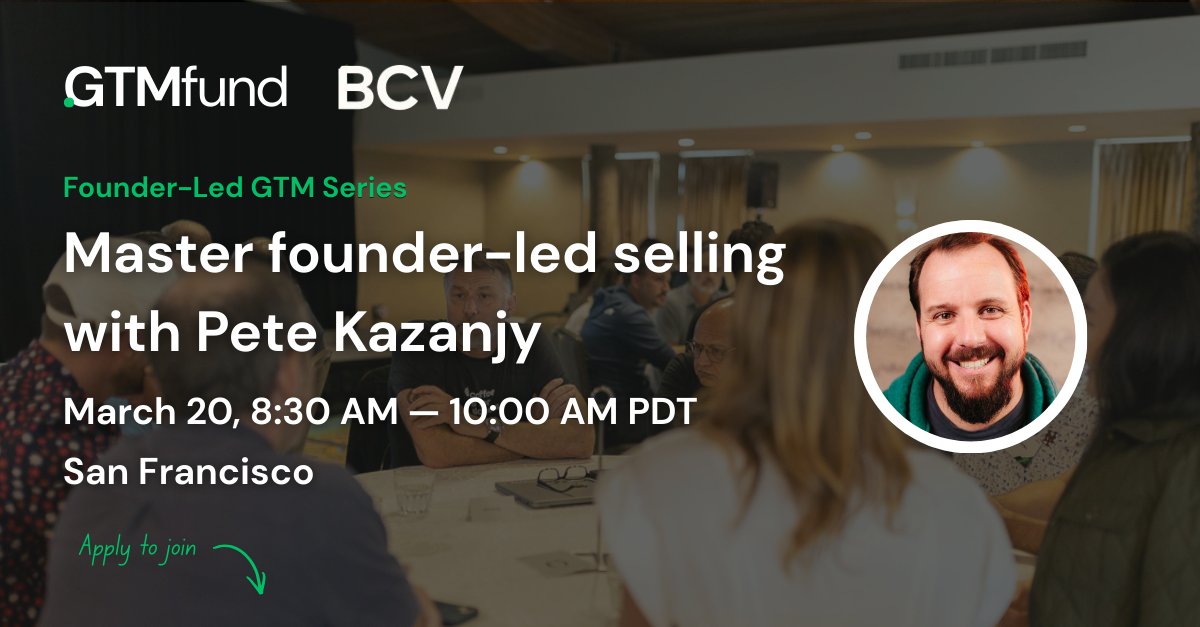
MARCH 20TH! We’re excited to be hosting the second GTMfund Founder-Led GTM Series, alongside our friends at @BainCapVC and @Kazanjy! It’s a highly interactive workshop-style breakfast, where you’ll learn how to successfully generate early revenue before scaling a GTM team. This event is for founders with technical backgrounds, who want to excel in selling. When: Friday, March 20th 8:30 - 10:00 AM PDT Where: Downtown San Francisco
gtmfund tweet media
English
1
2
6
388
gtmfund retweetledi
Max Altschuler
Max Altschuler@HackItMax·
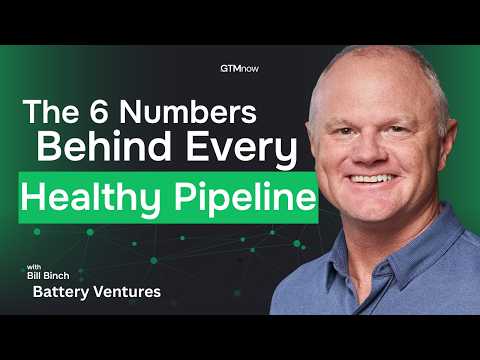
Episode 5 of the @GTMnow_ VC Series is live! I sat down with the legend, Bill Binch (Operating Partner at Battery Ventures), to talk about what 116 quarters on quota teaches you about running a sales org, the “mojo” metric, how to transition from operator to operating partner, and much more. Before the conversation with Bill, @PaulGTM and I also talk through what we're seeing across founders, funds, and go-to-market teams, right now. A few takeaways from the conversation that are particularly valuable for founders and sales leaders to note: 1. Every forecast conversation should anchor to quota, not forecast. Bill requires reps to start with three numbers in order: my quota is, my forecast is, my closed won is. Most reps default to leading with forecast, which lets the conversation drift from the actual target. When you anchor to quota first, the gaps become immediately visible, and you know exactly how much urgency is required. Sales leaders get paid on quota, not forecast. Language used should reflect that. 2. Most companies don't track whether they've actually deployed enough quota to hit plan (and that’s a massive mistake). Three metrics, tracked monthly: company plan, planned quota deployed, and actual quota deployed. Bill gets called all the time by leaders in Battery’s portfolio saying "we don't have enough pipeline." The first place he looks? Quota deployment, because more often than not the real problem is they're running at 70% of planned capacity but expecting 100% of plan. That math is never going to work, and reveals that hiring is your problem, not quota. 3. Pipeline health is a daily exercise. The "mojo metric" tracks six daily inputs: three that add to pipeline (new deals, expansions, pull forwards) and three that subtract (killed, shrunk, pushed). Net them out every night. Three straight days of net negative and you're sounding the alarms. Foolproof way to catch slow leaks overnight instead of once the quarter is already gone. 4. The transition from CRO to operating partner is more of an identity shift than people expect. After 29 years with a clear scorecard, Bill moved into a role where outcomes might be 5-10 years out. Measuring impact is entirely different in venture. Be prepared to solve a completely different set of problems requiring a lot more context switching than when success metrics were pre-defined. 5. The path from operator to operating partner starts years before you're ready. If you're working for a venture or PE-backed company, build relationships with those teams now. Show up at industry events, chat with the team. It's a sales pipeline nurture, just for your career. Big thank you to our series partner, @AngelList, who have been instrumental in helping GTMfund scale since the early days.
English
3
1
4
306
gtmfund retweetledi
Max Altschuler
Max Altschuler@HackItMax·
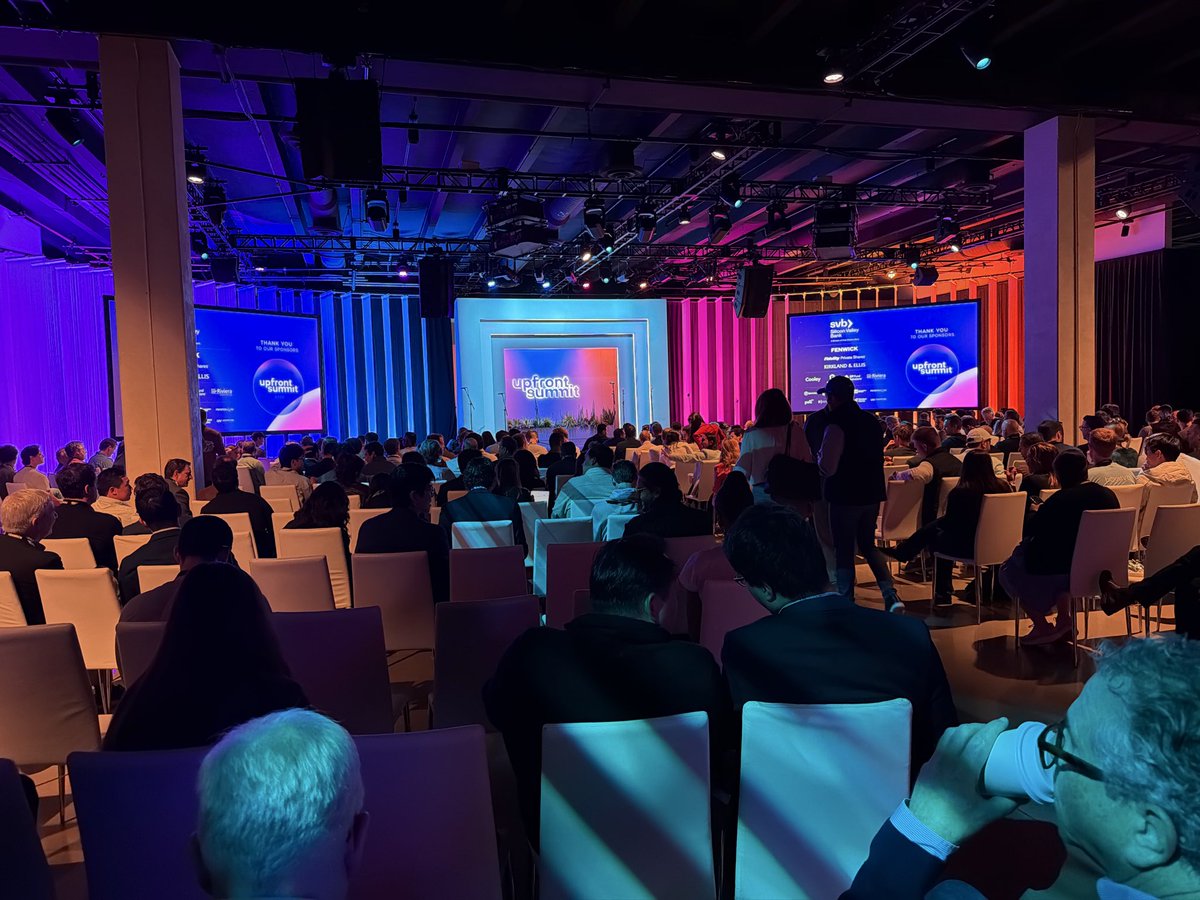
The folks at @upfrontvc really know how to do a conference right
Max Altschuler tweet media
English
0
2
7
561
gtmfund retweetledi
Max Altschuler
Max Altschuler@HackItMax·
Before every podcast episode under the VC series on @GTMnow_, @PaulGTM and I talk through what we’re seeing across founders, funds, and go-to-market teams right now. Here’s what we covered - available in full here on X. - Ownership compression in competitive rounds. - Smaller funds deploying broadly to manage uncertainty and access. - Check sizes scaling over time as conviction and fund visibility increase. - Renewed focus on fund math and realistic return profiles. - Market reset after 2022–2023, with more scrutiny on pricing, ownership, and entry multiples. - The “SaaS is dead” narrative and the broader shift toward AI-driven categories. - Increased investor skepticism around AI positioning vs true AI-native products. - Oversubscribed early-stage rounds limit allocation even for high-conviction investors. - Performance increasingly outweighs model purity in how funds are evaluated over time.
English
0
3
8
397
gtmfund retweetledi
Robby
Robby@robby_mtf·
Really enjoyed this convo with @HackItMax from @gtmfund! Got into a LOT of detail around founder traits, tailwinds vs. TAM, AI expertise vs. theater & more ✨ Thanks for having me on 🤗
GTMnow@GTMnow_

@robby_mtf (Founder & Solo GP of @mtf_vc) joins @HackItMax on GTMnow to break down how she evaluates companies at the very earliest stages, why discipline matters more than ever in today’s market, and much more. Amanda has spent over a decade in venture before launching Modern Technical Fund, investing across verticals ranging from security and compliance to developer tools at firms like Norwest and Cowboy. Her investment thesis is centered on backing elite technical founders early and helping them translate deep engineering talent into real products, real customers, and real momentum. Highlights: 00:00 – Why Modern Technical Fund exclusively backs technical founders 02:15 – What actually defines a “technical founder” beyond coding ability 03:45 – Why product judgment and customer instinct matter early 05:05 – How early teams split engineering and go-to-market roles 07:10 – When investor advice helps and when it gets in the way 09:05 – Why calibrating the hiring bar matters more than providing playbooks 12:40 – How network-driven support helps founders see what “great” looks like 15:45 – Why valuation discipline sets the bar in today’s market 17:10 – When first-time founders become too risky at certain prices 19:40 – How early-stage defensibility often comes down to the team 27:20 – Why TAM momentum matters more than static market size 30:30 – How small markets quietly turn into billion-dollar categories 39:55 – What separates real AI companies from AI theater 41:40 – Why infrastructure and data tools benefit most from AI tailwinds

English
1
2
17
1.5K
gtmfund retweetledi
Flo Crivello
Flo Crivello@Altimor·
Introducing Lindy Assistant, the ultimate AI assistant. It talks with you through iMessage, connects to 100s of apps, helps you with your meetings and emails, and proactively finds ways to save you time all day. Check out some examples of ways Lindy assistant helps below.
English
189
59
689
679.6K
gtmfund retweetledi
Jaleh Rezaei
Jaleh Rezaei@jalehr·
The era of the specialist is over. Full-stack GTM athletes are taking over. For too long, GTM has been divided into specialists, creating a soul-crushing web of dependencies: - Sales needs a custom business case to close a deal, but Marketing is slammed. - Marketing has a winning campaign idea, but design and engineering can’t prioritize it. - CRO has 5 ideas for increasing sales productivity, but no GTM engineers to execute. In GTM, speed is everything and dependencies are the enemy. That's why we're giving GTM teams the full-stack capabilities they need to close revenue. Welcome to the era of the GTM Athlete. These are people who don't ask permission or wait in queues. They can do whatever is needed to take deals from cold to closed—research accounts, launch ads, create a business case, generate tailored follow-ups, and close deals. Sales rep brainstorms with their champion how to convince the CISO. 30 mins later sends them a polished business case with security architecture and ROI. By lunch time, she launches ads to the entire buying committee. The next day, the rep presents a custom deck to key decision makers and gets verbal commitment. No more begging. No more waiting. No more losing. Our vision is to build the AI Swiss Army knife that turns specialists into GTM athletes. Today we are launching a critical capability that enables this vision: an AI agent that can create anything customer facing. You can now create executive business cases, deal follow-ups, landing pages, ABM campaigns and more, all by yourself. Unlike other AI tools, our agent plugs into your brand and data to create materials that actually look and sound like you. Sign up on our website. We're letting people off the waitlist every day, with 30 days of unlimited AI usage. I’d love to hear your feedback.
English
35
32
622
216.7K
gtmfund retweetledi
Max Altschuler
Max Altschuler@HackItMax·
Too many people talk about venture as strategy, spreadsheets, and logos. This episode is about the real job: people, trust, and doing the work when nobody is watching. Episode 3 of the GTMnow VC series is live. I sat down with Mark Goldberg (Managing Partner & Co-Founder at Chemistry) to talk about spinning out of a mega-fund, building a firm from scratch, and what conviction actually looks like at the earliest stages. Before the conversation with Mark, Paul Irving and I cover what we’re seeing firsthand across founders, funds, and go-to-market teams. My takeaways: 1. Early-stage venture rewards conviction over consensus, and punishes hesitation. Mark was clear that his biggest misses over the years weren’t bad investments; they were the deals he didn’t do. Chemistry is explicitly designed to avoid that trap. Individual partners can lead with conviction instead of optimizing for group agreement, because consensus tends to flatten outlier thinking. At the earliest stages, the cost of being wrong is survivable; the cost of being late isn’t. 2. When you leave a mega-fund, the logo stays behind, but your reputation doesn’t. Spinning out of Index Ventures meant starting fresh without brand gravity, but Mark’s experience shows what actually travels with you: founder trust, long-term relationships, and how you behave when things are hard. LPs may underwrite resumes, but founders underwrite character. If people don’t call you when it’s messy, you never really had an edge. 3. Events still work, but only if they’re actually worth a founder’s time. Chemistry ran roughly 70 events in under a year. These weren’t your usual happy hours. I’m talking about chess tournaments, surfing days – intimate gatherings built around shared interests. The insight here is simple: founders are busy and selective. If you’re going to ask for their time, it better be memorable, human, and genuinely enjoyable. Distribution without depth doesn’t compound. 4. The hardest investing lesson is learning when to shut up. Mark’s most painful experiences came from co-founder breakups that nearly killed companies. Over time, he learned that founders don’t always want advice. Often, they just need someone to listen. Being an effective investor means knowing when to guide and when to create space. Empathy, not answers, is frequently the highest-leverage move. 5. Venture doesn’t scale well, and pretending it does breaks culture. Chemistry is intentionally small, focused, and built like a SWAT team. No bureaucracy, no internal noise, no unnecessary layers. Mark’s view is that early-stage advantage comes from attention, speed, and presence (not headcount). The job is to find exceptional people early and show up fully. Everything else is a distraction. Thank you to our VC series partner AngelList, who have been instrumental in helping GTMfund scale and evolve since day one. Watch the full episode on YouTube or wherever you get your podcasts.
English
1
2
7
784
gtmfund retweetledi
Max Altschuler
Max Altschuler@HackItMax·
It’s wild to see how far things have come in just 5 years. As we wrapped up Fund II and pulled together our 2025 Annual Update, I found myself reflecting on how much @GTMfund has evolved — from a small circle of GTM execs pooling capital to a full-fledged institutional fund. Our first “annual update” in 2021 was literally a single LinkedIn post. Today, it’s a 60+ page deep dive into our investments, portfolio performance, GTM support metrics, and predictions for the year ahead. The difference is night and day. So are a few reflections on how GTMfund has evolved:
English
1
3
9
525
gtmfund retweetledi
TechCrunch
TechCrunch@TechCrunch·
The best investors aren't looking for perfect products. They're looking for desperate customers. @PaulGTM from @gtmfund shares what actually gives VCs conviction in early-stage companies. It's all about customer pull, not product push. 🎧 Listen to the full Build Mode season one finale: bit.ly/4bmMstB
English
2
4
25
18.6K
gtmfund retweetledi
Max Altschuler
Max Altschuler@HackItMax·
Here are our 8 Predictions for 2026. Last week, we sent out our Annual LP Letter. We included our predictions for 2026, portfolio review, fund evolution, portfolio support metrics, case studies, and more. It was 67 pages! Of course, AI is a dominant theme, but how can it not be? It's one of the biggest platform shifts in history. It’s still early, so it should only get even more exciting in 2026. I'll be sharing sections of the report here over the next two weeks.
English
1
1
7
561
gtmfund retweetledi
Sophie Buonassisi
Sophie Buonassisi@sophiebuona·
There’s a clear through line across everything we’ve built at @gtmfund: democratized access as a lever for impact. - Access to not only capital, but also world-class GTM support (portfolio companies) - Access for operators - i.e. the builders of SaaS companies - to financial diversification through investing (LPs) - Access for the broader ecosystem to practical GTM insight from the best minds in tech (@GTMnow_ media) There are barriers for people innovating. We’re in the business of removing those barriers. If you equip people with the right information, resources, and support - they can fulfill their mission, and accordingly positively impact people and the greater world.
English
0
1
4
155
gtmfund
gtmfund@gtmfund·
Thanks @medinism (founder of Paid, former founder of Outreach) and @MollySOShea for the shoutout in the recent Sourcery episode, highlighting how @HackItMax was Manny’s first call when starting @paid_ai. Manny needed to validate whether there was real demand for Paid, not just a problem he believed existed. So he called Max. Today, Paid has $33.3M in total funding and early customers have already reported 20-40% revenue growth within six months of adopting the platform.
English
1
3
7
367