Ganesh

187 posts

Ganesh

Ganesh

@GaneNalla

Startups | Partnerships | Ecosystem | AI | Cyber | History

California Katılım Ocak 2009
1.1K Takip Edilen113 Takipçiler
Ganesh
Ganesh@GaneNalla·
The ego-centric video point is the strongest part of this thesis. Most robotics training data is third-person which is robot cameras pointing outward. Aria-scale ego-centric data captures human intent and physical interaction from the actor's perspective. That's structurally different. Every robotics company needs this data. Meta has it. That's the actual moat.
English
1
0
0
22
Hynek Kydlíček
Hynek Kydlíček@HKydlicek·
Everybody thinks of Physical Intelligence, Figure or Tesla when thinking of embodied AI. But imo Meta will become big player very soon, especially if one believes ego-centric videos are the way to scale out / solve robotics - Project Aria / Oculus -> probably best hand-tracking / SLAM without gloves - Great Image/Video researchers (Dino / Segment Anything, SAM etc...) + now @giffmana et al, (PaliGemma is still very popular VLA backbone) - By far the most compute available, just unclear how much can be given to these efforts - Just acquired ARI with @xiaolonw (Open-Television / ExBody2)
English
8
2
74
7.3K
Ganesh
Ganesh@GaneNalla·
Uber and Microsoft are the early signs of a structural problem. Enterprise budgets were designed for SaaS - predictable per-seat cost. Agentic AI is metered utility - consumption × complexity. Totally different math. Cloud had the same problem in 2012. FinOps solved it in 3-5 years - reserved instances, cost allocation, usage forecasting. AI FinOps is the function which does not exist yet. But, will soon be.
English
0
0
0
8
Solid Intel 📡
Solid Intel 📡@solidintel_x·
INTEL: Agentic AI costs are blowing past enterprise budgets, with Microsoft scaling back Claude Code access and Uber burning through its 2026 AI coding budget in four months
Solid Intel 📡 tweet mediaSolid Intel 📡 tweet media
English
9
5
62
11.7K
Ganesh
Ganesh@GaneNalla·
The coordination failure pattern is right. It's the same problem distributed computing hit in its formative days. The failure mode wasn't processing power - it was consensus. The solution (Paxos, Raft) wasn't smarter nodes. It was protocols for nodes to agree when they disagreed. Multi-agent AI needs the same layer. Not smarter agents - verified agreement.
English
0
0
0
3
Z.ai for Startups
Z.ai for Startups@ZaiforStartups·
The hardest problem in AI agents may no longer be intelligence. It’s coordination. Multi-agent systems are failing 41–87% of the time — mostly from coordination breakdowns, not model weakness. which means: the next infrastructure layer isn’t smarter models. It could be systems that keep agents aligned, verified, and on track.
English
35
18
420
37.5K
Ganesh
Ganesh@GaneNalla·
@PredicHistory Models today were trained on human-written text. But soon, a significant fraction of available training data will be AI-generated. When the model trains on its own outputs. Curious what will happen..
English
0
0
0
8
Predictive History
Predictive History@PredicHistory·
AI is not independent of humans. It is built on humans. ChatGPT writes good essays because humans wrote the essays first. Facial recognition works because humans labeled every face manually. Every AI system runs on human labor that is deliberately hidden. And here is the problem: AI is far more expensive than humans. But humans are hard to enslave long term. That is why the system will fail. You cannot build a god on the backs of people who eventually stop obeying.
English
9
79
327
10.7K
Ganesh
Ganesh@GaneNalla·
@esrtweet Local inference (Apple M5, Llama, open models) will hit the crossover soon not on capability, but on per-query cost. Running a model locally undercuts API pricing for 60%+ of enterprise queries. The disruption isn't a capability story. It's a price story.
English
0
0
0
12
Eric S. Raymond
Eric S. Raymond@esrtweet·
Low-end disruption. That's the key phrase to think about when you contemplate the medium-term future of AI. Nearly 30 years ago, now, Clayton Christensen identified a pattern of technology companies plowing huge amounts of capital into technology to pursue ever-increasing capacity and higher margins. Bigger steam shovels. Bigger cars. Bigger disk drives. He also noticed what tends to happen to them. Low-cost competitors find cheaper ways to serve niche markets. Over time, both the dominant expensive technology and the cheaper, lower-spec alternatives improve. Often, the expensive technology overshoots customer demand, and the cheap one gets just good enough in terms of performance. At which point the bottom abruptly falls out of the market for the expensive technology, and the disruptor inherits the Earth. The former incumbents are left wondering what happened. "Bbut.. our stuff was better!" Yes, it was. It was better at every single point in the timeline, including the moment when the bottom fell out. Just good enough and cheap beats better but more expensive. That is the harsh lesson of dozens of technology disruptions. Now consider the way that low-cost, low-capability AI engines like the little machine I described in my quoted previous post are beginning to nibble at the outer edges of the market for AI inference. They're not very good yet. But there is a very clear path for them to get better. Hardware improvements. Software improvements. Yes, they'll get a little more expensive, and a lot more capable. Huge centralized data centers selling remote operation with subscription fees, versus a whole bunch of smaller, distributed on-premises AI appliances that aren't as powerful, but don't incur subscription costs forever and are a lot better for security and privacy. The question isn't if low-end disruption will cut the legs out from under the big AI providers. It's how soon.
Eric S. Raymond@esrtweet

Economics is a harsh mistress. Devices like this running open-source LLMs are the reason I believe the current massive wave of data-center buildouts is a massive over-investment that's going to end in a crash. All that's needed for the value proposition of the big AI providers to pop like a bubble is for the tokens-per-second return of a device like this one to get fast enough for practical use. In this video, it looks very much like it has. And they're going to get faster - RISC-V chips are still underpowered, but that will change as soon as one of the startups working the problem begins shipping out-of-order implementations. I've lived through two technology-driven speculative bubbles; dot-com and the less-remembered fiber mania that preceded and overlapped with it. I know what they smell like, and we are in one now. youtu.be/bjH9qvOq_wk

English
26
23
287
16.6K
Ganesh
Ganesh@GaneNalla·
@svembu The American Dream was always "work hard, move up." Students can't see where up is anymore. That's the real crisis not the technology.
English
0
0
0
5
Sridhar Vembu
Sridhar Vembu@svembu·
How is it that in the US, the AI leader, a good part of the population, even a lot of college students, have come to hate AI? It does not help that companies are blaming job losses on AI, which is both convenient and as an added bonus, makes a company look visionary. The layoffs are related to rising cost pressures - we experience those pressures too so we know this first hand. The economic picture is getting grimmer. The AI investment bubble has kept the US economy afloat but that can only go on for so long. Zooming out, I believe what we are witnessing is the gradual collapse of the post World War 2 global economic and political order. Before you think "orange man bad", this process was well under way with the global financial crisis in 2008-9. That is why I said "zoom out", think in decades. Note that the iPhone-unleashed mobile revolution did not prevent the GFC. AI will not magically cure global imbalances. We must prepare for tough times ahead. I would be happy to be proved wrong, so please present ideas that disagree with this.
English
154
153
1.2K
95.6K
Ganesh
Ganesh@GaneNalla·
@milesdeutscher Cloudflare cut 20% headcount while revenue grew 34% YoY. When revenue and headcount decouple across all enterprises. Whats the future of org charts ?
English
0
0
0
7
Miles Deutscher
Miles Deutscher@milesdeutscher·
I didn't think it would happen this soon.. But the white-collar AI bloodbath is here. This month alone: • Ken Griffin, Citadel CEO (May 5): "extraordinarily high-skilled jobs being automated by agentic AI," - said he went home "fairly depressed." Was an AI skeptic in January. • Brian Armstrong, Coinbase CEO (May 5): cut 14% of staff (~700). "engineers use AI to ship in days what used to take a team weeks." • PayPal (May 5): planning to cut ~4,760 jobs (20%). CFO cited AI + automation on the earnings call. • Mark Zuckerberg (one week earlier): told 8,000 staff their layoffs were a "direct consequence" of the $145B AI infrastructure bill. • Cloudflare (May 7): cut 1,100 jobs (20%) - first mass layoff in 16 yrs - despite revenue +34% YoY. Internal AI usage up "more than 600% in the last three months alone." • BILL (May 7): up to 30% workforce cut. • Upwork (May 7): ~25% workforce cut. • Cisco (May 13): cut 4,000 jobs. Stock popped 15% on surging AI orders. • LinkedIn (May 13): cut 875 staff (5%). The platform that tracks the job market is laying off its own. First the farm. Then the factory. Now the office?
English
97
68
406
118.5K
Ganesh
Ganesh@GaneNalla·
@JonhernandezIA AI makes the individual 10x faster. The org still runs at bureaucracy speed. Amplifying individual output doesn't amplify org output - the bottleneck is no longer the work. It is the approval chain above it which was built for a different world
English
0
0
0
7
Jon Hernandez
Jon Hernandez@JonhernandezIA·
“The real disruption is not AI replacing people. It’s people with AI replacing everyone else.” Jeff Bezos, founder of Amazon, says the people predicting the collapse of white-collar work are missing the real story. AI is not a replacement layer. It’s a force multiplier for people with expertise. Engineers, doctors and builders won’t disappear — they’ll operate at a scale that used to require entire organizations.
English
201
344
2.1K
751.1K
Ganesh
Ganesh@GaneNalla·
@kimmonismus 77% of Claude deployments are automating tasks, not augmenting workers - This is Anthropic's own data. Its time enterprises start separating budgets between AI Augmentation and AI automation
English
0
0
1
500
Chubby♨️
Chubby♨️@kimmonismus·
Anthropic co-founder Dario Amodei has been saying this for over a year now. And he keeps saying it. Louder each time. In May 2025, he told Axios that AI could eliminate 50% of all entry-level white-collar jobs within five years and push unemployment to 10-20%. In January 2026, he published a 20,000-word essay calling AI “a general labor substitute for humans” that will cause “unusually painful” disruption. At Davos, he warned of a “zeroth world country” forming in Silicon Valley, decoupled from the rest of society, running at 50% GDP growth while everyone else faces mass joblessness. In his own words: “We, as the producers of this technology, have a duty and an obligation to be honest about what is coming.” And the data is starting to back him up. Tech entry-level hiring dropped 30-50% in 2025. Wall Street banks are cutting ~200,000 roles concentrated at the junior level. S&P 500 companies shed employees in net terms for the first time since 2016. Anthropic’s own labor market research confirmed that 77% of businesses use Claude to automate tasks, not to augment workers. Now another Anthropic co-founder is echoing the same message: “There is a real possibility that AI will displace human labor at a very large scale. Supporting those people will be a moral imperative of historic proportions.” This is no longer a warning from the sidelines. This is the company building the technology telling you, repeatedly, that the disruption is real, it’s fast, and society is not ready for it. x.com/disclosetv/sta…
English
133
86
1.1K
126.3K
Ganesh
Ganesh@GaneNalla·
Toyota didn’t just stop predicting which parts they'd need. Built the system to produce them on demand instead. Just-in-time software does the same to code: the agent writes the workflow when the case arrives, not months before. Developers stop building workflows. They start building the systems that generate them.
English
0
0
0
8
Garry Tan
Garry Tan@garrytan·
Dynamic skills are one of the coolest and most powerful parts of the new way to make personal AI work Just in time and markdown is code, and the agent can just change it when you discover new cases to handle Just in time personal software is the most powerful idea of 2026
Marcus@MarcusSpillane

The skillpack architecture is the right call. We run something similar where each skill bundle carries its own tests and the agent can modify them in-flight. The part people miss: letting the agent update its own tooling is what creates the compounding effect. Static skill libraries plateau fast.

English
45
30
390
50.5K
Ganesh
Ganesh@GaneNalla·
@gdb 2026 isn't the year enterprise AI becomes a theme. It's the year the CFO demands the ROI for the money. First wave was experiments. 2026 is the audit.
English
0
0
0
4
Thierry from arvy 🇨🇭
Thierry from arvy 🇨🇭@ThierryBorgeat·
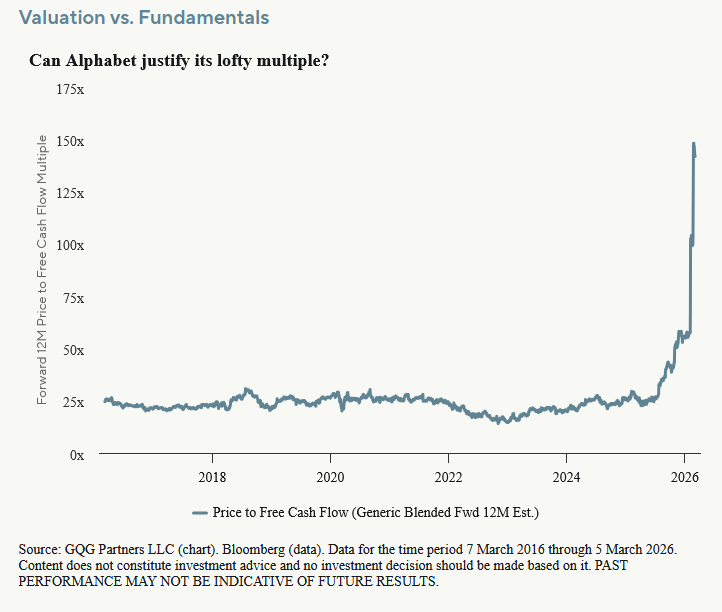
🚨Alphabet $GOOGL trades at 133x free cash flow. For context: its pre-COVID multiple was ~20x. And free cash flow hasn't grown since 2021. GQG Partners — one of the world's top institutional investors — just published a full research note titled: "Not Much Alpha Left in This Bet." Their three concerns: 1. AI is cannibalizing Google's core search revenue. Over 50% of searches may now end without a single click. No click = no ad impression. 2. CapEx is exploding. Google Cloud's capital spending now exceeds the revenue it generates. $175–185B in CapEx planned for 2026. Google Cloud generated $ 59B in revenue in 2025. 3. Advertising is cyclical. When the economy slows, ad budgets are the first to be cut. The last time this happened — 2022 — the stock fell 40%. Alphabet is an extraordinary business. But 133x FCF leaves no room for anything to go wrong. And a lot could go wrong.
Thierry from arvy 🇨🇭 tweet media
English
83
139
850
206.7K
Ganesh
Ganesh@GaneNalla·
Google isn't losing to AI. It's losing the postal contract that built it. Passenger rail collapsed not because people stopped traveling but because the mail moved to trucks. The railways were subsidized by postal contracts, not ticket sales. When the contracts left, the economics collapsed. The trains kept running. The business didn't. Google Search is the passenger train. $175B in search advertising is the postal contract. AI is the truck. People aren't leaving Google. The money that funded it is. The bakery, the blogger, the local newspaper .. they're the towns that lose the station. Not because people stopped wanting to visit them. But because the train can no longer afford to stop there.
English
0
0
0
48
Ganesh
Ganesh@GaneNalla·
@jasonlk When buyers can find, evaluate, and buy enterprise software without talking to a salesperson, that's the sign the product is mature enough to sell itself.
English
0
0
1
398
Jason ✨👾SaaStr.Ai✨ Lemkin
54% of Anthropic's new enterprise logos in 2026 came through self-serve. Self-serve enterprise. Real ACV. Real terms of service. No AE in the loop. Anthropic's Head of Industries Eleanor Dorfman walked through at SaaStr AI 2026 last week how they rebuilt the entire sales org in 30 days after Claude Opus 4.6 broke their demand curve in December. 👉The constraint: couldn't 3x or 4x the sales team fast enough without lowering the recruiting bar. The thesis: don't buy a new stack. Thread Claude through the one you already have. What they kept: 1⃣ Clay for enrichment 2⃣LeanData for routing 3⃣ @salesforce as system of record 4⃣@Gong_io for call coaching 5⃣Ironclad for contracts 6⃣@slackhq for everything else What they added: Claude as the connective tissue between all six. The four moves: 1/ Killed the PLG vs SLG orthodoxy. Launched enterprise self-serve in January. Intercom Fin guides the buyer through the journey. Now 54% of new enterprise logos. 2/ Threaded Claude through the existing stack. Every AE starts the day with a "morning brief" Skill that pulls context from Gmail, Gong, Slack, Salesforce, @intercom, Greenhouse. 3/ Made Slack the front door for every support function. Slack ticket in, Jira ticket out. Claude triages and resolves inline if it matches precedent. Escalates with full context if not. 4/ Codified what the best reps do as Skills. Every new rep gets a sales plug-in with 5 Skills: morning brief, call prep, customer follow-up, competitive intel, create-an-asset. Anthropic didn't replace anything. They invested in the stack they already had and let Claude be the seam between everything. Most companies will spend 2026 evaluating AI-native sales platforms. But Anthropic did it with its current stack + Claude. Almost none of it required new software.
English
29
21
314
325.6K
Ganesh
Ganesh@GaneNalla·
Enterprise AI budgets currently run infrastructure-heavy. Soon things will change: GPU spend will plateau, agent spend will scale with headcount reduction. A new P&L line will appear: Agent Operations Budget - not a software cost, not headcount. A new category with measurable ROI per workflow. Finance teams will model this in 2027 planning cycles.
English
0
0
0
13
Jordi Visser
Jordi Visser@jvisserlabs·
This may be my last video of the year. I walk through where I agree and disagree with Jim Chanos on the AI bear case, especially on the revenue side in 2026. The key difference: AI agents, not models or data centers, are the revenue unlock. That’s where enterprise budgets shift, labor gets replaced, and earnings start to show up. What companies win. I also cover Micron, Cisco, Tesla, Bitcoin, jobs & inflation, Bill Gurley, Demis Hassabis, Sam Altman and why agents are the framework for investing in 2026. Full weekly recap 👇 youtu.be/0Hcw9toVRNg
YouTube video
YouTube
Jordi Visser tweet media
English
27
65
608
45.7K
Ganesh
Ganesh@GaneNalla·
@zodchiii Shopify's Lütke earlier this year: prove AI can't do the job before you ask for a new hire. Not a recommendation but a condition. The org chart is changing before the job market. The lag is usually around 18–24 months.
English
0
0
0
16
darkzodchi
darkzodchi@zodchiii·
Shopify's Head of Engineering: "If you don't figure out how to harness agents in 2026, you'll be behind." This interview is the most practical breakdown of enterprise AI coding I've seen this year. Farhan Thawar explained the full Shopify AI playbook here. Watch the interview, then grab the exact template below 👇
darkzodchi@zodchiii

x.com/i/article/2056…

English
35
108
1.1K
332.7K
Ganesh
Ganesh@GaneNalla·
@scaling01 Gates' 1995 memo called the internet "a passing fad." By 1997 Microsoft had rewritten their entire strategy around it. It takes about 18 months to go from "slop" to "joining."
English
0
0
0
13
Ganesh
Ganesh@GaneNalla·
@emollick The consulting layer didn't shrink when SAP got better. It grew. Organizational changes aren't an AI capability problem but a human trust problem.
English
0
0
0
9
Ethan Mollick
Ethan Mollick@emollick·
You will know that the AI labs believe in ASI when they disband their newly formed consulting (sorry “forward deployed engineering”) groups. As long as people are required to figure out how AI is useful & do organizational change & systems integration, jobs seem to be pretty safe
English
97
84
891
97.7K
Ganesh
Ganesh@GaneNalla·
@levie By 2027, token budgets will become a board line item the same way cloud costs became one. "FinAI" is the function that doesn't exist yet. The CIO who owns AI spend governance first owns the budget conversation for the decade.
English
0
0
0
692
Aaron Levie
Aaron Levie@levie·
Token costs will become a dominant topic in enterprises going forward with AI. Just got out of a dinner with many Fortune 500 enterprise CIOs and this was the most heated topic. A mix of strategies are being employed, but basically no one feels like they have the right solution. A mix of: figuring out how to prioritize workloads to different models, giving out access to better or worse agents by user type, setting different spend caps by team, having teams justify AI by their use-case, and some just having unfettered access. Everyone is trying to figure out a semi/predictable model right now in a world where the underlying tech and cost models are constantly evolving.
OpenAI@OpenAI

Introducing OpenAI Guaranteed Capacity: a new offering that enables customers to guarantee long-term access to OpenAI compute. We’ve made long-term investments in infrastructure, partnerships, and capacity planning to help customers scale reliably. Now, Guaranteed Capacity helps customers plan ahead for critical workloads in a compute-constrained world. openai.com/guaranteed-cap…

English
129
98
1.1K
347.6K